Kimberley Kayak Expedition #5
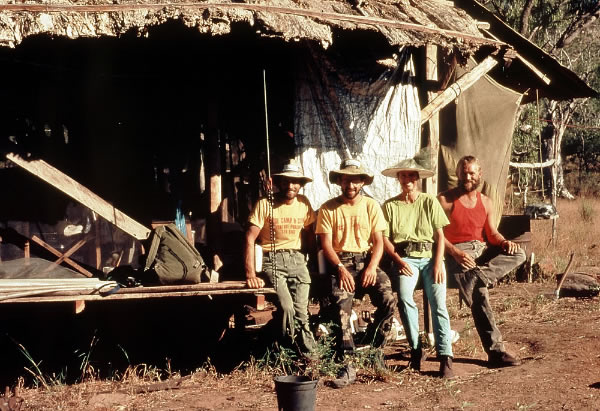
Seeing how Mike and Sue lived was pretty interesting. They were allowed to have food which they kept in big drums, a chain saw to build their shack and a lot of other necessary items, so they didn’t have to live off the
land.
To supplement their diet they did eat a donkey or two. In fact Mike said, have you tried a donkey, there is nothing better so we went bush to capture one. The donkeys were left over from the Mission days and they were in
plague proportions and classed as vermin. After 20 minutes of searching Mike shot one and that night he cooked it up and although the meal was delicious the meat was as tough as old boots leaving us with loose teeth. The next night it was a little more tender.
Mike wrote in his book: The four of us dined in style – fresh baked bread, barbecued spareribs, with sesame and soy and curry. The last of our excellent supply of dried fruit went into the custard and stewed
fruit. No mention though of how tough it was but his version is a lot more romantic.
Saturday 18th June
As soon as the sun came up so did the flies. Mike prepared breakfast, rice, dried fruit, honey and syrup. They had run out of cereal ages ago. After breakfast we went on a sightseeing tour to the local spring and to check
out some Aboriginal paintings. Mike and Ewen used mountain bikes and I ran behind. It was pretty rough going with long grass, rocks and gullies. The mules had made trails so following them was a lot easier.
The spring was like a small miniature rain forest with pandanas palms, cicads, banksias, several other trees and a multitude of birds singing. In the dry season this is where they had to get their water from,
sometimes Michael had to make two journeys a day, a 6km round trip.
As we were leaving the spring a coucal pheasant flew off but only to be swooped on by a hawk, and with feathers flying it didn’t stand a chance.
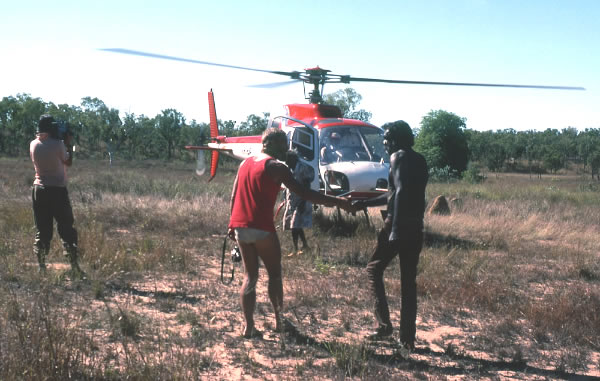
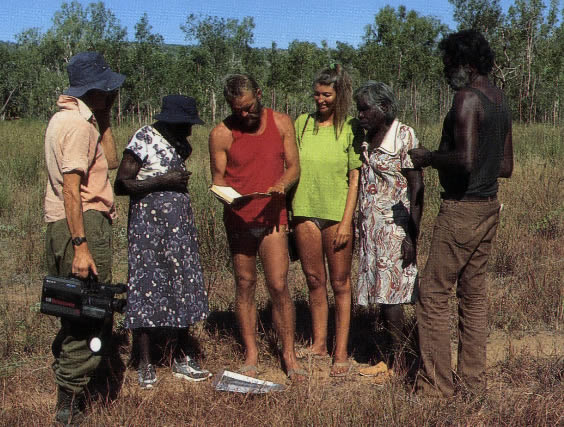
Back at base Susan prepared noodles for lunch inside the netting. Halfway through a helicopter started to circle the shack and landed nearby. To our surprise Pat Vinnicombe from the WA museum and three Aboriginal elders who
once lived at the Kunmunya Mission climbed out. They were out checking their sacred lands. I knew Pat as she had been a member of the Ascot Kayak Club.
The elders were Patsy, Amy and Victor. Patsy was the oldest Aboriginal to have been at Kunmunya and she has never been back there since it was abandoned in 1951. Pat reckons she is about 90 years old. She was living in the
bush before the missionaries came in 1912. Patsy wondered around remembering and smelling the timber for its sweet smell and collected some stone flakes to make her-self an axe.
Amy looked about 50. She started reminiscing and telling us about the Sacred Hill over there and when the men finished their business they used to light a fire. Over there was the girls pool and further over the boys pool.
When the pool dried up we had to go further over. We used to have picnics down at the waterfall in the creek about 1.5 kms downstream.
The girls and boys had separate dormitories, all family members were split up and the dormitories were locked.
Patsy said, when the first missionaries came they chased the girls to put dresses, made of flour bags on their naked bodies. Patsy said, she and another friend ran up a hill and watched the others get caught. Finally Patsy
was caught and she felt she was suffocating when the flour bag was put on. She didn’t like it one bit.
Amy was saying that they used to go out to the Montgomery Islands 25 kms off the mainland in dugout canoes. They used to go across on a tidal stream and come back on another. It is bad enough paddling in a closed
kayak.
Victor also had a lot to say, but their time was up and they had to go to visit another old mission in Hanover Bay and other sacred grounds. It was most interesting hearing their stories.
The afternoon flew by and dinner was most impressive again. Donkey meat, chapattis, rice, veges followed by custard and fruit pudding, bloody beautiful. And the meat wasn’t quite as tough as the night before.