|
|
|
|
It has been a big week in more ways than one. I paddled 252.59 kms this week (finishing on Wednesday) bringing my total to 3436 kms, 64 kms short of my half way mark in a 17 week period, a third of the year. So I am well on track to paddle 7000 kms.
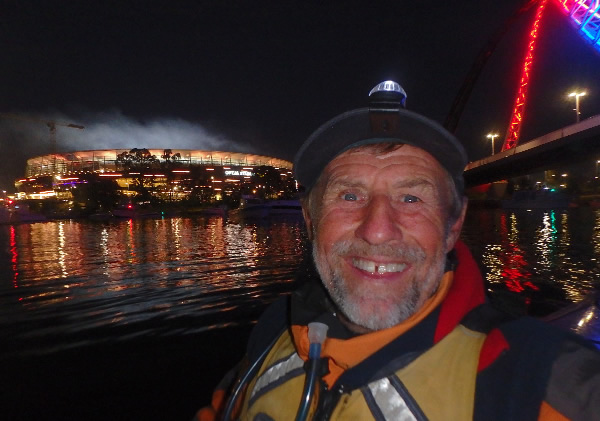
I have had some highs this week. One was paddling to the Grand Final, although I had to stay outside the stadium as I had no ticket.
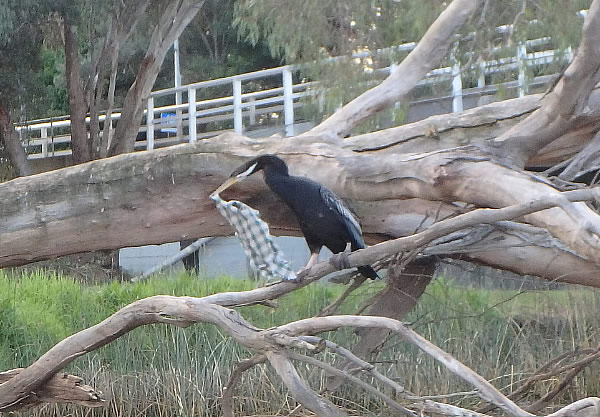
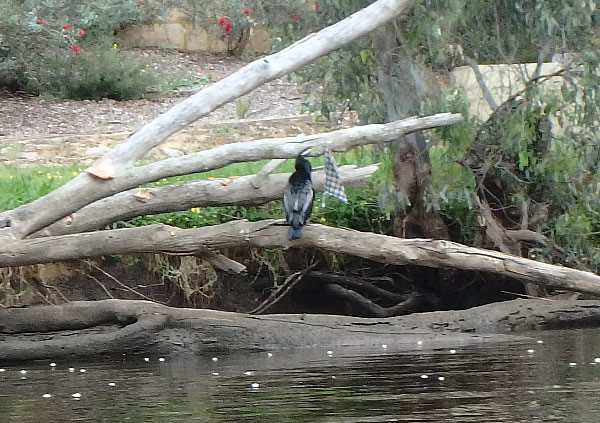
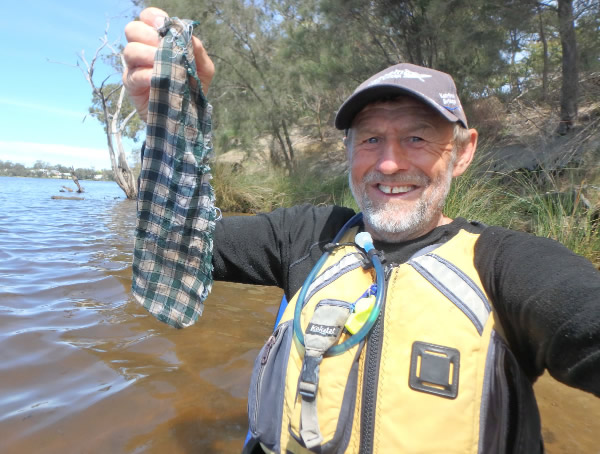
I have had some lows as well. I found a Darter with a rag fixed in its beak and was unable to get it off. It couldn’t eat or drink. For nearly 3 days we were worried, but after a stroke of luck it managed to free the rag because it got snagged in a branch just when I was passing. Read the story.
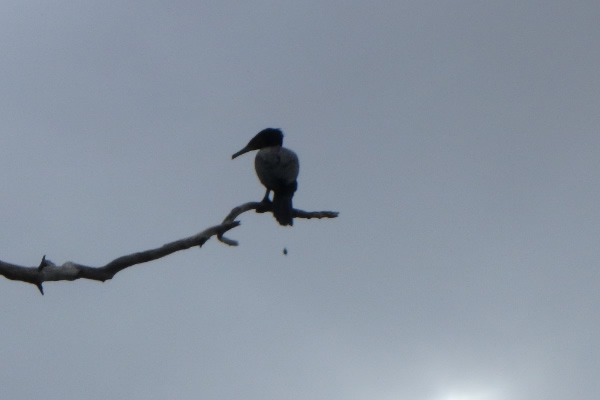
A real low was finding a dead cormorant hung high in a tree by a fishing line. Another cormorant is flying around with a fishing line attached to it which will most likely get caught up.
**************************************************
If you would like to purchase an Epic ski or a Grafton Paddle Sports kayak don't be shy to ask me.
With yesterday and today, 17 weeks and 2 days I have now paddled 3500 kms.
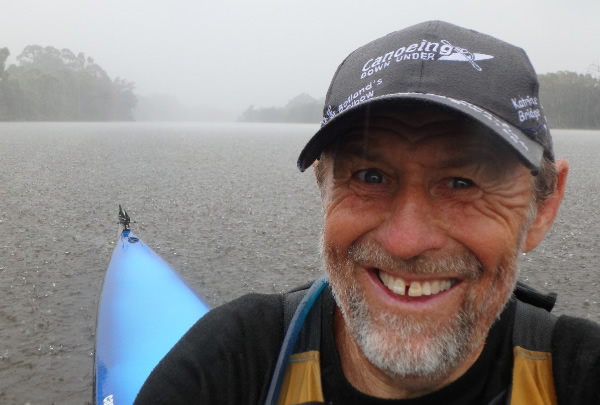
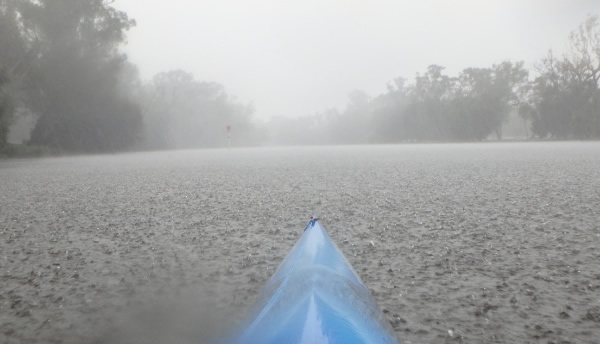
A bit wet this morning.
- I Want to Paddle a C1
- Jess Fox Wins Extreme Gold
- Progressive Racing Group
- Ascot Season Opening & WA Slalom Course Opening
- Paddle WA AGM
- Darter in Distress
- Hung by Fishing Line
- To the Grand Final
- Sprint Regatta 2
- Kimberley Kayak Expedition #5
- Birds in Bassendean
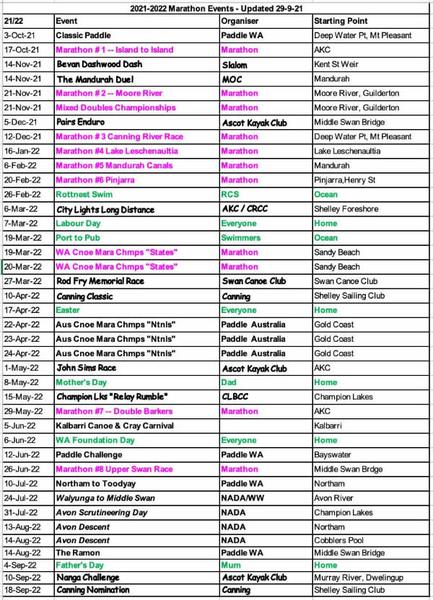
- Coming Events
I Want to Paddle C1
(single canoe)
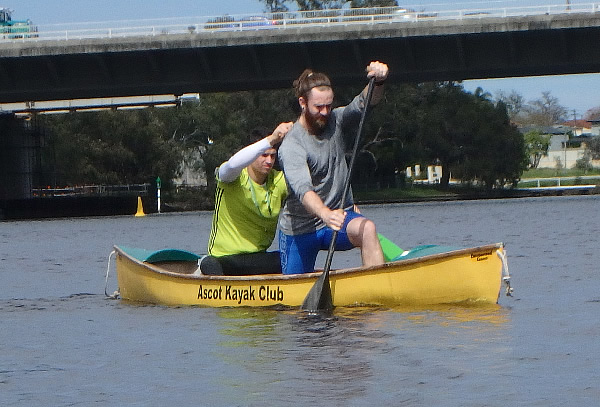
When Cameron Jones watched the Olympics, he said to himself I want to learn how to paddle a high-kneeling C1. Apparently he hadn't paddled at all before.
After an enquiry he was put in contact with Gergely (Gary) Nagy-Balazs who paddled at the last World Champs in China, 2019 for Hungary. Gergely has lived in Australia since then and is keen to get a C1 program for juniors and seniors together.
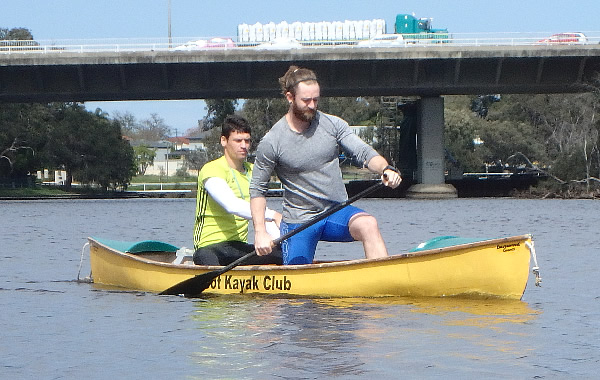
C1 champion Gergely Nagy-Balazs (rear) giving Cameron Jones some expert instruction.
They are using this wide canoe so Cameron can learn the best technique before moving to the skinny C1s.
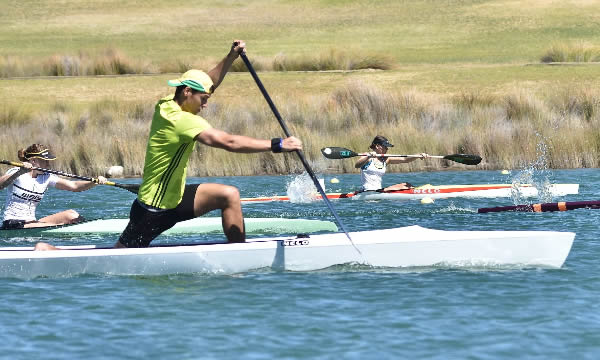
Gergely at a WA sprint race.
Photo Lawrence Greed
Progressive Racing Group
AKC
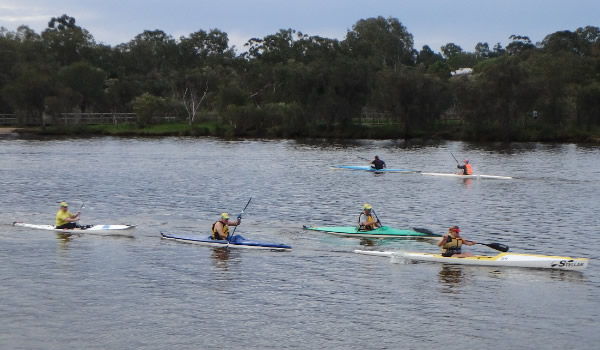
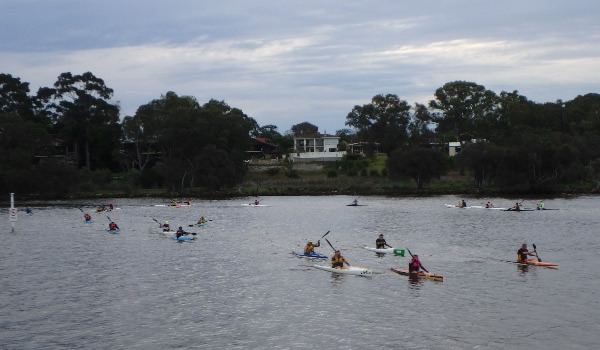
Paddlers are from novice to the more experienced and paddle a variety of boats.
They start at staggered intervals depending on the speed of the paddler.
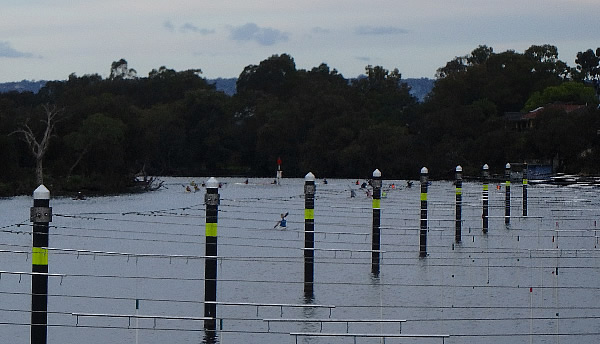
There are 6 turns on the 3.8 km course so being able to do a good turn can be important.
On the last turn 21 paddlers come over the line in less than a minute so no-one gets left behind.
WA State Slalom Course Opening
&
ASCOT KAYAK CLUB
SEASON OPENING
SATURDAY 2ND OCTOBER
Garvey Park, Redcliffe.
Saturday 2nd October 8-10am (before the Slalom Course Opening)
Mark on your calendar to come down and enjoy the festivities of our official start to the paddling season
8.00 - 10.00am
4km Race
Novelty races
Demo boats
Come and try slalom paddling
Food
And much more....
Come down and join in our festivities.
Official opening of the slalom course.
10.30 - 11.30am
Don't Forget
The 2021 Paddle WA AGM & Annual Awards Day
is coming up and will be held on Sunday 3rd October, at Gilbert Fraser Reserve in North Fremantle.
(After the Classic Paddle Race)
Please find the notice of AGM attached, as well as an invite to the AGM & Annual Awards Day below. The venue will be open from 12.00pm with light catering provided, and the bar will be open for beer, wine and soft
drinks.
We would love to see you there, if you could please RSVP your attendance it would be very much appreciated.
for Paddle WA members.
develop@paddlewa.asn.au
On My Paddles
Darter in Distress
As I approached Guildford Bridge on my Sunday evening 13 km paddle I noticed a darter perched on a tree with some cloth attached to its beak. It wasn’t looking good as I expect it wouldn’t be able to feed or drink. It kept shaking its head and rubbing its beak along the branch to try to get it off which was quite distressing to watch, but it
couldn’t.
I hung around and it eventually jumped off its perch and darted under water when a boat came by. It was out of sight for some time and then came up a little downstream before hopping up onto a log.
I waited until it appeared to put its head down to doze and I slowly crept up from behind to see if I could catch it, but it was more alert than I thought and it heard me coming and dived into the water and swam to another tree branch.
It was getting late and I wanted it to dry out before nightfall so I continued paddling. On my way back it had his wings sprayed wide drying them out.
When I got home I sent a message to the Halina at the WA Sea Bird Rescue to let her know.
A Darter has a rag stuck in its beak.
Unable to drink or eat it will die if it can't be removed.
Monday morning Halina sent me a message to say she has put a note out for volunteer animal catchers to try to catch it. Being a public holiday many were away or going somewhere.
When I paddled to Guildford Bridge it was still there with the rag in its beak, still trying to shake it off. Instead of paddling upstream another 6 kilometres like I usually do I decided to paddle up and down around Guildford Bridge and wait for the bird catcher. Two hours later no one arrived so I headed home after paddling 21
kilometres.
A volunteer did later arrive but she didn’t have the equipment to catch it. Graeme a local paddler and rescue volunteer was there when Jenny and I drove to the bridge to check it out. Later another two volunteers with a net launcher arrived but they both had little hope to catch it as the darter was so alert and would dive in the water if someone
got close.
I paddled back up to Barkers Bridge that evening and checked to see if was still there, it was. It was a beautiful evening.
It was a beautiful evening.
Tuesday morning the darter was still there. I paddled by and upstream a kilometre and then returned to find Graeme on shore. He had tried to catch it at 10.00pm the night before, when the darter was sleeping, but he wasn’t successful.
A little later two people arrived from the Sea Bird Rescue with a net launcher but they were on shore and the darter was just too smart, so they had no choice but to think of something else and left to rescue another bird.
The third morning the Darter still has the rag in its beak.
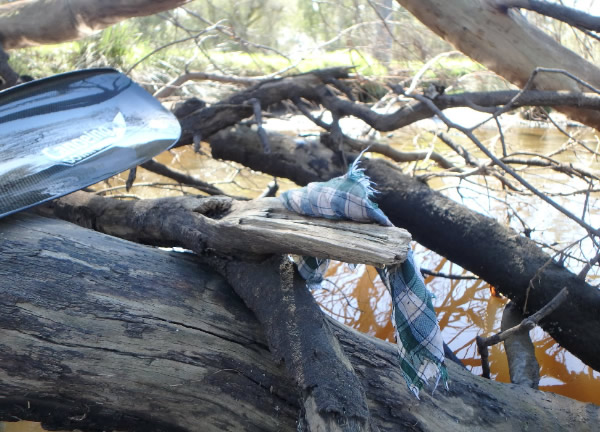
I decided to paddle upstream 3 kms to make up my 21 km distance and on my return the darter was in a different tree and as I was passing it I noticed that the rag had snagged between a crack in a branch. The opportunity to catch it was now possible as it couldn’t get away. I moved towards the branch, the darter struggled and the rag dislodged from
its beak in the struggle and it was free. It dived into the water and surfaced soon after and I couldn’t see any rag in its mouth.
Graeme was 100 metres away so when he came over he used his binoculars to check further. By looking at the rag I don’t think any of it would have been left in his beak which was good news.
I called Halina and Fiona at the WA Sea Bird Rescue telling them of the success and left Graeme to follow it for a while. Graeme later told the Sea Bird Rescue that the bird could drink and feed. I will keep you posted if I hear anything else.
I took the rag home.
I paddled by the Darter and noticed the rag was caught in the branch so I thought a rescue could now be done. On my approach the darter struggled and the rag came clean out of his beak.
It was free and now it could eat and drink.
On My Paddles
Dead Cormorant
Hung by fishing line
Wednesday morning on my usual paddle upstream I met Graeme who was looking through his binoculars at a cormorant which had a line and a lead weight attached to
it.
Fishing line is one of the biggest killers of our birds. So isn’t it time for the Fisheries Department to educate fisher-people about the dangers of fishing line or to get their boats and people to collect all the fishing line that are attached high in the trees.
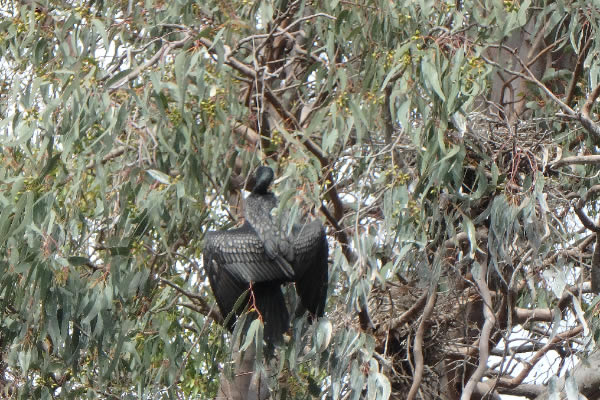
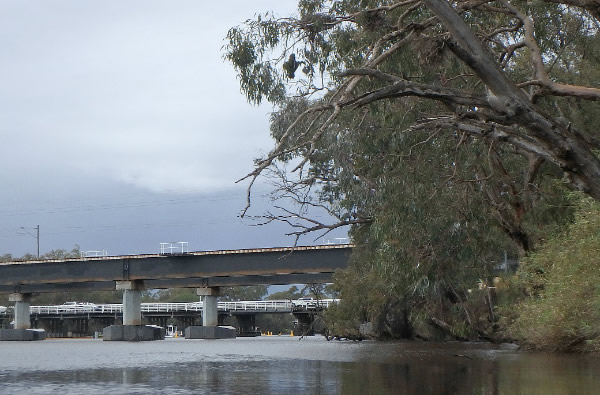
I paddled passed the railway bridges and noticed a dead cormorant hanging by fishing line high in the tree next to two nests. I thought I could hear chicks in the nest squeaking. Were they part of the dead birds family?
There was nothing I could do as the bird was several metres up so when I returned home I called the Sea Bird Rescue yet again. Two days later it was cut down.
Graeme sad to see fishing line around a cormorant.
There was also a pelican reported with a long lot of line around its wing.
A lead weight at the end of the fishing line. I wonder where the hook is?
A dead bird hangs by fishing line near two nests that only recently had chicks in them.
A very distressing sight.
It has now been cut down.
On My Paddles
To the Grand Final
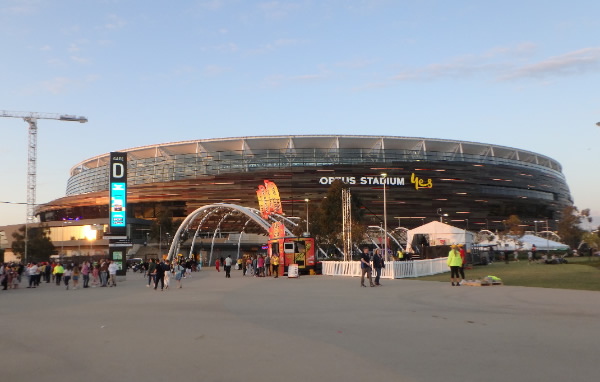
I couldn’t resist using my evening training run to paddle to the Grand Final even though I knew I could never get inside the stadium. It was only 11kms to the stadium and it turned out to be a good afternoon after such a cold blustery morning which I raced 10 kms and paddled another 10 kms to make up 20 kms.
I paddled my Epic sea kayak just in case the water got churned up. I made good progress on the way there and just missed out on hearing the national anthem but I was happily singing my own song:-
When I wake up, well I know I'm gonna be
I'm gonna be the man who wakes up next to you
When I go out, yeah I know I'm gonna be
I'm gonna be the man who goes along with you
But I would walk 500 miles
And I would walk 500 more
Just to be the man who walks a thousand miles
To fall down at your door
A couple of dozen boats, a police boat or two and Transport Department boat were parked up. Some of the revelers were already well lubricated. Most of the boats had TVs so they were watching it, although the occupants in the odd boat were watching the big screen.
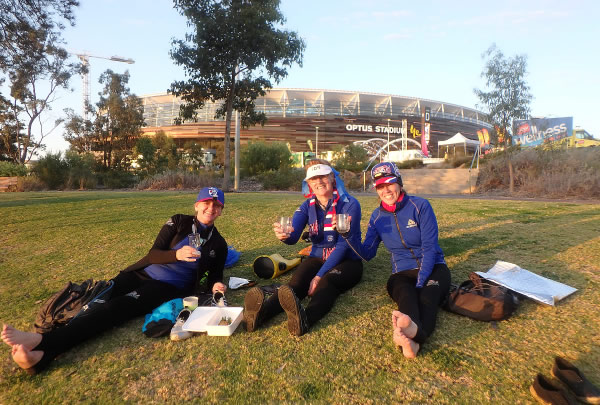
I did a tour around, had a gander at the big screen and then noticed three paddlers, Leonie, Gemma and Di sitting on the grass all kitted out in their team uniforms.
They invited me ashore to eat some of their left over dinner and have a chat. Unfortunately they had drank all the wine so I had to make do with my coffee. Two of them had bought Epic skis from me so although I didn’t know them that closely, I knew them as good customers.
Although the big screen area was packed there wasn’t as many people milling around the stadium as I would have thought. I tucked into two small keish cakes that they offered me, had some of my nuts and a coffee. We could hear cheers from the crowd inside the stadium when one of the footballers did something special. I could imagine how great
it must have been to be inside the stadium.
Paddlers Leonie, Gemma and Di.
The sun about to go down.
As the sun set the coolness crept in so I donned my cag and a sleeveless polartec fleece jacket. Some of the ladies on the boats had exposed arms, but the drink must have been keeping them warm.
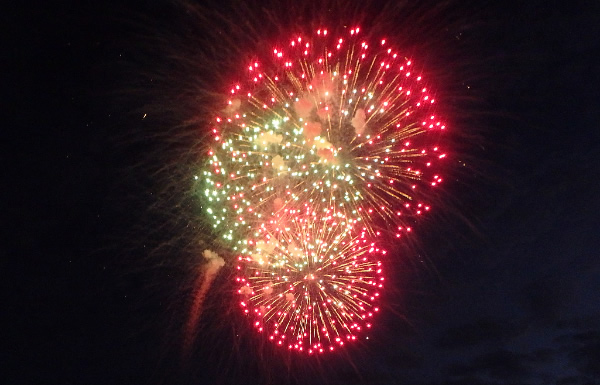
Quarter time went by and then half time arrived so we decided to get back on the water, the ladies heading across the river to watch the half time fireworks from there, me, well I started doing a lap around. Heading under the foot bridge there was suddenly one hell of a big bang which gave me such a start. I turned to see the fireworks lighting up
the sky. There was a barge to my left and a barge the other side the bridge to my right so I didn’t know which way to look. The sky exploded with vivid colours, bangs and whistling missile noises and then within minutes everything was quiet, it was all over.
Smoke lingered over the stadium due to their fireworks, music rang out with the crowd applauding. The stadium kept lighting up with flashing lights and fireworks. There was certainly something special going on in the stadium. I couldn’t see exactly what it was, but the crowd loved it.
It got a little chilly for a while but the fireworks and the lights had me spellbound.
Fireworks exploded only a few hundred metres from me.
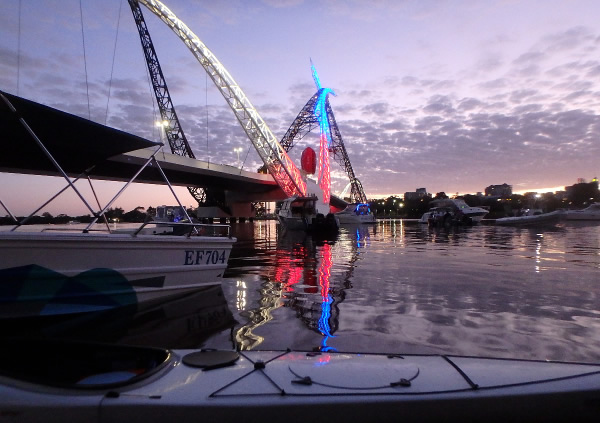
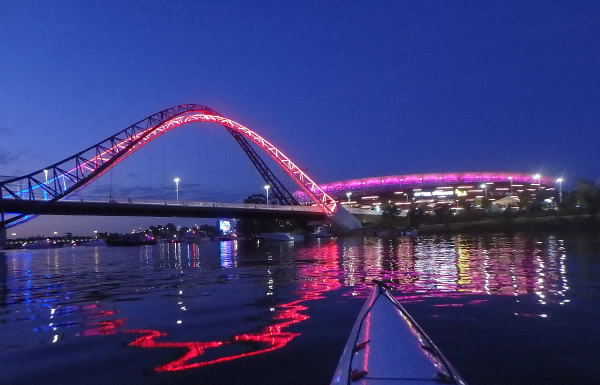
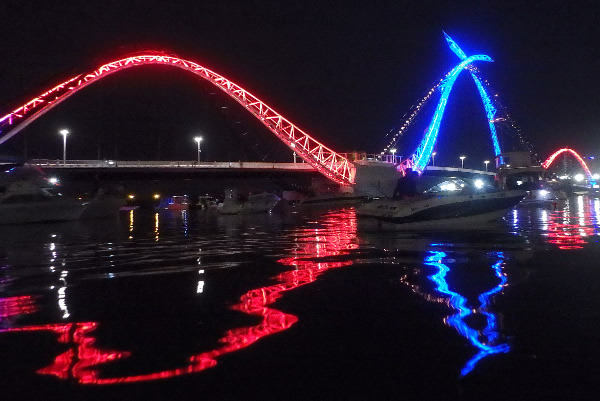
The second half started so I sat watching the big screen. I had no idea who the players were, but it didn’t really matter. The Matagarup Foot Bridge kept changing colour and every time someone would kick a goal the stadium lights would flash red, white and blue. Behind me the merry lads were getting merrier, the merry gals were
too.
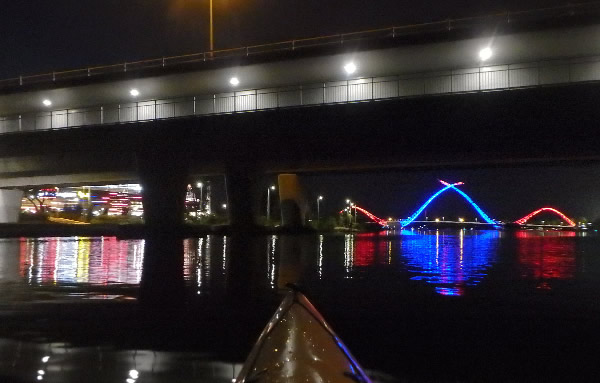
Just before three quarter time I decided to head for home but it was hard to leave the lights behind. The chill had gone, the wind had gone so I had to take off two layers of clothing so not to overheat on my 11 km paddle home.
I caught up with the ladies on my way and said my goodbyes. They were headed to Maylands Yacht Club. A couple of power boats made a wave that swept across to us, but after that my paddle home was in very calm conditions. Eventually as I passed the Maylands boat ramp, about 5 kms after leaving the massive stadium that was shining brightly, it
was now disappearing from my sight. I didn’t want to lose it but I had no option, but it was such a perfect evening for paddling.
Passing through Ascot Waters birds were twittering as if it was daylight. Although the moon was still to show it was quite light. There was a smell of the bush, maybe the trees in flower or something. At the end of Kuljak Island, in Ascot Waters I passed a dead pelican that I saw earlier. I now only had 3 kilometres to paddle home. Just before
Tonkin Highway Bridge and near the end of a 42 km day paddle, the fireworks at the stadium lit up the sky behind me.
What a great paddle I had.
The lights on the bridge kept changing colours and whenever someone scored the stadium would change colour.
It was time to leave and paddle 11 kms back home.
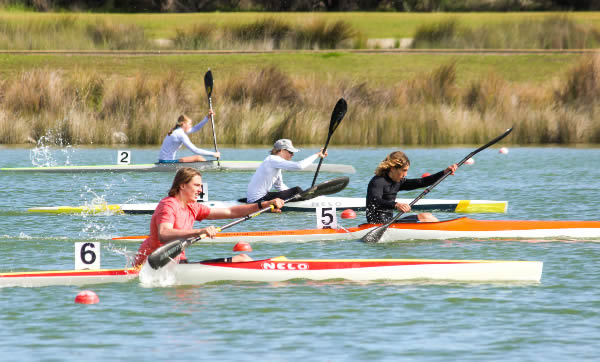
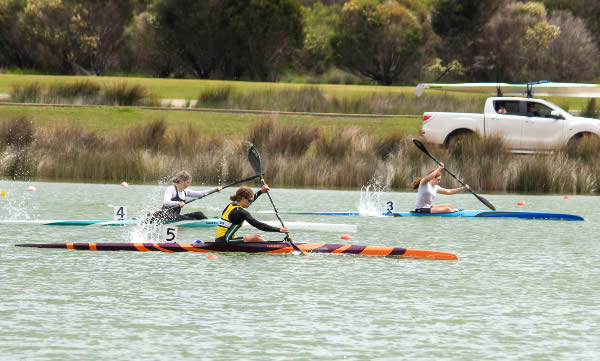
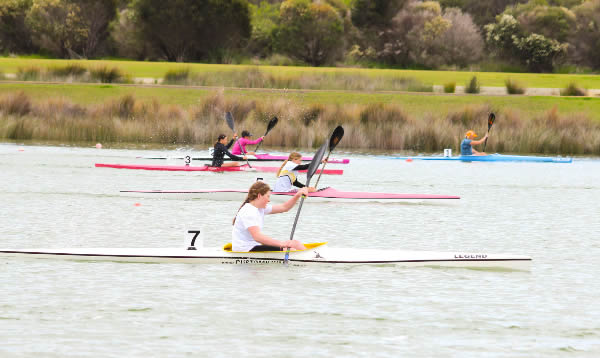
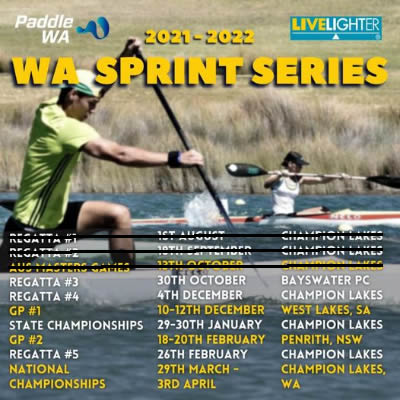
2021 Sprint Regatta 2
Champion Lakes
Photo Lynette Campbell.
Next regatta 30th October.
Bayswater Paddle Club.
Kimberley Kayak Expedition #5
Wednesday 15th June 88
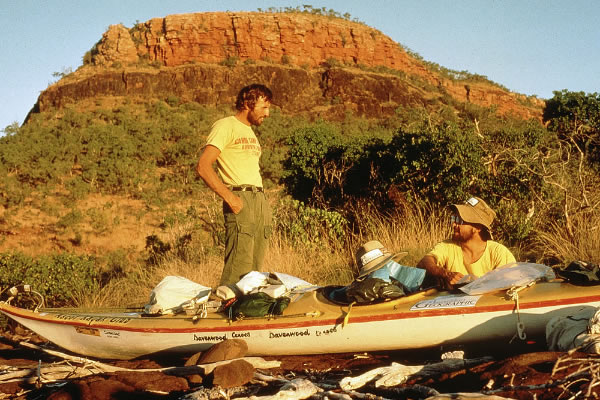
A native cat had been inside Ewen’s bag at night ripping it apart to get to the dry egg. At 6.30am we made our way to the mess to have breakfast, eggs, 4 pieces of toast and coffee before walking our gear
down to the water. The majority of our weight was water and 17 days of food.
I think Bob was going to be sad to see us go as he had been working at Kuri Bay for 10 years and he really didn’t have anyone to talk to having his only friends being Japanese and Thursday Islanders. He is
the radio man so at least he keeps in contact with the office in Broome.
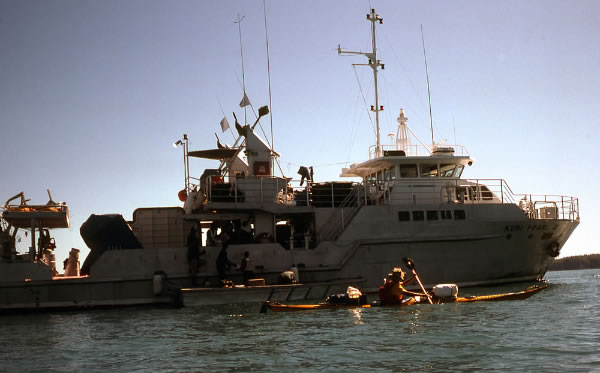
At 9.30am many of the Thursday Island workers came back from the pontoons for morning tea and soon after the Kuri Pearl 2 arrived with fresh stores. As soon as we had finished fiddling around and ready to
go the workers were back in their boats and unloading the stores.
As we made our way out to the Kuri Pearl our kayaks were sitting pretty low in the water with our new load. There was a flurry of activity with three power boats and 20 or so workers unloading boxes of
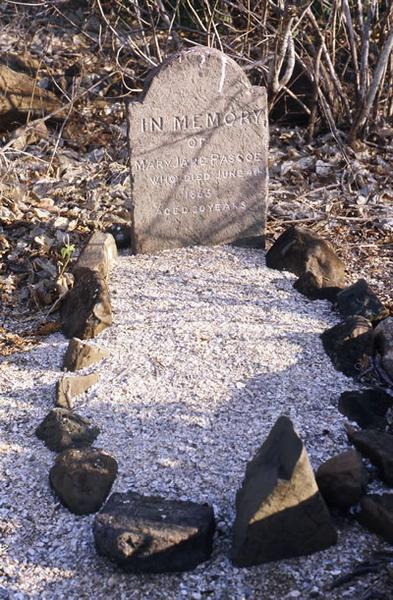
oranges, rock melons, apples and a variety of other stores. We didn’t hang around to taste them, we said our goodbyes and headed across Camden Harbour towards Sheep Island 10 kms away, where the lonely grave of Mary Jane Pascoe was.
It was calm, hot and the sun’s glare reflecting off the water didn’t help to make us feel lively. By noon we had landed on Sheep Island and had a look at the grave and then moved over to the mainland to
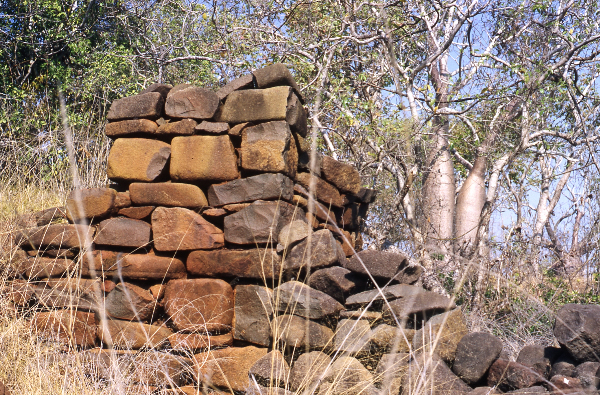
find the abandoned Camden Settlement. I had been to these places 3 times before but I never get bored seeing them again.
Kuri Pearl delivering stores.
The grave of Mary Jane Pascoe.
Mary Jane Pascoe, was brave enough to remain with the hardy settlers. However, she became a victim of the harsh outback when she died on 4 June 1865 while giving birth to her child.
In December 1864 two hundred settlers and their families departed from Victoria in three ships destined for the far side of the country to establish the Camden Harbour Settlement, the first attempt to establish a settlement in the West Kimberley.
It became a short-lived settlement 1864–1865 that was situated in the larger Camden Sound. The settlement was also known as the Camden Harbour Expedition, as well as the Government Camp.
Ships known to have transported people to the settlement included Calliance, which was wrecked on its shores.
The ground was hard and stony and the grass of little value to the sheep. The sheep were accustomed to the cool Victorian climate, so over 1200 died of thirst, fly blown or simply malnourished from the lacking sustenance of the dry Kimberley spear grass.
It did not continue after 1865.
https://www.divingwawrecks.com/camden
We moved on towards Kunmunya Hill followed by a 2-3 metre shark, its white belly shining through the water. As we entered Rogers Straight the tide was going out and we started picking up speed – the land was passing us by so quickly I got dizzy just looking at it. Eventually we had to
divert away from the speeding current to get to Kunmunya Hill. The thinly lined mangroves fronting the hill didn’t look very inviting but there was a break in them to allow us through to hit the rock which was super slippery, slimy and wet. It was decided to have a cup of staminade, a hot drink and let the tide go down before we emptied our kayaks.
Camped near Kunmunya Hill
Thursday 16th June
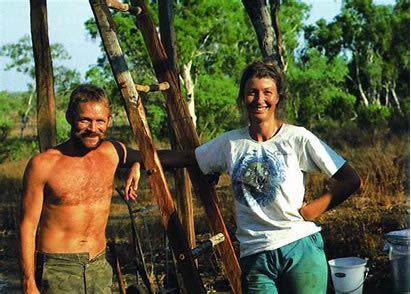
Our mission for the day was to find Michael and Susan Cusack who were living in the wilderness at the abandoned Kunmunya Mission for a year. They planned to be there on our arrival. They were sponsored by Australian
Geographic. They only had two weeks of their year-long stay to go so we were eager to meet them to see how things had gone.
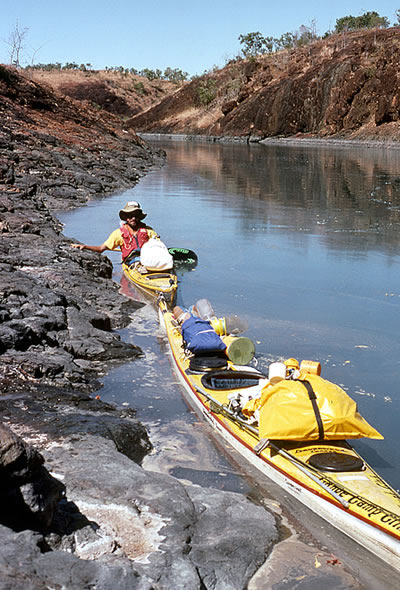
We headed for the Gutter 8 kms away which will give us access to their home so it was going to be an easy paddle. Just before the gutter thick mangroves closed in so we were on full alert for crocs. Eventually the
mangroves gave way to steeply sided volcanic rock channel about 50 metres wide, where at the bottom of the channel a creek came in. It wasn’t easy to get out and one slip and we would be swimming in 15 metres of water.
The creek had stagnant pools and donkey poo was spread throughout and flies were in their thousands. We had arranged to meet Mike and Sue but they were nowhere to be seen. We had lunch, wrote in my diary, had several
hot drinks, sorted gear, fished and continually wafted flies away. The flies and heat drove us mad, and when the tide went out and the mosquitoes came out. By nightfall Mike and Sue were nowhere to be seen so we cooked dinner and found a spot on the uneven rock to place our sleeping sheets as there was no room to put a tent up.
Ewen in the Gutter getting ready to unload.
Friday 17th June
The donkeys came down from the hills in the night to drink at the polluted waterhole making one hell of a racket. At times it felt as if they were on top of us so we had to shine the torch to make
sure.
As soon as we had got a fire going we heard the sputtering of an engine. Within minutes we could see a dingy with Mike and Sue in. They motored up to us but said they would have to go and fish for a while out in the bay
until the tide came up enough to get the boat ashore.
It was an exciting time meeting up with them and exchanging stories. We moved all our gear into the shade, grabbed our essentials and started walking for an hour along a bouldery creek bed, before crossing a plain with long
grass eventually arriving at their hut they had built. It was made of timber and corrugated iron taken from some of the abandoned Mission buildings that were nearby. They had a fly net tent inside the building which was a saving grace. Without it they couldn’t get away from the flies or mosquitoes. The area was plagued by flies, because of the many wild mules and cattle that roamed the region.
One year in the wilderness.
Apart from radio contact with the RFDS base at Derby, 240km away, Mike Cusack, a ranger, and his wife Susan, a naturopath, were left entirely alone, by Australian Geographic, to survive for a year in 1987 in the remote Kimberley.
Enjoying the sun on the Ascot Kayak Club disable ramp.
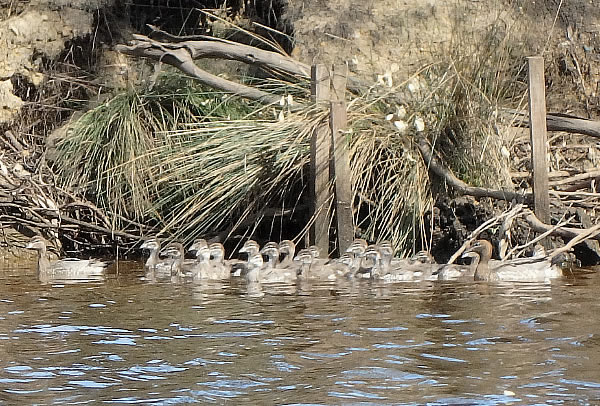
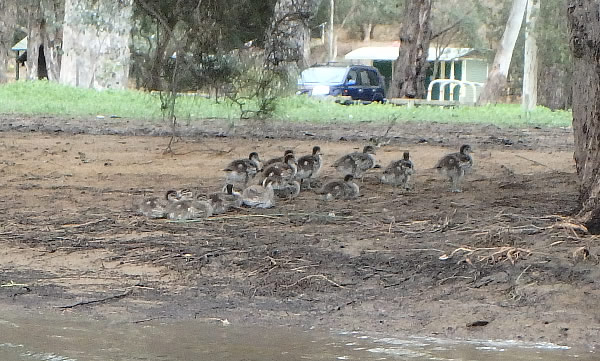
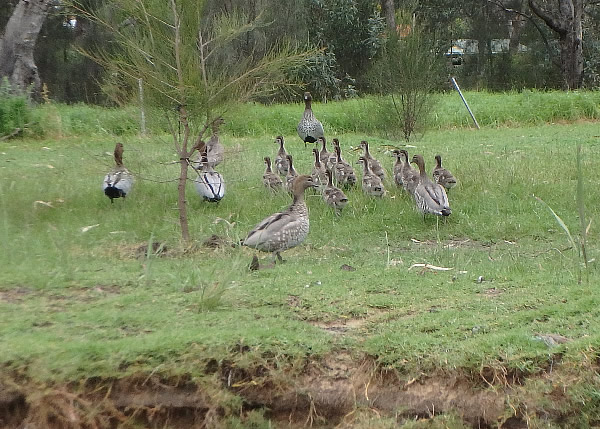
What a huge family - about 17 young ducklings.
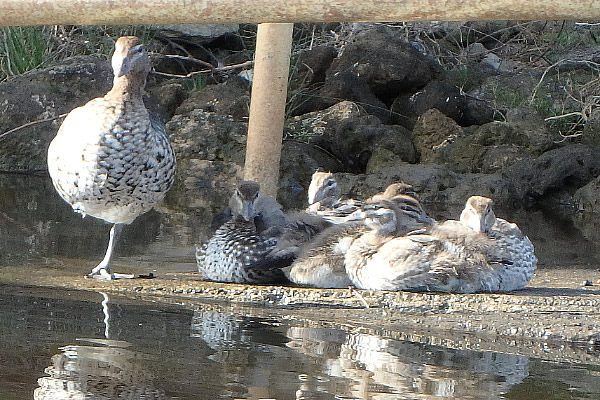
The river is full of ducklings at the moment.
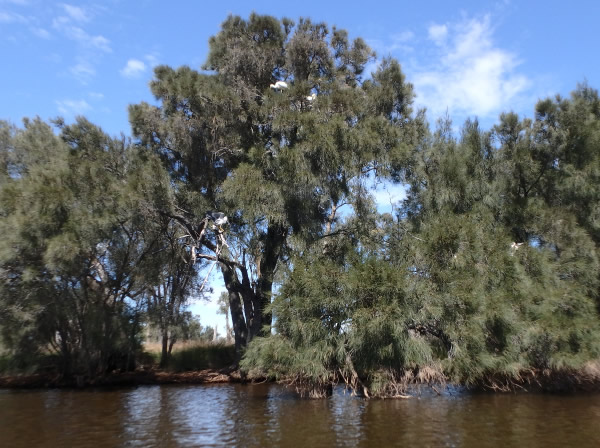
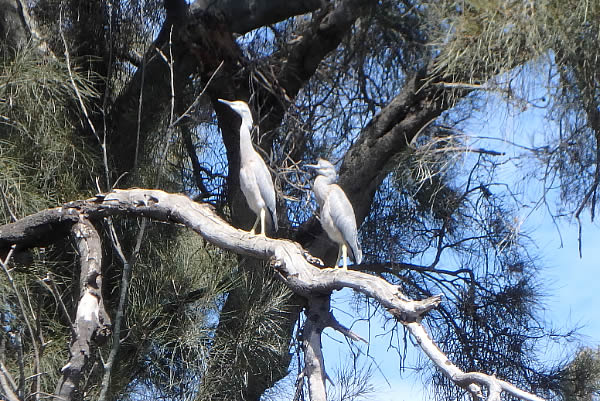
Two spoonbills nesting up high, 2 cormorants nesting to the right and 4 young herons to the left.
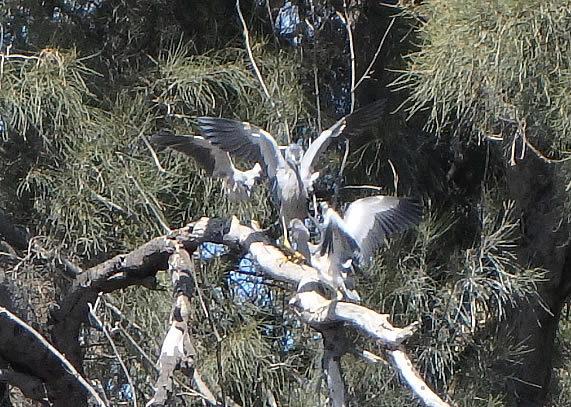
Three young Herons having a tiff.
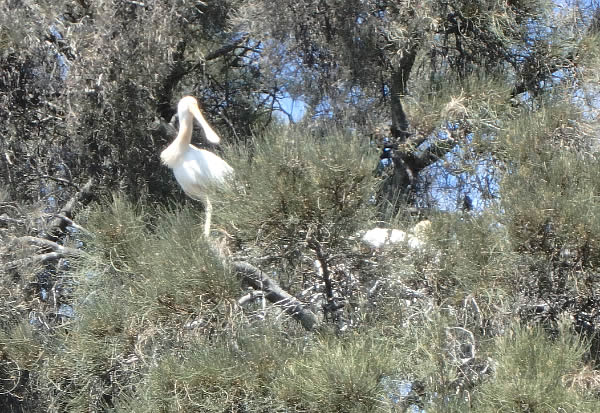
A Spoonbill sitting on the nest and another on guard.
It's been wet at times this week.
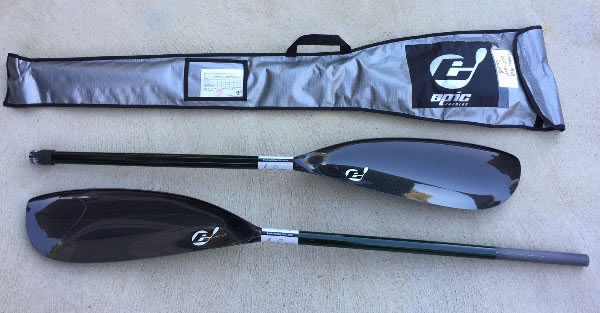
Club Carbon $460.00
Midwing Club Carbon construction - 737 grams; comes standard with Epic’s Length-Lock 2™ adjustable ferrule technology.
Carbon fibre blade, Green oval fibreglass shaft.
Fully adjustable length & feather.
Includes paddle bag.
|
|
|
|
|
|
|
|
|
|