|
|
|
|
On Track
13 Weeks - One Quarter of a Year -
2536 kms Paddled
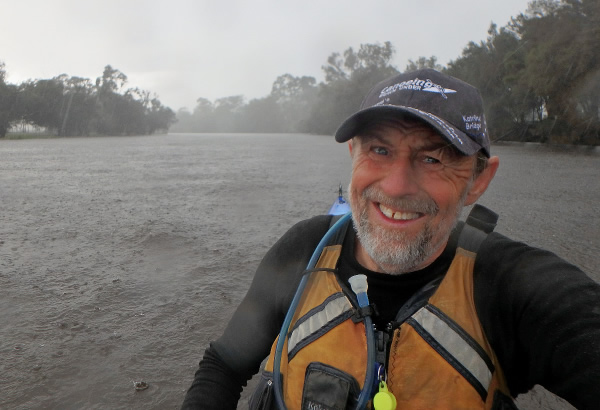
Can you believe it but 13 weeks have passed since my 70th birthday. That means I am a quarter of the way
through my 7000 km challenge. My 210 kms this week brings my 13 week total to 2536 kms. That is 195 kms on average a week. If for some reason I would be able to keep this quarterly target up I will have paddled 10,000 by the end of my birthday year, but that is a big ask and a long way off. In fact if I can do another 26 weeks at the same distance of the last 13 weeks I will reach my target with 13 weeks to spare. My original target was 20 kms a day, 140 kms a week and 1820 kms in a 13
week period. However I have averaged nearly 29 kms a day and I have paddled every day for the last 13 weeks.
Let's hope for no lock downs.
The weather is still giving a hard time, eventually it will get warm.
I am still feeling fit although I am not paddling at racing pace when I do the 30 kms.
Plastic Pollution
along the upper reaches of the Swan River
and Another Challenge
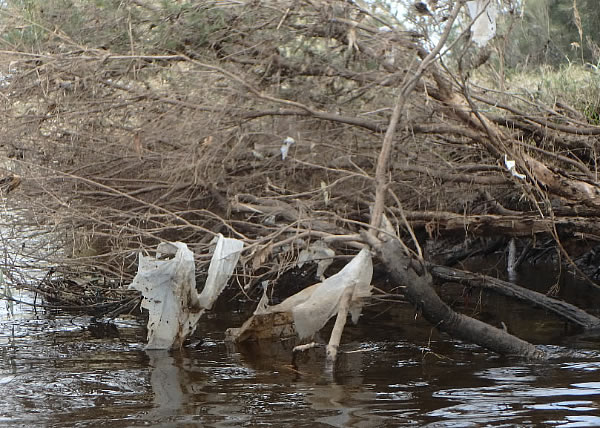
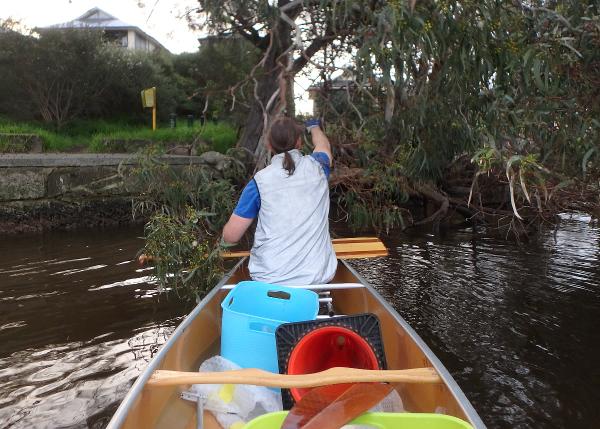
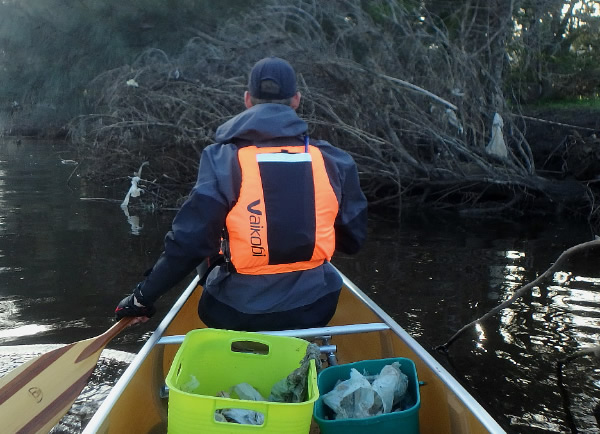
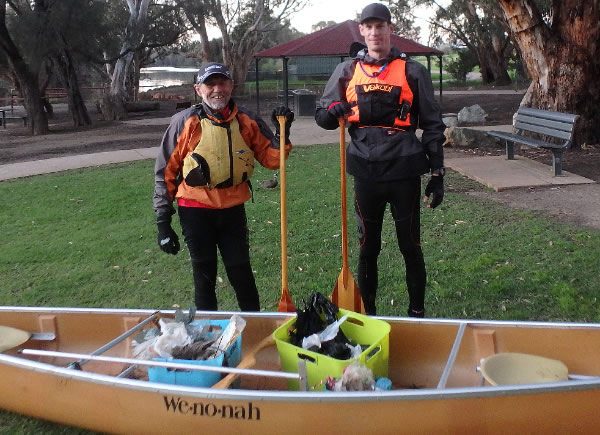
On my travels up to Middle Swan Bridge (which is virtually daily) I have noticed a large amount of plastic stuck in the trees brought down by the floods. Now the flood waters have ended I felt it time to collect this plastic off the trees to make the river look beautiful again. I have
been collecting some rubbish as I paddle my kayak, but there is so much plastic upstream of Guildford Bridge that I have found it more efficient to find a partner and use my canoe.
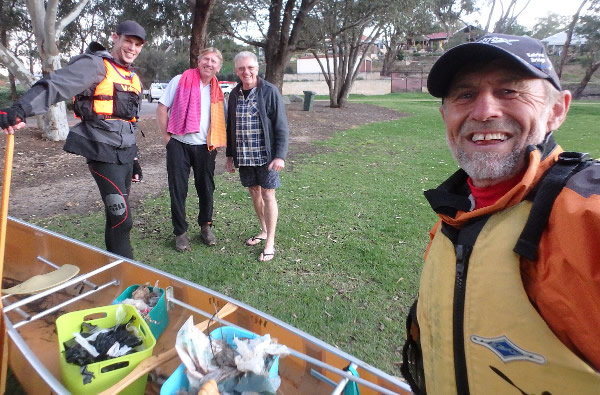
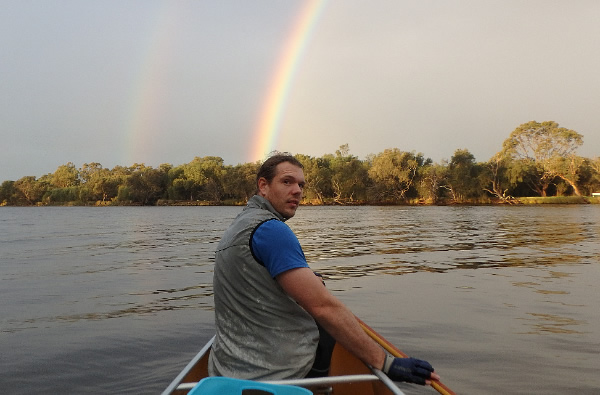
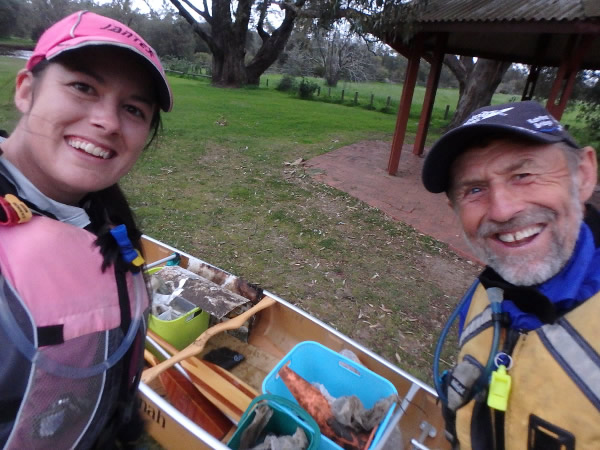
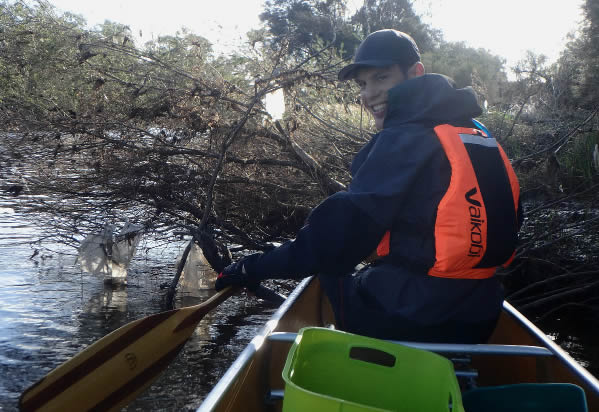
So on Sunday evening Josh Richards and I took the canoe out and picked up plastic and rubbish on a 6km stretch of river near home. This stretch around Garvey Park and Sandy Beach Reserve is also patrolled by the juniors at Ascot Kayak Club and Marie at SUP Tonic Australia.
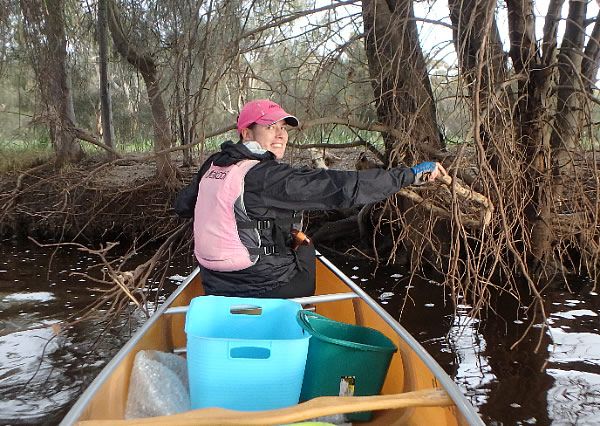
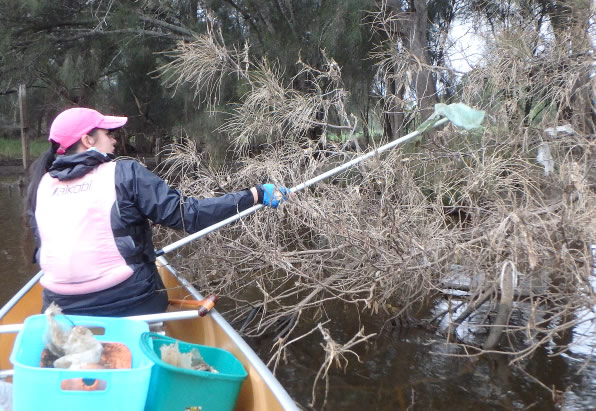
On Monday evening Steph Bedden joined me for 2 hours to clean up 3.5 kms of river near Barkers Bridge. The further upstream we go from Barkers Bridge, the more plastic is found so it takes longer to do a section.
On Thursday Anthony Clarke joined me for 2.5 hours to clean up 4kms of shore downstream of Ray Marshall Park, Midland. There is just so much plastic it takes a lot of time.
The river is now relatively clean from Tonkin Highway Bridge to
Ray Marshall Park, Midland.
We will be going out collecting the plastic rubbish until it is all cleared upstream.
I think a lot of he white plastic is coming from the vineyards that were flooded.
How much plastic is under the water!!
Anthony & I met Bruce and Warren at Ray Marshall Park after collecting plastic.
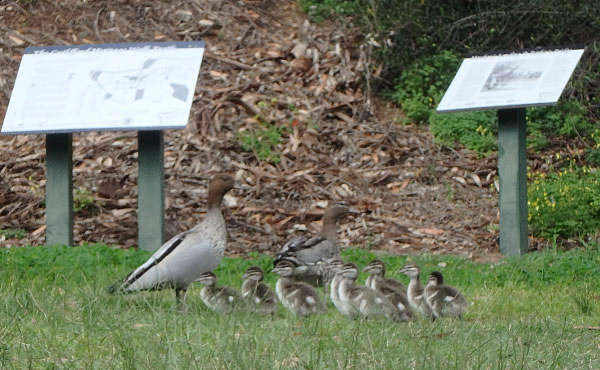
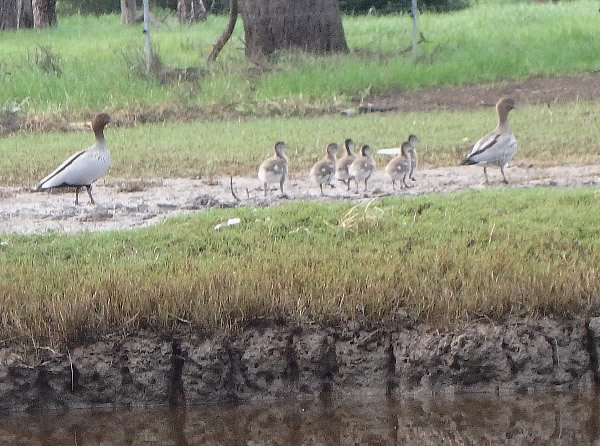
There are lots of ducklings around at the moment. Most are Australian Wood ducks. At Guildford Bridge there is the Smith family, at Lilac Hill Park, there is the Jones family, opposite Lilac Park there is McKenzie family, Ray Marshall Park there is the Bond family and further upstream
of Caversham House there are several families that have made their homes at the edge of a field of some grape vines.
What is strange at the moment is the lack of Black Ducks on the river. Once upon a time I would see hundreds. Is it the time of year they flee to warmer waters or are they dying out?
The Post family at Barkers Bridge, Guildford.
I have had several people interested in reading my Kimberley Expeditions so I have carried on and included another one. Hope you enjoy it.
Kimberley Kayak Expedition #5
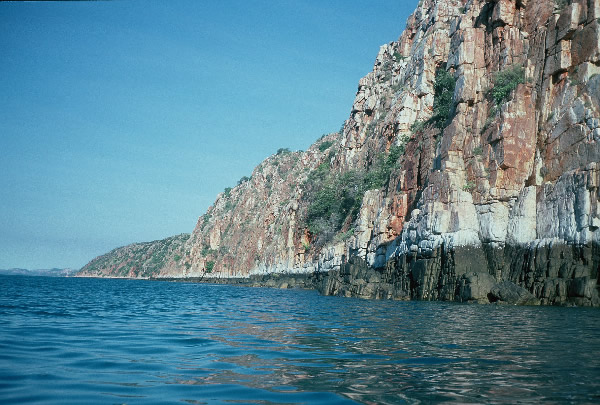
As the days passed we appreciated the beauty of the magnificent coastline which was indented with hundreds of bays and islands. The high cliffs, rich in colours and a variety of peculiar patterns dominated the unpredictable ocean, riddled with treacherous reefs where fish leaped in silver cascades and turtles floated peacefully in the habitat of the lurking salt water crocodiles. The grandeur of the surroundings certainly eclipsed the pain of paddling and the anxiety caused by the sharks hits,
crocodiles and the foaming rapids we had to negotiate.
Read the full story further down.
********************************************************
The 2021 Australian Masters Games has been postponed until April 2022
- Nina Mueller
- WA State Slalom Championships
- WA State Wild Water Champs
- Progressive Racing Group
- Kimberley Kayak Expedition #5
- River Clean Up
- Birdlife
- Coming Events
Nina Mueller
Last week I mistakenly wrote that Jane Pankhurst won the WA State Wild Water Championships. Jane won the Avon Descent but it was Nina who won the State Championships.
Nina is one of those paddlers who can paddle virtually anything and be good at it. She is also one of the nicest people you will meet and she will help others at the detriment of her own race like she did in the Avon Descent.
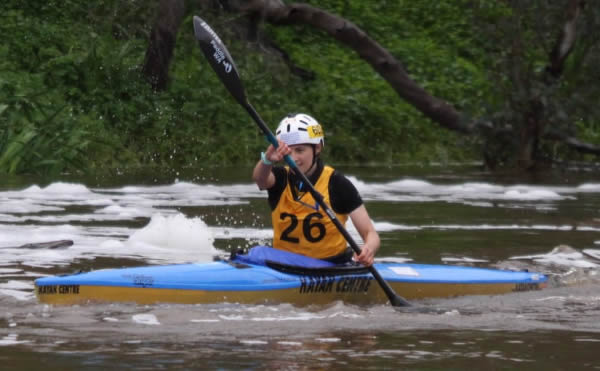
Nina Mueller WA State Wild Water Champion.
What Kayak Club do you belong to: Ascot Kayak Club.
Nickname: Nins.
Occupation: Midwife.
When did you start paddling: I started paddling when I was 9 years old.
How did you get into paddling: I got into paddling after mum saw an advertisement in my sister's school newsletter about a come and try day. I had always loved kayaking on our plastic sit-on-top when we went on family holidays down south so I thought I would give it a go.
What has been your biggest paddling accomplishment: My proudest
achievement was definitely making the Australia Junior team in 2016
which meant I got to travel to Europe and paddle/race in Augsburg,
Prague and Krakow.
Favourite food: I think it would have to be between sushi and
burritos.
Favourite place to paddle: Even though I have only travelled there once, I think it would have to be Augsburg in Germany. The course is challenging and narrow, there are 3 different channels so you can warm up on moving water, it is located amongst the beautiful European forest and they have accommodation right on the course. Couldn't really be better!
Favourite colour: Teal Green.
Favourite holiday destination: My happy place is Dunsborough but if I could go anywhere in the world, I would have to say Munich at Christmas time - snow, Christmas markets and toffee fruit.
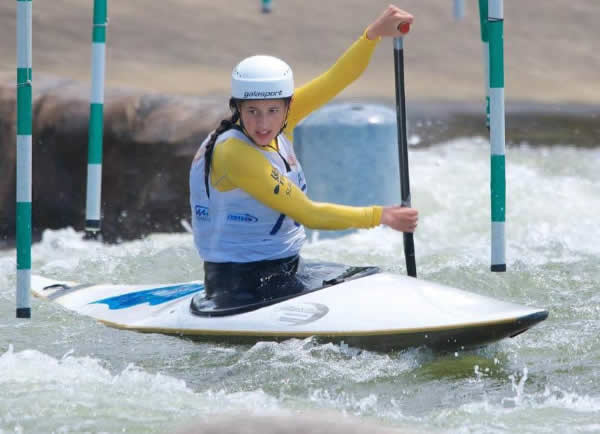
Represented Australia in slalom kayaking, her main paddle sport.
Nina is also an accomplished C1 paddler.
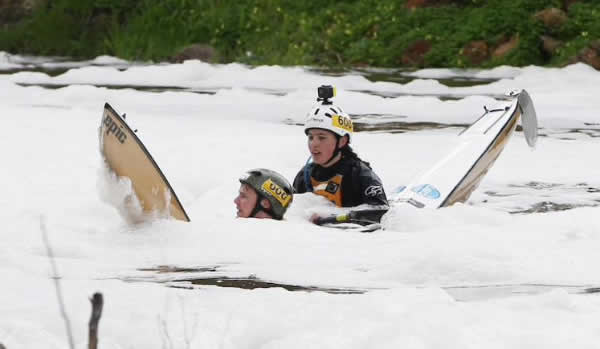
Things didn't quite go right for Nina and Coran Longwood at Extracts Weir when paddling in the Avon Descent. They hit a rock with a bang.
Ooppss
Watch the video:
https://www.facebook.com/100003839730638/videos/pcb.1176375519167095/1176373935833920
Nina paddled a K1 in the Avon Descent.
Photo Mitch Hale.
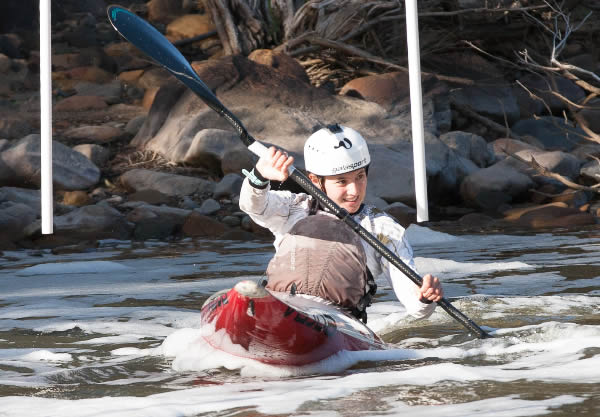
See her paddle at the State Slalom Champs tomorrow at Walyunga NP.
WA State Slalom Championships
Saturday 4th September | Walyunga National Park
Slalom WA have announced that their State Championships will take place this Saturday at Walyunga National Park!
With current water levels of ~0.8m at Walyunga, the championships looks to be a fantastic event for both experienced and novice slalom paddlers. If you've ever wanted to give slalom a go, or want to watch WA's best paddlers tackle the course, then come on down to the State Championships!
Registration: 8.00am
Race start: 8.30am
Race fee: $10
WA State Wild Water Championships
Bridgetown
Results here:
Wayne Martin WA 2021 Wild Water Champion.
(Nina Mueller female WA Wild Water Champion.)
Photo Jane Hilton.
Phil Langley WA 2021 Wavehopper Champion.
(Steph Beddon female Wavehopper Champion.)
Photo Tom Canavan.
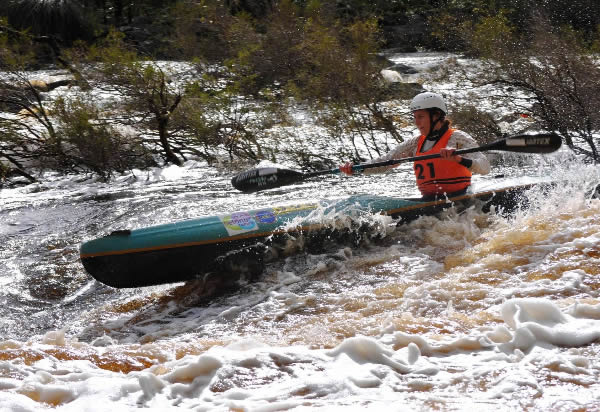
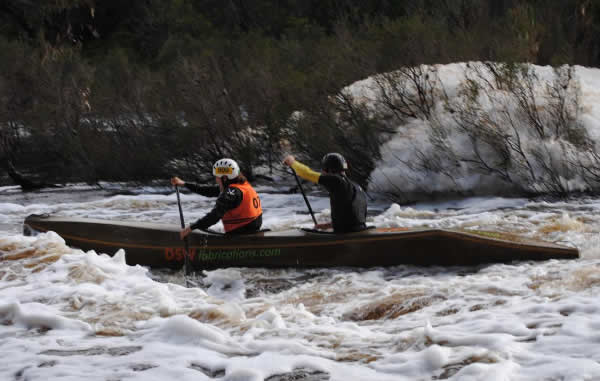
Clare and George Pankhurst paddling a C2 at the champs.
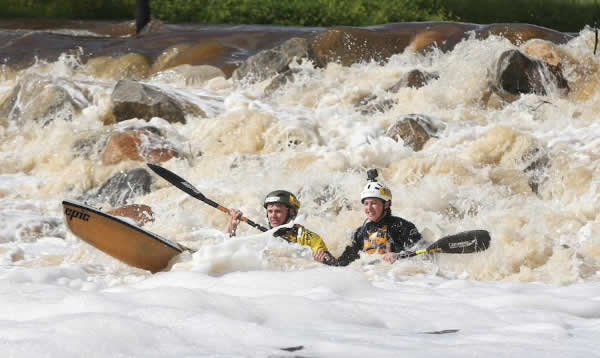
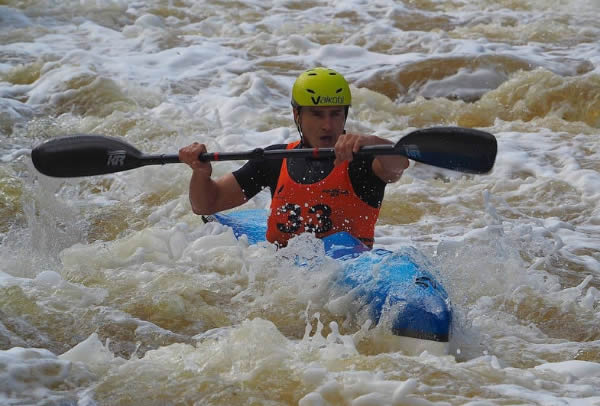
Competitors at the WA Wild Water Champs.
Progressive Racing Group
The Progressive Racing Group has had a 3 week break but we are back with 24 paddlers taking part on Tuesday evening.
New paddlers welcome.
Great for paddlers who want to increase their fitness.
It's a very friendly group.
Kimberley Kayak Expedition
number 5
After four expeditions in the Kimberley I was determined to plan another, bigger, better and harder expedition. My plan was to go around the Kimberley, starting and finishing at Broome, keeping to the most isolated regions
and using four different disciplines:
Running 445km
Kayaking 700kms
Backpacking 420kms
Mountain Biking 1930kms
The most important objectives of the expedition were firstly to explore the areas around the Mitchell, Hunter and Roe Rivers and secondly to retrace the movements and find material evidence of the two German aviators,
Bertram and Klausmann, who became stranded along the Kimberley coast in 1932.
We aimed to push ourselves to the limit, to have minimum rest days and achieve high milage over a three month period. Dreaming up such an expedition was easy. Finding the money and companions willing to put themselves under
severe pressure for three months was much harder.
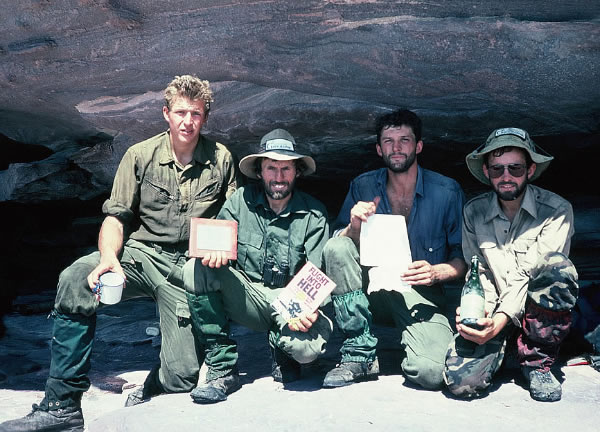
Eventually I convinced an experienced white water kayaker Ewen MacGregor, who had recently migrated from the UK that it would be a trip of a lifetime! Two of Ewen’s friends, Duncan Hepburn and Dennis Sproul, also from the
UK agreed to be our support team. Ewen, Duncan and Dennis had no idea where the Kimberley was and what to expect. For my part, being an Adventure Pursuits Instructor and having already completed four previous Kimberley expeditions, I was the only one who had some insight into what lay ahead of us.
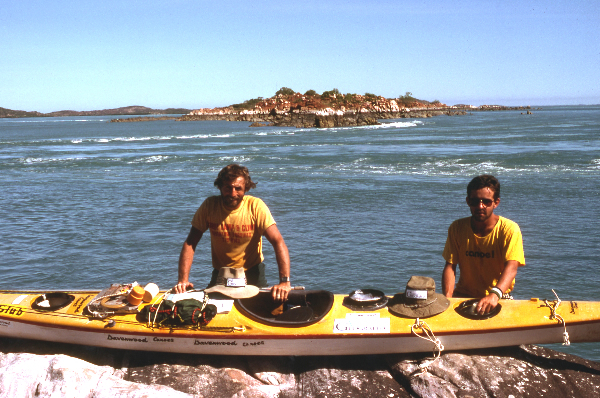
Duncan, Me, Dennis and Ewen.
At 7.30am on 25th May 1988 in Broome, Ewen and I warmed up for a 225 kilometre run and the beginning of a gruelling 3500km challenge across rugged and unrelenting, yet magnificent, Kimberley terrain. Broome was still quiet. There was no fanfare for our
departure, only Duncan and Dennis witnessed the start of our daunting marathon at 8.40am.
It was going to be hot real hot, up to 40 degrees so we left Duncan and Dennis to buy some ice as we might need it to keep cool over the next 3 days. After 7 kilometres we left the bitumen road and hit the gravel and the corrugations.
We soon found out that we couldn’t run more than 5 kms without a water stop. By 1.30pm and in 36 degree heat, Ewen and I had run 35 kilometres along a dusty corrugated track. At our refreshment stop we were hot, exhausted and we both sat in silence. Ewen’s pace had slowed to a stagger and by the look on his face he could
collapse at any time.
I broke the silence. “How do you feel”, I asked.
“I’m feeling dizzy and just feel like dying”, he muttered.
This was the first day of our gruelling journey. After Ewen fell victim to the extreme heat and conditions, Dennis kept me company, first running every other 5 km section before running every section. When it became dark Duncan and Ewen went 10 kms ahead to make camp. It became extremely hard to run on the ruts, the
corrugations and the sand patches in the dark, so we walked. The moon helped enormously as it gave us just enough light to see our feet and get our fatigued muscles to our first nights camp. The highlight of the day was when a lady, Moya Smith stopped to talk to us. I had met Moya in 1982 on my first trip. At the time Moya was learning the old traditional ways of hunting and fishing from the Aboriginals and I stayed with them for 10 days trying to learn as much as I could. The
Aboriginal elders Sandy and his wife who taught Moya and myself the traditional ways were in the car with her.
A thick mist in the night had dampened all our gear and when we took to the road it was like running through a tunnel of mist. The cool air was refreshing but when the mist disappeared the mysterious morning vanished the sun appeared and the birds started singing. At the 40km mark Ewen felt the full force of the scorching sun
and decided to retire again. When we got close to Beagle Bay the boys drove into the community to have a look at the church with a pearl shell alter whilst I ran on. Soon after the turn off, the road deteriorated even more making the running even tougher than it was. To make matters worse we didn’t have ice or cold water so it was harder to quench my thirst, but they had bought some jam and biscuits to keep me happy. At the same time the boys returned a car pulled up with Eric Hunter in it. Eric
was an Aboriginal who I went trochus shelling with at One Arm Point in 1982. We had a chat and he was away. It had been another really hot, tough day and by 8.00pm, when it was cooler and dark I had run 80kms that day.
My third day on the track I only had to run 65kms, but I knew it was still going to be a tough day as we were all a little stiff. Ewen wasn’t going to be put off by the heat today he was determined to run with me all day. With the birds singing and some cattle roaming we slowly entered the heat zone and by the end of another
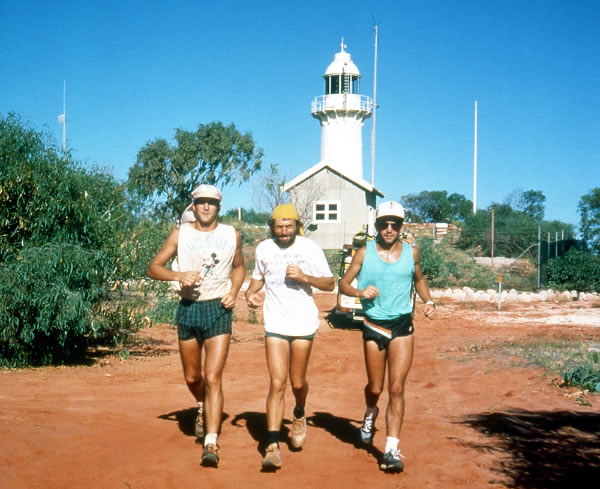
very tough day, when the sun was setting over the quivering blue Indian ocean we arrived at the Cape Leveque lighthouse. With 225 kilometres behind us, our dream of resting under the palm trees of Cape Leveque was very welcome.
After a rest morning at the Cape and an invitation to have breakfast with Rafiel who lived there we took off again for a 15 km run to Cygnet Bay pearling settlement where we met Bruce Brown who allowed us to camp on the beach for a quick
get-a-way in the morning.
Running from Broome to Cygnet Bay. 225 kms.
Monday 30th May 1988
No time was lost before Ewen and I commenced our 700 kilometre ocean paddle along one of the worlds most treacherous coastlines. Tides in the King Sound are among the highest in the world, exceeding 10 metres with two high and low tides per
day. Swift currents reach speeds of 12 knots in many places. The coastline is isolated and crawling with sharks and crocodiles. It was truly a wild, wondrous wilderness to be in.
To reach East Sunday Island, our first camp site, we had to paddle across several swift currents between the islands. It was a good introduction to the Kimberley but being experienced white water paddlers we took the strong
currents in our stride but admittedly the crossing that we had to ferry glide across were must bigger than river ferry glides. We settled in at our campsite, ate rice pudding and planned the following days paddle. Ewen caught 3 fish whilst I planned the trip ahead. The currents looked frightening. The tides were on springs which meant they were at the highest and fastest of the month so the 15km crossing was going to be a challenge. The alternative was to wait a week for neap tides when the
currents were at their slowest speed but that was too long to wait, we had to give it a go in the morning.
Our kayaks were really loaded down.
Tuesday 31st May
I awoke to a howling wind from the north-east and drifted in and out of slumber for the next few hours. Signs were not favourable – giant tides, fast currents and now a gale. As we rose a red glow emerged behind Mermaid
Island and finally the sun appeared to reveal massive white caps that dominated the huge expanse of water of King Sound. Swift tidal currents forged past our reef and the rocky island beyond.
Anxiety cramped my stomach. Conditions were far from ideal for such a treacherous crossing. For the next hour we carried our gear down the beach in silence, lost in our own thoughts. The tedious job of loading the kayaks
was completed some distance from the water’s edge as the tide was rising at an alarming rate.
Every piece of equipment had its place and failure to load it correctly would mean unloading and starting again and we had little time today to do that. The silence between us continued until we were both satisfied with our
preparation and ready to leave the safety of the shoreline.
The kayaks sat deep in the water, fully loaded with 140 kilograms of camping gear, food packs, fresh water, radio, battery and solar panel. We wore buoyancy aids and survival jackets jammed with emergency equipment,
including a distress beacon, flares, mask and snorkel, signalling mirror, fishing, fishing line, matches, compass, spare food and 700mls of water. Separated from our kayaks we hoped to be self-sufficient for a few days, although water would be our biggest concern.
As we rounded the lee of the island, the wind and currents created a mass of towering waves which pounded us from all directions. The ride was wild and far more difficult than handling river rapids with its safe banks on
either side. A big wave hit our boats and Ewen said that he nearly went over. The further we moved from the island the calmer the ocean became, although it still wasn’t an easy ride. We could have waited a week for the neap tide, when there is less current but it was much more exciting to cross the sound on spring tides and much faster currents.
Mermaid Island, our destination 15kms away was lost in the haze, but as we closed on the beckoning golden beach, the swift currents swept us south-ward deeper into the open waters of the King Sound. Realising that it was an
impossible task to reach Mermaid Island, we focussed our effort on Long Island which was several kilometres to the south. Failure to reach there would mean spending the night out in the open ocean drifting with the currents towards Derby, so after a short water stop we paddled as strong as we could and our efforts were eventually rewarded, although we missed Long Island and landed on Fairway Island 4kms west of Long but 6 kms too far south. This was the last small island that we could land on
before being swept into the massive open ocean of the King Sound so it was a relief to have landed. We climbed the highest hill to check out the tide and saw the swift currents fly by the island at a rapid pace. It was a sight to see. When the currents eased we jumped back in our kayaks and paddled across to Long Island to camp at the northern point.
Calm waters one moment swift currents the next.
Wednesday June 1st.
We skipped breakfast to get on the water early and catch the tide that was going out fast causing at least 5 long walks across a reef. Just as we thought we were nearly packed the tide went out another 15 metres so we had to drag the kayaks to the water. It wasn’t easy.
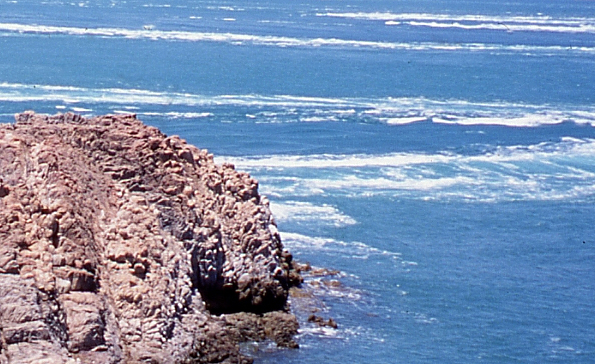
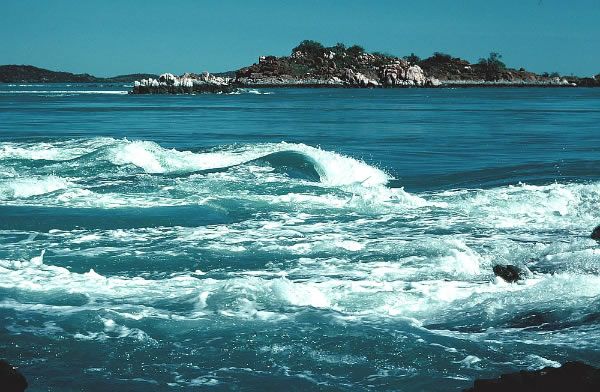
Once in the water we headed over to Pascoe Island where the fun started again as the incoming tide started to gain traction. We had to ferry glide across gaps in islands where the current was moving at terrific speed which was testing at times. Boils and eddies also made paddling our heavy kayaks quite difficult. The currents
were heading south and we were going north and it got to a point that we could no longer make progress against the swift current so we landed on a beach at a place the locals called 'Hells Gate' and waited for the current to die down.
Turtles swam around near the rocks of our beach accompanied by an assortment of fish. The tide rose quickly so we continually dragged our kayaks up. The beach was soon lost and replaced by mangroves so we had no choice to ascend some rocks close by, where we found a good spot overlooking the area. I threw my line in
and caught a fish but hunger pains for breakfast had us hunting for real food.
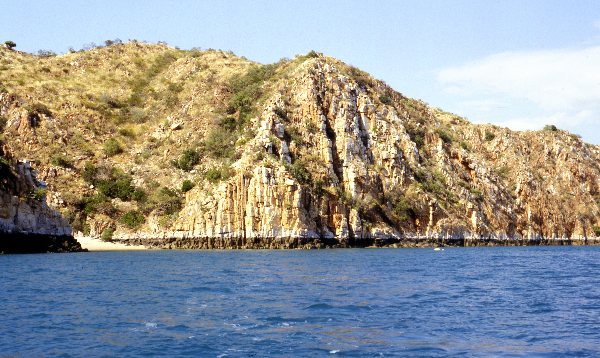
Watching the tidal rapids was one hell of a great sight and we were quite happy to be there, but when the current had eased we loaded the kayaks and headed for Cone Bay. Crossing Crawford Bay the sun reflected off a semi circle of cliffs and what a fantastic sight it was and not only that we sighted a
dolphin.
We soon entered Cone Bay where the wind waves pushed us along the towering stunning cliffs to a beach I had visited twice before. A powerboat lay at anchor and the people in it were just leaving after spending four hours laying on the beach which was quite noticeable as they were as red as a rooster’s comb.
Nuts, dried fruit, muesli bars, staminade and a wash in the fresh water stream added to an interesting enjoyable day. We slept really well.
The currents are too fast to paddle against.
River Clean Up
Sunday evening with Josh Richards.
Josh untangling fishing lines.
River Clean Up
Monday evening with Steph Bedden.
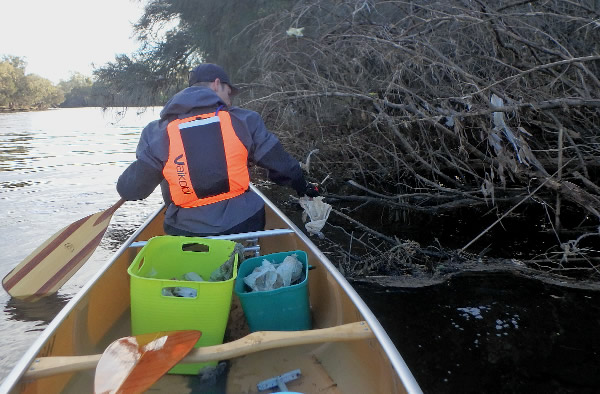
The main rubbish is plastic caught in the trees after the flood.
A pole is needed to get some of the plastic.
Two hours we cleaned up 3.5kms of river.
River Clean Up
Thursday Evening with Anthony.
Anthony Clarke having a go collecting plastic and rubbish.
And there were lots of plastic pieces.
As you can see there is a lot of plastic caught in the trees so its a tedious job.
2.5 hours and only 4 kms of shore cleaned.
There is so much plastic.
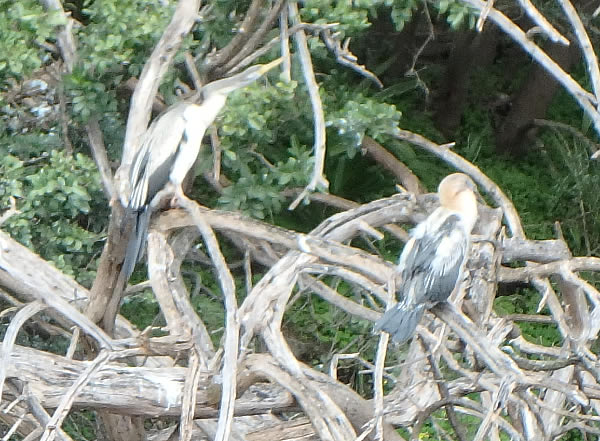
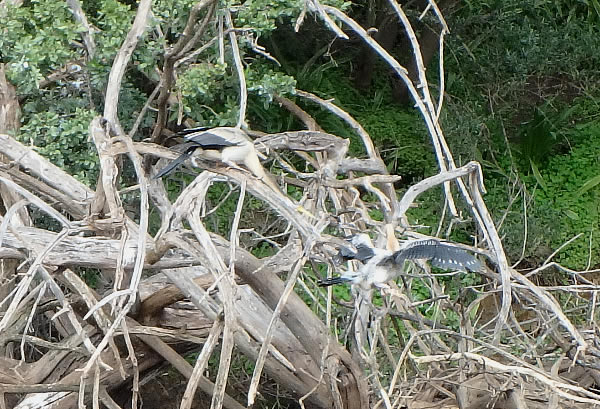
This young darter on the right was happy perched on the branch.
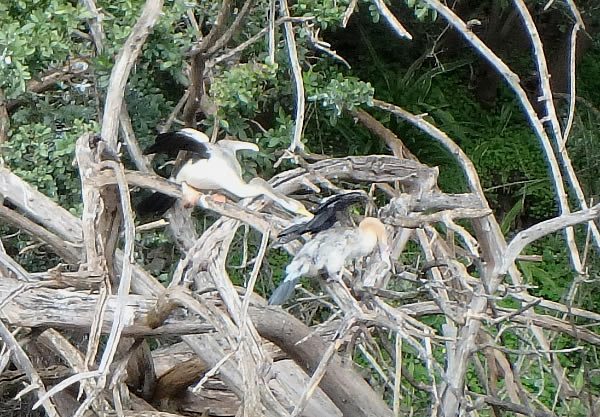
However the adult darter either didn't want the young on the same branch or it was trying to make it attempt to fly.
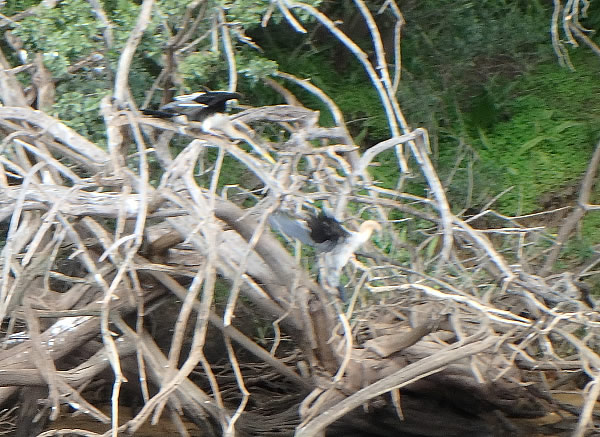
The young one jumps down to another branch.
Look how long the darter's neck is.
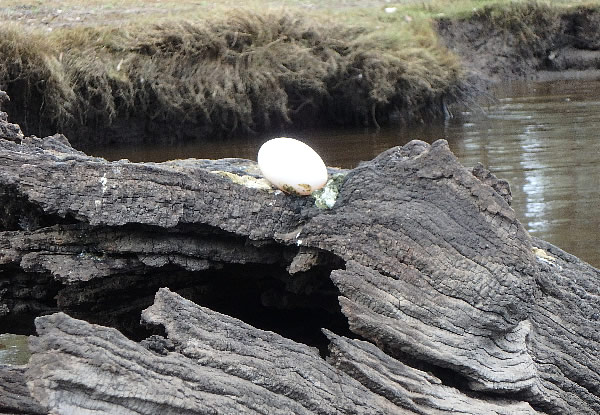
Not the best place to lay an egg.
The Holland Family
Like other waterbirds, the Australian Wood Duck hatches with a covering of waterproof down and can enter the water almost straight away.
Breeding season: September to November in the south; after rain in the north.
Clutch Size: 8 to 10 eggs
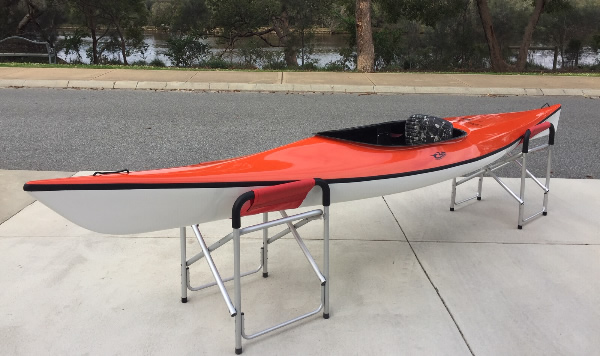
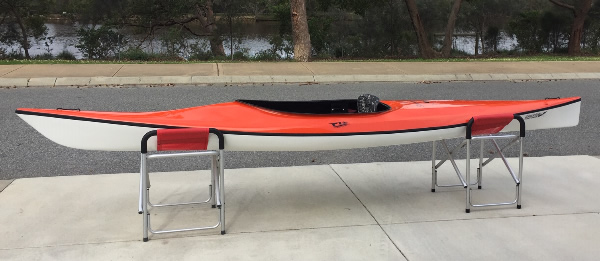
Lenght 4 metres. Width 65 cm. Cockpit size 46 x 107 cm. Weight 10.5 to 16 Kg (depending on outfitting)
Available with rudder and bulkheads, hatches and storage areas.
Without rudder and bulkheads
Only 10.2 kgs
Geograhe Bay Paddling Club
Paddle WA are very excited to announce that WA has a brand new club in Busselton, the Geographe Bay Paddling Club!
Formerly known as the South West Development Program, coach Beau Lewis was able to make this training squad so successful that it quickly evolved into a fully-established paddling club in WA's South West!
For more information about the club or to become a member, visit their Facebook group in the link below, or email beaumont.lewis@yahoo.com.au.
Australian Masters Games
Postponed
23rd-30th April 2022 | Perth WA
The 2021 Australian Masters Games has been postponed until April 2022.
|
|
|
|
|
|
|
|
|
|