|
|
|
|
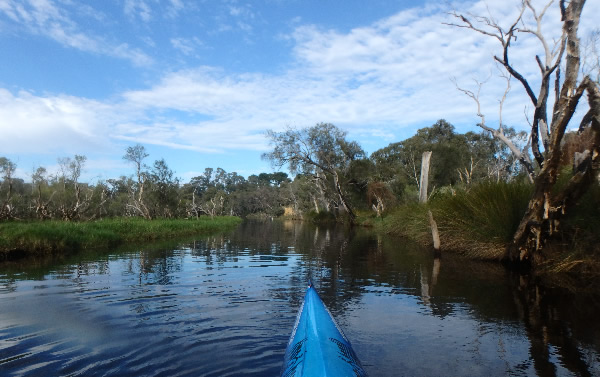
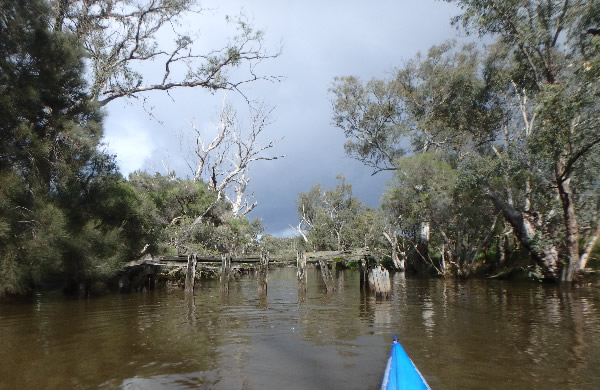
Another week of extremes. Hot one day heavy rain and gusty winds the next.
I paddled 253 kilometres this week which brings my total so far to
3003 kilometres in a 15 week period.
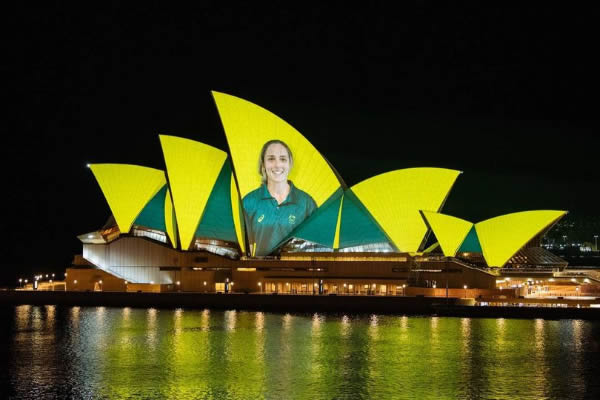
A welcome home for WAs Olympian Jamie Roberts.
- On My Paddles
- Ken Vidler
- AKC Nanga Challenge
- Ascot Kayak Club
- Kimberley Kayak Expedition #5
- On My Paddles
- Coming Events
On Tuesday I gave 9 members from the Over 55 Canoe Club a white water instructional course.
A great bunch of paddlers.
They appreciated learning the finer points of white water paddling.
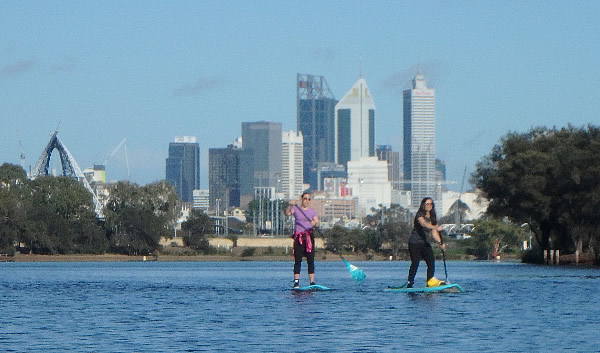
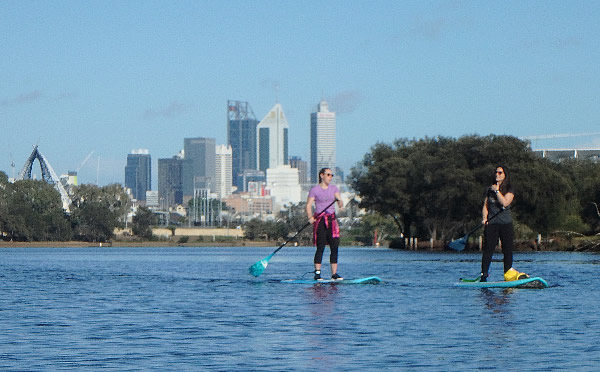
Some lovely lady paddlers near Sandalford Winery.
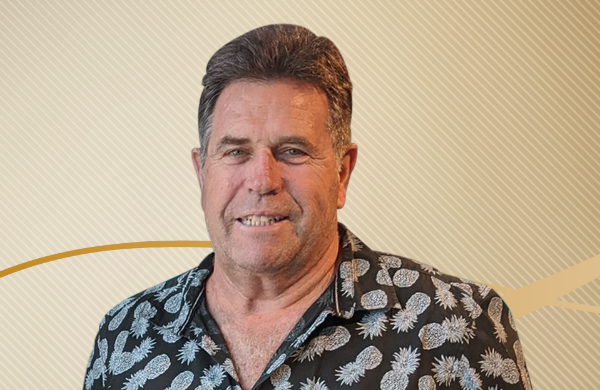
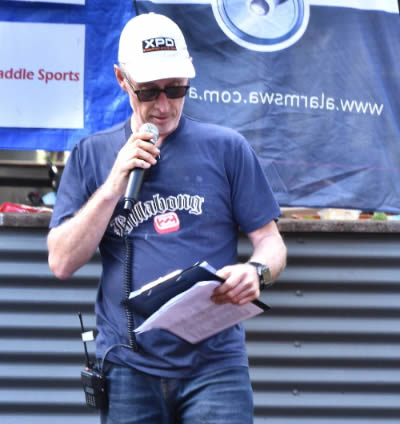
Ken Vidler
Paddle WA Board Member
Paddle WA has some amazing Board Members who are committed in seeing that WA Paddling is professional, effective, functional, dynamic and is beneficial to all WA paddlers no matter which discipline or activity they paddle.
And Ken is one of them.
Ken Vidler
Born Perth W.A.
28 April, 1954
Ken is a life member of Scarboro SLSC.
Paddle WA Hall of Fame.
A father of five children.
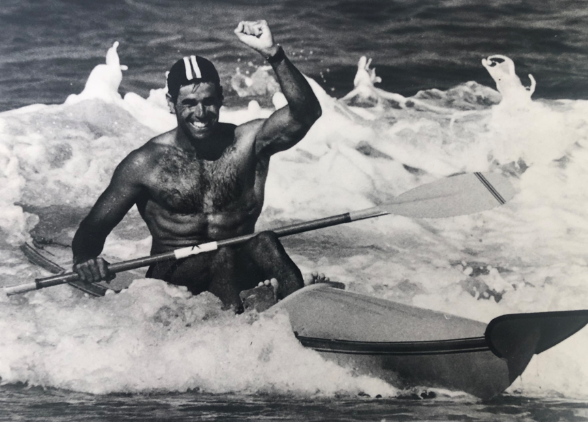
One of five brothers who grew up in Scarborough and competed with success in the surf, Ken Vidler was Australia's most-decorated surf lifesaving representative when he retired from top-level
competition. Ken won more than 50 medals in a career that spanned 23 years at junior and senior level. His major successes included one World Title and seven Australian Senior Championships.
After switching from pool swimming to surf competition, Ken joined the Scarborough Surf Lifesaving Club in 1967. He won the Australian junior Iron Man Titles in 1971 and 1972, adding the single ski
crown to his list in 1972.
On graduating to senior ranks he won the first of three Australian Iron Man Titles at Burleigh Heads, Queensland, in 1973. He claimed his second Iron Man Crown at Dee Why, Sydney, in 1975 when he also
won the first of four National Ski Titles. He completed the Australian Iron Man and Single Ski Title double at Clifton Beach, Tasmania, in 1976.
At the World Championships in South Africa, Ken won the Single Ski, was runner-up in the Iron Man and finished second in the Ski event with Murray
Braund.
Ken won many medals in the Single Ski and was a great Iron Man.
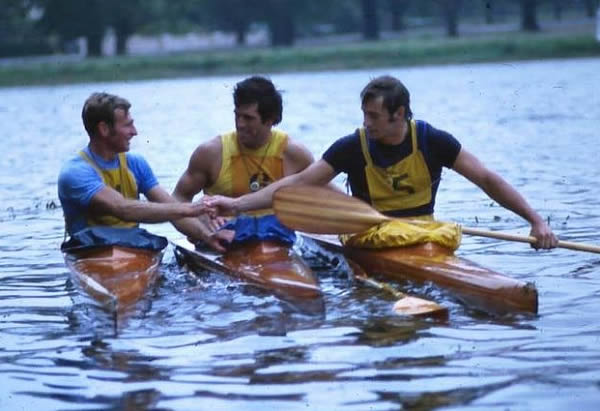
1975 Ballarat Australia National Championship 1000 m.
From left: John Southwood, Ken Vidler, John Sumegi Silver Medalist World Champs and Silver medal Moscow Olympics.
In 3 x Lancer kayaks.
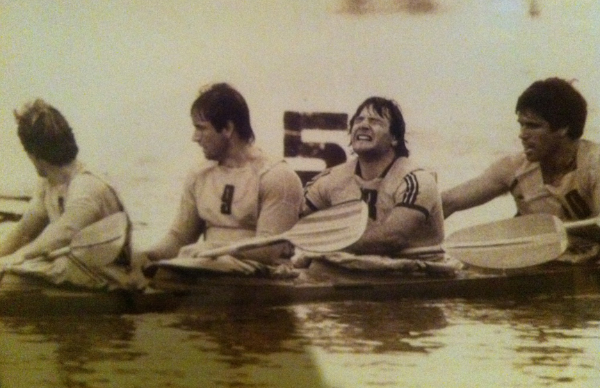
Ken contested the 1978 and 1979 World Canoeing Championships, finishing fourth in the four-man kayak final (1000m) and fifth in the single ski (10,000m) in 1979. He went to the 1980 Moscow Olympic Games
as a member of the Australian four-man kayak team that finished eighth.
His national championship included four double surf ski titles, with brother Colin, and five ski relay victories. In 15 years Ken won 10 individual Australian Titles and had 10 placings as well as nine
Australian Team Titles and eight team placings.
Ken was selected in five Australian teams from 1971 to 1985, competing in South Africa, Europe and New Zealand. On the 75th anniversary of the Australian surf lifesaving movement in 1983, he was
officially acknowledged as the nation's most decorated competitor. At State level Ken won 29 Individual Titles, including eight successive Iron Man championships, the first two after winning the junior Iron Man event as well.
He showed his versatility by winning the Australian Championship in white water paddling, the Wild Water single kayak event, at Harvey in 1978.
Finished 8th at the 1980 Moscow Olympic Games in the K4 1000m event.
Listen to Ken's inspiring story
https://soundcloud.com/bowraodea-inspiring-stories/ken-vidlers-inspiring-story-15112020
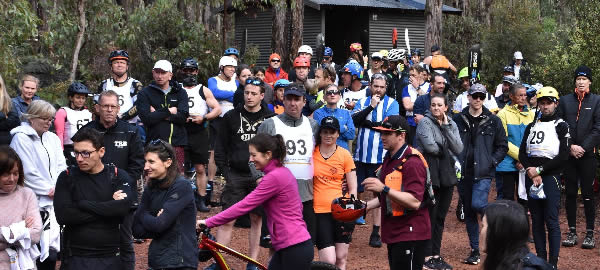
Organiser Grant Pepper giving the briefing.
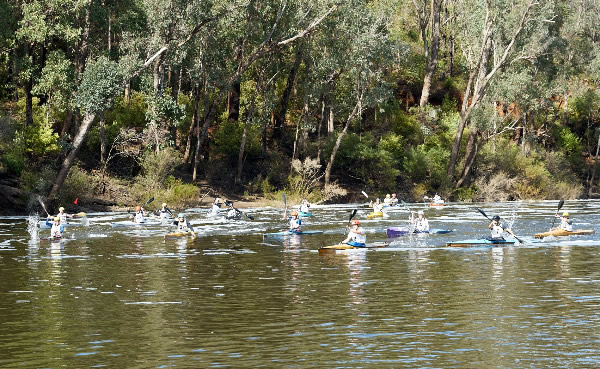
They are off.
Photo Brendan Welker.
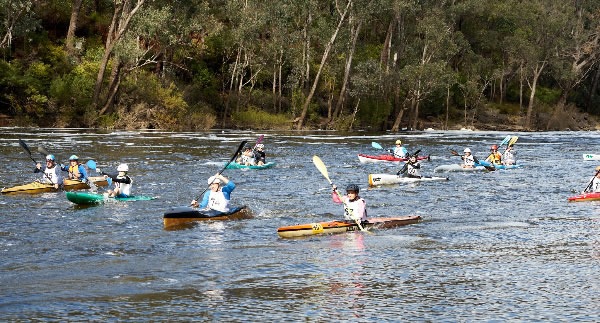
The less speedy paddlers are off.
Photo Brendan Welker.
Genevieve Stanley female winner of the Nasty Course
Photo Brendan Welker.
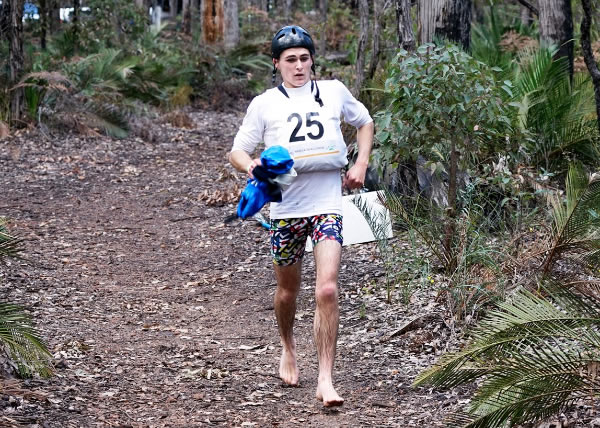
George Pankhurst (no shoes) is as tough as nails.
Photo Brendan Welker.
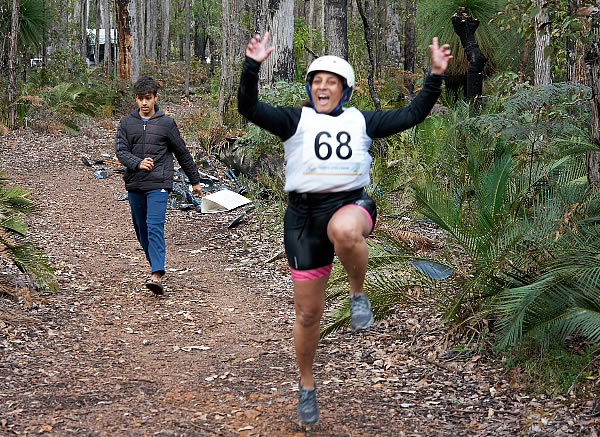
It was a happy day for Nishani Jacob!
Photo Brendan Welker.
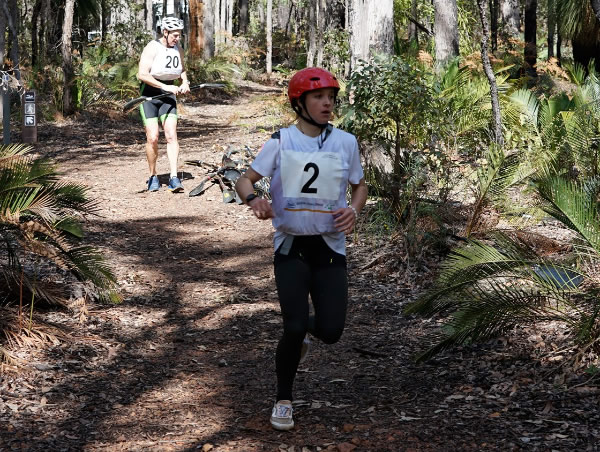
Isabel Combe changing from paddling to running.
Photo Brendan Welker.
Andy Mowlem winner of the Nasty Course.
Photo Brendan Welker.
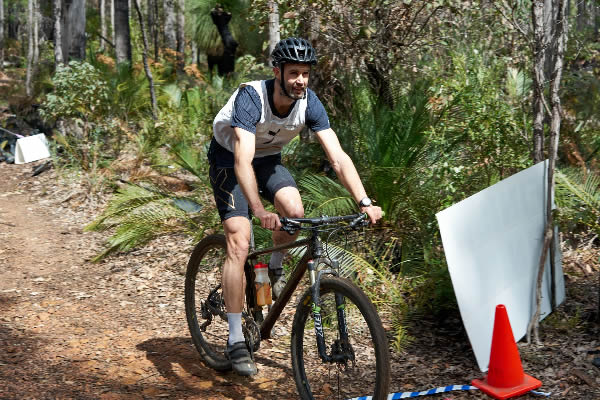
Janelle Hartnett prepared for a real nasty course.
Photo Brendan Welker.
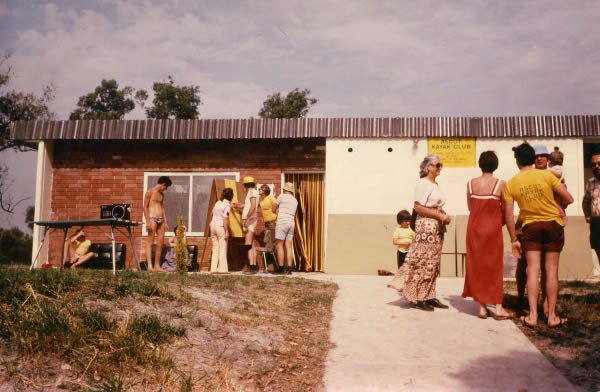
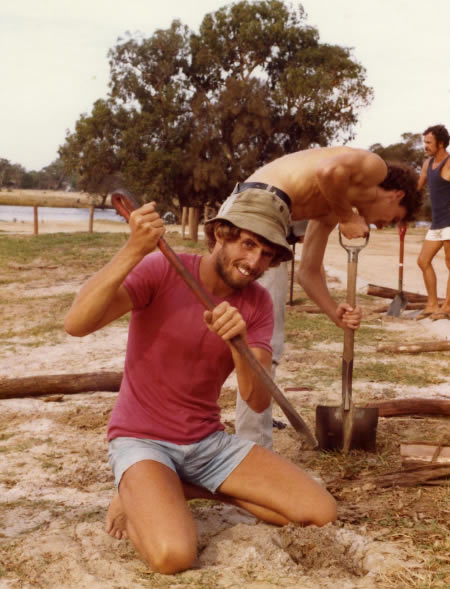
The first club house 1978
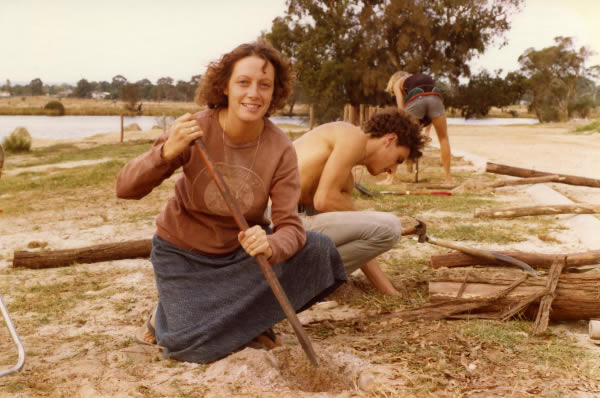
Jenny digging holes to put in poles.
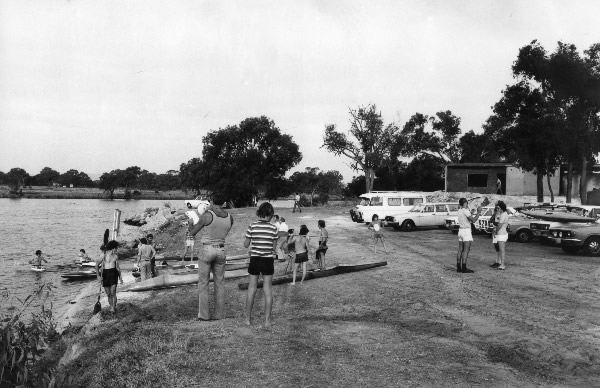
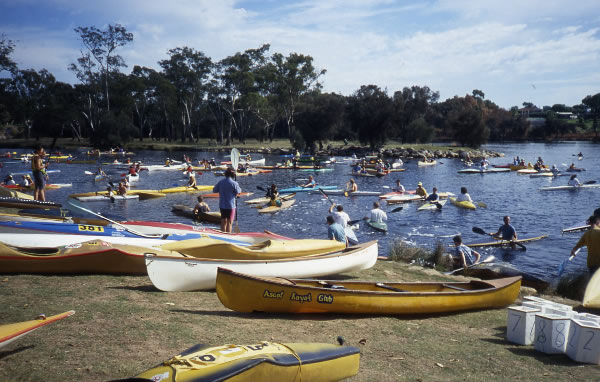
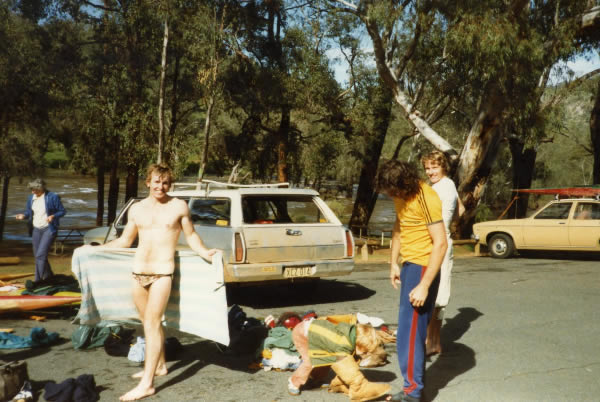
An event in the early days.
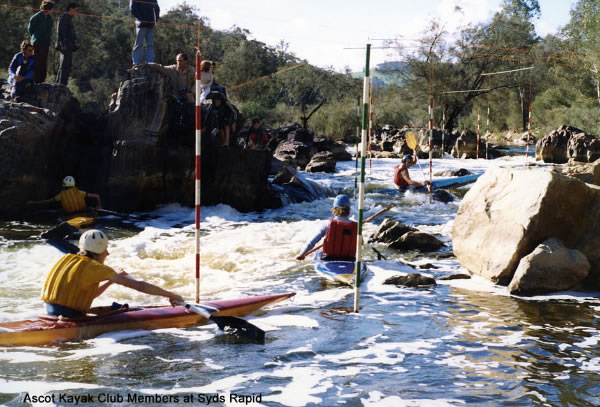
Peter Robinson, I think Lindsay Binning and Mark Vucak,
three of Ascot top slalom paddlers.
Slalom event at Syd's Rapid.
|
Kimberley Kayak Expedition #5
Tuesday 7th June
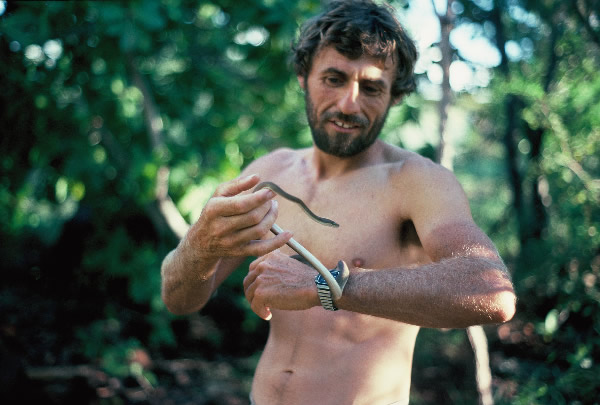
We couldn’t have stayed with a nicer, easy going couple but it was time to get back on the high seas. Before leaving though we found a small python lying in the bird bath, just another wild creature that they have in their garden.
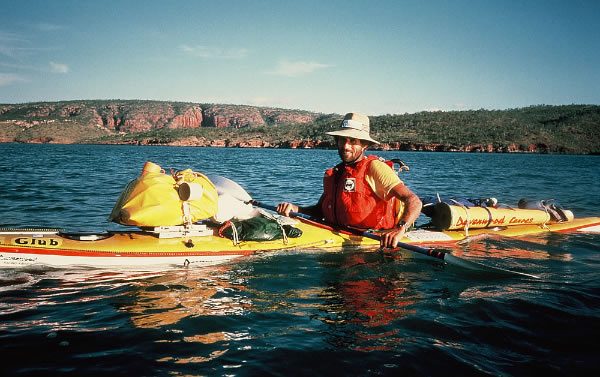
Lee had baked us a giant fruit cake but we had no room inside the kayaks so it had to be placed between Ewen’s legs. I had the large Flying Doctor Radio between my legs and if you have seen a Nordkapp Kayak you will know that it has a very small cockpit so it was very tight to get in and out.
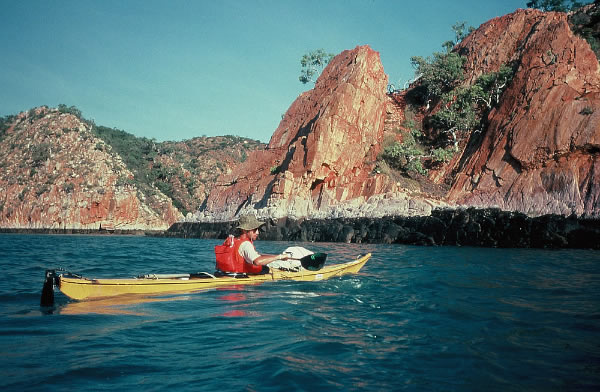
We pushed away from Koolan Island with the tide helping us along, leaving white bellied sea eagles hovering. Six hours later we made camp on a small beach opposite the Traverse Islands. At dusk Ewen was still walking around
in his shorts so he was being savaged by mosquitoes. He hadn’t taken the opportunity of washing in the light, so it was dark when he strolled down to the beach which wasn’t a good idea in the Kimberley. It was warm, the water was lapping gently into our cove and although it was probably a perfect evening nothing could be seen lurking in the dark shadows of the ocean. For Ewen the crocs were out of sight and out of mind. When he returned to camp I politely warned him again about the dangers or
going down to the beach for long periods and to always wash away from the water, especially at night.
It was Ewen’s first trip to the Kimberley and we had only been paddling for about ten days so he was still finding his feet although his kayak has been hit by sharks twice already.
It’s not just crocs and sharks that are a worry, small things, like infected sand fly or mosquito bites, or a cut by coral can turn into a major problem. We had to think about blisters or cuts on our hands, just little
things that can ruin our chances of finishing a trip.
As Ewen listened to the old man giving him advice, a rocket flare near Koolan Island lit up the sky. Somebody must be in trouble but we could do nothing. I tried my flying doctor radio but I couldn’t make contact, so we had to wait for the following morning to inform the authorities about somebody was possibly dying out there. Our concern was not needed as there had been a flare demonstration on Koolan Island.
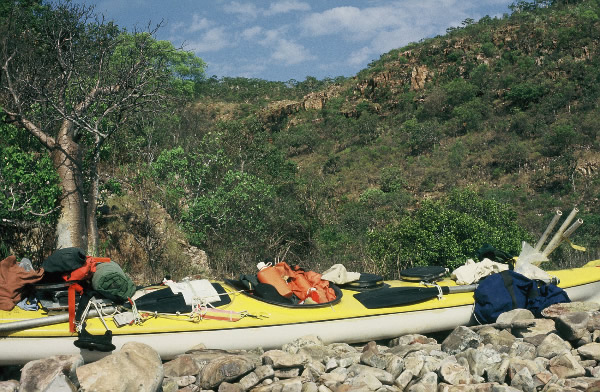
A small python found in a bird bath.
Ewen along the coast after leaving Koolan Island.
My kayak was loaded down with little freeboard.
On June 8th
With 200kms of our 700km paddle behind us, Ewen and I toiled against large relentless waves, south-east of Koolan Island. When it was time for our first drink I stopped and had a guzzle, then something rammed my stern
leaving a big splash. It was probably a shark.
The sea were becoming rougher so it was a pleasure to be close to an island after battling the elements for 3 ½ hours. Exhausted, we paddled in silence along the rocky shoreline slowly creeping towards a semi-circular
pebbly beach both eager to step ashore to have lunch and rest.
Suddenly with no warning there was an enormous splash close to Ewen’s kayak. I glanced over and was confronted by the most chilling sight. The open jaws of a crocodile were gripping the stern of his kayak. “Croc paddle
fast”, I bellowed. Ewen let out a shout of terror and accelerated.
The croc released its grip but the respite was short lived, seconds later it exploded from the water and struck again, its open jaws bent on crushing the kayak. My rifle was strapped on the back deck in a watertight case so
it was of no use and if I turned around in the cockpit, my unstable craft would capsize, then I would be in deep trouble.
It was terrifying and I was helpless to assist my friend. The predator’s jaws were locked around his kayak’s stern. It lifted its head high out of the water and, with a tilt, tried desperately to put the kayak into a death
roll. Looking at this horrific sight fear was shaking my body, I was icy cold, and my heart raced out of control. My mind tried to refute what my eyes were seeing, but this was no Jaws movie or Crocodile Dundee, it was real.
Ewen never looked back to glimpse his predator but he felt its strength. His arms pumped like windmills and his kayak, although heavily laden, ran swiftly through the water. The croc lost its grip again and disappeared
under the murky water. Several frightening seconds ticked by. When or where would it attack next?
I now had to pass the area where the croc had submerged so I was now concerned for my safety and in my mind urged Ewen to come back as it was his croc.
By now Ewen was several metres in front of me and as I sliced past the crocs foaming waters, I paddled hard to reach the waves breaking over the sandbar ahead. I continually scanned the water behind expecting the croc to
attack again. Minutes seemed like hours. I still had the thoughts, would the croc attack me next?
After paddling 2 kilometres out into the open sea, Ewen finally allowed me to catch up with him. He was badly shaken so I tried to turn our frightening experience into a light hearted joke as we still had 3 weeks and 500
kilometres to paddle and we had no option but to keep going!
I have spent over 200 days kayaking in these dangerous waters and I have been chased by crocs on several occasions, but this was the first time that one had actually attacked. It was only last year in 1987 that Ken Cornish
and I had been at the head of the Prince Regent River when a tourist, Ginger Meadow who was on a tourist boat was taken by a croc, and this year it was nearly our turn! She was swimming to a boat from a waterfall at the time.
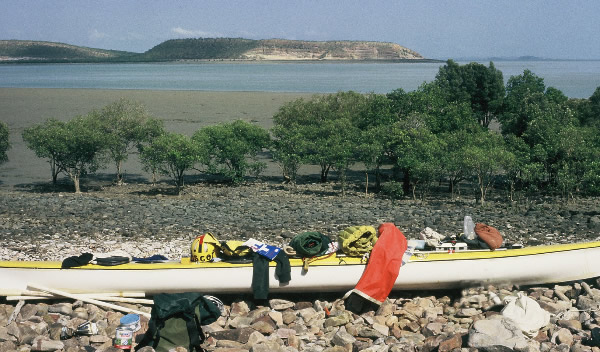
We paddled through the mangroves to our campsite.
In the far distance, about 22 kilometres our destination shimmered in the heat haze. Walcot Inlet, the home of the giant whirlpools was four hours away and with the previous stresses of the day it was going to be a hard
paddle. As we approached the inlet we encountered driftwood, carried by the rising tide, which was hard to distinguish from crocodiles. Our campsite lay ahead. I pointed to a boulder strewn beach partially hidden from view by extensive mangroves.
We suddenly focused on a mangrove bough that jerked into the water ahead of us. “Oh no, we’re not going to camp here”, Ewen shouted. It looks too much like croc country. Looking west towards the sun disappearing behind
Fletcher Island, I said, “it’s too late, there is no other campsite nearby”. With 150 metres to go, we raced through the gap in the mangroves and struck the boulders and quickly jumped out. Convinced a big saltie was in the area, I gingerly waded into the murky water, unstrapped my rifle and we took it in turns to stand shotgun as we unloaded the kayaks.
That night after the attack, at our campsite at Walcott Inlet, I told Ewen a story about a kayak trip down the river Nile that I had read about.
….One night a croc was attracted by some meat being stowed in the kayak and tried desperately to get it out. Unsuccessful , it returned to the water, but had left a musky scent on the boat. The following day, the kayak
was attacked several times. It is believed that both sexes use the musky secretions to locate and attract each other….
After telling Ewen the story, he scrubbed around the scratches made by the crocs teeth, very thoroughly! No amorous crocodile was going to mistake his boat for a possible mate! A huge tree trunk that was bumping the cliffs
and water lapping into rock crevices, echoed around the cove throughout the night.
From my place to the Matagarup Bridge is nearly 11 kms by river.
9 kms by road.
Matagarup Bridge
The stadium is going to be the focus of the footy finals.
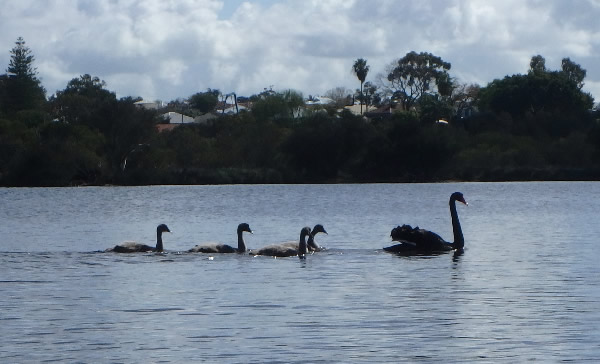
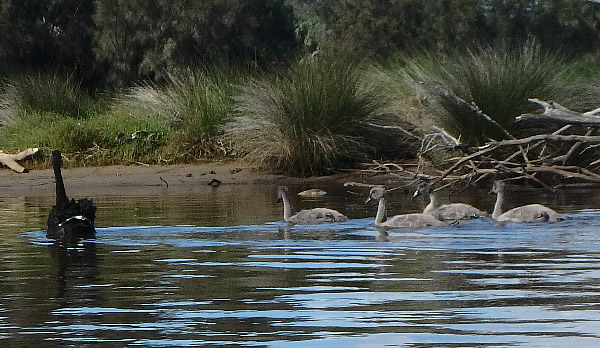
Mother Swan with four cygnets.
Black swans reach sexual maturity when they are about two years old. Most start breeding in their third year. Breeding can take place all year but usually occurs between February and May in tropical climates and between May and September in the cooler temperate climates.
While younger black swans may be promiscuous by having many partners, older black swans are monogamous, a male and female pairing for life.
The female lays between three to nine pale green or greenish-white coloured eggs. Until the full clutch of eggs is laid, the parents sit on the eggs to protect them but do not incubate them by warming them. Once the final egg has been laid, both parents share in the incubation of the eggs which take between 35 to 45 days to hatch.
Young swans are called cygnets. They are covered in soft grey-brown feathers for the first three to four weeks of their lives before their black feathers begin to appear. The young cygnets are looked after by their parents for about 9 months. Cygnets sometimes hitch a free ride on their parents' backs, especially when travelling in deep water.
NORTH FORK, NY — Two rare Australian black swans saved from a Southold Creek in July were brought to their forever home in North Carolina this weekend.
The black swans, because they were domesticated and were likely abandoned by whoever owned them, were unable to defend themselves against wild swans that were attacking them, neighbors said.
The black swans, he said, were not indigenous to the area and were likely raised in captivity, Di Leonardo said. Australia also has a very different climate, he said. "Come winter, they'd be dead. But they'd likely have been dead before that. They don't know our natural predators and they don't have a healthy fear of humans, as they should."
But many neighbors worked together to save them, grabbing their kayaks to help.
All were brought to Skywatch Bird Rescue, a not-for-profit dedicated to caring for abandoned or injured birds, where, Di Leonardo said: "These magnificent animals will have acres to roam and socialize with members of their own species, be provided shelter and veterinary care, and be loved and cared for— and never exploited for their flesh or entertainment."
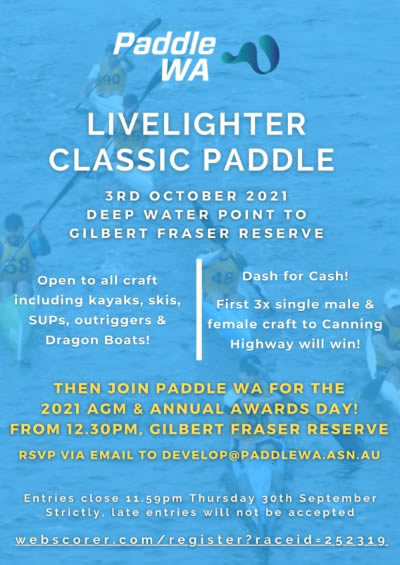
Entries are now open for the
2021 LiveLighter Classic Paddle!
https://www.webscorer.com/register?raceid=252319
Sunday 3rd October
Deep Water Point to Gilbert Fraser Reserve
Check-in from 7.30am
Life jackets are not compulsory but are recommended.
Once again, Royal Life Saving Society WA have kindly sponsored the Dash 4 Cash for the first 3 male & female craft to reach Canning Highway! First place will win $150, second place wins $100 and third wins $50!
To win you must:
– complete the entire race
– be paddling a single craft (K1, S1, LP, outrigger etc.)
– attend the presentations
The 2021 AGM & Annual Awards will also be taking place after the Classic Paddle! Anybody is welcome to attend and will be commencing from 12.30pm at the North Fremantle Football Clubrooms! RSVP via email to develop@paddlewa.asn.au
|
|
|
|
|
|
|
|
|
|