|
|
|
|
6 Weeks Paddling = 1020 kms.
208 kms this week
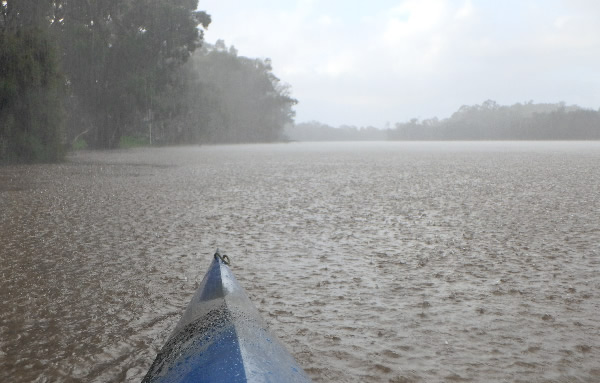
Wind, Rain, Cold, High Tides and a river current to paddle against.
I stepped up my mileage this week paddling 30kms most days. It was certainly a week to remember. I can’t think of any time that I have been so wet. (Maybe Canada 2019). Thanks goodness I have lots of thermals and warm weather gear because virtually every time I paddled it
rained.
So in 6 weeks I have paddled my first 1020 kms, 208 kms this week but I still have 6000 kms to go and I imagine we will be in lockdown again before long which will limit me to 11 kms a day.
So for the last 42 days, apart from the 4 lockdown days I have paddled 20 to 33 kms every day. I’m 160 kms ahead of my 6 week target but that is only 8 days ahead of schedule and there is a long way to go.
I’m hoping it will be easier in summer.
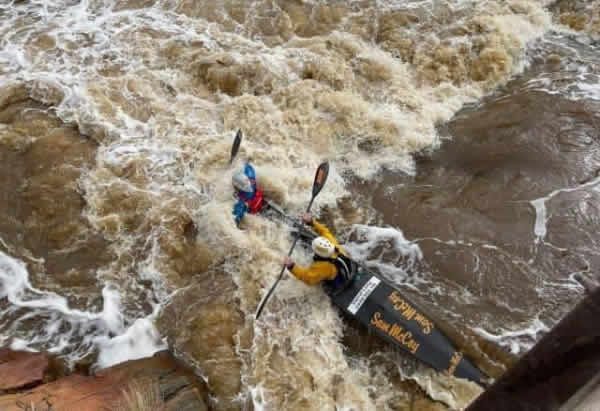
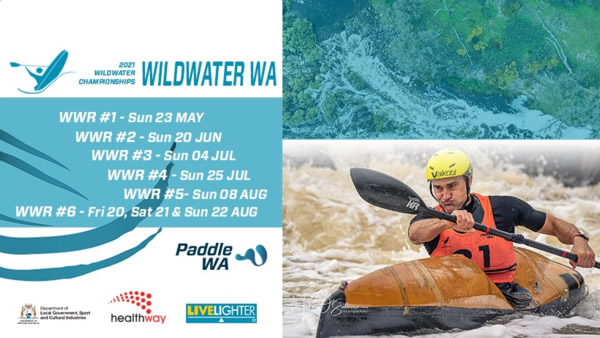
Be careful out there if you are paddling white water.
The river has some big rapids - don't dice with your life.
- Will It Ever Stop Raining
- The Avon River Has Risen
- Sad News
- Kimberley Kayak Expedition #6
- Coming Events
- Products
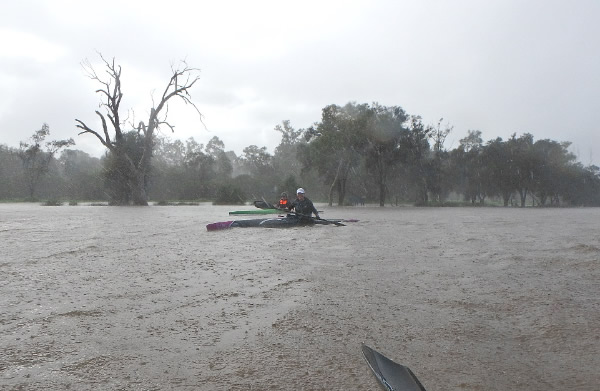
It's been a wet week. I still paddled 208 kms.
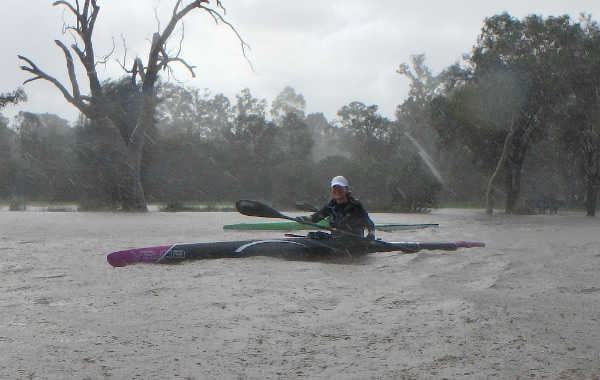
Anne Couch, Jane Liddle and Erica McNight enjoying the wintery weather!
Anne loving the weather but eager to go back to the club for coffee and cake.
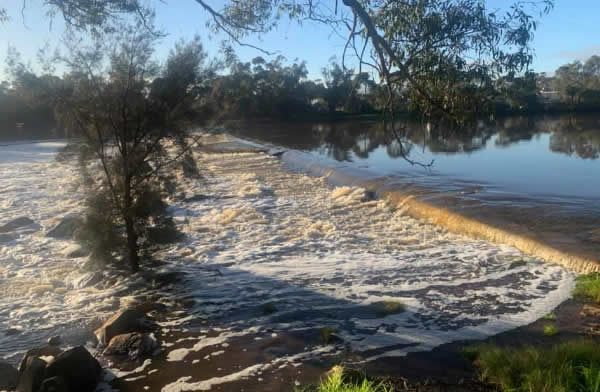
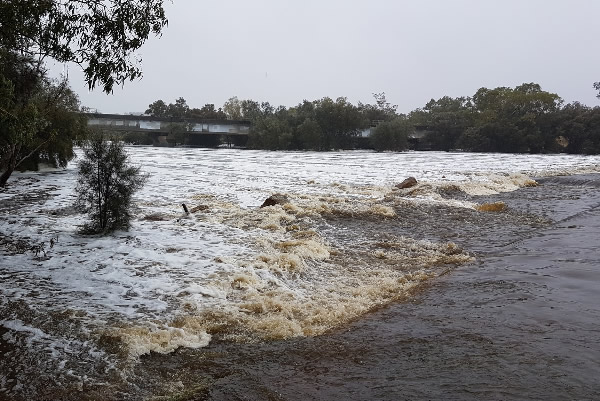
Northam Weir
Photo Helen Andrew
Northam Weir getting higher.
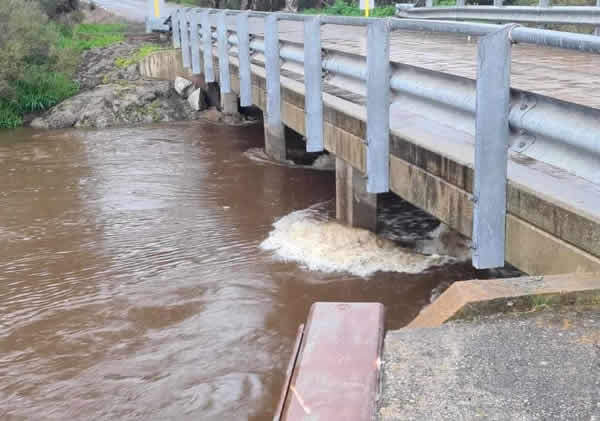
Katrine Bridge Wednesday.
Photo Steve Bolger's friend.
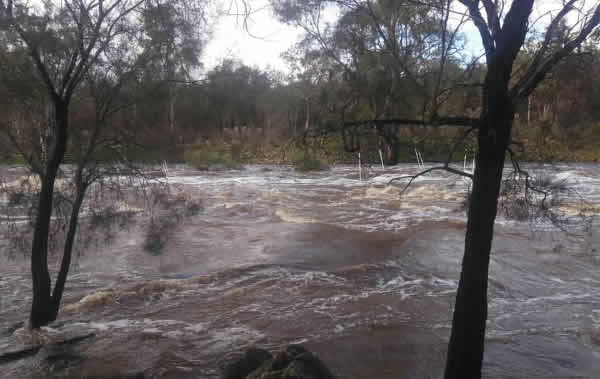
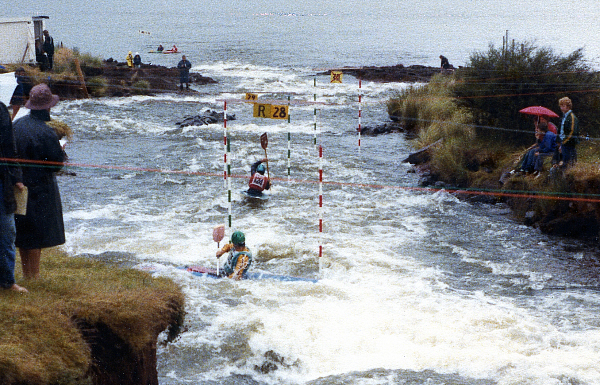
Slalom course at Walyunga.
Photo Trevor Bulley
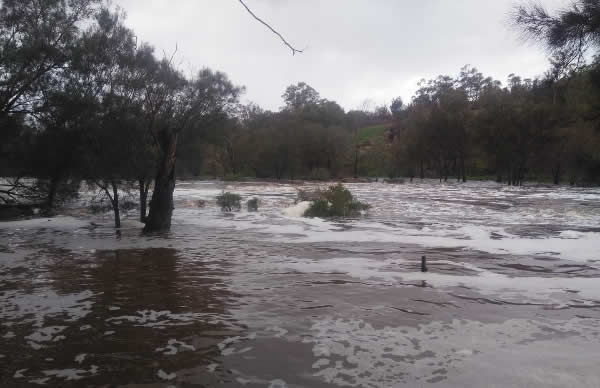
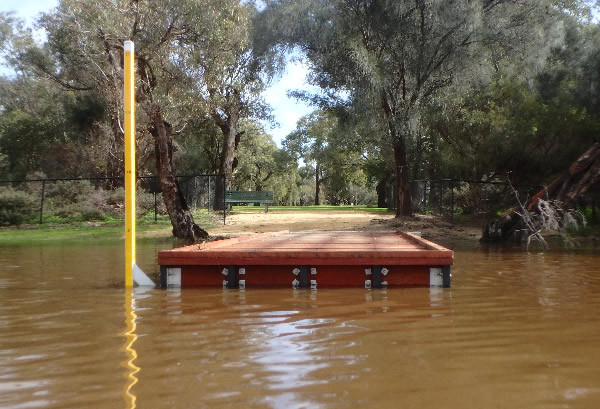
Walyunga Lower Pool. Thursday.
You can just see the top of the post.
About 2.2 metres.
Photo Trevor Bulley
Darryl Long and Spencer King taking on Bells Drop.
About 1.6 metres.
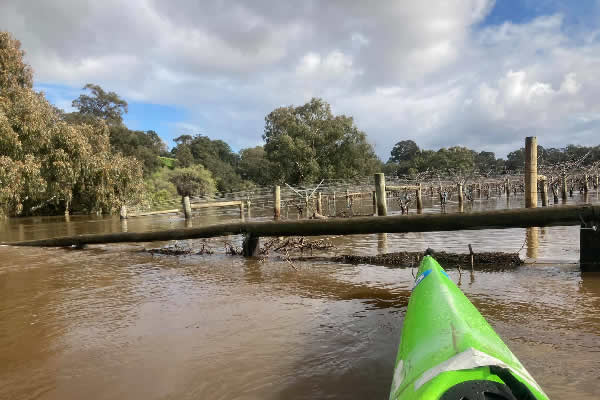
The wine yards at Upper Swan are being flooded.
Photo Jane Liddle.
Paddler Drowned
The President of the Association said, “We have lost one of our most notable members who gave so much to our sport”. “He will dearly be missed”.
Last weekend Alfred Cocoban, 55 was on a paddle when he suddenly capsized after having what is believed to have been a mini heart attack. Members of his party who were coming up behind him saw Alfred capsize. At first they thought nothing of it, it happens, then they saw him struggling and sink underwater and out of sight. He wasn’t wearing a lifejacket.
By the time the group got to him he wasn’t visible. Two paddlers jumped out of their kayaks and dived in to try and find him. Other paddlers were quite frantic. They searched and eventually one of the swimmers saw a flash of colour in the murky water and was able to grab some of his clothing. It was a struggle for the two swimmers in the water to get him to the surface as
they weren’t wearing lifejackets either. Eventually they managed to get him to shore.
Several minutes had past by the time they got him to shore and started CPR. They worked on Alfred for a long period, but eventually they realised there was nothing more they could do to save their friend, he was gone.
Authorities said if he had been wearing a lifejacket Mr Cocoban would most probably have survived. The life jacket would have held him up and although he might have been weak he would have had the chance of keeping his head above water and alive. His rescuers would have been able to assist him, had he not gone under.
Family and friends were devastated.
Please Note: This is just a fictional story, but it could happen. Are you prepared? Is it best to wear a PFD?
Lindsay Binning and Mark Vucak paddling at Brady's Lake, Tasmania in 1979.
Kimberley Kayak Expedition 6 –
Kimberley Revisited
After paddling around the Kimberley coast for a year in the 1980s on four trips, I was dying to revisit it again so in 2002 it was time to head north once more. The Kimberley is one of the most special places in the world, it has its many dangers and its rewards, but it’s not for the faint hearted.
On other trips I have paddled the Kimberley solo or with one other person but this time there were going to be 6 of us, Pam Riordan, Tel Williams, Gary Nixon, Don Kitson and John Dinucci.
Having paddled this area several times before and having spent a year paddling along the Kimberley coast on different trips, I became the leader. Although every member of the team were experienced paddlers, knowing the area did have its advantages. Not only were we going to be paddling in the ocean we would also encounter some huge tidal rapids.
Three of the members, Don, Gary and Tel were sea kayakers but hadn’t had much white water experience, whereas Pam had a lot of white water experience but hadn't sea kayaked a lot. John was an excellent whitewater paddler, an excellent sea kayaker and was as fit as a bull. So it was my job to lead and John’s job to bring up the rear and make sure we were all together in a pack.
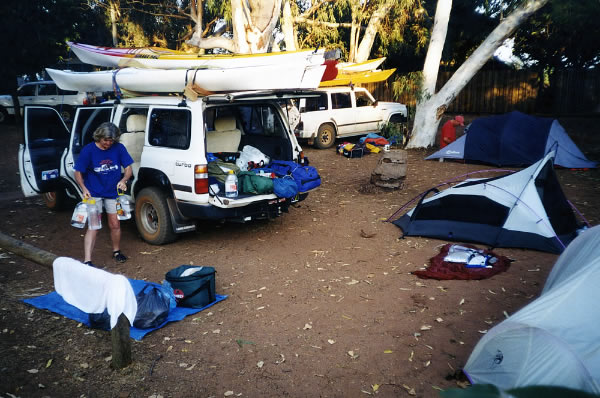
We drove from Perth to Cape Leveque 2420 kms north, where we made camp before starting the trip. At 5.00am the next morning we emerged from our tents, it was already light and a chorus of birds were singing away. I could hear snoring beside my tent and it was Don, who had said the night before that he was going to have the billy boiling for us when we rose. When he eventually woke up he said, this is not usual, I never sleep in. It must have been the Kimberley
air.
We slowly had breakfast taking in the early morning warmth and the wildlife singing and twittering that we never hear in Perth. The palm trees rattled and the red dirt and cliffs along the coast gave us another indication that we were far from home. Part of the 1970s and 80s the Kimberley had been my home. I had worked in Camballin, on an irrigation station in 1973-74 and spend over a year doing my trips in the 1980s so things were more familiar for me here than
the others.
The time came when we filled our water bottles, paid for the campsite and motored down to the beach to unload the kayaks. The tide was well out and sand packed firm so the cars had no trouble gaining traction. Don, Tel and Gary were packed first and sometime later we were all ready to go. The cars were taken back to the campsite and we seemed to wait forever for the drivers to return. With the tide coming in fast we had to pull our boats back up the beach so they
didn’t get swamped.
At last we were away pushing against an easterly wind. The shoreline at this point was a long line of sand dunes, nothing too inspiring but it was the turtles that were keeping our interest. Swan Island from afar seemed joined to the mainland, but as we closed in a small gap started to appear. Swan Point opposite was low with a small rocky cliff. The current in the middle of the channel was moving pretty quick and we were soon to join it. The current raced swiftly
over a rock shelf creating some good sized standing waves which splashed over our decks. For a bit of fun we started surfing some of the waves.
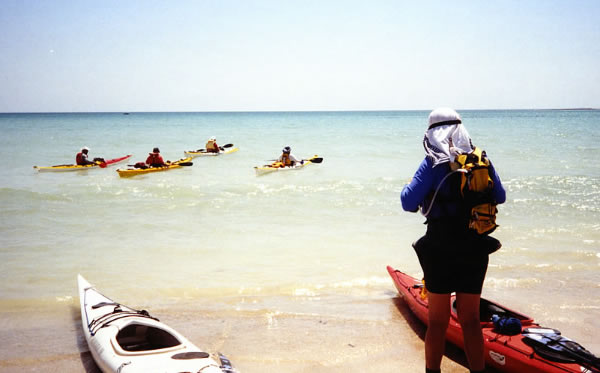
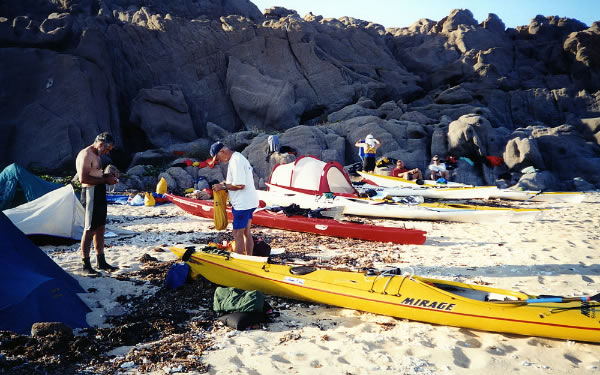
Taking off from Cape Leveque.
Once out of the channel we were in the notorious King Sound. Ask any skipper that has been in this area with a boat or yacht, the King Sound is not to be messed with. With the second highest tides in the world, attaining over 10 metres in height and gathering speeds well in excess of 15kms and hour and faster around the islands and reefs it can be like paddling a huge rapid river, but on a much bigger scale. To make it even more exciting these tides have two
high and two low tides a day so every 6 hours the tide changes.
To make for a safer passage it’s best to paddle in this region when the tides are on neap, when there is less movement in the tides and the current is slower, but it’s not always that easy to plan to pass over all the tricky spots on neap tides. We were about to cross the King Sound on neap tides but on our return back across the King Sound we would be up against the spring tides which means the water movement is the highest and fastest. Not only that we will be
crossing back on the highest of the spring tides in that year, so it doesn’t get any stronger than that.
Once we rounded Swan Point and looked south into the King Sound there were a large scattering of islands which we were going to make our way through by the way of Escape Passage, to get to East Sunday Island. Escape Passage was named by early explorer Philip Parker King who was caught in the strong tides in his sailing ship and incredibly managed to manoeuvre through the passage and escape.
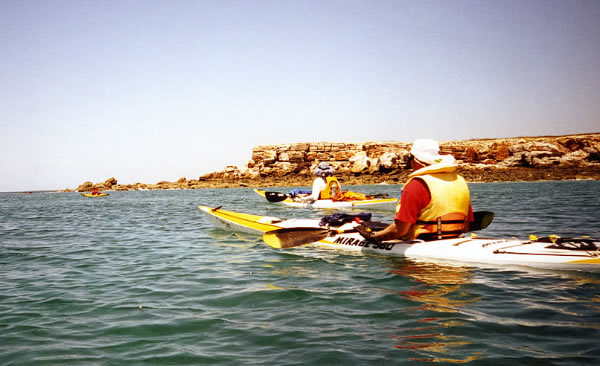
Moving around Swan Point and into the King Sound.
We paddled off in calm conditions side by side. I kept checking behind and although we were moving forward Swan Island seemed to take a long time to get away from. The current at this point seemed to be against us but a little later crossing over to Talboys Island the current started pushing us across to the south west and it was accelerating faster the closer we got to the island. Over to the east of us the current was punishing the rocky outcrops that looked as
if a boat was stranded on them but turned into being orange and white rocks.
The deeper we paddled into Escape Passage the quicker we moved along. Beaches on Tallon Island looked inviting so Pam suggested having lunch there, but the current was now too fast for us to cross over. Instead we paddled towards the island further south and got swept along at a terrific pace. We kept close to the shoreline so as to not get swept away and then we paddled into an eddy at the south end of the island to gain the safety of calm water.
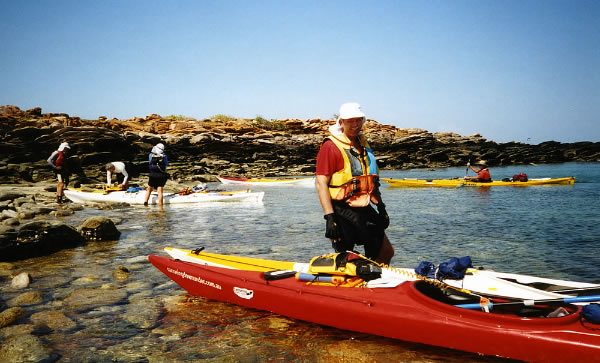
With the current being so fast it was interesting watching all the others spin into the eddy. The team was excited with the speed of the current and to think we were experiencing it at its slowest. A sheltered rock bay at the end of the island made a great place to have lunch. We pulled up to the rocks and let the boats sit there and just drift. Nearby a beach curlew and two oyster catchers were noisily moving among the rocks and probably a little annoyed that we
had invaded their territory.
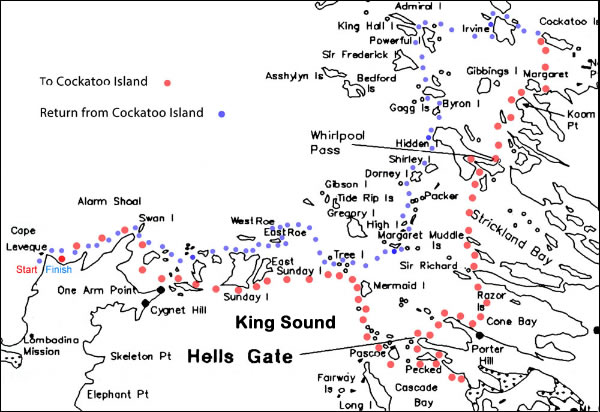
Red dots are our route over King Sound, blue dots are our way back.
About 20 minutes later we were on the move again crossing over to an island west of Sunday Island. We kept closer to the islands so as to keep out of the faster current that might drag us into the open, island-less part of King Sound. We had a spot on a hill to head for, but it seemed that Don had decided on another spot as he started heading more over to the west and further into the fast current. Nearing the small Hancock Island Don joined us and we soon all
scooted towards the south west tip of Sunday Island.
Near the tip a rocky outcrop stood in front of us and the water was rushing through a narrow channel. I advised the crew to take the longer route around the rock but John, Pam and Gary decided to have more fun so went between the rock and the tip just missing a large boulder that was partially hidden underwater, which they were unaware was there, until they looked back. It could have been disastrous if one of them had hit it. This narrow escape and the last few
hours of paddling the swift currents had been a learning experience for the group and being so isolated I think everyone realised that they had to take even more care to ensure a safe trip.
Being in the shelter of Sunday Island and out of the main current we now focused on East Sunday Island and our campsite. The wind suddenly picked up as a dingy with four Aborigines on board flashed by waving. We arrived at the campsite, which had a steep beach and a sandbar just west of it and the beautiful rocky backdrop that gave our camp a great feel. With the tide being fairly high we didn’t have too far to carry our gear, although the coarse sand and lumps of
coral made walking a little uncomfortable.
We settled in and climbed the ridge to look at the swift current between our island and Mermaid Island 15 kms across the channel. Later we drank a cup or two of wine, helped down with tuna and tortilla’s with parmesan cheese, followed by home dried apple and custard that Pam had provided.
As the stars shone bright we sat and talked developing a special friendship and admiring our surroundings. We went to bed early just after 8.00pm. It was a hot night.
Camped on East Sunday Island.
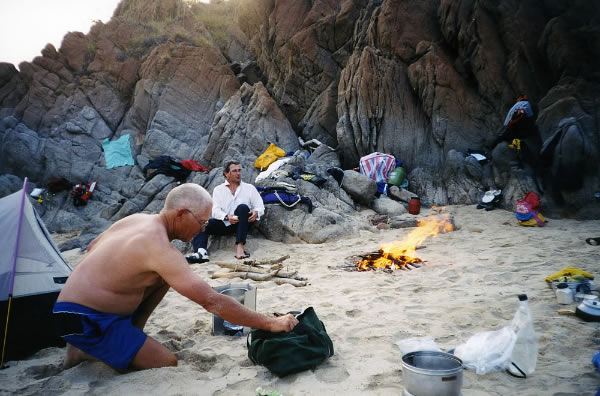
Don and Garry enjoying the evening around a campfire.
A little wine was drunk.
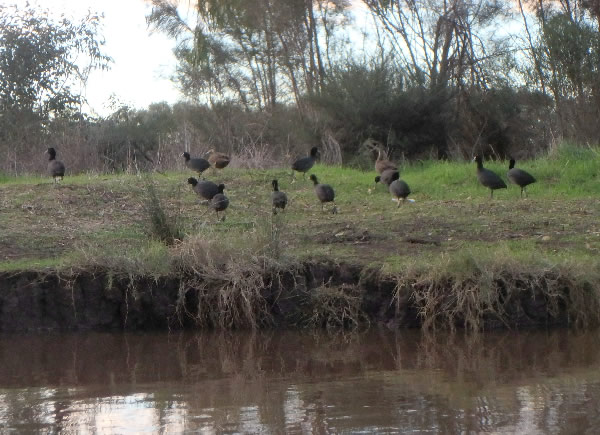
A group of coots.
A lot of birds have been in hibernation in these wet stormy days.
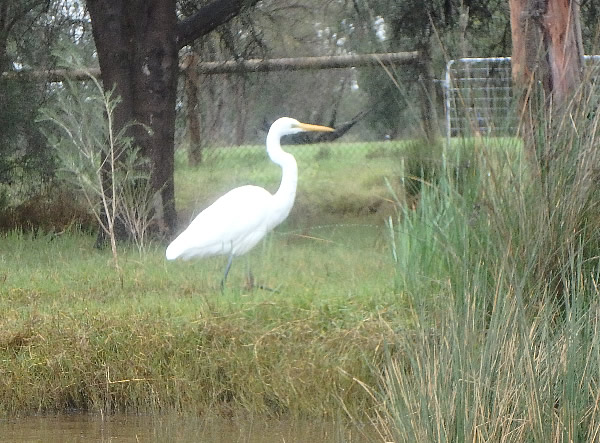
An Egret doesn't mind a wet day.
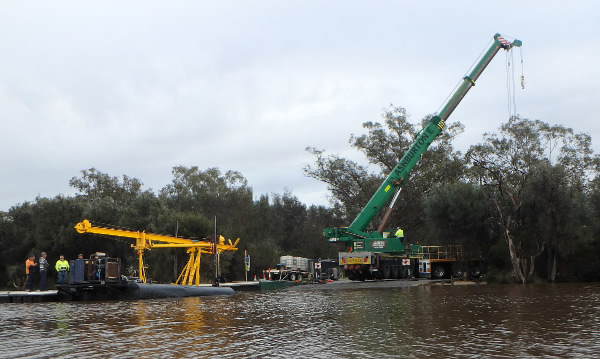
The new jetty at Sandy Beach on a fairly high tide.
The barge that constructed the jetty being loaded back on a truck.
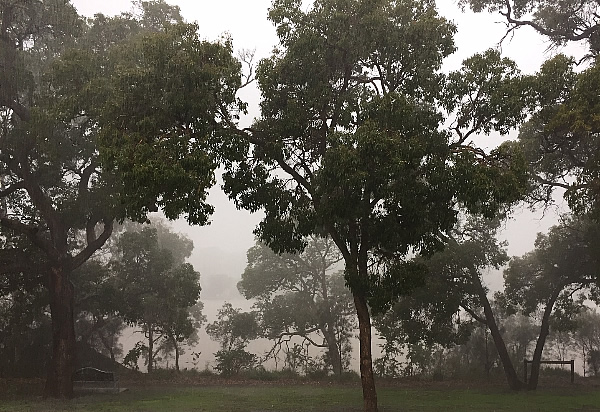
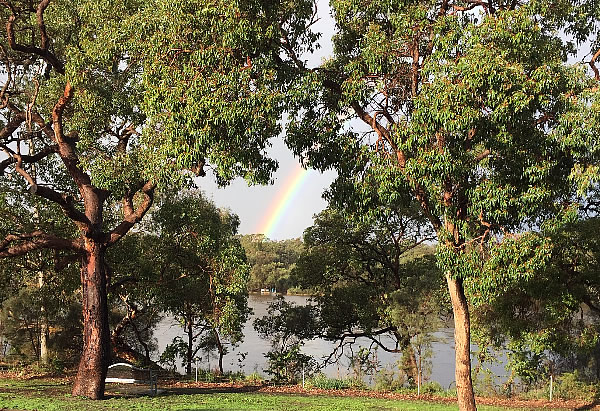
Typical Weather This Week
Most of the week has been wet and not very inviting to paddle.
But at times the weather did get better for a short time.
IOP Winter Race #2
entries open
Saturday 24th July, out and back from Sorrento SLSC 8-10kms, plus a short course as well. (PFDs and leg leashes required)
7am Start - Registrations from 6.00am
Breakfast available at surf club after.
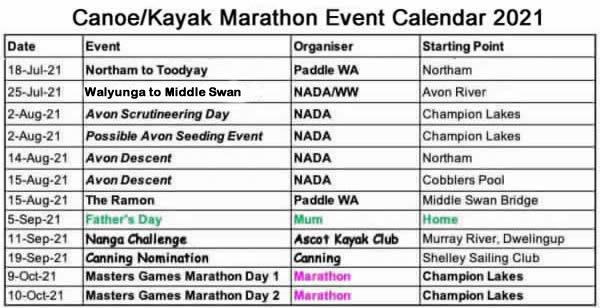
2021 Walyunga to Middle Swan
SUNDAY, 25 JULY 2021
Walyunga National Park Top Car Park
Top Carpark (Boongarup Pool), Walyunga National Park
Local park fees apply
Registration: 8.00am - 8.45am
Briefing 8.45
Race Start 9.00am
Starting from the long pool at the top carpark in Walyunga National Park, and racing downstream 24km to Middle Swan.
Competitors will receive a split time from the bottom of Bolland's Elbow (Bells Rapids) and a timed result and ranking at Middle Swan.
Safety: Due to the course being held across wildwater conditions, it is compulsory for all paddlers to wear helmets and PFD’s.
Seeding Points: Avon Descent Seeding Points are awarded as per the 2021 rules available at 2021 Paddler Seeding.
All competitors will receive 5 points for participation when completing this event.
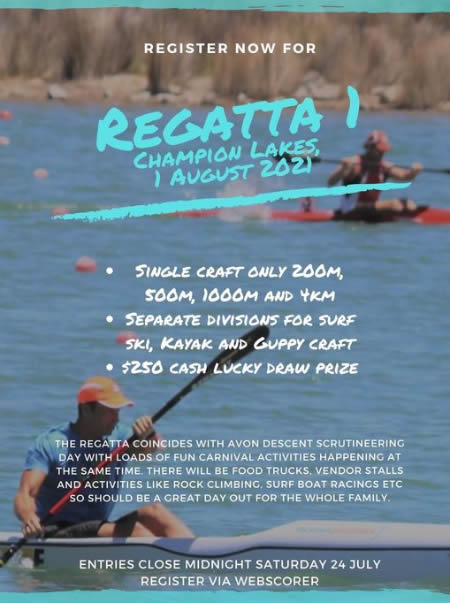
Paddle WA Live Lighter Sprint Regatta #1 -
2021/2022 Season
Champion Lakes Regatta Centre
This is a Sprint distance and Long Distance Race Regatta for Ski, Kayak, Canoe, OC1/V1/Va'a Sunday 1st August 2021
Held in conjunction with the Avon Descent Scrutineering
Includes a Lucky draw prize of $250 donated by the Avon Descent
https://www.webscorer.com/register?raceid=247458
Entries close midnight Saturday 24th July - Late fee for entries after this date.
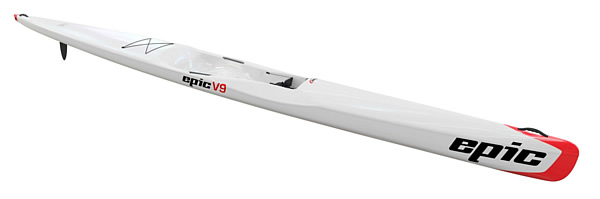
Like the Gen 3 V10, the V9 has been optimized for downwind surfing, with increased rocker, and stability. Flatwater speed is a step up from the V8 Pro due to the slightly narrower beam. This is the boat many paddlers have been waiting their whole lives for – the one that launches you onto the swells, glides
efficiently across the water, and keeps you in the “zone”.
Length: 5.79 m (19'0")
Width: 49 cm
Depth: 32 cm
Capacity: 120 kg
Ultra 12kgs
$4900.00
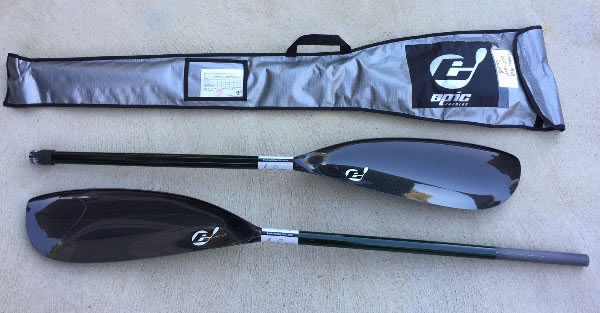
Club Carbon $460.00
Midwing Club Carbon construction - 737 grams; comes standard with Epic’s Length-Lock 2™ adjustable ferrule technology.
Carbon fibre blade, Green oval fibreglass shaft.
Fully adjustable length & feather.
Includes paddle bag.
|
|
|
|
|
|
|
|
|
|