|
|
|
|
Well it finally stopped raining on Wednesday and for once in the last two weeks I didn't go home wet, but it looks as if it isn't going to last long as more rain is on the way.
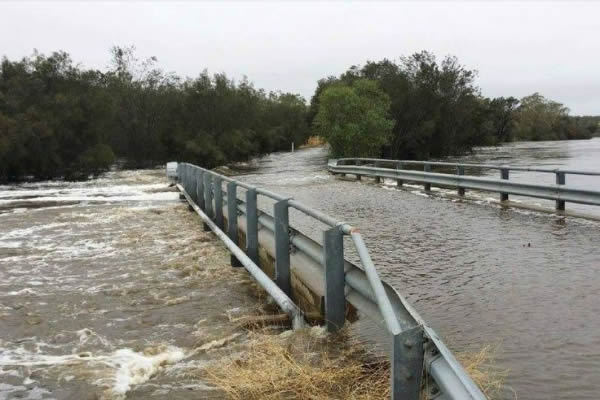
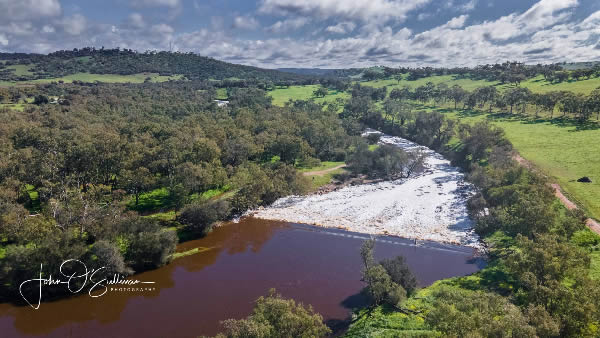
The Avon River is dangerously high at the moment with the
Walyunga NP to Middle Swan race changing venues.
I paddled 203 kilometres this week which included the Northam to Toodyay Race. So I have paddled between 20 and 33kms every day for 7 weeks bringing my total to 1223 kilometres.
Paddling for Prostate Cancer Awareness.
- Bells Rapid
- Kris & Steph
- Paddle WA School Program
- Over 45 Canoe Club
- Masters Games -Early Bird Entries Close 31st July
- Northam to Toodyay Race
- Kimberley Kayak Expedition # 6
- Amazons Perth Dragon Boat Club
- Spoonbill
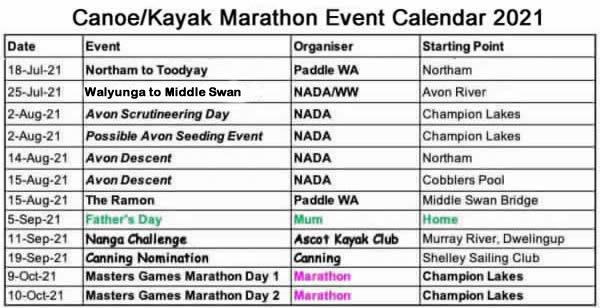
- Coming Events
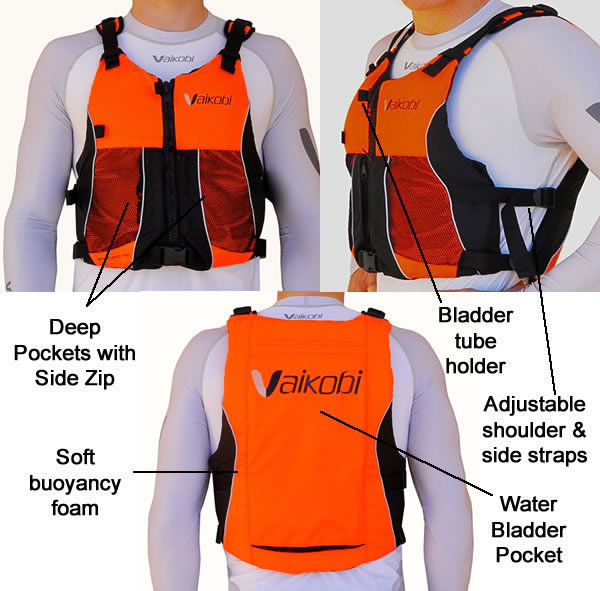
- PFD
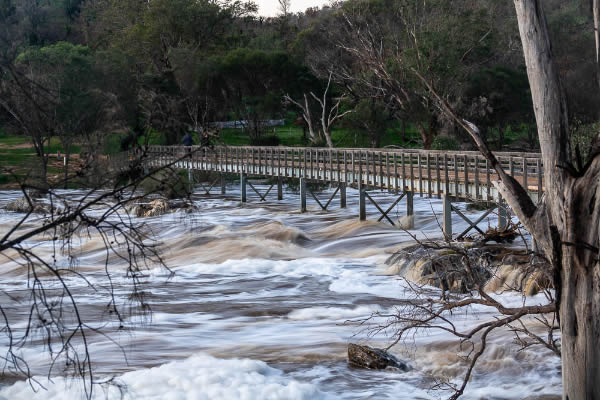
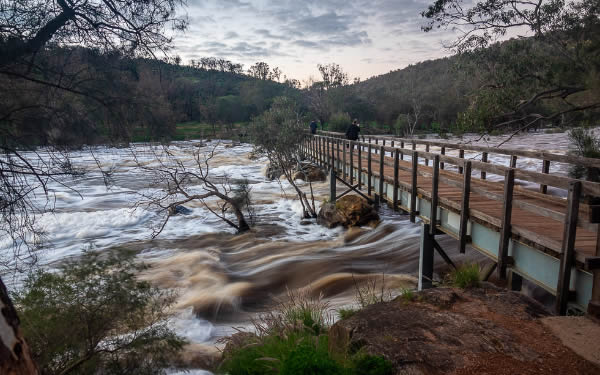
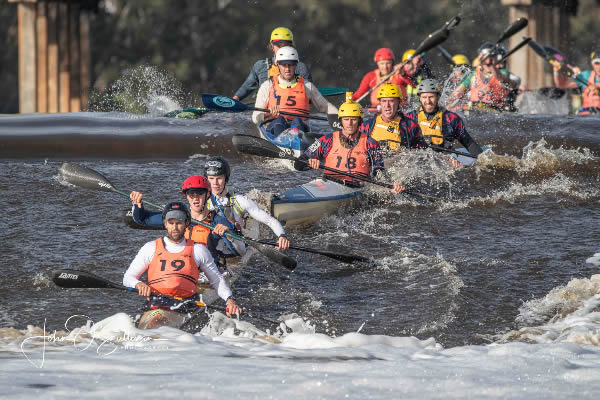
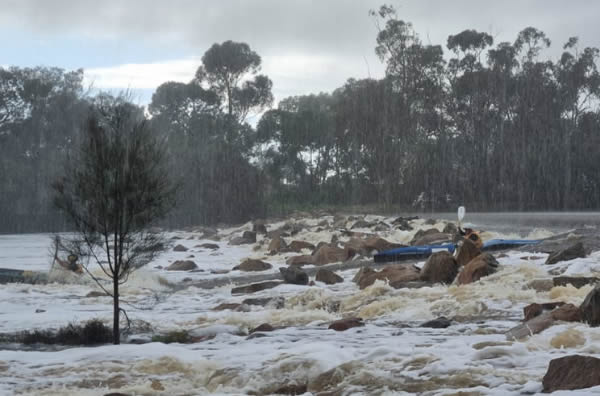
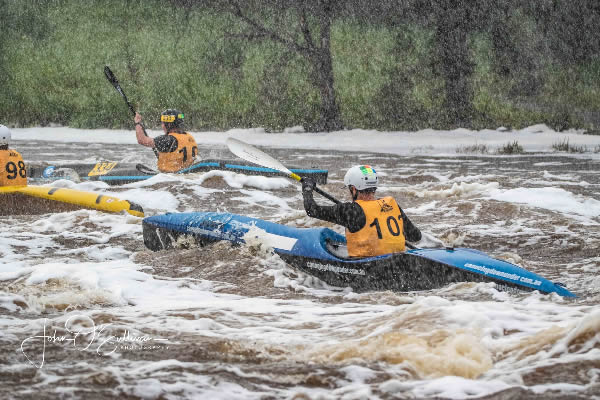
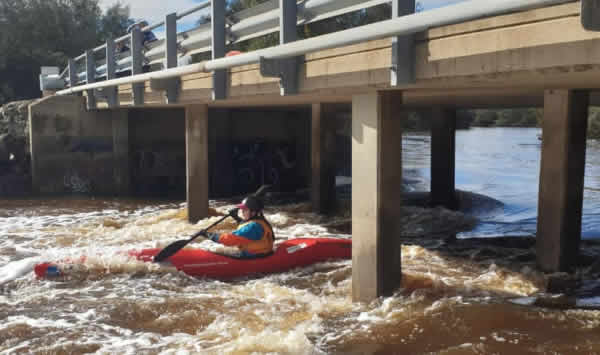
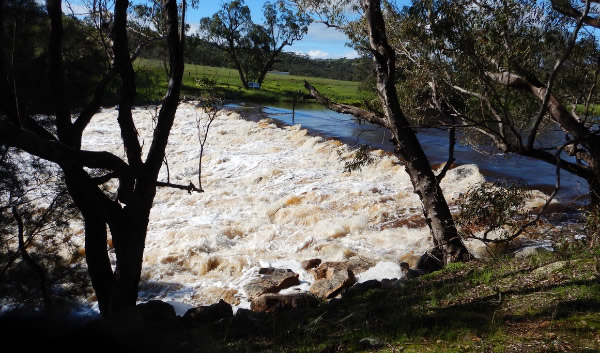
Bells Rapid yesterday (Thursday).
Photos Doug Hodson.
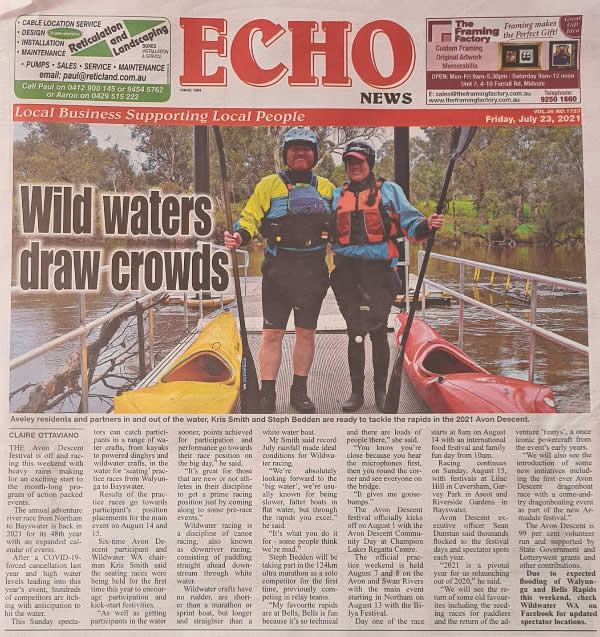
Kris Smith and Steph Bedden make the local papers.
Kris is the main organiser for the Wild Water Series
and this weeks Avon seeding race.
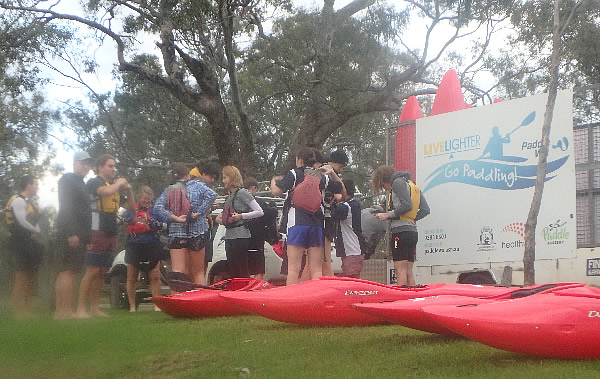
Leonie Cockman and Nicholas Greed taking out a school.
(Sorry about the moisture on lens.)
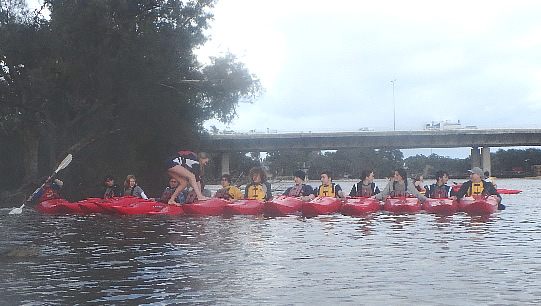
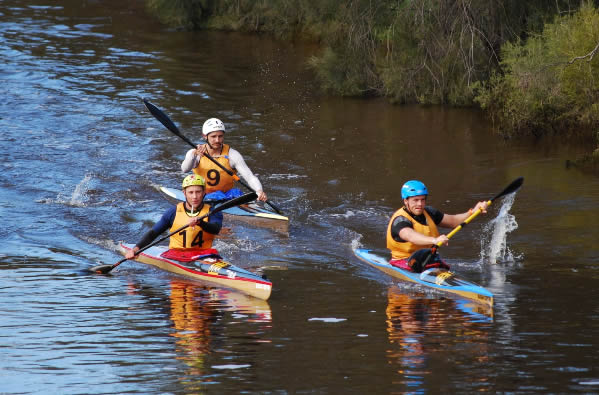
Having fun out on the water.
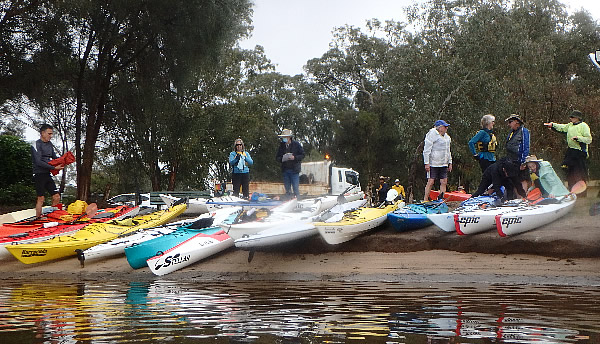
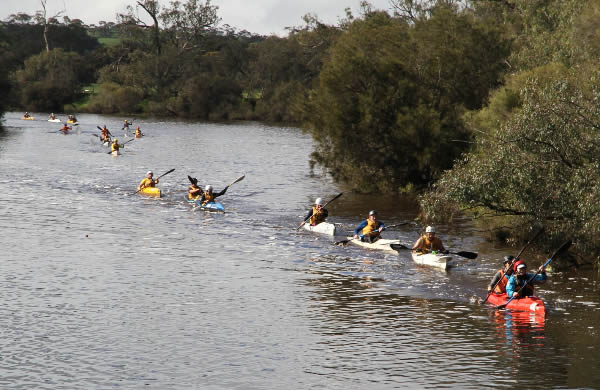
Over 45 Canoe Club about to go for a social paddle from Sandy Beach.
Masters Games
Early Bird Entries before 31st July.
*Register for 2021 Australian Masters Games**
Dates: Marathon: 10th and 11th October Sprint: 13th October
Location: Champion Lakes, Henley Drive, WA 6111
Early Bird: $115 [70+ $105] for games and $30 for Canoe/Kayak
After Early Bird $145 [70+ $135] for games and $30 for Canoe/Kayak
Early Bird before 31st July
Northam to Toodyay
Brendan Welker arrived at my home at 6.00am. We loaded our boats on my landcruiser and headed to Toodyay to meet with Tom. Having no support team, (Jenny can’t yet drive due to her arm fracture), we had to do a car shuffle. We arrived at Northam having checked Katrine Bridge to hear that the river level had gone down enough to allow us to
paddle under the Bridge which was good news and would make for a better race.
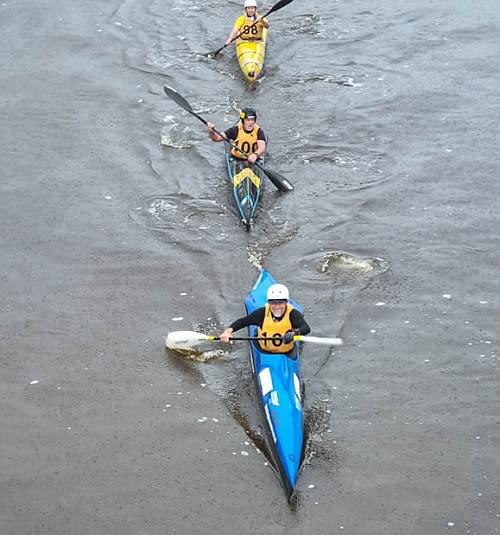
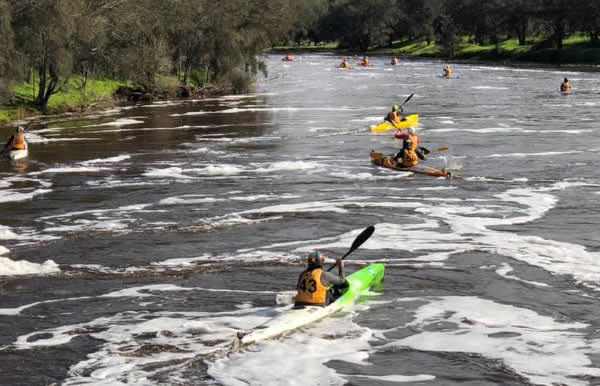
Paddlers at Northam were excited because of the high water level. Rosie and the team briefed the paddlers and the race was on, the fastest boats first, which meant the K2s. Unfortunately my class, the Wild Water Kayak was on grid 6, the last boats to go. We had a lot of catching up to do and a lot of passing the slower boats, in fact I passed over 50
boats.
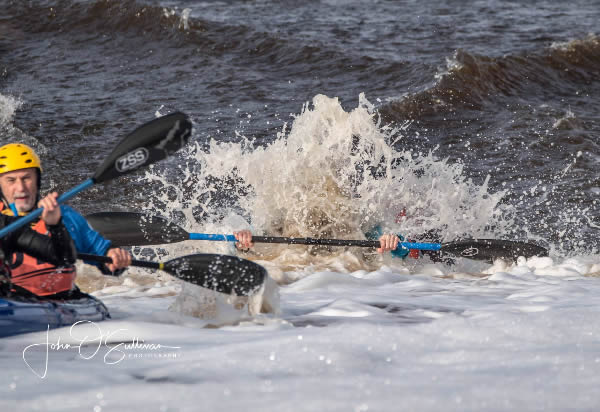
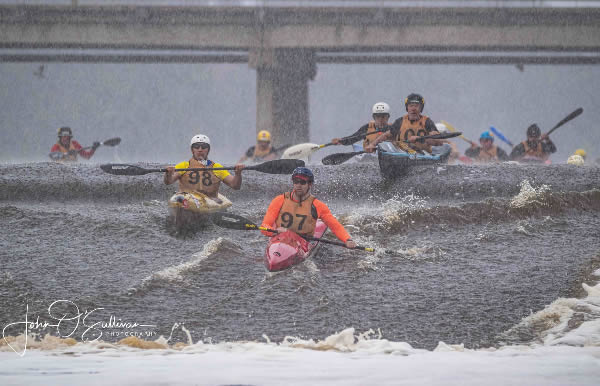
The K2s and K3s slide down the Northam Weir.
Photo John O'Sullivan.
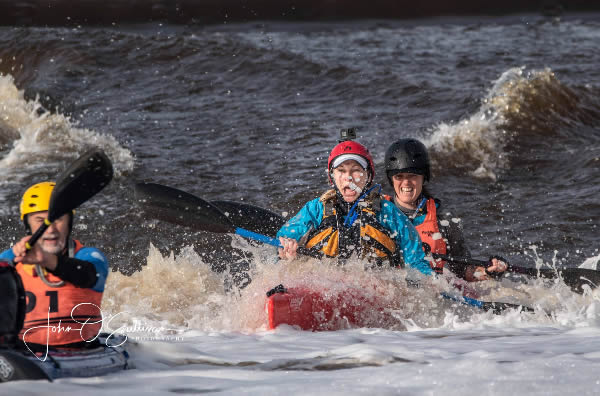
Sharon Cobley and Kate Martin in hiding!
Photo John O'Sullivan.
Oh there they are!! Guess who got wet!
Photo John O'Sullivan.
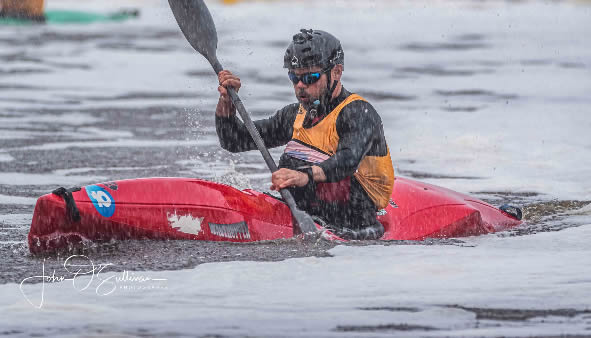
There were only 4 of us in WW kayaks but the other three, Phil Edwards, Peter Gigengack and Paul Measey were younger and faster so I didn’t expect to get a placing.
We were off. Peter sprinted ahead followed by Phil and Paul with me lagging but before we reached the bridge I was on the wash of Phil. By the time we got to the weir it was Peter, Paul, Phil and then me with all the paddlers in the wavehoppers behind us.
We all slipped over the lip of the weir and coasted down the concrete into a stopper at the bottom. And what a surprise that was when I hit it and the cold water smashed into my face.
Surprised and shaking my head like a dog I chased the others. I went to the left of the island and Paul went to the right and took longer. Two paddlers from an earlier grid had already eddied out not far down from the weir and were struggling.
One by one we all caught up with Peter, with Phil, then me, then Paul forming a line behind him. As we caught up with slower paddlers we all managed to keep together but when we hit the shallows and the wash waves changed form, it was tough to keep on a wash. It took extra power to catch up again. Every time I got left behind and had to struggle to catch up I sneaked a
glance behind to see if Paul was there, and to my dismay he was. If I was going to get a place in our class I needed to lose Paul.
As Pete forged on, I was wondering when I would get dropped, but as luck should have it I kept up, but as we passed other paddlers, many who we knew, they tried to get on Pete’s wash. There was usually a bit of a squabble as we all fought to keep on his wash.
Peter Gigengack leads the Wildwater kayaks down the Northam Weir.
I'm the 4th paddler.
Photo John O'Sullivan.
Paddling down the weir.
The other have quite a lead.
Catching up to Paul and Phil.
Photo John O'Sullivan.
A line of paddlers ahead led through some t trees. I could see a channel that we usually use on the left, but it was hard to make a decision to take it when all my competition was following the other boats, so I followed Pete and Phil into the trees. Many of the boats in front were going slower than we were so we started to bank up. Pete took a detour through the shallows to
try to get around them and I followed, but by the time we joined up, Phil ended up being a little in front.
As we came out of the trees we fought our way around the long plastics and then the race was on again. Somehow I managed to get beside Pete and started passing him. He said something like, you are pretty determined. I was determined, but I must admit I didn’t think I would get ahead of him or Phil but I did and I kept there. It might have been around this point when Peter
dropped back a little as a photo taken from Katrine Bridge had Phil and Paul wash-riding me with Peter not in sight.
At Katrine I was catching up with a few boats so I slowed as I didn’t want to be too close as we were going under the bridge, then once we were through it was full speed again, soon passing Kate and Sharon in the heavy 515 double. It was here that Phil started to come along side. We started passing a ski, I was passing on his right and Phil on his left, but then I heard Phil
clash paddles and suddenly lost a bit of ground. From the bridge to Glen Avon it was flat flowing water and I expected Phil who I have never beaten before pass me, but he didn’t.
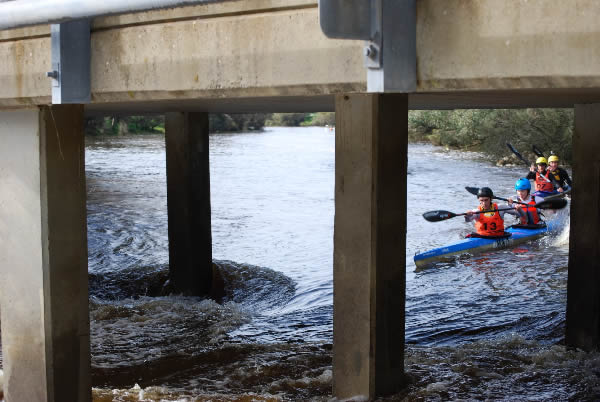
The K2s heading under Katrine Bridge.
Luckily the water had gone down which allowed us to paddle through and saved a portage.
Photo Monica Berson
The leaders Brendan Rice 1st, Will Lee 2nd and Steve Bird 3rd.
Photo Monica Berson.
Catching up with more skis.
Photo Nicky Taylor
Phil Edwards and Paul Measey have a ride.
Paddlers weaving in the swirls below Katrine Bridge.
Photo Julie McDonald.
Steph Bedden at Katrine Bridge.
Approaching Glen Avon I caught up with a paddler and he said, good I will follow you, you know where you are going. I didn’t really know where the best route was. Three paddlers in front went over to the right but I decided to take a gamble and go centre. It wasn’t until I got
closer to the first drop that I realised I might not have taken the right path as I saw some really big rocks, but somehow I missed them all which was a relief. The second drop had some long high waves with a stopper at the bottom. It looked safe enough but once I hit the waves I realised they were bigger than I thought making me feel a little insecure when paddling over them.
I whipped past a couple of capsized paddlers below the drop and paddled on passing others along the way. I was a little surprised that Phil or Peter hadn’t passed, but I was happy being in front. A few kilometres before Extracts Weir I glanced over my shoulder to see Phil and Paul not too far behind and as I got closer they were there right up my
bum.
With Extracts ahead I thought Phil would make a break, but he didn’t and I ran up onto the grass, where we were going to portage. This was it. If I was going to stand any chance of winning I needed to get back into my kayak first. As soon as I picked up my kayak I started running, not overly fast because it was slippery but my pace increased when I hit firm ground. At the
water’s edge I slipped into my kayak but I didn’t put my spraydeck on as I imagined that there would be no big waves from here and I didn’t have time if I wanted to keep ahead of Phil. I heard later that Paul was directly behind Phil at the portage, but slipped getting out of his kayak in deep water.
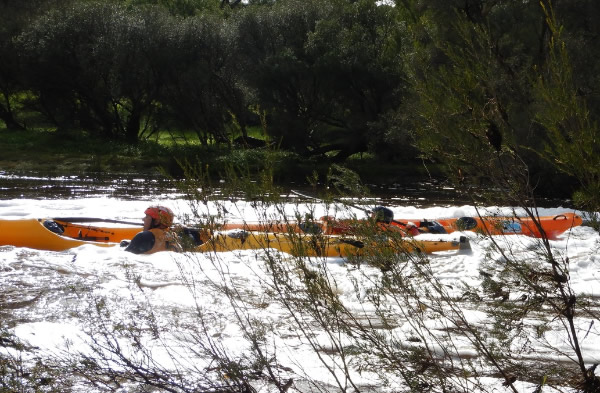
I took off ploughing through a long line of foam chasing another paddler. The foam was very deceiving as I couldn’t see any water movement underneath it. I looked back and I couldn’t see Phil but I didn’t have a good look. The foam stretched for kilometres making it a little risky to cut corners on the big wide bends. I caught up with a ski and every time I tried to pass it,
it quickened. I could now see Phil in the distance so I really needed to pass the ski to be able to put on some extra pace. We passed under a road bridge and then I got the opportunity to pass and I did, which I was grateful for. I knew we were getting closer to the finish and when I paddled under Toodyay footbridge and Phil was still behind I was feeling good and time to get a little excited. There was another ski paddler ahead and just before the finish line I passed it.
Yippee I beat Phil. (PS. He has increased his training this week.)
By the time we had finished we had passed over 50 boats.
Another great race. Thanks organisers and volunteers.
Full results here:
https://www.webscorer.com/racedetails?raceid=247959
Capsizes at Glen Avon Rapid.
Photo Robyn Khorshid.
Extracts Weir.
Photo John O'Sullivan.
Extracts Weir.
Photo Robyn Khorshid.
Manny Carabott winner of the Wavehoppers.
Photo John O'Sullivan.
Full results here:
https://www.webscorer.com/racedetails?raceid=247959
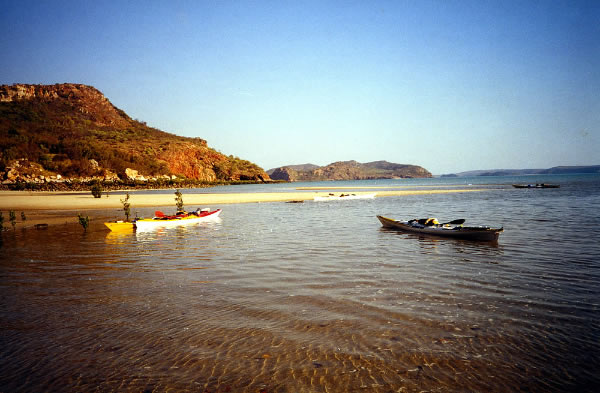
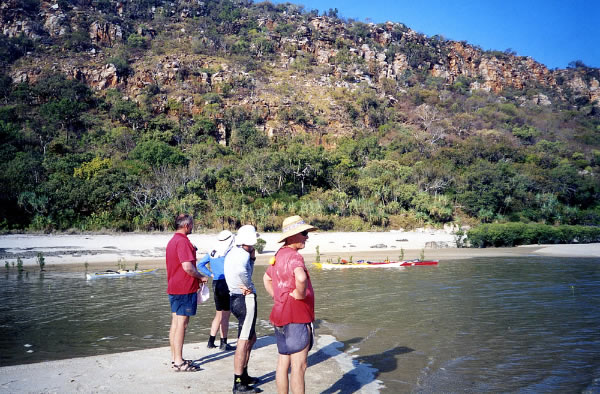
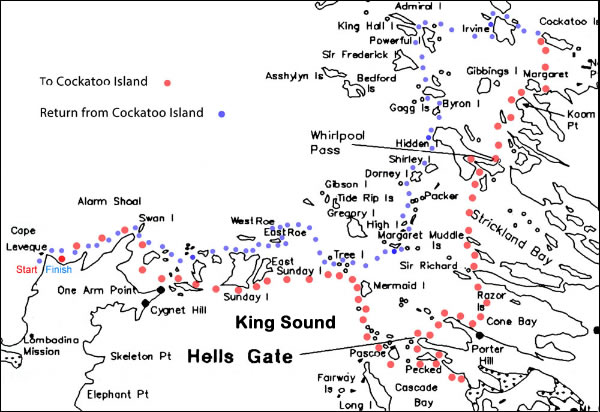
Kimberley Kayak Expedition #6
Monday 30th
By 5.30am we had all risen. We had until 9.00am to get ready, so we didn’t need to rush. The tide was ripping along the beach at an enormous pace, jump in and you would just float to the end. We all sat and relaxed along the cliff face keeping cool in the shade. By 8.30am our beach was fully exposed and the shallows were getting shallower so it was time to get going. The idea was to start our paddle across the channel on the latter part of
the outgoing tide and by the time we were halfway across we would be paddling on an incoming tide. We lifted our boats into the water and started dragging them through the shallows but then another reef was being uncovered before our eyes that stopped our progress.
Beneath our feet were huge cone shells, some with the creature walking away, clams that were agape and trochus shells littered in the pools. Our second portage to deeper water was more difficult because of the rock pools and changing depth in water, but by 9.15am we were away heading to Mermaid Island with several turtles surfacing around us. Mermaid Island was the name of Captain King’s ship.
As we moved away from the island we hit the current and soon after started to drift. It wasn’t long before we could see a beach on Tree Island, our closet island, which we intended to use as a leaving place on the way back across the sound.
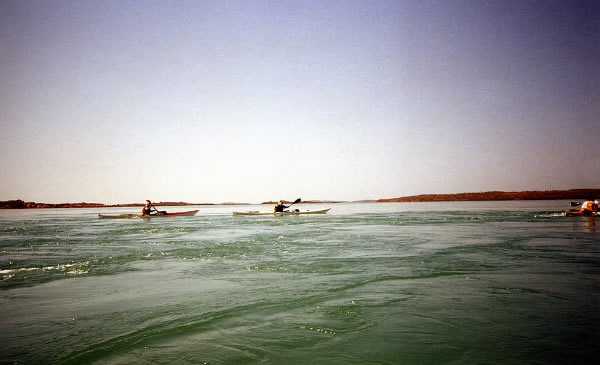
Birds dive bombed the water and fish flurried and jumped ahead of us. Although the tide was supposed to be on the turn we were now drifting fairly fast and over to the east where we were headed we could hear the tidal rips, rapids and waves breaking on the rocky reefs and shores. The disturbances looked fairly big from where we were and to be pushed onto them just wouldn’t make our day.
The further we paddled the closer we were being pushed towards Tree Island. The outgoing tide was still going out long after it was supposed to have turned, which happens a lot in these waters. We had already drifted about 3 kms so we stepped up our paddling speed and soon-after the tide turned and we were pushed back on track.
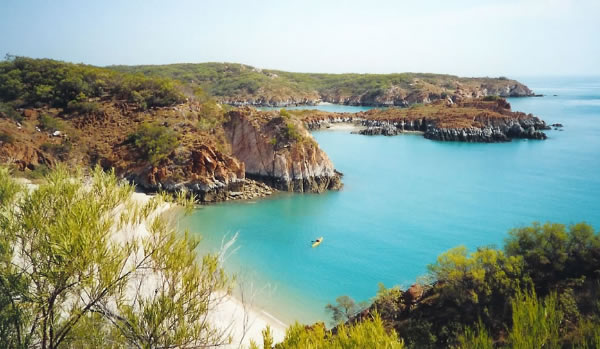
The weak incoming tide helped us to head south along a line of rocky islands and reefs to a beautiful cove on the north westerly side of Mermaid Island. The low tide accentuated the different browns and reds in the rocks above and below the high tide mark. It had taken us 3 hours to paddle the 15 kms.
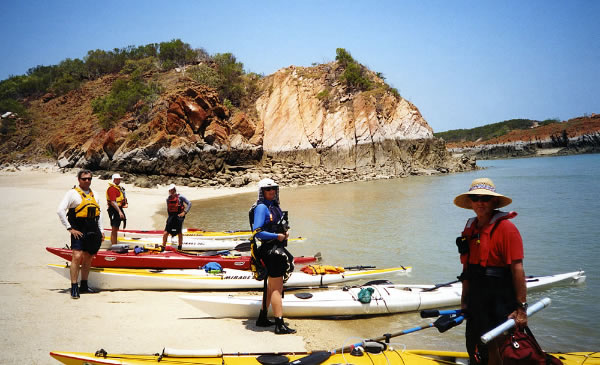
On Mermaid Island.
Gary, Tel, John, Pam and Don
We carried our gear up to the beach and Don soon erected a shade which was very welcome as the midday sun was fiercely hot. Before using it we sat in the water trying to cool off watching at all times for those little crocodile eyes.
After oysters, cheese and pitta bread for lunch I donned my walking clothes and scaled the hill behind our camp. Don donned his paddling clothes and paddled into the bay to catch a fish and Gary and Tel tried fishing from the rocks.
I fought through tangled vines that tried strangling me several times, carpets of deep spinifex, spindly trees, dead branches and precariously unstable rocks that made walking difficult. The view from the top of the ridge was well worth the effort though. I could see the lone figure of Don in the calm bay on one side and the current streaming by the island to the west on the other. The prominent rocks clear of vegetation towered beautifully above the surrounding area. I climbed them and accepted
the grand views of the islands to the east, the north east and to the west. It was a stunning view. About a kilometre away a forest of mangroves were spread in the valley. A little further on there was a higher point with an overhang and big fig tree. I searched the overhang for Aboriginal paintings but saw nothing apart from a small bat that fluttered around.
On Mermaid Island. Don fishing down there.
I climbed further to another high point but it had more trees and vegetation and had less spectacular views. I descended and I was thankful of my gaitors that protected my shins as I wobbled over the loose rocks and tripped over the vines. Back down the hill the crew were talking or writing diaries and the rock face had now shaded an area to sit beside. Later Tel, Don and Gary did the manly thing and tried fishing again. They paddled and drifted out in the bay,
but came back defeated. We had no fish to cook in the beautiful campfire coals. Instead we listened to Don’s interesting diving exploits.
When the fiery red sun descended over East Sunday Island we started cooking, dried beef and rice, followed by milo and biscuits. What no fish in the Kimberley!
The stars were bright and Scorpio was very evident.
Tuesday 1st October
I laid in my tent listening to the guys talking, the water lapping up the beach, the birds singing and watching the condensation dripping from my tent. The sun was still well beyond the ridge behind us when I rose but the sand flies were pinching at our heels.
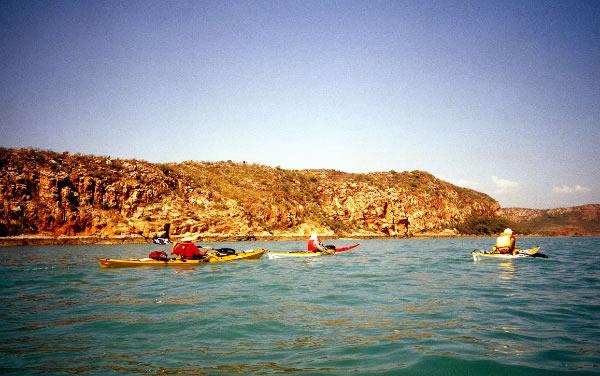
We slowly started to load and by 9.00am we were away. It was well before we needed to go to take advantage of the tide, but we thought we would take it easy along to the south end of Mermaid. We paddled at a relaxed pace admiring the orange rocks. Turtles were bobbing up all over the place. The current was against us and going out so we moved slowly taking shelter along the reef shore. Fish were jumping, turtles were surfacing and a school of sharks were milling
around out in the faster water. We moved over to check.
The currents make paddling interesting.
Don threw his line out and caught something that straightened his hook, probably a shark. The tidal currents were streaming around the island so we had no chance to get across the channel to Scott Island. While waiting in the eddy Tel said he spotted a croc so we decided to move away. There was an island about 500 metres out. The current was pretty quick but we were able to get across to it. We stranded our boats on the sand and walked onto a rocky hill where we
were able to check the currents across the channel. It was still too strong. After about 40 minutes we decided to give it a go. Don was already out there fishing.
The current still felt swift so we sat for a while in an eddy. A few minutes later we gave it a go and we had no trouble reaching Scott Island where there were plenty of beaches. Don spotted some mangroves in a bay so he asked if he could go and find some crabs. We moved in and stopped in the shallows of a reef and waited for him to return with nothing in hand. Pam thought we were mad stopping in crocodile country.
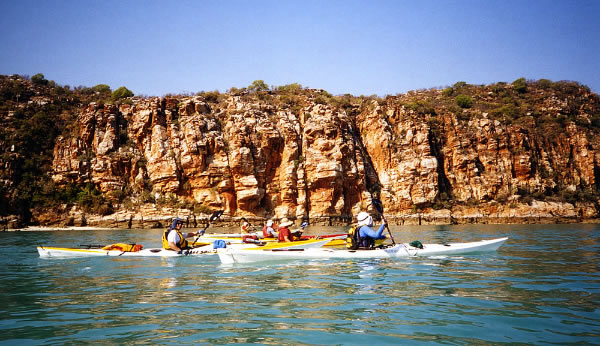
We moved around the next point and then the current started to quicken in our favour. It was great paddling. As we moved along Pascoe Island the current eased that was until we had to cross over to Pecked Island then it was quite swift and against us so we had to do a big ferry glide before paddling along the coast heading towards Cascade Bay. The cliffs were absolutely beautiful. We took it easy and just took in our surrounds.
Heading towards Cascade Bay.
By the time we reached our camp the tide was well out. We felt it was too far to walk our gear so we decided to wait for the tide to rise which lift and push our kayaks closer to the beach. Meanwhile I went to explore a great little mangrove creek nearby. I returned and took photos and we sat on the edge of the mangroves in the shade and waited. The incoming tide started pushing our kayaks slowly
towards the beach. We relaxed, talked and looked on taking in the red ochre cliffs, the hills and boab trees looking down at us. It was a stunning scene. Eventually the flood tide had our boats at the bottom of the beach so it was time to unload.
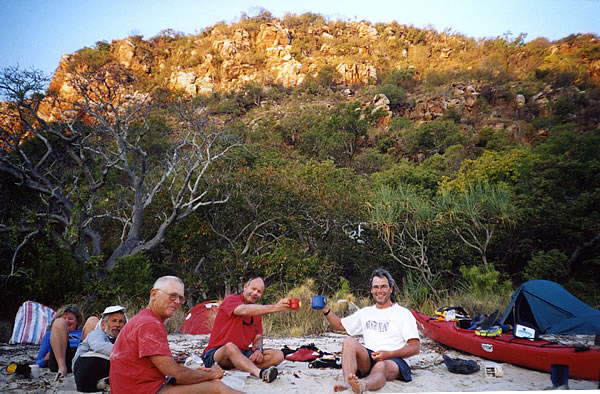
We sat around our campfire chatting having a drink of wine taking in all the splendour.
Waiting for the tide to come closer to the beach before unloading.
The tide was well out when we arrived but now we are nearly ready to unload.
Camped at Cascade Bay. Wine all round.
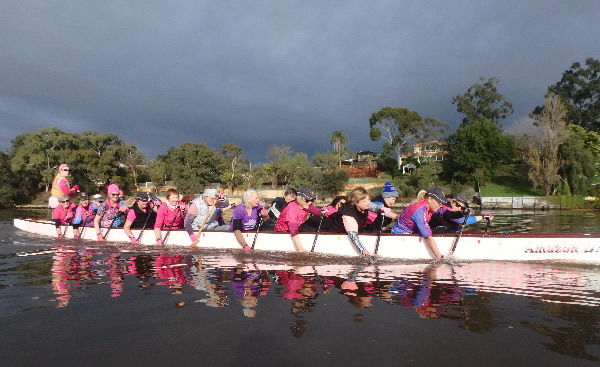
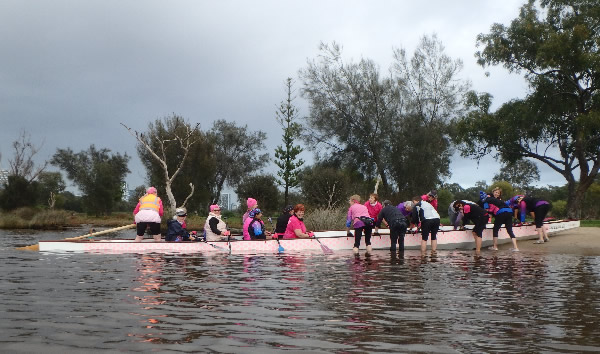
Amazons Perth Dragon Boat Club
Maylands
A powerful group of ladies. Saturday morning at Maylands
Amazons Perth Dragon Boat Club was founded in 2000. We are a member group of BCNA (Breast Cancer Network Australia) and cater for breast cancer
survivors and supporters through dragon boat paddling. We find the active, vigorous exercise of paddling enhances physical and emotional well being within a context of caring
companionship.
Dragon boat racing for Pink Ladies has become a part of the world wide movement to raise cancer awareness and to better manage post-treatment for cancer
survivors.
Amazons Perth is committed to raising awareness of breast cancer whilst encouraging women to regain an active, adventurous life despite the physical limitation imposed by breast cancer surgery. Dragon boat racing is a remarkable diversion from the psychological impact of breast cancer
while offering a social atmosphere for the team to train.
The group disembark at Maylands.
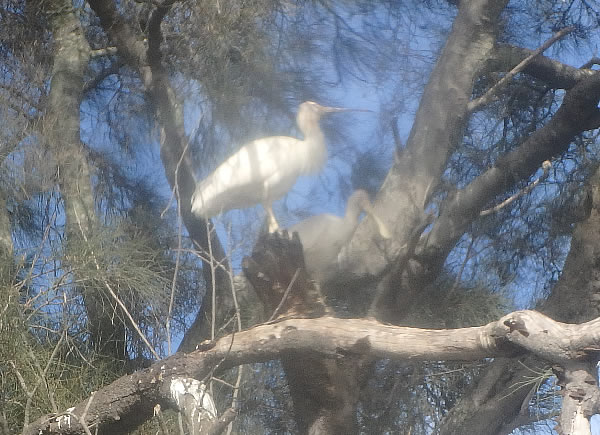
Spoonbill
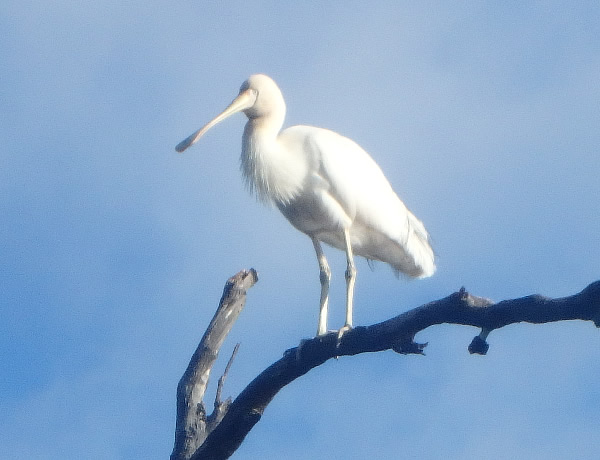
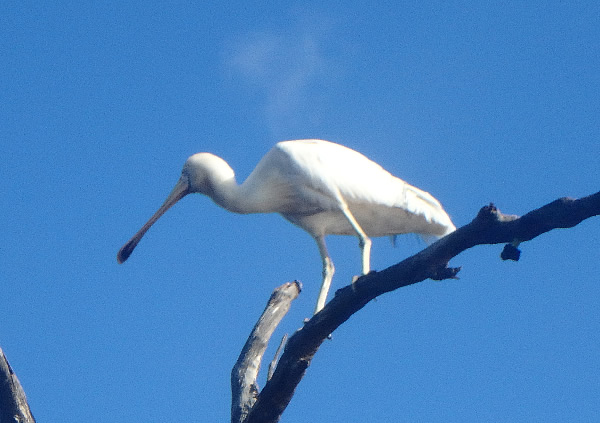
This Spoonbill has made its home on Ron Courtney Island for a short time at least.
I have seen it most mornings this week. Its unusual to have a regular spoonbill on the island. Probably sheltering from all the squally weather and using Ashfield Flats to find food.
The unusual spatula-shaped bill of the Yellow-billed Spoonbill is a feeding adaption which allows the bird to specialise in foraging for invertebrates in deep, muddy water. Instead of searching for food by looking for it, the sensitive tip of the spoonbill’s bill allows the bird to feel for its food instead. The spoonbill walks through the water, sweeping its bill from side to side in a series of
arcs or crescent-shaped movements, and when it detects a small creature it is quickly grabbed and swallowed.
Similar Species
Their large spoon-shaped bills easily distinguish spoonbills from all other water birds. The yellow bill and legs distinguish the Yellow-billed Spoonbill from the slightly smaller Royal Spoonbill, P. regia, which has a black bill and legs, and a distinctive crest (more apparent during breeding season).
Feeding
The Yellow-billed Spoonbill feeds on aquatic insects and their larvae, using its bill to sweep shallow waters for prey. The spatulate bill has many vibration detectors, called papillae, on the inside of the spoon, which means the bird can feel for prey items even in murky water and can feed by day or night. Once food is caught, it lifts its bill up and lets the items slide down its throat. The Yellow-billed Spoonbill has less sensory papillae and a smaller spoon
than the Royal Spoonbill, which means that it catches slower moving prey.
Breeding
The Yellow-billed Spoonbill often nests in colonies with other water birds, such as ibises and Royal Spoonbills. It places its nest in high forks of trees over water, or in among reed beds, building a shallow, unlined platform of sticks, rushes and reeds. The male collects the nest materials while the female builds and both sexes share incubation and care of the young.
Birdlife Australia.
The Spoonbill high in a tree.
The Spoonbill had a partner in his island den this morning.
(Moisture on lens).
Paddle WA Live Lighter Sprint Regatta #1 -
2021/2022 Season
Champion Lakes Regatta Centre
This is a Sprint distance and Long Distance Race Regatta for Ski, Kayak, Canoe, OC1/V1/Va'a Sunday 1st August 2021
Held in conjunction with the Avon Descent Scrutineering
Includes a Lucky draw prize of $250 donated by the Avon Descent
https://www.webscorer.com/register?raceid=247458
Entries close midnight Saturday 24th July - Late fee for entries after this date.
|
|
|
|
|
|
|
|
|
|