|
|
|
|
- Progressive Racing Group Training
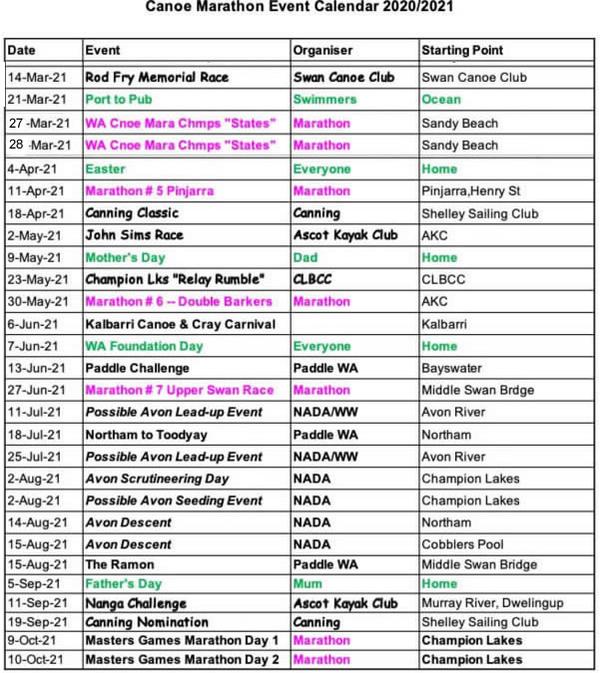
- WA State Canoe Marathon
- Is it time to improve your skills?
- Leotta's Orchard Farm
- Water Wanderers Kayak Trips
- Rod Fry Race
- IOP Downwind Race
- Drysdale River Expedition
- Fishing for Dead Fish
- Products
- Coming Events
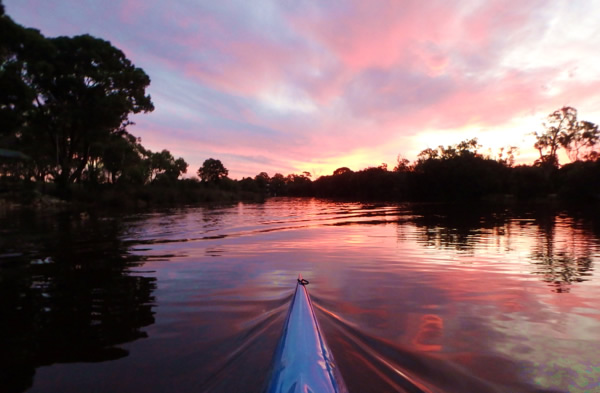
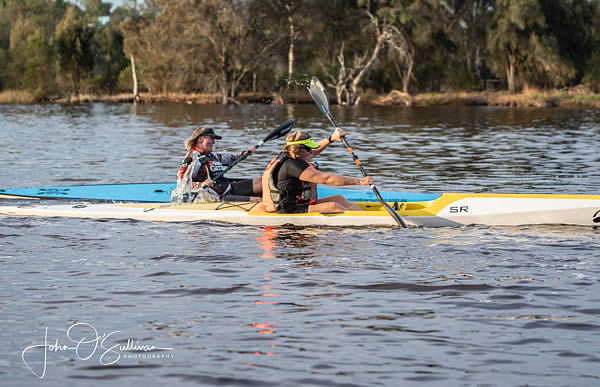
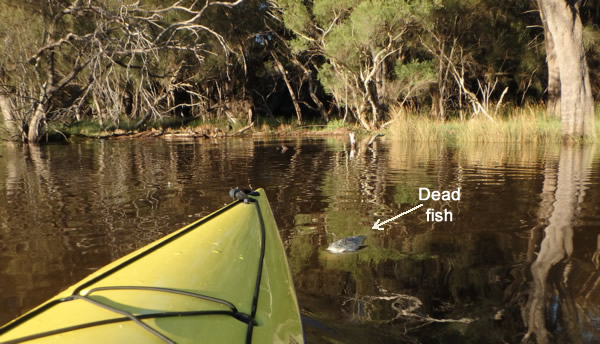
I took a photo as I was heading home on Tuesday night after PRG training.
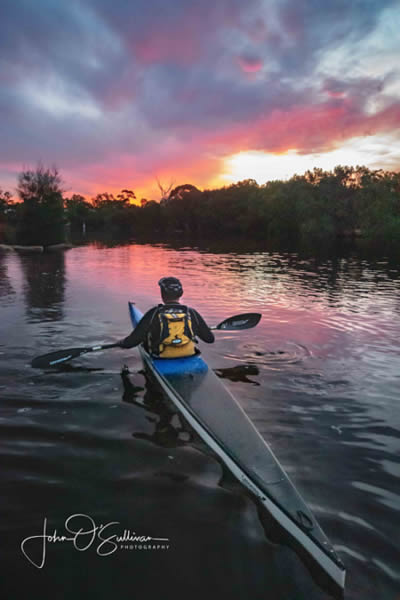
John O'Sullivan took this photo of me about to head home.
He got my best side!!
Progressive Racing Group Training
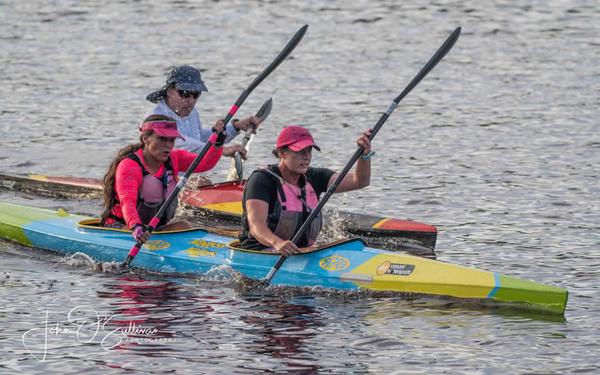
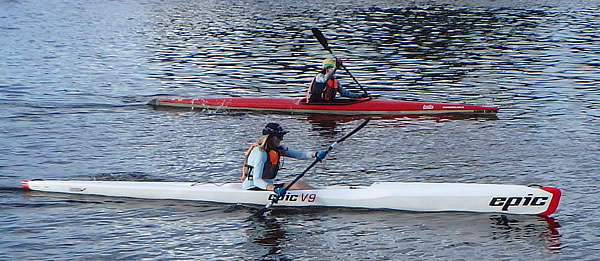
Isabel Combe and Steph Bedden looking good.
They are getting ready for the WA Marathon Championships in two weeks.
Photo John O'Sullivan.
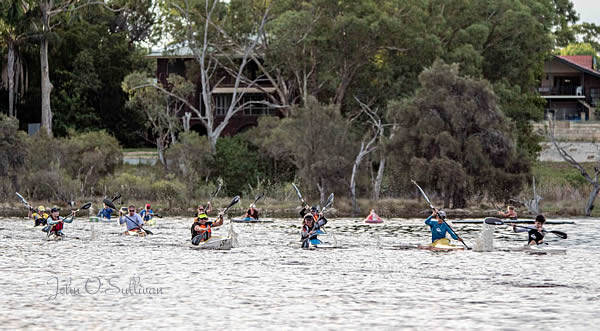
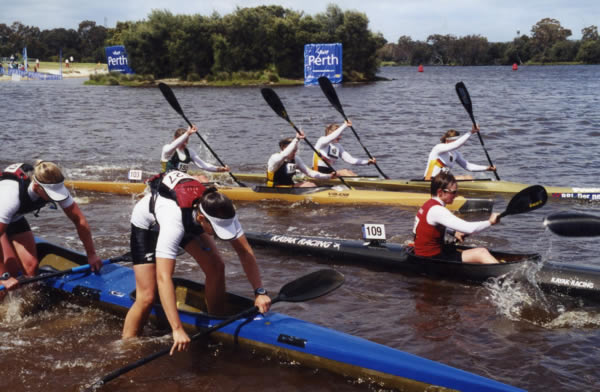
A pack of PRG paddlers heading for the finish line.
Julie MacDonald and Jane Dooley are neck and neck.
Photo John O'Sullivan.
Two metres from the line Jane has a slip in concentration and balance and over she goes leaving Julie to take line honors.
Photo John O'Sullivan.
WA State Marathon Champs
27/28 March 2021
In 2005 the World Marathon Championships were at Bayswater.
Remember the WA State Championships are in two weeks.
Register here:
With the Avon Descent getting closer.
Is it time to improve your skills?
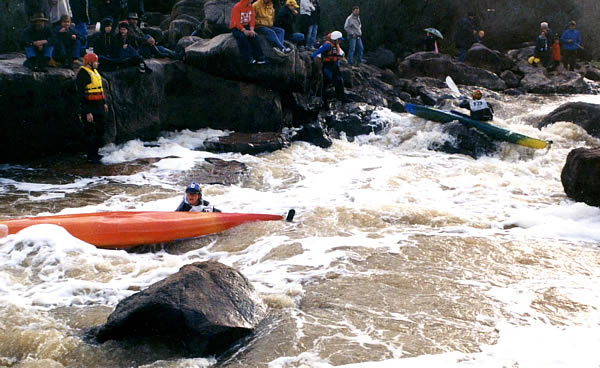
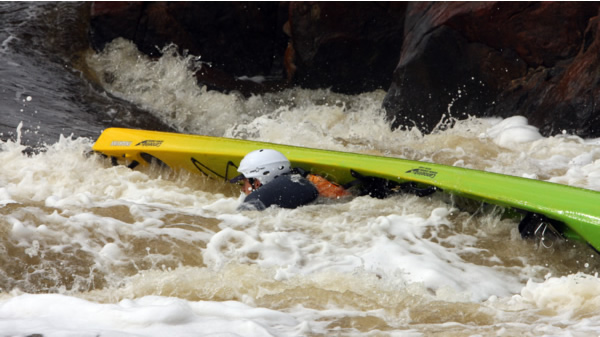
As you can see from the above picture, the paddler has his paddle blade hooked in close to his ski. This position doesn't give him any support so once the boat starts to tilt over the paddler is more likely to capsize. He needs to do a support stroke straight away or time his forward power stroke as he hits the wave. A forward stroke placed at the right time can
act as a support stroke and power stroke.
He didn't do a support stroke so over he went.
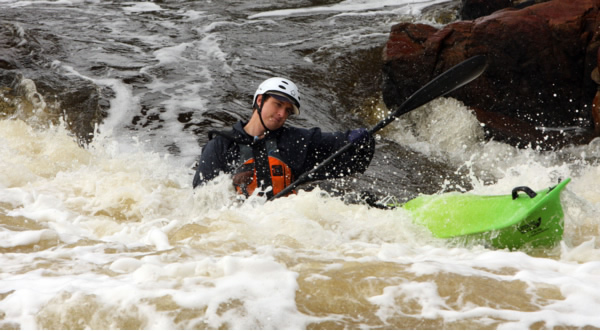
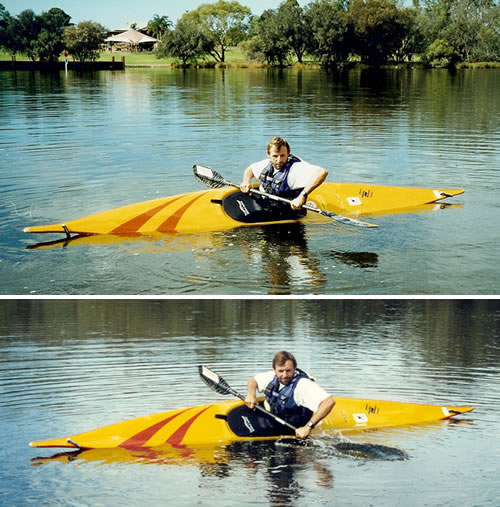
To avoid a capsize practise the low support stroke.
See below.
SUPPORT STROKES/ BRACE STROKES
Support Strokes are also called Brace Strokes or Recovery Strokes. An efficient Support Stroke can prevent a capsize, especially important in rough water. Before attempting a Support Stroke, in a kayak brace yourself inside the cockpit and rock the
boat from side to side to familiarise yourself with the feeling of knee lift and the flicking of your hips. Be careful not to tilt too far and overbalance.
LOW SUPPORT STROKE
This is the simplest of support strokes.
- Ensure your knees are braced.
- Use the back of your blade.
- Keep your paddle low and horizontal, with your elbow on the support side at right angles above the
shaft.
- Maintain your controlling hand in its usual grip on the paddle.
- Slap the back side of your blade onto the water surface as far from the boat as is comfortably possible (without losing the correct
position of the elbows). This slap support halts the capsize movement and provides support.
- For maximum support your lower hand should be opposite your hip, with the paddle blade slightly
behind your hip.
- Hold your non-working hand slightly forward, but low and close to the deck.
- Using the paddle blade as a support, bring the kayak upright by using knee lift and hip flick.
- If your paddle blade should sink below the surface, roll your wrists (moving your knuckles upwards) and slice it back to the surface.
To practise, overbalance slightly at first, then increase your lean when you feel more confident.
This stroke is also used when paddling a ski, except you won't be able to brace your knees.
Leotta's Orchard Farm
Sponsored the City Lights Race.
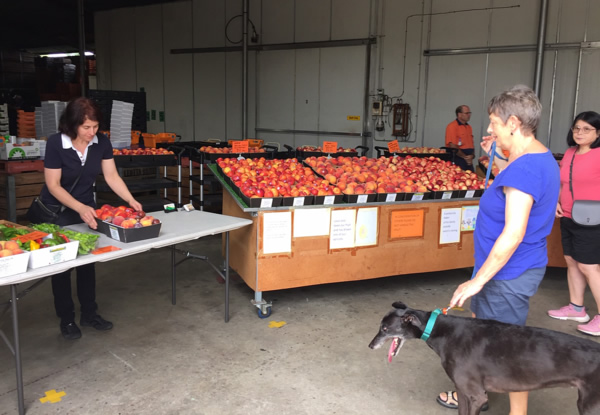
I was one of the lucky ones who was given a fruit box on Sunday night at the City Lights Race. The fruit was so good Jenny and I just had to drive out to Leotta's Orchard Farm, 741 Canning Road, Carmel to get a couple more boxes. They have heaps of stone fruit there.
I have been on a fruit and vege diet now for nearly two weeks and I have lost just under 5kgs.
Many thanks to Leottas for sponsoring the Ascot Kayak Club event.
And thanks to Bruce McWhirter for sponsoring the chocolate.
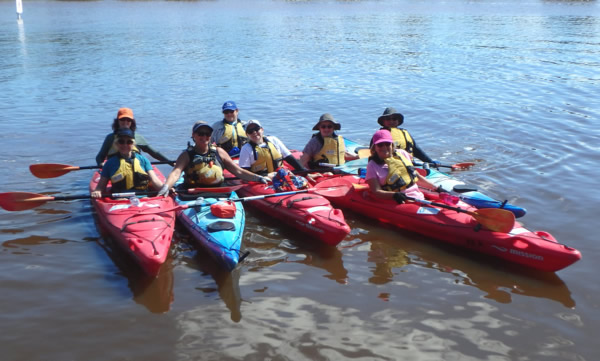
Leonie from Water Wanderers escorting a group of Adventurous Women down the Swan River in sections, starting from near Yagan Bridge, (Upper Swan) and finishing in the city.
Leonie organises local city trips or extended school activities.
leonie@waterwanderers.com.au
IOP Downwind Race
The wind is still not co-operating with us so we have a change for Saturday's EPIC/IOP Series race:
Race Course: Start and finish at Sorrento SLSC, decision of the course will be made Saturday morning
Race Time: MORNING race - 6.00-6.30am registration, 7am start.
Thanks to Will and Vanessa Lee - EPIC Kayaks WA for race sponsorship and to Kate and Brad Hardingham - REALMARK for the series sponsorship.
Drysdale River Expedition
With
Tarquin Bowers &
John Mustard
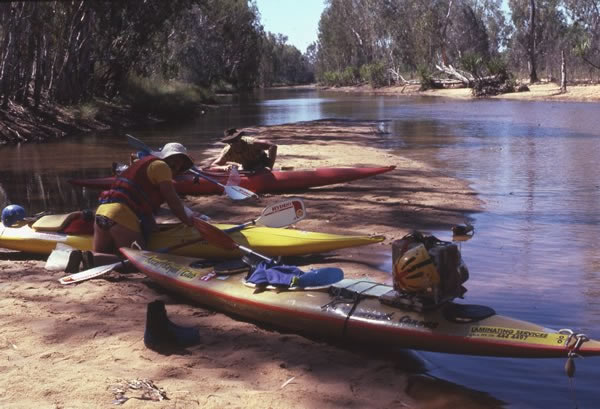
In 1985 John Mustard and Tarquin Bowers, who were studying recreation at University had to organise an outdoor expedition as part of their university studies. Many other students planned their expeditions closer to home and some overseas but John and Tarquin decided to do the first descent of the Drysdale River which was situated in the Kimberley wilderness area. Having already completed two, 3
month expeditions around the Kimberley coast they asked me to go along. Their friends Andrew Kikeros and Vic Challis became our support team.
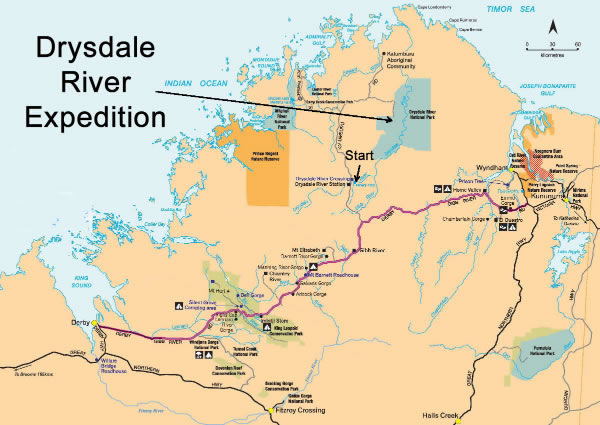
The Drysdale is a remote river that flows through the Drysdale River National Park in the Kimberley region. Not a lot is known about this National Park as it is rarely visited, rarely promoted and difficult to access. The river itself has a variety of conditions, from a sandy river bed, narrow channels, deep pools and in the wet season big and small rapids and high waterfalls.
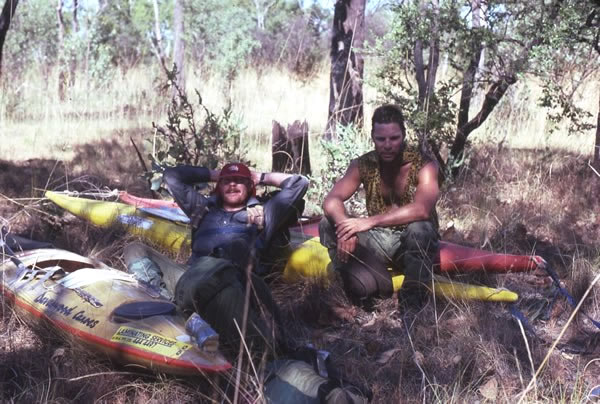
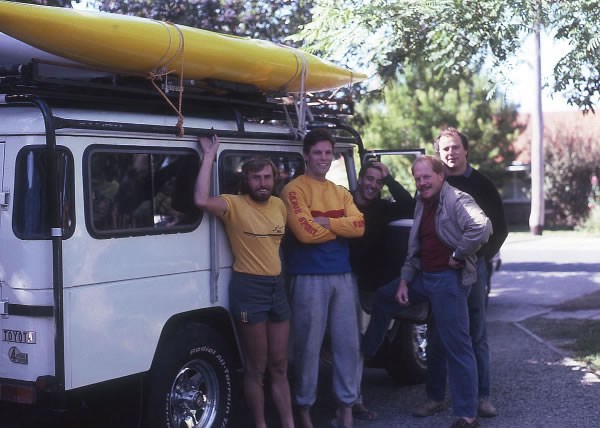
The Team. Me, Tarquin, Andrew, John and Vic.
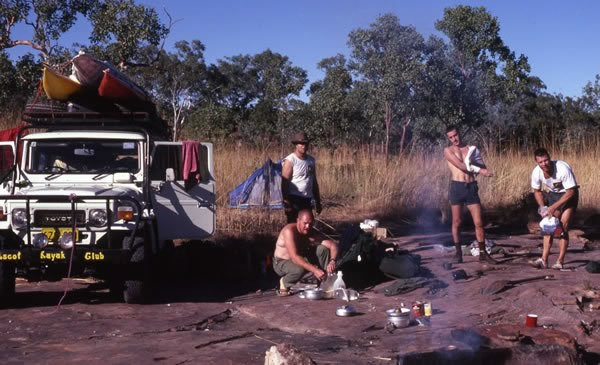
To get to the heart of the rugged Kimberley we took my four wheel drive which was loaded with 3 kayaks, 4 spare wheels, 6 jerry cans, food, clothes, equipment for 4 weeks and 5 people. We had to travel 2500kms on a bitumen road with the final stage of our journey being 500kms on a rough gravel track, the Gibb River Road, which was very wet because it was the end of the wet season and certainly not
as good as it is today. While John and Tarquin chose to paddle plastic river kayaks, some of the first ever made, I chose to build a very strong kevlar river kayak with hatches and bulkheads.
We drove all the way from Perth to the Kimberley to paddle the river in the wet season high water but the river was a sorry sight when we arrived.
John Mustard, Vic Challis, Andrew Kikeros and Tarquin Bowers.
Our kayaks loaded with 18 days of supplies sat low in the water and were hard to control. The deep pool, downstream of the Drysdale River Crossing allowed us to make good speed but 400 metres later we struggled to get over our first rocky rapids leaving coloured marks of our kayak hulls on the rocks. In the matter of minutes our joy went to despair and we soon realised our 320km journey to the end of the river with dozens of rapids and waterfalls was going to be
tougher than we imagined. We had expected to be paddling down every rapid making good time but the wet season hadn't been good.
Pandanas palms, paperbark and gum trees lined the sandy banks. Sand bars soon intersected the river creating pool after pool and causing us to get out of our kayaks and drag them. Further along islands of foliage dotted the wide river creating a maze and many dead end channels. We moved on, looking for openings to glide our boats through the islands and channels which were too shallow forcing us to exit our kayaks. It was tedious work with only short distances
covered before we had to drag our kayaks over greenery, rocks or sand. Our very slow pace was only helped when the river narrowed and shallow races developed giving us just enough water to float down. Small crocs mingled among the weed, some less than a metre away. In the first two hours we had only paddled 4kms.
As the light faded and the birds chattered stronger we camped on a sandy island surrounded by stagnant pools of water and debris from the last flood. We caught a few fish and settled to eating a basic meal around a campfire and listening to the mysterious sounds of the night life under a clear sky full of dazzling stars. This was the life.
It started off with small shallow pools and apart from a few sections it didn't get any better.
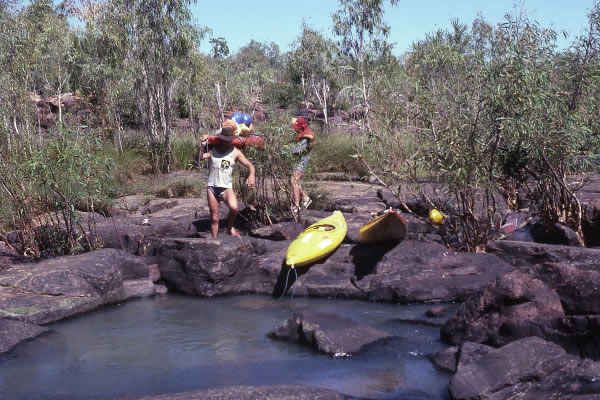
Tarquin and John carrying the kayaks over many rock rapids that have no water.
As the jungle of trees diminished once again the river became sandy and shallow. Time out of the kayak well exceeded time in it. Our arms were stretched as we pulled the kayaks over the sand bars but were rested in the deeper pools. We soon discovered that sitting in the seat and dangling our legs over the kayak in the short pools was much better than getting into the kayak properly. Our cockpits were quite small and quite difficult to enter easily.
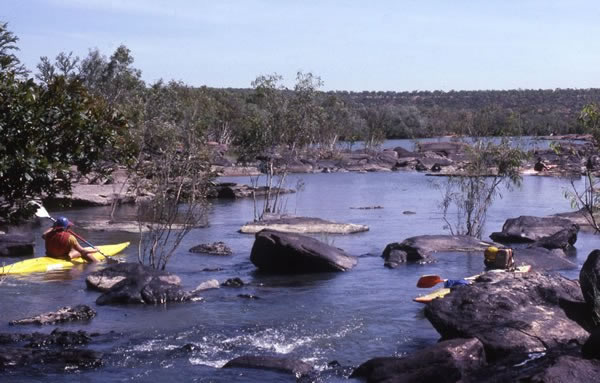
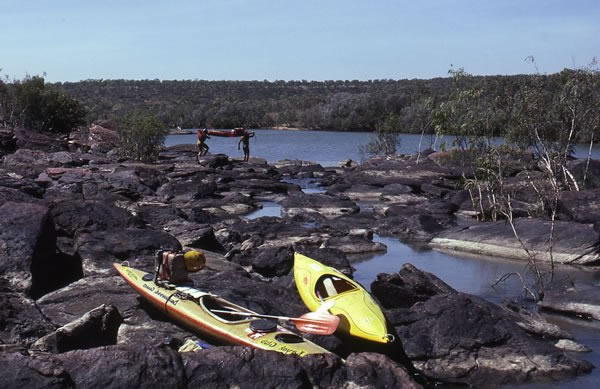
When we reached the confluence of the Gibb River it was disappointing to see no water flowing out of it. From here the river became extra rocky, so there were more portaging, more dragging and very slow progress. Eventually the dry rapids that sometimes took hours to clear turned into long dry rock sections with water just trickling through the rocks.
As the day slid by, dingoes and goannas raced from the river bank and owls roosted in the trees, not even flinching at our presence. To add insult to our already tired and battered bodies we found long wiry red worms in the flesh of the fish we had caught at the end of the day. The sight of the worms turned our stomachs knowing that we had already eaten several, but that didn’t deter us from devouring the non-polluted meat.
A portage then a short pool and then another portage.
The river and river banks were still dotted with dingoes, goannas, crocodiles, fruit bats and a mass of birdlife. We had seen several Johnson crocodiles but an increase in rocky islands attracted more of them to sun bake. The sun seemed to make them docile which allowed us to creep close and surprise them. We got more than we bargained for when a crocodile guarding a narrow channel of pandanas palms was startled by Tarquin as he entered it. It swiftly jumped over
rocks and then gave John a fright as it brushed his kayak and then smashed into his paddle before submerging and swimming out into a pool. At least I managed to get it all on film.
The pandanas palms were black with chattering fruit bats hanging in the trees. The foul smell encouraged us not to linger and find fresh air again. Once out in the open there was a short paddle to another pandanas palm alley. Leaving it John spotted a crocodile stalking a cormorant. Within seconds the croc snapped and took the cormorant firmly in its jaws and then lay in the shallows allowing us to paddle around it. We left the croc to his lunch, paddled a few
more short pools before being stopped by another long dry boulder rapid resulting in another tiring portage. Our lunch here consisted of nuts, dried fruit and a little jerky, not a lot to keep our energy levels up, but it did. It’s surprising how little food we really needed to consume to keep us going.
Beautiful lilies that were in bloom when we camped in the afternoon had their petals closed in the morning but the beauty of a long pool had us excited as we made some good paddling progress, however before we thought our fortunes had changed the river became shallow again and it was back to walking. Another long pool lifted our spirits which helped us to paddle more than 12 kms for an entire day which was the best we had done so far.
A pool suddenly stopped leaving only sand ahead. It was hard to believe where all the water had disappeared to. We just lost a wide river. We walked in all directions trying to find water. Eventually we came across a narrow stretch of stagnant water hidden amongst a forest of pandanas palms which on further inspection was the only channel we could find. We came to realise that water was filtering through the roots of the palms and into the channel.
The task of carrying our kayaks 150 metres up and down the slimy, muddy banks of disused gullies through the thick palms and deep mud was a major exercise. We were hot and sweaty and once in the channel the spikes from the thick palms were best avoided which was pretty hard to do when the channel narrowed to nothing. At times when the prickly palms blocked the way, but allowed water to filter through their roots and stems, we had to portage.
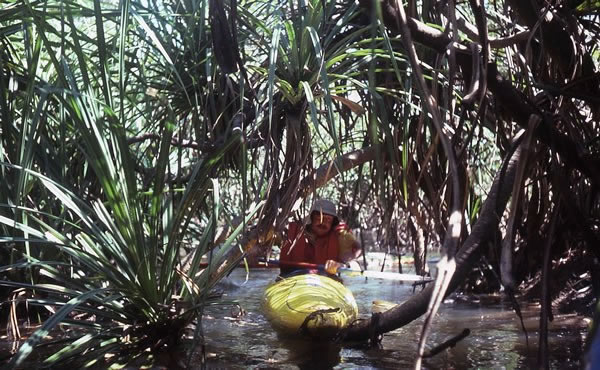
The channel was a gruesome place, full of stagnant water, slime, frogs and spider webs that strung across the trees entangling around my head and body. I became the lead paddler for a while which meant I collected all the spider webs and cleared it for the others. As a goanna lizard shuffled through the fallen palm leaves I wondered what other creature was going to appear in this forbidden jungle.
It was slow work pushing over and through the dark canopy of palms with spiders and frogs falling into my lap, on my legs and into the kayak. Once I got used to all the spiders tickling my legs the dread of paddling through the palms soon became quite exciting. We started jumping logs, weaving in and around the palms like a slalom paddler and feeling the fun of the jungle. We were soon covered with creepy crawlies, branches, dry debris, spider webs and frogs that
hitch hiked on our PFDs and kayaks. After several hundred metres and when we were back out in the open we had lunch and cleared our cockpits of all the debris.
John trying to paddle through a section of dense pandanus palms.
Once back in the water we scored a pool several kilometres long which brought the day’s kilometres to the best yet – 18kms. Our enthusiasm to keep going that evening was dampened when we came to another long rocky rapid. After making camp and walking downstream to check the route Tarquin had caught 4 fish by the time I returned.
We were in high spirits when we came across another long pool but our joy didn’t last long as difficult rock rapids stood in our way. This was followed by another long pool dotted with rocky outcrops and several crocs sunning themselves. I was able to creep up and film them with my 16mm movie camera. Another pool, another rock rapid and another surprise! As I dragged my kayak down some tiny rapids, a five foot croc lay virtually under my feet in a rock cavity.
With it seemingly frozen I took the opportunity to shoot some movie film, before it shot off in a desperate bid to find deeper water.
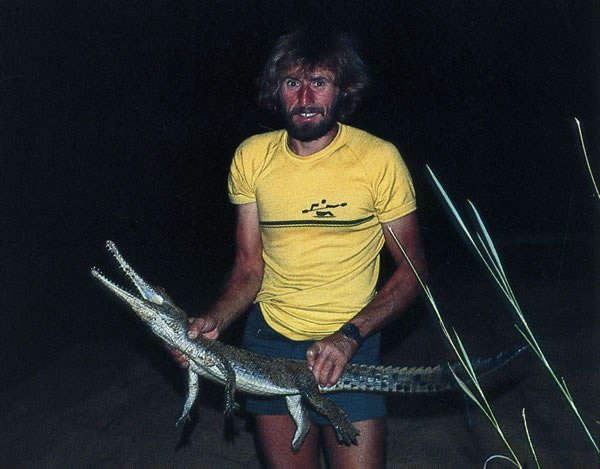
I caught a crocodile on a fishing line.
We left an excellent campsite at 8.30am and managed to paddle 5 ½kms our longest paddle so far before having to portage over 500 metres of large boulders and trees. As we picked our way through the vegetation we were halted by the sight of a green tree snake slithering along the branches. Supported by its powerful tail it moved from bush to bush, weaving its way higher into the leaves.
As John and I took interest in the snake, Tarquin took to the water and paddled off in the distance. When we caught up with him he too had been fraternising with nature! A croc had just attacked the bow of his kayak as he sat waiting for us under a tree. He said he couldn’t believe the size of it and how the croc closed its jaws around the bow of his kayak.
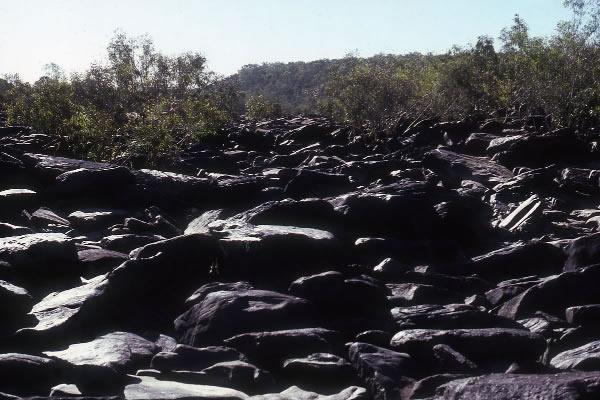
It was a depressing sight having no water running down the rapids.
After 10 days of paddling, carrying and dragging we scouted on to check the river ahead and it was a sad sight. I walked down the centre of the river not getting a drop of water on my feet. The large black rocks leaned downstream for hundreds of metres and it was these stone barriers that had encouraged us to cancel the first known kayak trip down the length of the Drysdale River.
We just knew if we carried on trying to paddle the river we couldn't reach our rendezvous point with Vic and Andrew on time, so we decided it was quicker to walk to the rendezvous point.
This meant we had to drag and carry our kayaks about 10 kilometres overland to the edge of the Carson Escarpment. Here we would leave our kayaks and then walk along a track to the nearest Station, Theda and call our support team waiting at Carson River homestead, and get them to drive back for us and then pick the kayaks up by using the track that was on our map.
It sounded easy but as we about to find out Theda Station marked on our revised map had been moved 18 years earlier and the track on our map was no longer there.
So the drama continues>>>>>>>>>
To read the full account go here:
https://terrybolland.wordpress.com/drysdale-river-expedition-kimberley
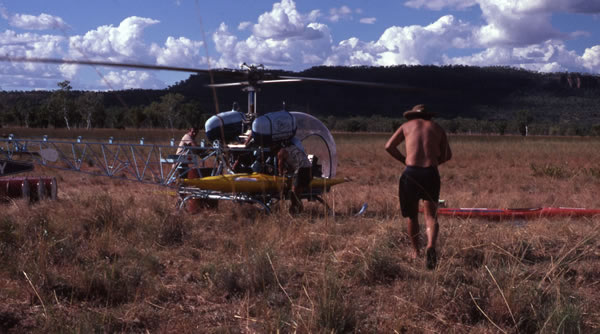
We rented a mustering helicopter to retrieve our kayaks from the top of Carson Escarpment.
Fishing for Dead Fish
I went fishing Sunday evening, but not with a rod, but with an ice cream container with holes in and a bucket to collect the dead fish in the river. Although a lot of the dead fish, that had died overnight on Friday of low oxygen levels had washed downstream to Bayswater, there were still several upstream of my place and Ascot Kayak Club that were going to stink if not picked
up.
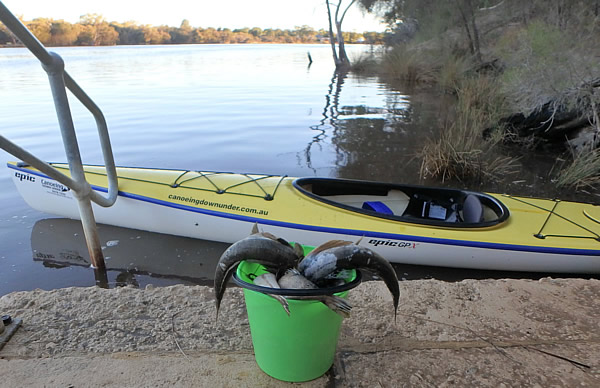
As I didn’t have a partner to help drive my canoe I decided to take my 4 metre Epic GPX which is a great stable kayak with a fairly big cockpit. It however could only carry a bucket rather than a container much bigger that I could get in a canoe.
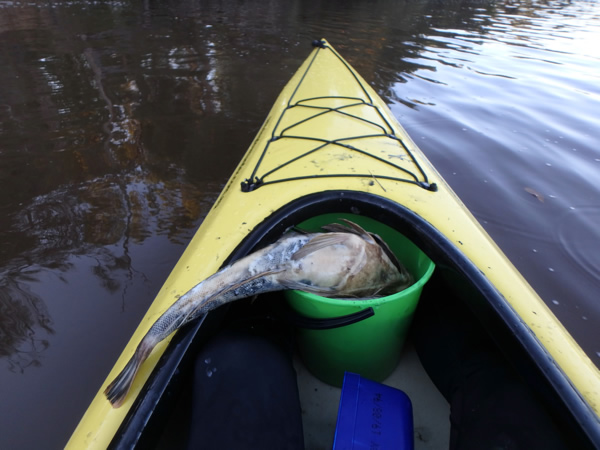
I did imagine that the fish were going to be quite small so my bucket would hold plenty, but that wasn’t the case, most were 40cm long and longer than my Epic paddle blade although they were a few smaller ones.
After seeing a lot of small dead fish on Saturday morning I expected that was what I would be scooping up.
There were less small ones and more larger ones.
Most of the fish were about 40cms long.
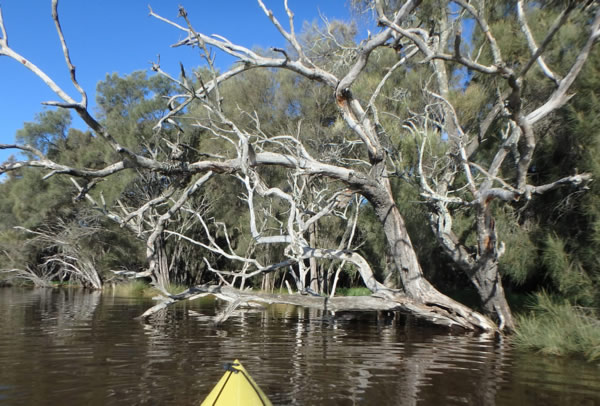
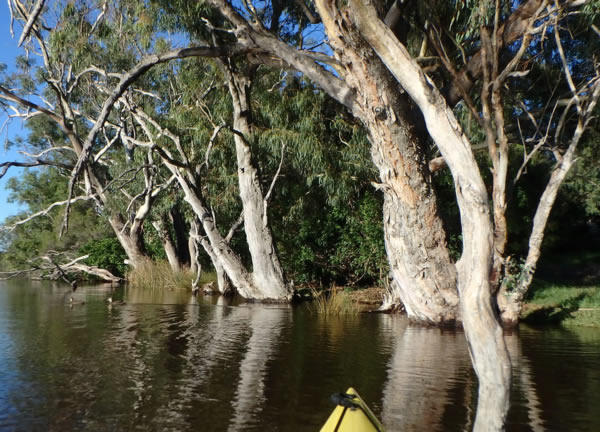
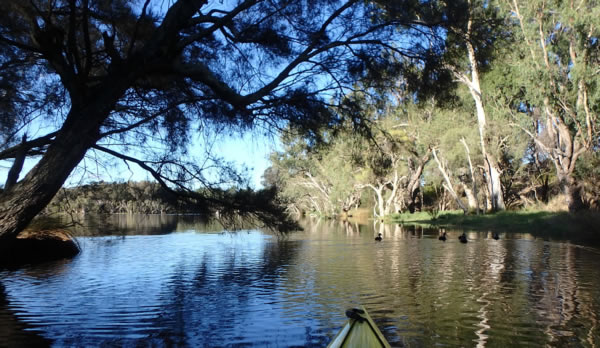
As I was looking for the fish along the shore I was captivated by the beauty of some of the trees that were lit up by the dying sun. Branches intermingled and shone. Although there were areas of dead branches and toppled trees they still portrayed a beauty that drew my attention. All along the right bank
heading upstream I found pockets of real beauty that are never seen by most passing paddlers. There were also cormorants, darters, ducks and pelicans that usually attract my attention, but tonight it was the scene behind these birds that did. It was becoming a really nice social paddle if it wasn’t for the smell.
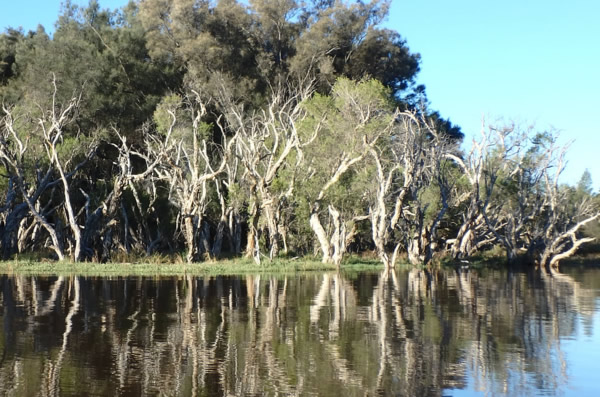
A dead tree with a tangled group of branches was quite a pretty picture.
When you stop and look there is beauty to be found.
I paddle the river virtually every day but I can still find impressive scenes.
My bucket was filling but it only took the first dead fish dumped in my bucket to cause a smell that was near unbearable. Nevertheless I had committed to checking the shores to Point Reserve so no smell could stop me.
The larger fish did create a problem. My ice cream container scoop wasn’t big enough to lift the big fish out, so I had to use my paddle blade as well. This worked well for a few fish until one slipped off my paddle and out of the container and splattered fish scales all over my kayak and onto the legs of my paddling pants. And I was being so careful not to come in contact with
a fish!! Now my paddling pants smelled.
When I turned at Point Reserve and checked the bank heading downstream my bucket was getting full. I stopped to have a chat to a couple I sometimes talk to who were on the riverbank of their home. We got chatting and the man mentioned the smell of the river but it wasn’t the river I said, it was all the dead fish in my kayak. When I left I’m sure the smell went with me.
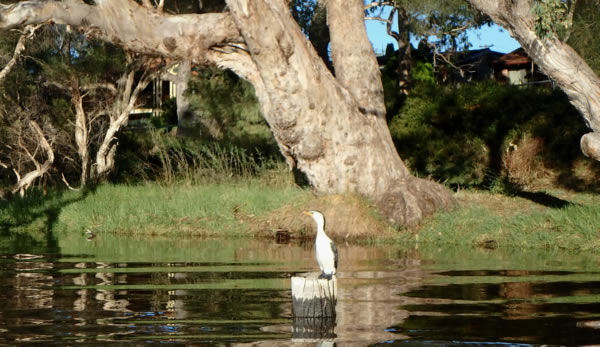
A cormorant sits quietly on a stump contemplating Harry and Meghan's situation.
By the time I reached home my bucket was over-flowing but there were still two good sized fish near my get out point. They were a struggle to get in my bucket, but at least I got their heads in and I was able to carry my kayak and the bucket to home without spilling any. Nevertheless it was tricky.
I couldn’t dump the fish in the park bins, so I just had to take them home and dump them in our bin. Luckily it was bin day on Tuesday. What a smell they caused and the smell leached out of the bin thereafter. When I walked inside Jenny instantly could smell fish on me. My clothes went straight in the washing machine and I washed my hands 3 times and had a really good
shower.
Although I was clean the smell still lingered. We don’t know if we were imagining the smell but even when we went out for a meal at the local restaurant it seemed the smell was there following us.
We vowed not to open the bin until after it’s been emptied, so it just sits on the verge as far from the house as possible and hoping no passer-by will open it and put some rubbish or dog doo in. Luckily it was bin day in two days.
My bucket of dead fish overflows.
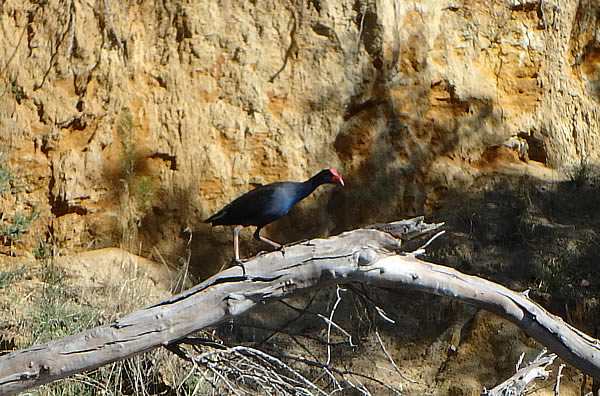
A swamp hen climbs a dead branch opposite Fishmarket Reserve, Guildford.
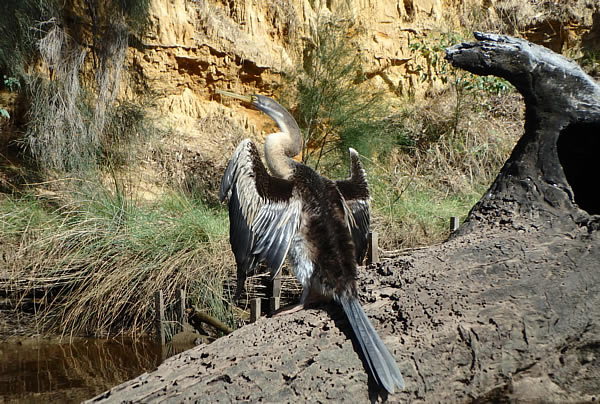
A darter doesn't seem bothered with me being less than a metre away.
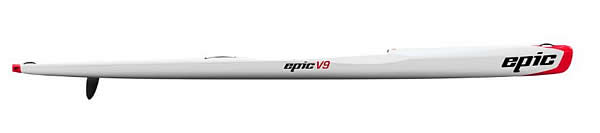
The latest entry to the Epic surfski line up can take you to new and exciting places you’ve only dreamed of: downwind surfing, open-ocean crossings, challenging races, fitness sessions, or just plain fun. Decades of experience in advanced hull designs have produced the most versatile surfski on the water! At 19’ x 19”, the V9 was designed by Epic’s founder and chief designer, Greg Barton, to
fill a sweet spot between the V8 Pro and V10 Sport.
Like the Gen 3 V10, the V9 has been optimized for downwind surfing, with increased rocker, and stability. Flatwater speed is a step up from the V8 Pro due to the slightly narrower beam. This is the boat many paddlers have been waiting their whole lives for – the one that launches you onto the swells, glides efficiently across the water, and keeps you in the “zone”.
Length: 5.79 m (19'0")
Width: 49 cm
Depth: 32 cm
Capacity: 120 kg
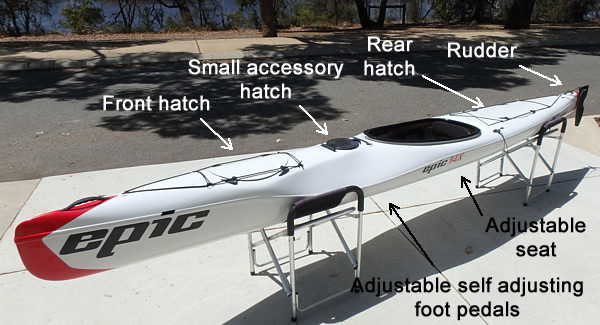
The 14X touring kayak. A great camping kayak or for just general paddling.
The new Epic 14X is the ideal choice for anyone looking for a comfortable, efficient, and responsive day-touring kayak that is as easy to manage on land as it is in water.
The hull design builds off the success of our popular V5 surfski, with the full feature list of our longer touring kayaks like the 18X Sport.
There has simply never been a smarter, better-designed kayak in its class. Paddlers looking for stability and speed will love the 14X, and those seeking adventurous waters will be thrilled by its performance!
SPECIFICATIONS
Length: 14"4' feet (4.4m)
Width: 61.7 cm
Depth: 34 cm
Capacity: 150 Kg
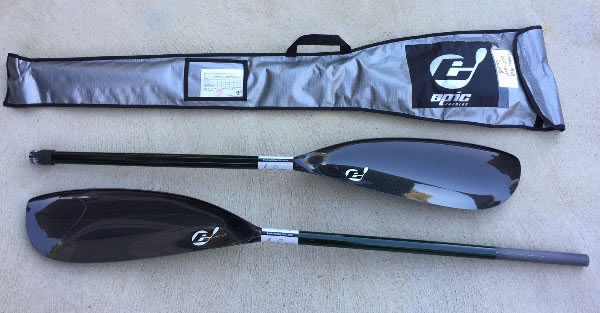
Club Carbon $460.00
Midwing Club Carbon construction - 737 grams; comes standard with Epic’s Length-Lock 2™ adjustable ferrule technology.
Carbon fibre blade, Green oval fibreglass shaft.
Fully adjustable length & feather.
Includes paddle bag.
|
|
|
|
|
|
|
|
|
|