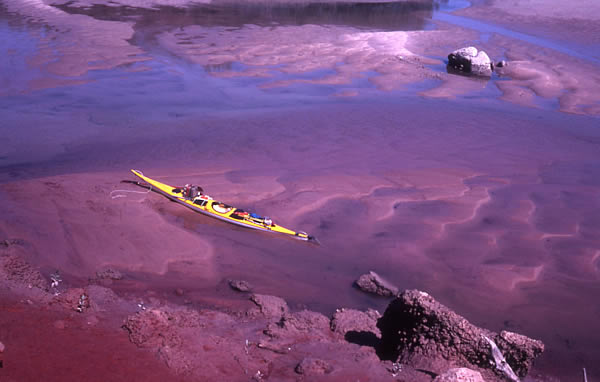
My kayak sits on a sand bar along the Kimberley Coast.
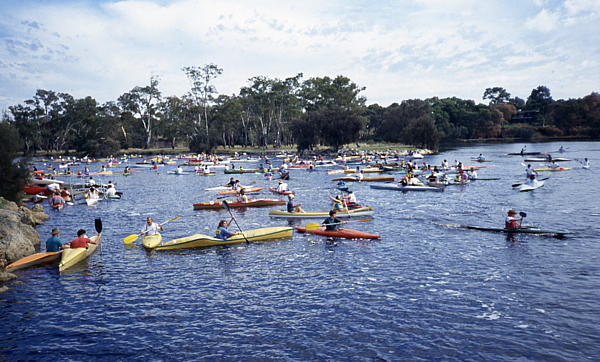
An Ascot Kayak Club event in the 1980s.
Saturday Morning Dash
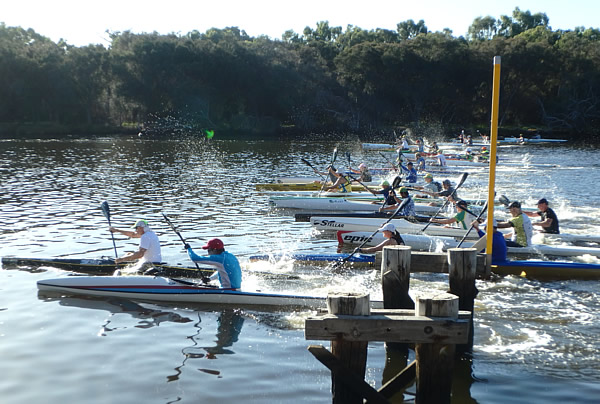
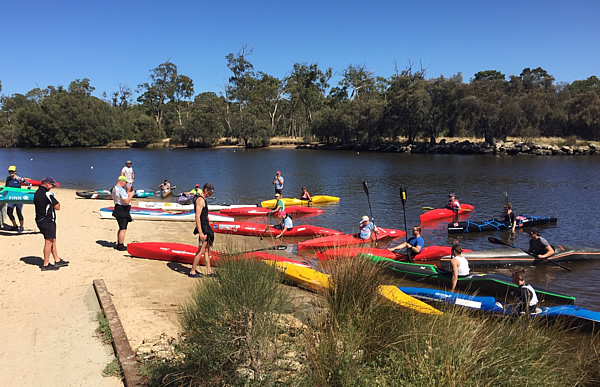
The Saturday morning dash is still very popular with club members from all clubs and non club members. The friendly atmosphere is one of the main reasons it's popular.
Progressive Racing Group
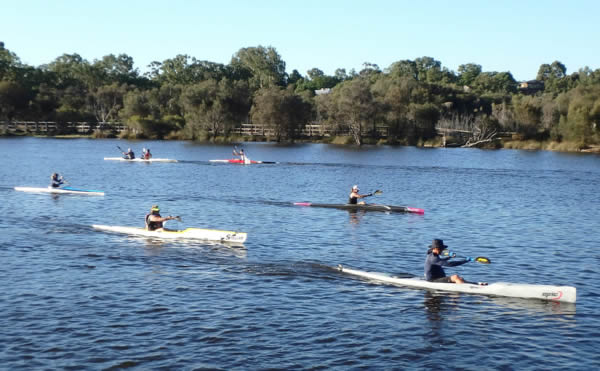
Tuesday evening
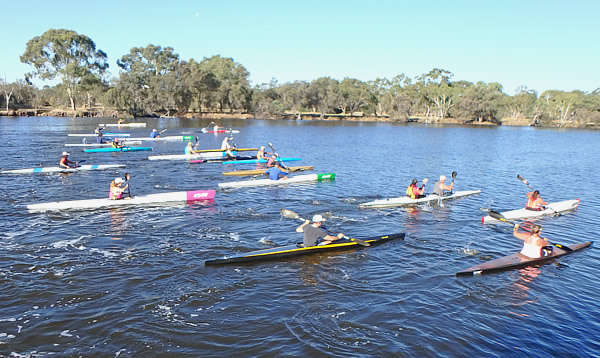
The start of a warm up.
Four of the paddlers are in sync but they went off on different grids.
Summer Down River Series
After 6 Friday morning sessions and races and 2 evening races and 1 Sunday race the Summer Down River series has come to an end.
Tom Canavan getting better with every paddle.
Series winner Luke Dooley.
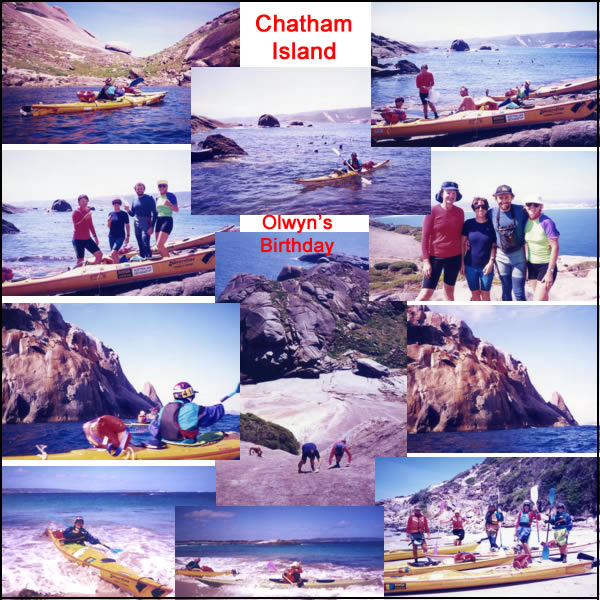
Happy Birthday Olwyn Brown
Olwyn has just turned 75 years old, although she might not want others to know, so keep it a secret.
Olwyn has been paddling socially for many years.
I have backpacked and paddled with her -
she might be small but there is no-one tougher than Olwyn.
On Olwyn's 50th birthday we paddled out to Chatham Island.
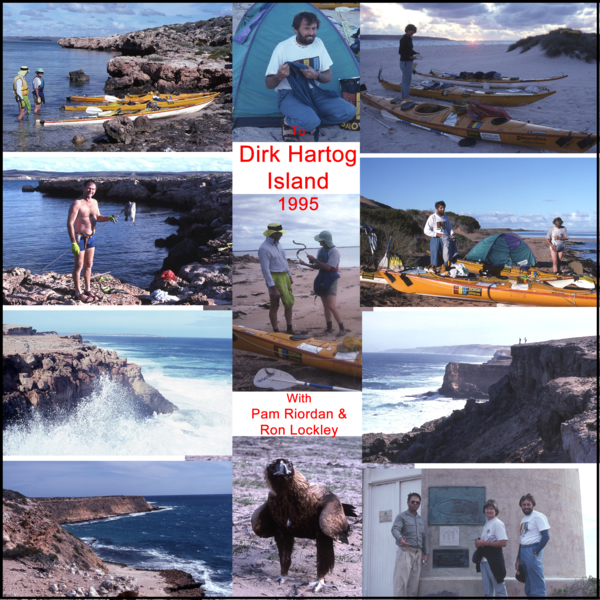
To Dirk Hartog Island
With Pam Riordan
and Ron Lockley
Within minutes of leaving Denham we were seeing turtles and dolphins. In the far distance our first destination Cape Heirisson, 20kms away shimmered through the haze. South of our target we could vaguely see a salt stock pile which for several kilometres looked similar
to a white boat in the distance. It only appeared as a stockpile about half way across. At 12.15 pm Pam declared lunch so we rafted up and floated with the current for 20 minutes until our share of nuts, dried fruits and muesli bars were eaten.
Pam had been talking to several people on the lead up to the trip and many had made her unsure about it. Stories of king waves, big seas, dangerous waters, sharks - the list went on so she was far from confident about the journey although Jenny tried to reassure her
that she was in capable hands!
We arrived at Cape Heirisson where we were going to stop for a break as a flock of cormorants took off from the small cliffs. It didn't take us long before we were exploring the area finding animal bones, rabbit dirt and Ron found a snake skeleton. The point was quite high so we were able to see for miles and our next destination Cape Bellefin which was about 6.5 kilometres away across a shallow channel.
After a short rest we pushed on across the bay. The sea was so calm we could see the bottom. It changed constantly from sand to sea grass and as we peered down we could see a plentiful amount of starfish and shellfish. About 2 kms from the cape, Ron decided to
jump overboard to dive and collect a feed of shellfish. It was perfect, the sun was beaming down, the sea flat like glass and Ron's kayak floated around aimlessly without a paddler. After collecting a feed he returned to his boat.
Once around the cape we found a camping spot about 300 metres south and just moments before landing Pam experienced two large splashes next to her boat, a shark maybe? At sunset jumping fish splashed around and shovel nosed sharks
patrolled the shallows.
Pam had dehydrated some curry at home so she was on cooking duty the first night. After hearing all the stories of the limited selection of food that I usually lived on, whilst on my expeditions, Pam decided to bring more variety. She didn't like
the sound of rice, noodles, dried peas, TVP, and rice pudding and damper every day. Our first meal consisted of oysters/shellfish, curry and rice, dried apples and custard, tea and chocolate, finished off with measurement of port. I don't usually take alcohol on my extended expeditions, water is more important, but I was convinced that it was a social thing to do.
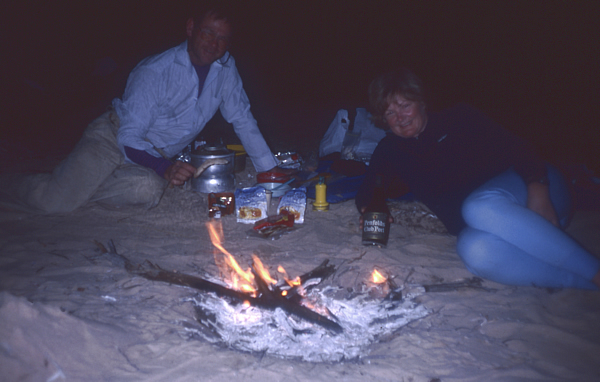
Around the campfire eating some of Pam's delicious dehydrated foods.
By 9.10 am we were crossing the shallows and spotting anything that moved. I kayaked over a 5 foot shark and it didn't seem to bother. Forty minutes later a turtle swam at an escaping pace for several seconds underneath me. I later skidded over a large manta ray, which with a flap of its huge wings shot off into the deep blue.
At 10.35am we arrived at a sandy cove surrounded both sides by 6 metre cliffs. The sign of goat and sheep tracks were visible in the sand ridges. The vegetation was scrappy and skulls appeared at different spots around the cove. Nevertheless it was a beautiful cove. I walked along the cliffs to see small 3-4 foot sharks in the crystal clear below. Stacks of oysters clung to the cliff, a school of small fish and several bigger varieties mingled around a large part of the cliff that had separated
from the rest of the cliff line. On land on a high point there was a large intricately woven eagles nest that was safe from land predators.
As we were about to leave a 5-6 foot shark cruised along our beach and along the cliffs where Pam had been snorkelling. Hell, she said, I'm not going in there again
As we leisurely cruised next to the cliffs we could see the fish mingling below and the millions of oysters clinging to the rocks. Three small blue, - white spotted rays with long slender tails slid underneath me. The 6 metre cliff was overhanging, like a large wave, which was ideal for swallows to nest. An old cluster of oysters clung onto the overhanging roof, two metres above the high water tide mark.
How did they get there, had the ocean receded that much? Cormorants, cranes and gulls bounded from the rocks and cliffs as we passed.
Eventually we left the cliffs to cross a small bay. A fishing boat that we had seen earlier lay deserted and at anchor at the bay entrance. We passed it by. Pam kept saying she was waiting for a rich, good looking sailor to whisk her away, but again it wasn't her day.
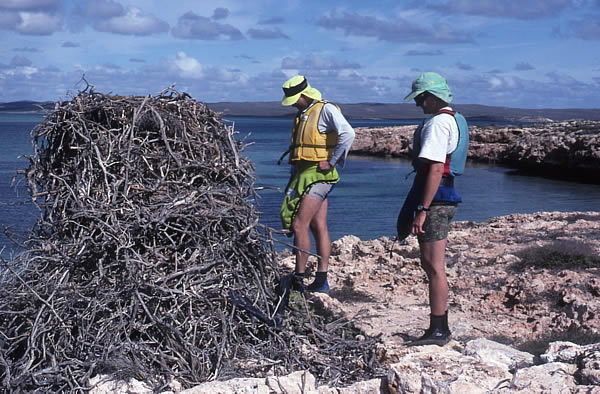
Having crossed the bay we could see a strange object ahead. At first I thought it was a person or two, then a beacon of some sort, but it turned out to be a huge 10 foot high eagles nest. We landed to have a closer look, as it was hard to believe an eagle could have built it so high. Twigs, branches, bits of plastic, even goat bones were intricately woven to build this very high but shallow nest. We found
out later from Keith at the homestead that the eagles build up the nest every year.
What a tall eagles nest.
After finding a campsite on the second night on the south-east side of the island, we prepared for snorkelling in the bay just behind our camp. Pam was first in telling us tales of the big fish beneath the water. We soon followed with spears in hand. I didn't have elastic on my gidgy so I had to poke at the fish which I did successfully on my first go but the fish struggled off. I looked at Pam who was
behind me. Her face was full of sorrow and she probably felt disgusted with me that I was going to kill a fish. I looked away feeling quite guilty.
The cliffs were overhanging with recessed cave areas so after diving below we had to make sure we didn't hit oyster laden areas of the roof on our way to the surface. Below us on the sea floor lay some of the biggest sea slugs that I have ever seen. Some were 2.5 feet long and very fat. Clams were abundant, as were spiky sea urchins and trochus shells. I spotted a 2 foot cuttlefish under a ledge, it was a
strange looking thing. I surfaced to tell Ron and he had already speared one.
We moved to the other side of the bay and ventured out near Cape Ransonnet. The fish were increasing in size and number. I spotted a scorpion fish in a hole, I checked closer as it took refuge. Pam acknowledged the find. What a beauty. By this time Ron had speared 3 fish for tea so it was time to leave. My teeth were chattering by that time from the cold but it was well worth
it.
Dirk Hartog Island was named after Dirk Hartog, a
Dutch sea captain, who first encountered the Western Australian coastline and the island on 25th October 1616.
The island is about 80 kilometres long and between 3 and 15 kilometres wide and is Western Australia's largest and most western island.
At 4.10 am I was woken from my deep sleep and dreams by my flapping tent. The wind had shifted more to the south. It was blowing a gale, raining hard intermittently and my tent now exposed to the
wind found it hard to stay upright. I laid there hoping to go to sleep but I had no hope. The wind became stronger and the alloy hooped poles were straining as the tent tried to buckle horizontally. The flapping increased and the wind grew stronger and eventually I had to venture outside to investigate the peg situation. I had used my two spare paddles as well as my sand pegs to hold up the tent, but they were out of the ground. I had camped in a more exposed area than Pam and Ron so I could get
good views from the tent of the sunset but I paid the price.
The ocean was chock-a-block with white caps which were extremely close together. To the west, around Steep Point of the mainland, and Surf Point the south westerly part of the island, huge breaking
waves were extended far out from its shores. Just to get off our beach was going to be a challenge. It wasn't the day to paddle to Steep Point which we were going to do.
With rain threatening we busily packed all but breakfast gear into our boats. It took quite an effort to stand up straight against the wind, so breakfast for sure had to be eaten in the lee of a sand
dune.
With all boats packed we had our hardest and most dangerous challenge ahead, entering the surf, and trying to keep upright until we paddled around to the sheltered side of the island. Even by my standards the conditions were
atrocious. I couldn't help but notice the amount of yawning that Pam was doing the result of apprehension and nervousness. She said her heart was beating quickly, and had the same feeling as she had before paddling the flooded Murchison River, two months earlier. Afterwards she said that my encouraging words; “if you are going to fall out Pam don’t do it near the cliffs,” didn’t help her feel any calmer!
Pam was positioned for the big push off. The waves were crashing onto the beach constantly so it didn't really matter when she left. Even with myself and Ron trying to keep her boat straight for the
final push, the waves hitting the boat proved to be very strong. Our push propelled her out into the ocean like a rocket, but the boat slowed as it hit the oncoming waves. The kayak screwed round to the right, the opposite direction to where Pam should be heading. With strong sweep strokes Pam struggled to persuade the boat to turn. The bow crashed constantly through the waves and the boat bobbed up and down like a yo-yo and wallowed in the wishy washy swell. I stood watching and wondering about
her fate. The strong wind was making her fight to make headway. Continual white caps also slowed her forward motion. Hang in there Pam, I thought.
Ron was next to go. He took off through the same slop but was advantaged by his much more stable boat and precise rudder control, which assisted with turning. With both boats now fighting the
conditions, it was my turn. Being the most experienced I was left to fend for myself and it didn't look like an easy task. Pam and I were paddling Nordkapps that have very small cockpits and hard to get in and out without using the paddle behind our bodies to assist with stability and to slip into the cockpit.
The beach was steep with a two foot high sand build up made by the high tide and dumping waves. This meant I couldn't get my boat to sit flat on the sand. The waves were pounding in on an angle and
very frequent and I was wondering how I was going to tackle it. There was too much bouncy slop to drag the heavy boat into the water, get in with the paddle used as an outrigger, put on the spray cover and paddle off. It just wouldn't work in these conditions. The only hope was to jump in quickly, paddle off from the beach and hope that I could get my spraycover on before waves filled the cockpit. Like I expected the wave angles made launching difficult. I struggled as I attempted to make a run
for it and the waves pushed me back towards the beach sideways. The heavy kayak didn't help but somehow I avoided being beached broadside and managed to paddle away from the beach to join the others.
It was rough out there, the channel was really stirred up and it was advanced paddling for sure but the further we paddled up the channel and closer to the homestead the calmer it became.
At the homestead we were greeted by Keith the environmental advisor. After a short talk we were invited to use the backpackers accommodation instead of camping which was $9.50 per night to camp on
the island. The old shearing shed which had beds inside, was very clean and spacious and had a sense of nostalgia. An ancient wool press and shearing equipment made it more like a museum.
We met Mike the builder/handyman, Steve the sheep/windmill man and Suma the wedgetail eagle. The wedgetail had been reared by Steve from a chick and still thinks it's a baby. It walks a lot and
just cruises around the homestead.
We were greeted to the homestead by Keith the environmental
advisor.
He and the workers couldn't believe that a women, a man with no fingers on his left hand and a scrawny little man like myself could have paddled across to the island from the
mainland.
Just after 7 am we rose, had breakfast and prepared ourselves for a walk to the cliffs to check out the blowholes. Our route was about 23 kilometre round trip, by track one way and cross country on
the return. It was 7 kms to the cliffs in a straight line. The windswept island was a sensitive environment and with a population of sheep and goats it has little opportunity to regenerate to its native state. This was evident on our walk but they are now trying to bring it back to its natural environment. Although there was lots of low scrub, it was fighting to survive. There were no signs of lizard tracks or snakes along the sandy track but there was some bird life, but very few.
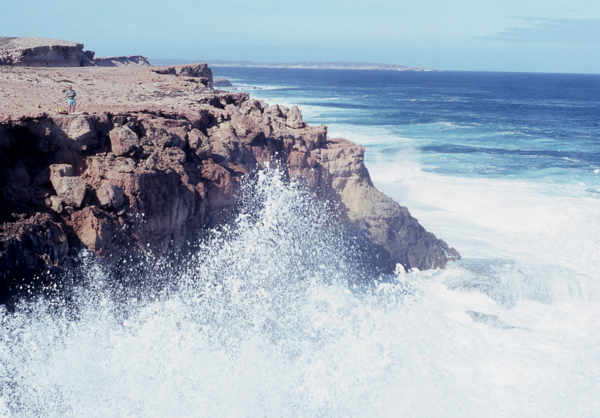
After a 2.5 hour walk we arrived at the cliffs. It was a spectacular sight. The waves created by the huge rolling swell crashed down on the lower cliff ledges, boiling backwash stirred anything loose
on the reef. Although it was quite rough, the ocean certainly looked more inviting than the previous day.
We walked towards the blowholes which could be seen for hundreds of metres. Huge sections of the cliff had broken off and tumbled to the base. Approaching the blowhole section waves pounded directly
onto the cliff which sent water splashing higher than the cliff itself. There were several small blowholes operating but when big daddy fired up, the noise of the wind being pushed through the hole was frightening. When the water spray and wind draught reached the top of the cliff you had to stand firm. The thought of the draught pulling me off the cliff was quite real.
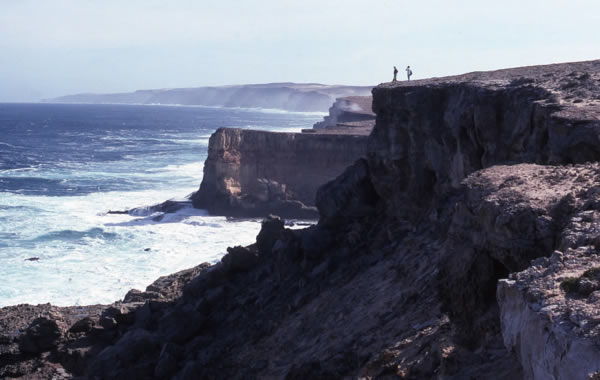
I sat on the edge of the cliff, eating my nuts and dried fruit watching the surf pound the shoreline to the north and the south. The blowholes hissed and were more effective on every six or seventh swell. Steep Point could be seen in the distance further down the coast about 12 kilometres away. The cliffs stretched for 82 kms all along the west side of the island.
Waves crashed up the cliffs.
The cliffs stretched for 82 kms along the western side of the island.
At 11.15 am we decided to move off north along the cliffs for 45 minutes and then walk directly across
country towards the homestead. As I moved off a small lizard ran under my feet and then retreated under a rock. We checked to see if it was okay, it was the first lizard we had seen. There were no rabbits, no foxes and no wallabies on the island, but there were feral cats. The wallabies had been wiped out several years earlier.
Our 45 minute scenic walk along the cliffs came to an end. We climbed a sand dune to the east and checked our bearings before heading off towards a well. On the way two more small lizards were seen
and Pam found a very healthy looking bobtail lizard (blue tongue). It had no ticks on it and looked in top condition. We were told later ticks were not on the island.
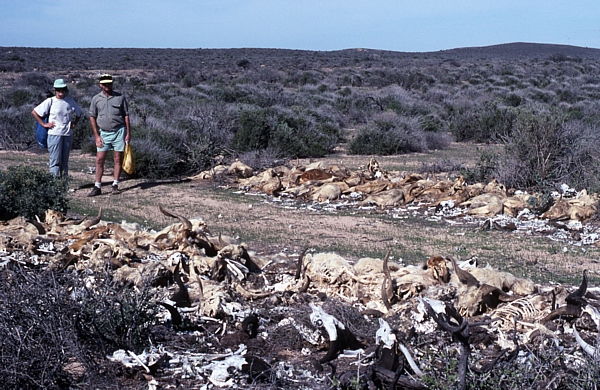
Approaching the well I noticed something that looked like carcasses. Ron said they were rocks but after a closer look they were carcasses. We walked over to check and found hundreds of dead goats
piled in avenues. The sight was a little disturbing but goats were a pest on the island. The smell was unbearable on the downwind side. As we walked away from the more freshly shot carcasses there were hundreds more scattered all around the well in different states of decay. It was one huge grave yard for goats.
The goats are mainly trapped in the summer months when water is scare. Once they enter the enclosure they are shot. With capstone being just under the surface of the scrub and no dozer on the island
it is impossible to bury them. It is a place you just wouldn't want to take tourists to. As we walked through the enclosure of death I could only think of the TV series the `X Files'.
We followed a race, indicated by two fence lines, back towards the station. I had kept Ron and Pam occupied all day by telling them stories of some of my experiences. I'm sure they were really
interested, as they were quiet and didn't complain.
On our return Keith indicated that Kieran the boss, who was 20 years old, was flying in that afternoon and going up to the top of the island in his four wheel drive the following day to take a power
boat part to the campers. We were invited along for a free ride.
That was a few memories of our first three days.
Hundreds of dead goats are the result of culling.
Avon River Whitewater Trips.
Canoeing Down Under Courses.
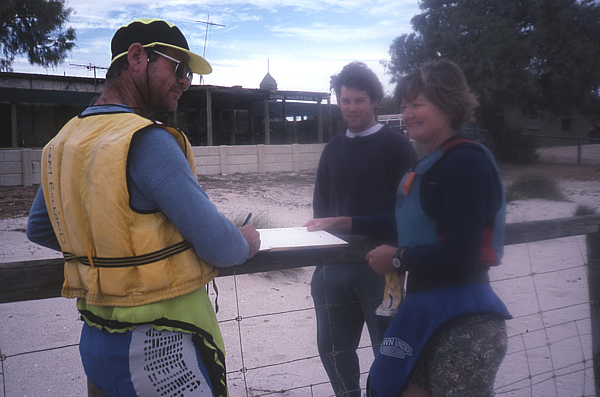
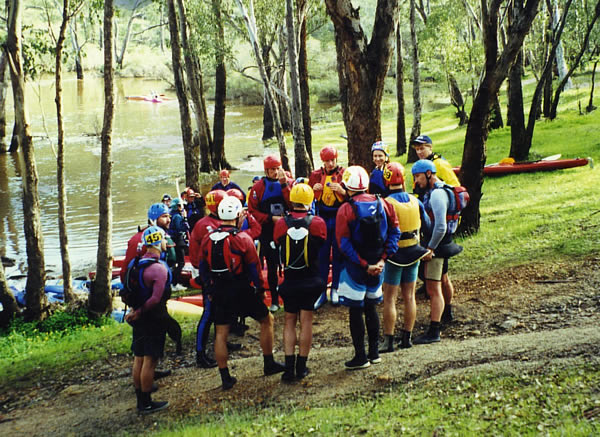
Pam Riordan, James Earl, Lawrence Greed and John Dinucci give a briefing before the start of a 6-8 hour whitewater paddle.
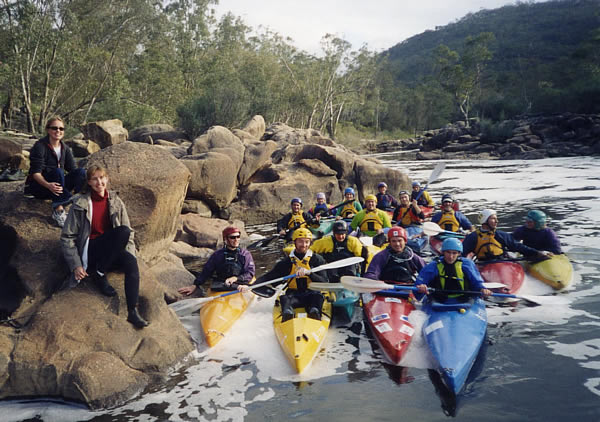
Just down stream of Emu Falls.
Pam Riordan, Ed Vaneer, John Dinnucci and I get the group together before moving downstream. Back then short plastics were the most popular boat.
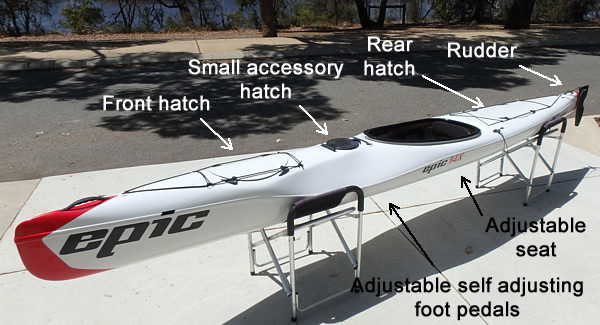
Epic 14X Kayak
Going on a weekend or a month paddling trip.
It has huge storage areas bow and stern for all your camping gear.
15.4 Kgs
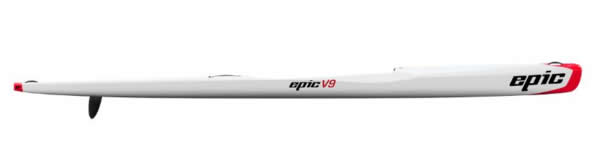
Epic V9
The Epic V9
The ski suitable for different skilled paddlers.
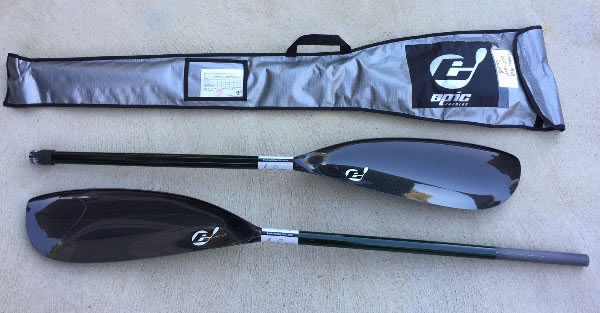
Epic Paddles Lightweight and a treat to paddle with
Club Carbon $460.00
Midwing Club Carbon construction - 737 grams; comes standard with Epic’s Length-Lock 2™ adjustable ferrule technology.
Carbon fibre blade, Green oval fibreglass shaft.
Fully adjustable length & feather.
Includes paddle bag.