|
|
|
|
- Join the AKC Paracanoe Program
- A Trip to Penguin Island.
- Sunset Downwind Series
- Sprint Regatta #4
- Kimberley Expedition - 100 days solo - part 20
- Paddle WA Direct Membership (Insurance Plus $85.00)
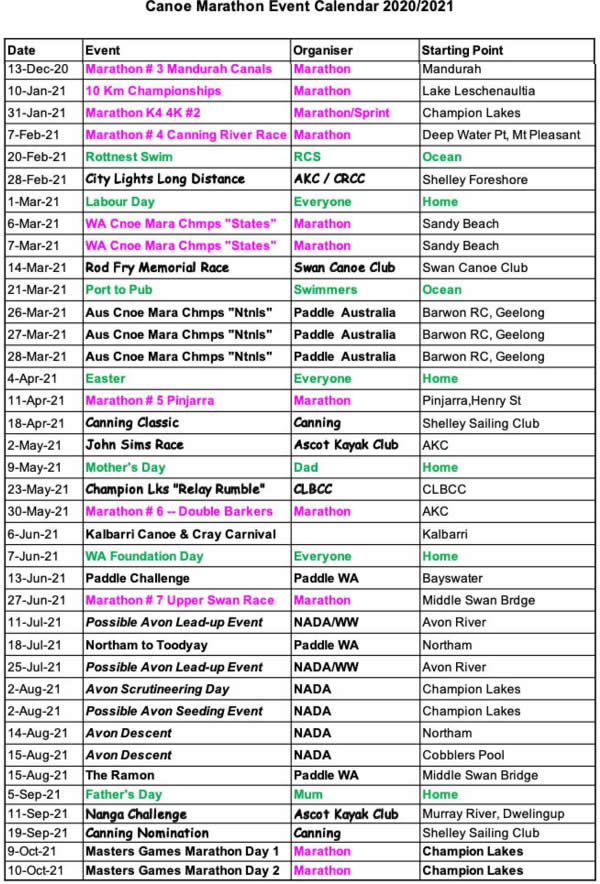
- Up-coming Races
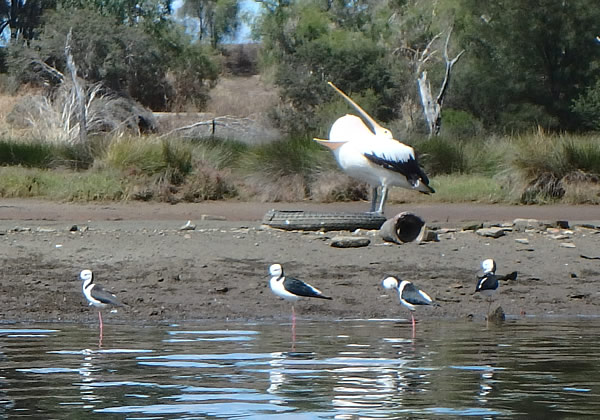
Four Stilts and a Pelican yawning at Ascot Waters.
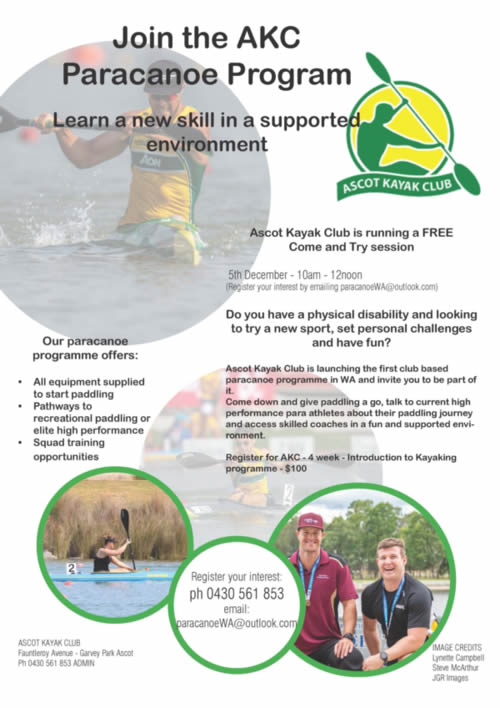
Ascot Kayak Club Paracanoe Program
Saturday 10-12noon - If you have a physical disability or know someone who does and would like to learn to paddle, we are running a Free come and try this Saturday
AKC is excited to launch the first club based paracanoe program in WA.
We are running a free Come and Try session on 5th December 10-12noon. Learn a new skill in a supported environment.
Contact paracanoeWA@outlook.com for more info.
Live_Lighter Healthway Paddle WA
#paddlewa #HealthwayWA #livelighter Inside WAIS
Call 0430 561 853
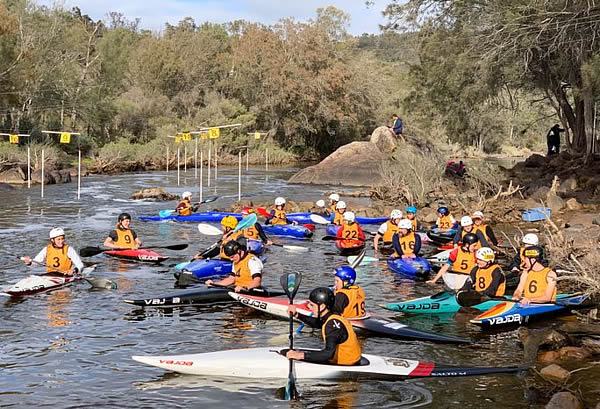
WA Slalom Summer Series #3 -
Sunday 5th December 3pm.
Sunday's race is a PARALLEL SLALOM RACE and will be held at Ascot Kayak Club. There will also be CASH PRIZES!
Being a parallel slalom race (with handicap starts) anyone can win so we encourage all juniors (& those not so junior) to join in the fun!
There will also be a BBQ (please byo food and drinks), presentations and the announcement of our 2020/2021 Slalom WASPS Team after the race. Racing starts at 3:00pm. Race Fee $10 payable on the day. Look forward to seeing you all.
The Duel
Downwind Race
Sunday 5th December
Mandurah
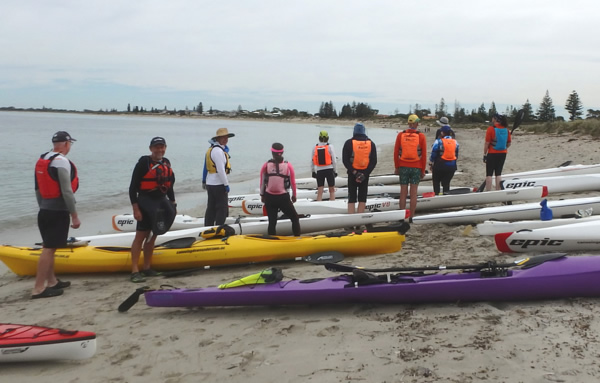
A Trip to Penguin Island
to find
Sun, Sea Lions, Sharks, Dolphins and some good snorkelling!!
It was going to be an Epic Day.
Photo Wise Ray Smith
Alaine tells everyone to turn around and they did.
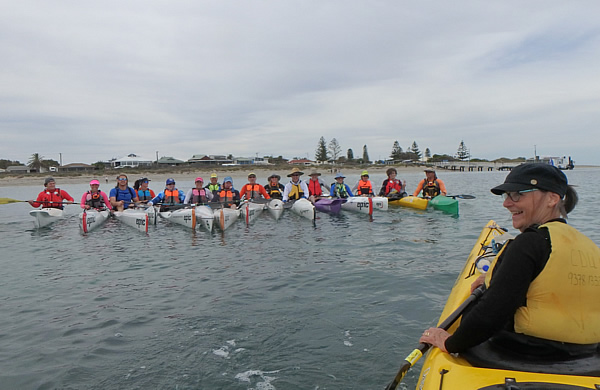
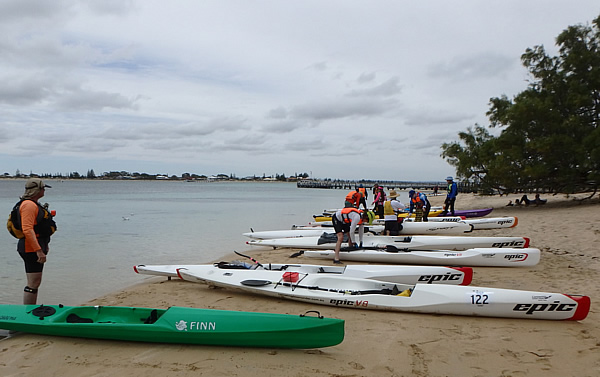
We raft up before heading off.
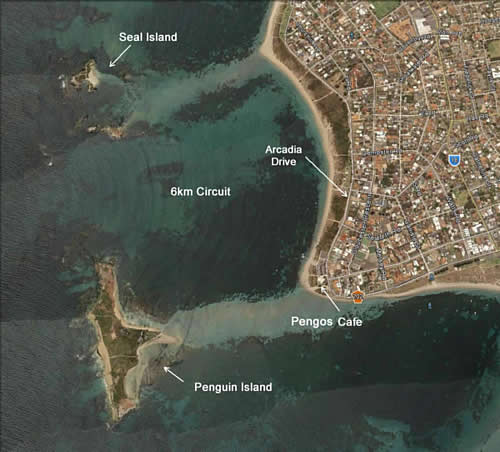
I did tell everyone that we would be seeing sun, sand, sea lions, dolphins and some great snorkling so the PRG gang were all excited as we left the beach and headed to Seal Island. The day was cloudy and there seemed to be no life on the ocean only a few pelicans flying around.
We arrived at Seal Island and there were no sea lions to be seen. What no sealions! I expected to see one at least, either hidden somewhere on the sand or a head to pop up beside us but none appeared. Our hearts sank a little as we checked around the island to find nothing. (Steph found out later that males are the ones that use the island and apparently they had gone north to Jurien Bay to find some females to breed.) I had been to the island many times and I’ve always seen sealions. However
there was a bit of excitement when Alaine said, look at the pelicans riding the thermals high in the sky over on the mainland. We looked closer and they were sky divers.
We get to seal island and there are no sealions.
What no sealions!!
We search.
We found out later that the sealions on the islands are all males and they have moved up north near Jurien Bay to meet females and make love.
We moved on moving around an island and headed towards Penguin Island trying to spot a dolphin but there were none to see. We never did see one - another disappointment.
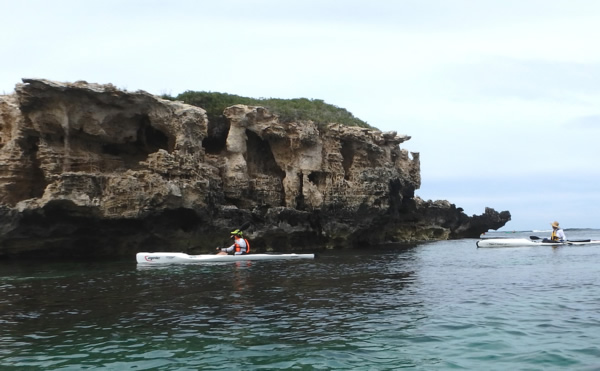
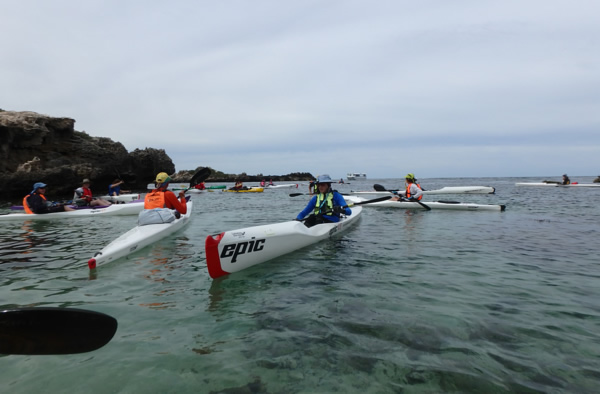
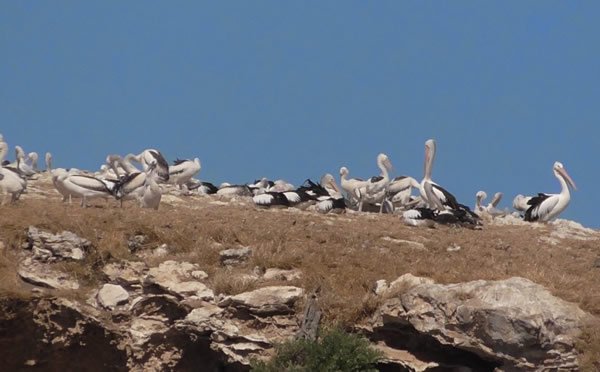
It looked a little too rough on the outside of Penguin Island for our group to circumnavigate so we headed to the most southern point of the island on the much calmer eastern side. At the point the sea got sloppy but the cliff was full of pelicans. As we backtracked only three paddlers decided to circumnavigate the island, Geraint, Kate and Izzy.
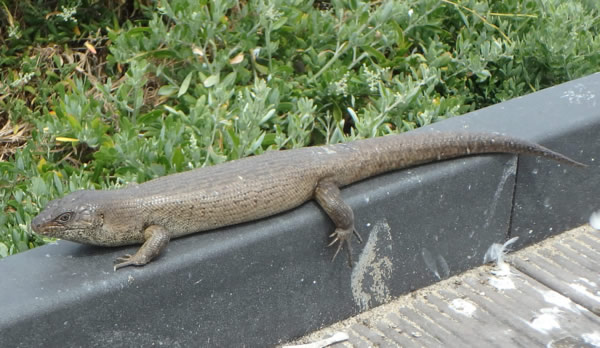
Meanwhile the rest of the gang landed on Penguin Island and a few of us walked across the island to the western side seeing several skinks on the way and a lot of terns.
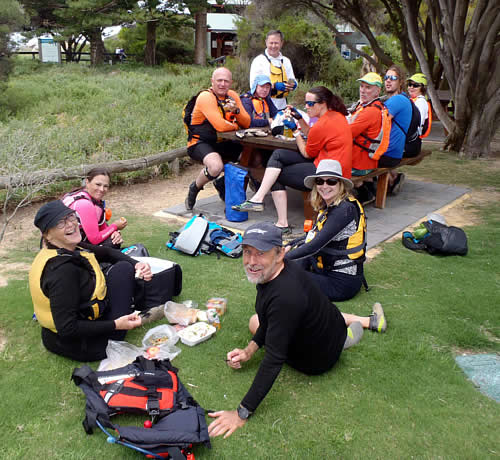
Lunch was eaten with much chit-chat and laughs on the grassed area near the Discovery Centre. It was too cold to think about snorkel diving so we all chickened out.
So far there was no sun, no sealions, no dolphins and now no one wanted to snorkel.
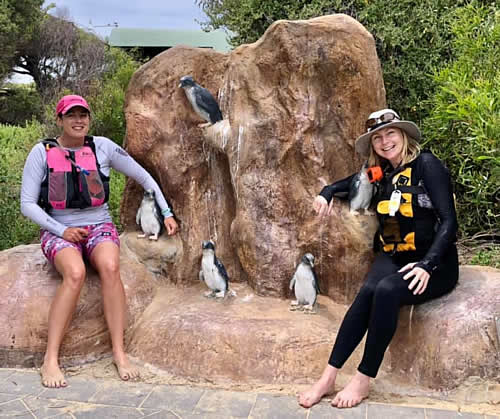
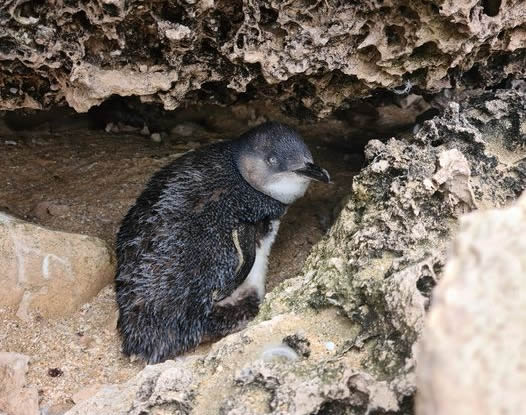
Despite the lack of aquatic creatures Kris and Steph did see a penguin and with 18 of us throwing around much banter we still had a great time.
You will find lots of King's skinks on Penguin Island.
Steph and Sharon happy to see some penguins.
Photo Nigel Emmett.
Lunch time on the island.
Photo Wise Ray Smith.
The Shoalwater Islands are a chain of islands between Cape Peron and Becher Point that run parallel to the coast near Rockingham, about 50 km from Perth. The chain comprises Penguin Island, Shag Rock, Seal Island, Gull Island, Bird Island, White Rock, The Sisters, Passage Rock, Third Rocks, First Rock and Second Rock. It covers an area of about 16ha. The Islands have significant
conservation value. About 50 species of birds use the Islands, some for nesting, feeding and roosting. They include migratory species that are covered by international treaties. Penguin Island supports the largest breeding population of Little Penguins on the west coast of Australia. The Australian Sea-lion, a species gazetted as in need of special protection, uses Seal Island and occasionally other Islands as resting sites. Penguin Island, the largest Island in the chain, covers 12.5ha and is a
popular visitor destination, providing a range of recreation and interpretation/education activities.
Penguin Island attracts many tourists, including people from interstate and overseas. Researchers study the Island's wildlife. The diverse natural resources on the Shoalwater Islands have conservation, recreation and education values that are enhanced given their proximity to the metropolitan area. Along with the Shoalwater Islands Marine Park, the islands and their surrounding waters,
which are important feeding areas for birds and Sea-lions, have long been recognised as having high environmental significance and recreational potential.
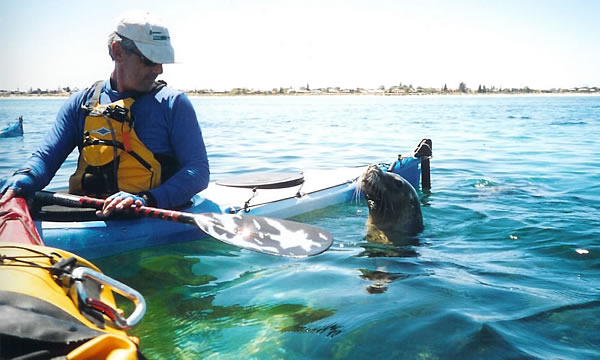
A sealion says hello to Tony Chounding on a previous trip to Seal Island.
A Little Penguin on Penguin Island taking shelter.
Photo Kris Smith.
If you don't see a penguin there is always - the Penguin Island Discovery Centre and the Penguin Experience - This unique viewing facility allows visitors to view rescued little penguins that could not be rehabilitated and released to the wild. Little penguins are normally quite secretive and are rarely seen in the wild. Penguin information sessions commence at 10:30am, 12:30pm and 2:30pm during the island’s open season and provide visitors an opportunity to learn about the intriguing life
of little penguins. The glass walls of the pool provide an unrestricted underwater view of these delightful animals. The centre also has information panels and touch-tables to help visitors learn more about the island’s inhabitants and history.
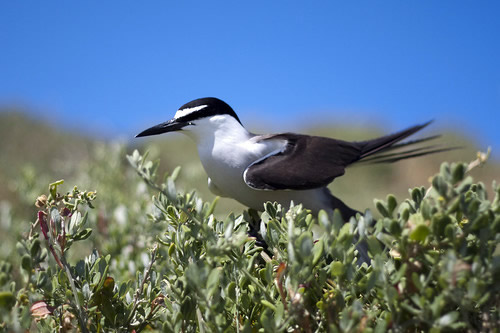
Bridled Tern
Stock photo.
Shoalwater Islands support a significant number of sea birds. Fourteen of the 48 species recorded in the area nest on the Islands, including the Little Penguin, Little Shearwater, five species of Tern, White-faced Storm Petrel and Pied and Little Cormorants. Some species, including the Caspian Tern, Bridled Tern, Ruddy Turnstone, Whimbrel and Bar-tailed Godwit, are covered by migratory
bird agreements with Japan and China. The plan encourages appropriate research on these species and their nesting, feeding and breeding habitats, and prohibits public access to specific areas. Up to 500 pairs of Little Penguins have been known to breed on Penguin Island. This isolated and distinct population may represent a sub-species. Whereas the past management of Penguin Island was more concerned with catering for visitors than conservation, this management plan minimises the number of
buildings on the Island to enhance the availability of nesting sites, and closes the Island to the public during the peak Penguin breeding season. Seal Island is closed to the public to protect the Australian Sea-lions, a species gazetted as in need of special protection. The beach area on Seal Island cannot support both the Sealions and the large number of people who visit the Island. People can observe the Sea-lions from boats and guided tours to Seal Island will be
considered.
Pests
Current estimates show that up to 4 000 pairs of Silver Gulls nest on Shoalwater Islands, including 3 000 pairs on Penguin Island. Before 1940 the figure was 200 pairs. The availability of food from landfill sites on the mainland is believed to be responsible for the population increase. The number of pigeons on the Islands is also increasing. Pigeons are not a native species and compete with sea birds, including the migratory
Bridled Tern, for breeding habitat. The increase in their numbers is related to the availability of grain from Kwinana. Methods will be instigated to control both the Silver Gull and pigeon populations. To this end CALM will continue to liaise with the City of Rockingham, CBH and other relevant agencies to limit the availability of food.
Six species of reptile are found on the Islands. All six species occur on Penguin Island. Three species, including the King Skink (Egernia kingii) are common, two species less common, and one species is scarce. The Fence skink (Cryptoblepharus plagiocephalus) is probably recently introduced. Only 23 one, the Marbled Gecko (Phyllodactylus marmoratus), is known to occur on some of the
smaller Islands.
from Parks & Wildlife.
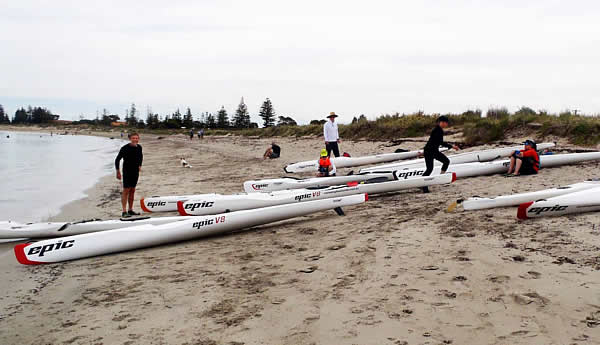
Sunset Surfski Series Race #3
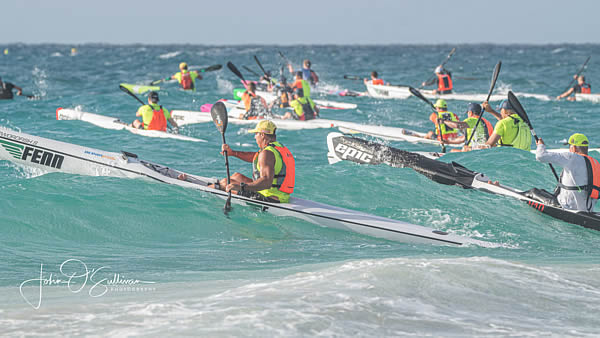
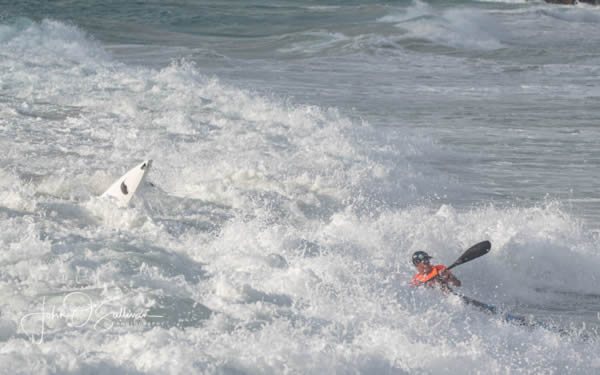
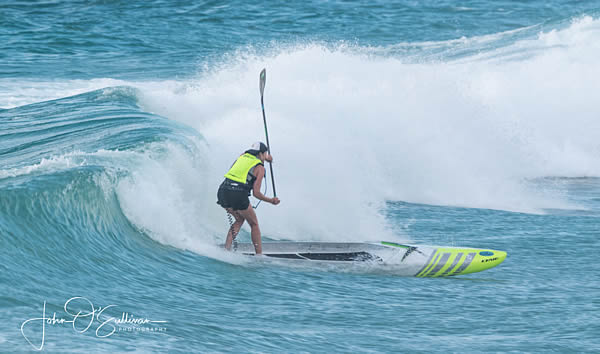
Competitions break through the surf to head to the start.
Photo John O'Sullivan.
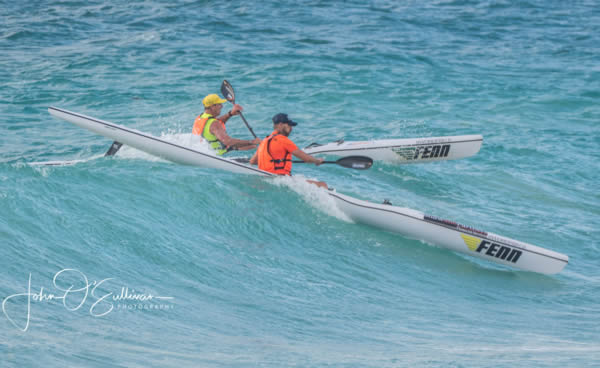
Going for a ride which just might turn into a swim.
Photo John O'Sullivan.
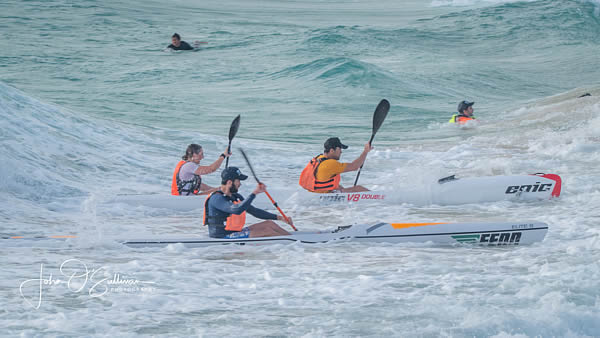
The beach break was a little bit sloppy!!
Photo John O'Sullivan.
The waves at the finish were bigger than most paddlers wanted.
Some didn't survive.
Photo John O'Sullivan.
I'm not sure what happened next but it is a spectacular finish.
Photo John O'Sullivan.
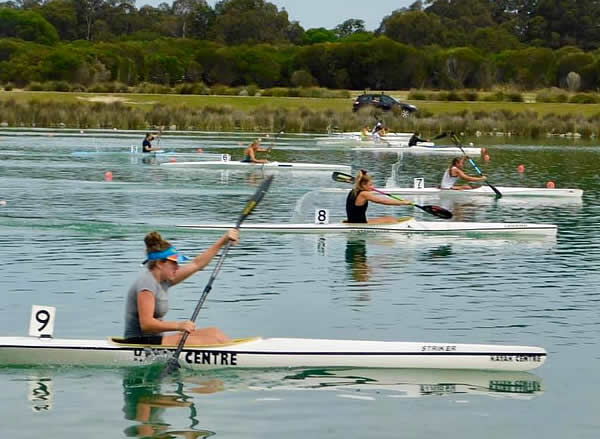
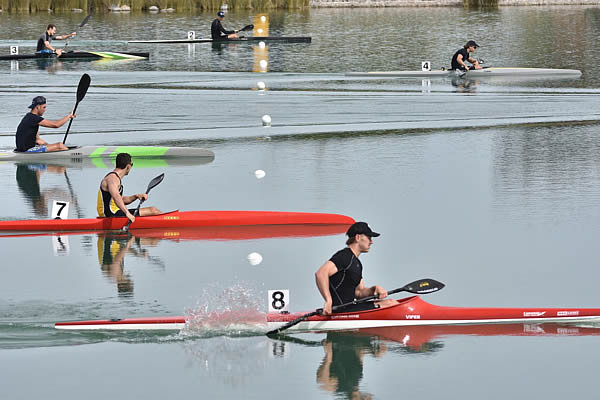
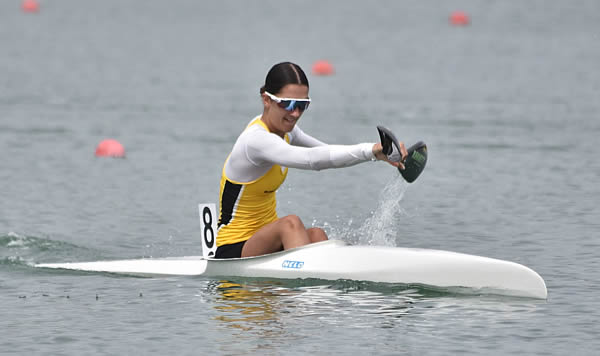
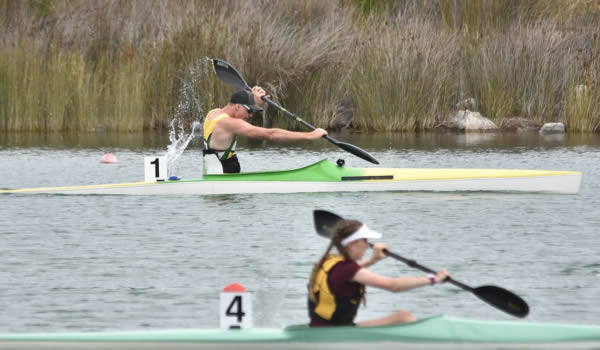
WA Sprint Regatta 4
29th Nov
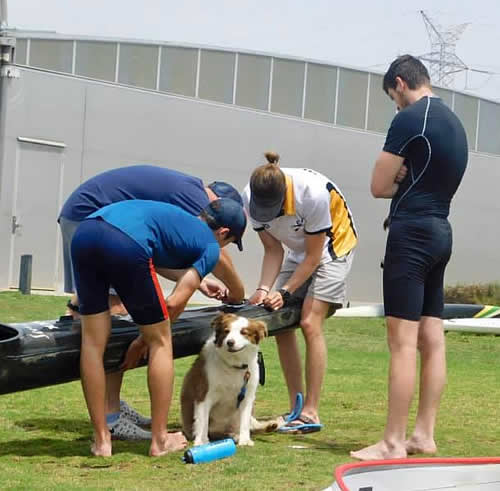
It takes a dog to sort out the problems!!
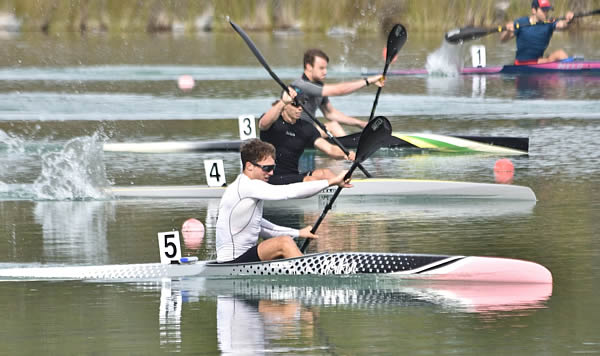
Open males go for it.
Photo Lawrence Greed
The ladies are away.
Photo Lawrence Greed
The top guys finish their heat.
Photo Lawrence Greed
Hana Vanek
Photo Lawrence Greed
Para paddler Ben Sainsbury and Scarlett Florisson power away.
Ben is training hard to get in the Para Olympics.
Photo Lawrence Greed
September 12th, 2017
IT WAS a track that experienced motocross rider Ben Sainsbury had ridden countless times.
But during a warm-up lap last Monday, the 16-year-old was flung over his handlebars as he rode over a small jump.
He landed head-first and his motorbike slammed into his back, the impact shattering two vertebrae and severely damaging his spinal cord.
Nine days later, Ben is out of intensive care but the extent of the injury to his spine is not yet clear.
He can use his arms but cannot feel anything below his chest.
Elder sister Cassie Strebel said surgeons had inserted two rods to stabilise and realign Ben’s spine and they were waiting until swelling subsided.
“It’s a really unknown time,” she said.
“Everyone is really positive, we know Ben is a fighter and he’ll give it everything he’s got but... spinal injuries are really serious.”
Ben was training for a State competition when he was injured at his local track.
The Year 11 student was wearing all his safety gear and his sister described the crash as a freak accident.
“Ben did everything possible to be safe and has always been a careful rider. Thank god he wore all that gear... because if it wasn’t for that, we probably wouldn’t be here right now,” Mrs Strebel said.
“Motocross is a sport like any other sport that has its risks.”
RPH orthopaedic spinal surgeon Edward Baddour said he did not think Ben would need more surgery but faced a long rehabilitation.
“The spinal cord recovers at a very slow rate and one cannot predict the extent to which it recovers or the length of time it takes to recover,” Mr Baddour said.
Ben and his family are not giving up hope and are grateful to everyone who helped the injured teen at the track and the medical team that has treated him.
Ben has no feeling from his chest down. Three years on Ben is paddling hard in the hope to make the Olympic Para Team.
Kimberley Kayaking 1982
part 20
100 Days Solo
Sharks - sharks and more sharks
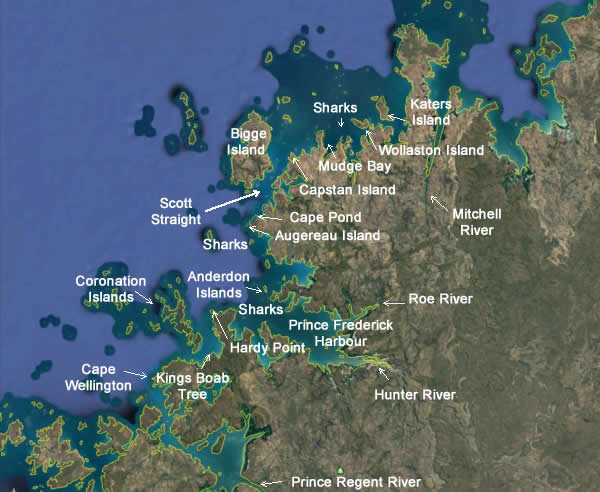
It was 4.45 am, dark, but I was keen to get on the high seas whilst it was calm. Crossing the entrance of Port Nelson the receding current ensured me a push to Hardy Point 14 kms away. Two hours had passed, so before rounding the point I decided to beach, stretch my legs and have a leak. In the open water around Hardy Point the easterly winds were having a ball making my passage to Cape Torrens something to remember. In a sheltered spot before Cape Torrens I
un-strapped my cup off the front deck, put it between my legs and had a leak. I knew I couldn’t paddle the next 12 km without having a pee.
Everything was now sweet, I moved out of the lee of Cape Torrens and into the adverse conditions and rough waters of Prince Frederick Harbor where I was thrown around like a yo-yo. Luckily the waves were coming straight at me. About 1 km out I heard a giant splash close to my rudder. I glanced behind to see a circular mass of turbulence, but again there was a worrying sight of nothing. With the exposed crossing just begun I was ill at ease for the remainder of my
passage, and the slapping of white caps that broke around me didn’t help.
After 35 kms and six hours of paddling I lost all concentration, I was feeling buggered and I couldn’t wait to hit the beach on Anderdon Island. In a semi-trance, knackered and with a sore bum I had to work quickly once I hit the beach as the tide was coming in. The best thing to freshen up was to have a wash, a cup of coffee and some dried fruits. Usually after I’ve been through this ritual I became human again and felt on top the world and ready for anything.
As I walked down to the water I saw an animal bigger than a rat, but slender with a long tail. It swam through a pool of water to get away from me. I didn’t recognise it but it was certainly wasn’t a quoll.
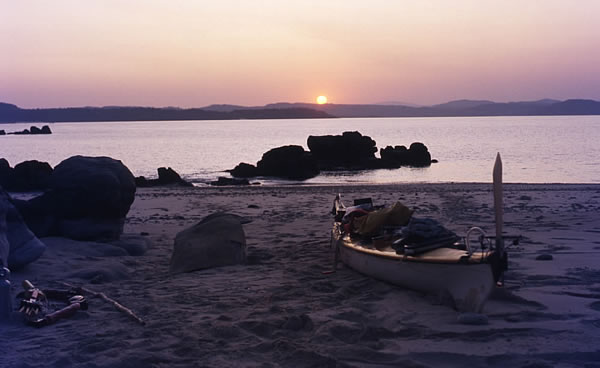
As the sun sets I am in one of the most remote places in Australia.
It was extremely warm in the night but when I rose at 5.00am it had cooled down. There was already an easterly breeze which hit me side on for 21 kms until I rounded Augereau Island. It was 2 ½ km before Augereau Island when I heard another loud splash behind me. I turned and saw a circle of white water and about five seconds later it splashed again, followed by a gurgling noise. A few seconds later I saw the shape of shark just below the water.
My next destination was Cape Pond, and I was heading into the wind and waves which were increasing in height and making my progress extremely slow. After 33 km and with 1 km go to my campsite I felt much safer as a waves died down. Then, crunch, something hit my side near the left rear hatch. The bump dislodged my bow on the back deck which I thought was extremely secure, but it now hung in the water dragging by the side the kayak. The bump and the splash it
created indicated to me that it was very big shark. Being so tired this was the last thing I wanted. I paddled much quicker, keeping my hands higher than usual, reaching a beach that I felt like kissing. I had been paddling for 7 ½ hours and the extreme heat, the conditions and the invisible sharks were draining.
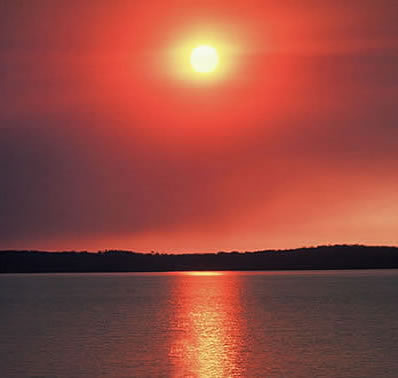
On my walk around the small island I came across a hornets nest. They always say where there are hornets water is close by. A cloud from a bush fire over on the mainland turned the sky red for a short time as it semi blocked out the sun. When it got dark I spotted two lights over on the mainland and at first I thought they were people, but then I realised the orange lights were the tail end of a bushfire.
A bush fire cloud passes across the sun.
As I took off at 5.40am the sea was calm and with it being neap tides there shouldn’t be as much current to slow me down. As I paddled through Scott Straight, Bigge Island was over to my left, looking barren and nothing to get excited about. My maps which have been very reliable, although not perfect, now missed a few rocky outcrops. Tuna were leaping in the beautiful calm waters and a bushfire was
raging in several pockets on the mainland as I passed Capstan Island heading north-east into Montego Sound. I had been paddling for six hours with only a slight breeze to worry me. In that time I allowed myself only two drinks but after a few hours I munched on dried fruit every 20 minutes. This kept my mouth moist and took the yucky taste of the water away. Water was now very scarce so I had to be very careful not to waste any. It was Tuesday 12th of October and getting
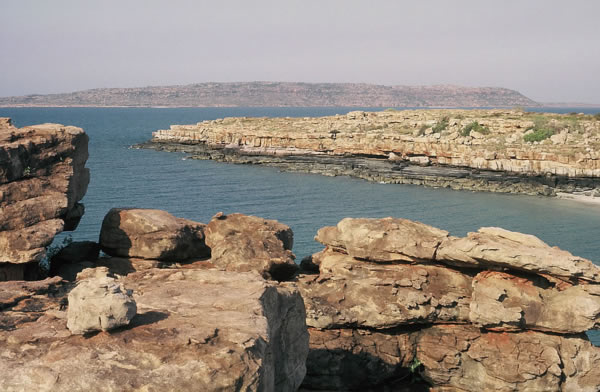
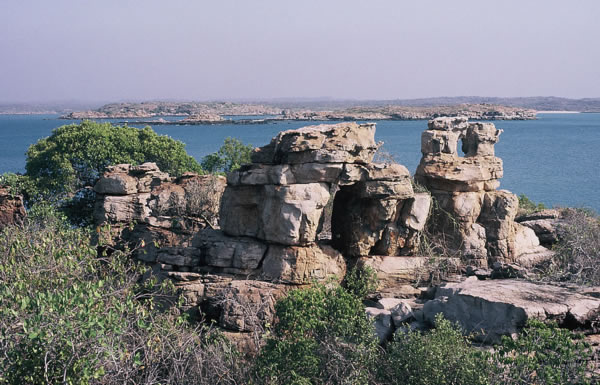
extremely hot in the north. The hills and islands around me were barren with stunted trees, spinifex and lots of rock. There were still many high ranges and cliffs. It was a different kind of beauty and the barrenness made it feel that more isolated. Ten days out from Kuri Bay and not the sole, or a boat to be seen. This was my world.
Trees are more sparse as I move north.
The islands are still rugged and very isolated.
I was told of a water hole in Mudge Bay although I didn’t see it as being a reliable source. The country was so barren and hot and the peninsula was not much more than a kilometre wide. It also meant a 13 km detour, but my water stocks were getting low so I needed every drop I could collect. I have been very careful with my water since leaving Prince Regent just in case this reliable spot that I was told of was dried up. I moved along the beautiful range of hills
heading south towards the creek in Mudge Bay. Somewhere between all the rocks was an entrance to a small creek. I couldn’t see it for the life of me until I got very close. It was between large boulders, then there was a sharp right turn to get up into the creek. At the end of the creek I had to leave my kayak on the mud at low tide. It was hard to imagine that any water could be here, the catchment area was only a few hundred metres long, but I noticed doves so they inspired me to climb a
fairly sheer ledge up into the gully. The gully was one mass of spinifex, fallen trees and rocks. I was only in my canoeing gear so the spinifex played havoc with my bare legs. There was no obvious signs of water, only kangaroo poo. The spinifex covered big holes between the rocks that I fell down. It was hot, my thirst was killing me as I clambered higher and higher up the gully. Reaching the top of the gully I retreated very disappointed. Walking through the spinifex I felt a sharp bite which
I instantly thought was a snake, so I immediately checked my leg to find a sharp twig stuck in it. Blood trickled but it was nothing serious to worry about.
Further down the gully sitting in a stone basin under the shade of a rock cavern I noticed two pools of water. It was brown and looked revolting. I tasted it and spat it out straight away. It was kangaroo urine for sure.
I thought I had been poisoned. The taste in my mouth was indescribable and the smell of it was even more horrific. Just the thought of drinking it made me think of spewing up and it took hours for the taste to go. I’ve found two more yucky pools, but I wasn’t that desperate to taste them again. I was wasting my time and energy on this goose chase so I returned to my kayak even thirstier. With the doves and the other birds around there must have been water
somewhere unless they were surviving on the heavy due that I’ve experienced every night. From my map there were 3 or 4 other rivers within 20kms with a much bigger catchment and a better chance to have water. However it meant having to paddle right up a narrow waterway lined with mangroves in the hope there would be water at the end and that there would be no crocodiles to attack me. There would be no escape in such a place if there were.
I didn’t have the time to go on another goose chase, and I didn’t fancy tackling the crocs as it was getting closer to their breeding season when they are the most aggressive, so I decided to carry on to Mitchell Plateau. I left the small inlet and the birds to the kangaroo urine and paddled 6 km across the rolling sea to an island. After 39 kms of peaceful ocean, a large splash, a gurgling noise and a circle of white water sounded behind me.
I thought, oh no this can’t be true, not another but then it splashed again. This time as I glanced behind I could see a 2-3 metre shark just behind my tail. Oh Lord, what’s it going to do! I cried out a few choice words to give me added strength and to let it know it wasn’t wanted. But as I peered behind again and again it was still following. My concern was multiplying every minute. Divert closer to the island I thought might help, but it wasn’t such a good
idea, the waves were rebounding from the rocks making my passage very rough. I finally shook the beast off as I pulled up to a beach. To greet me was another beach stone curlew. It seemed a friendly fellow. I was certainly happy to see its chirpy face.
On my afternoon walk I came across a large, steep gully, which was too vertical to climb down. An owl darted off leaving a chick and an egg on a small ledge1 metre down from the top.
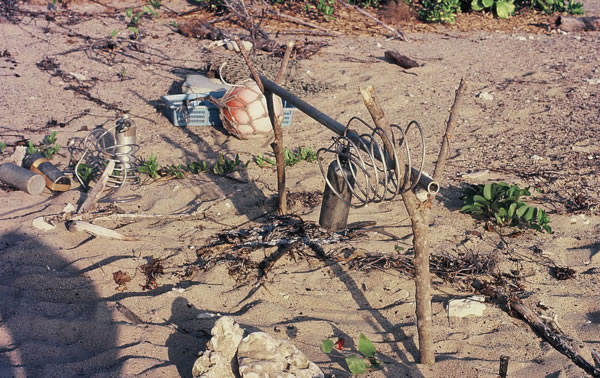
My water supplies had now dwindled to 15 litres. I expected it would take me four days at least to reach Mitchell Plateau where I was told I could expect to find a water source. I usually used 5 litres a day but the last few days I had been trying to use less. It was time to start distilling my own water. I had been carrying two home-made stills which were made up of aluminium Sigg bottles, with a three metre aluminium tube that was coiled and tightly sealed to
the bottle. The biggest problem was trying to achieve a constant heat as the wood I collected was dry and burnt quickly, which meant I had to tender to the fire constantly. The heat from the fire and the sun made me feel thirstier than usual. I had to be careful how full to have the seawater in the bottle. If the bottle was too full of seawater and the fire burnt too hot it could cause the seawater to boil over and filter through the pipe which I didn’t want. I needed the sea water to condense
and turn into steam producing fresh water. My still wasn’t perfect and I must admit I would build a better one next time I did a trip, but I did produce 3 cups of water in an hour. Unfortunately though it did have a slight taste of aluminium, so it was best used when cooking and not drinking straight. At dark a docile beach curlew came over and enjoyed a piece of my damper.
I had to start distilling my own water. My Sigg bottles were filled with salt water and boiled. As it created steam, water would drip from the end of the coiled pipe.
Admittedly it didn't taste that good. The aluminium bottle left a taste and a little salt water escaped. I used it as my cooking water as it didn't taste good to drink straight.
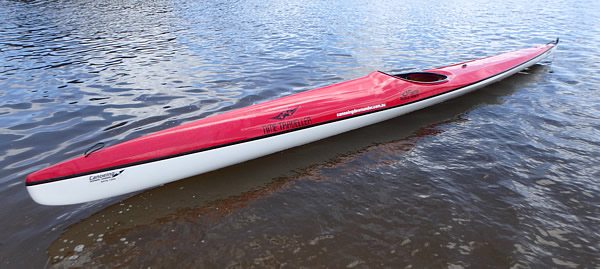
Used Time Traveller
Good condition
Length 6.0 Metres Width 54 cm Cockpit: Keyhole
The Time Traveller is a stable, fast kayak suitable for most levels.
With rudder and pedal steering.
I'm selling it for a friend.
Used. $1500.00
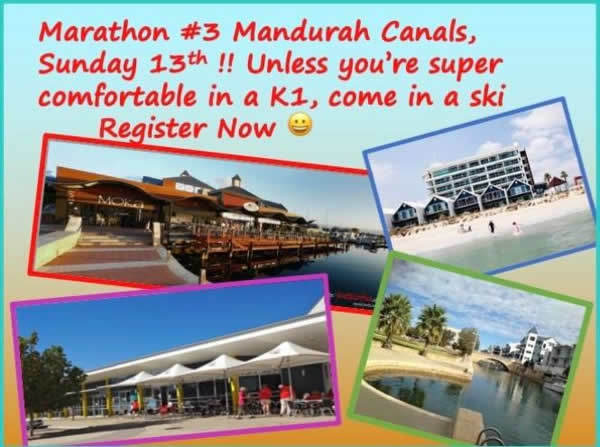
REGISTER FOR 2020 MARATHON #3 MANDURAH CANALS
EVENT IS GOOD FUN BUT INVOLVES FOUR CROSSINGS OF WIDE & POTENTIALLY ROUGH ESTUARY. UNLESS YOU ARE VERY COMPETENT, ITS RECOMMENDED YOU RACE IN A SKI. ORGANISERS RESERVE RIGHT TO INSIST SOME PADDLERS COME IN A SKI. ANY K1 PADDLERS ENCOURAGED TO USE PFD.
Date:
Sunday 13th December
Location:
Blue Manna Boat Hire, 13B Dolphin Drive, Mandurah, close to the harbour and beach-front cafes. Bring the family for a great day out !!
|
|
|
|
|
|
|
|
|
|