|
|
|
|
The Avon Descent
will soon be here.
Are you a novice and interested to train for it?
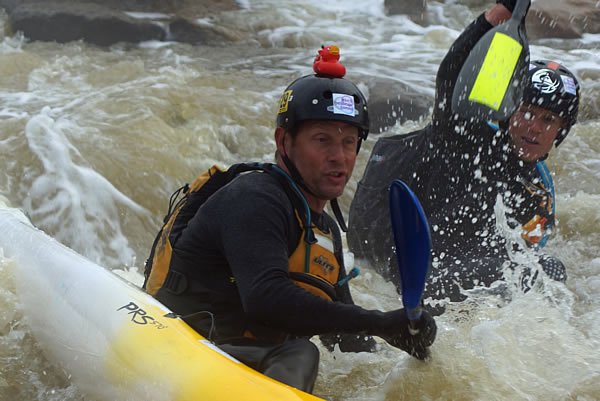
Chris Clarke and Scott Lacklison try to get down Emu Falls at the same time.
Not sure if Scott is in his boat though.
At the end of the race they were only 10 seconds apart. What a close race.
Chris Clarke13:26:05 - Scott Lacklison 13:25:55
Have you registered for the Moore River Race this Sunday?
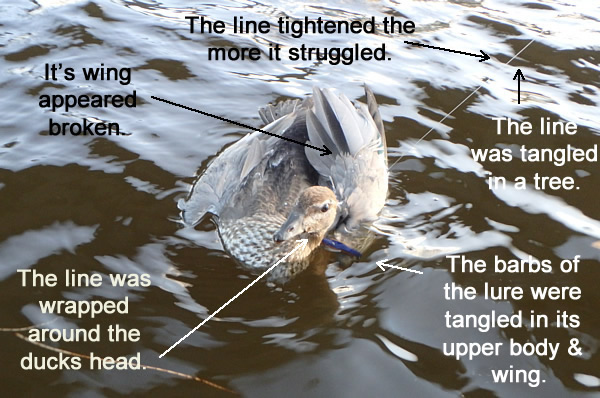
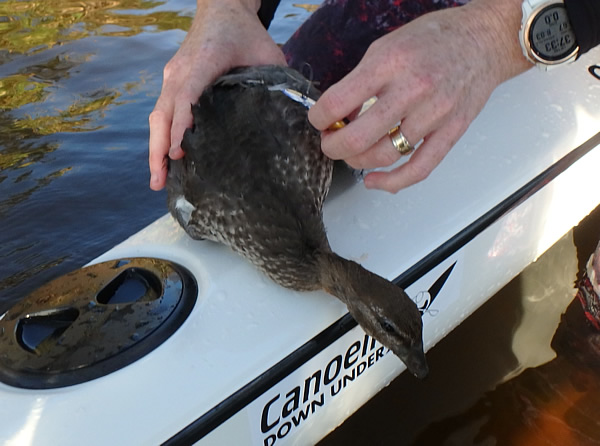
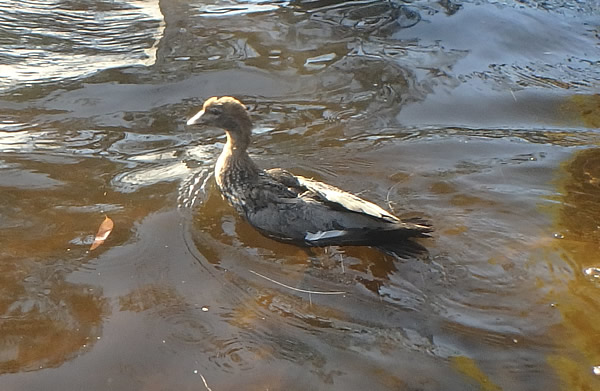
The duck was tangled in a fishing line with the hooks and barbs of a lure attached to its wing and body.
A fisherman was walking away as we approached leaving the duck to die.
It was very calm when I picked it up.
Monday was an amazingly wet day and even at 4.55pm when I was going to kayak training it was tipping it down. Monday is not a big training night for most but there is usually 6-10 paddlers who join Michael Liddle for his training session which varies from short interval sessions to 500 metres sprints to 1-2 km race chases. This Monday however only 3 paddlers
turned up Peter and Jane Liddle and Sharon Cobley as all the other paddlers must have thought it was going to be too wet and piked out.
Due to the fact there were only 4 of us Peter suggested heading upstream to Guildford for a steady paddle instead of doing our usual demanding routine on this blustery night. As we approached Guildford Road Bridge I noticed something splashing in the water a couple of hundred metres further along near the bank, just beyond the railway bridge. The splashing ceased
and I didn’t think any more of it until passing the point where I saw a fisherman walk away. Then in the water looking quite dead was a bird that I thought was a magpie tangled in a fishing line. It was what do we do with a dead bird? Nevertheless we turned to see what we could do.
It wasn’t a magpie but a young teenage Australian Wood Duck and it was alive. Sharon and I headed to shore and I waded out to find the fishing line it was tangled in was snagged high in the nearby tree and the line had wrapped tightly around its neck. It also looked as if it had a broken wing. As I picked it up it didn’t fight which was a relief as the
two sets of barbs of the lure which were quite hidden were attached to its wing and body. It was calm and relaxed.
Luckily I carried a knife so I handed the duck over to Sharon so I could cut the line which was around its neck. That was the easy part. The lure was entangled under its wing and at first look it was hard to see. With the barbs of the hooks embedded in its flesh and feathers that was going to be the hard part. This is where I really needed a pair of cutting
pliers to cut the hooks so they could easily be taken out.
Luckily the hooks were not in too deep so Sharon was able to fiddle with the hooks for a while, firstly getting the wing free and sometime later getting the hooks out of its upper body.
It was still calm so I took it to shore and placed it on the sand to let it revive but within a split second it waddled off at great speed into the water like a spring chicken and immediately found its composure and started swimming away.
With a cheer from Jane and Pete it swam away with not a worry in the world. Apart from the fishermen that is.
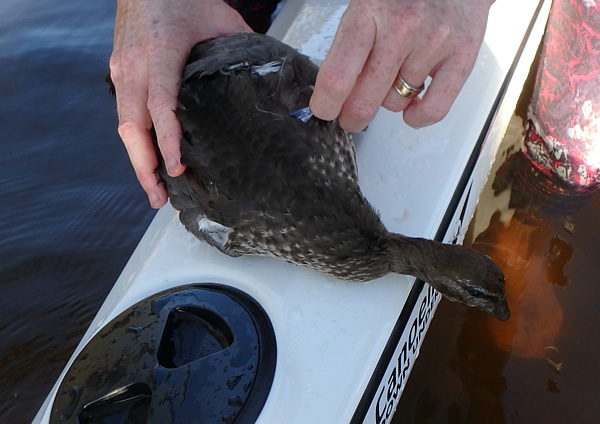
I cut the line that was tightly wrapped around its neck with my pocket knife as Sharon held on to it.
The lure was quite hidden under its wing. Sharon then set about trying to get the hooks out without hurting it. After a lot of fiddling she managed to free it.
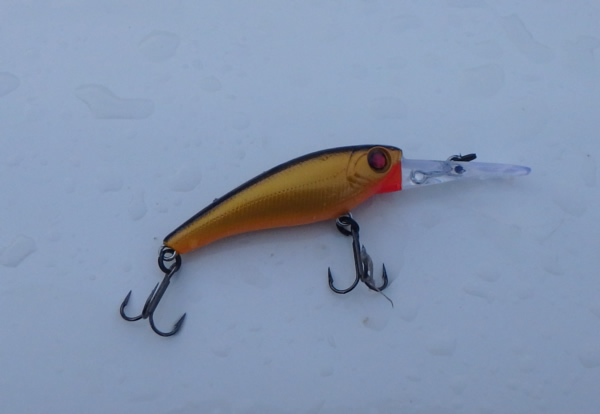
This was the lure. How the fisherman managed to hook the duck has me puzzled.
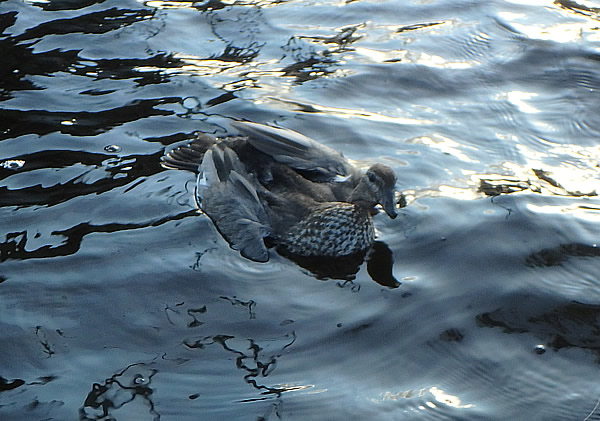
The duck looked a bit sorry for itself but it soon perked up.
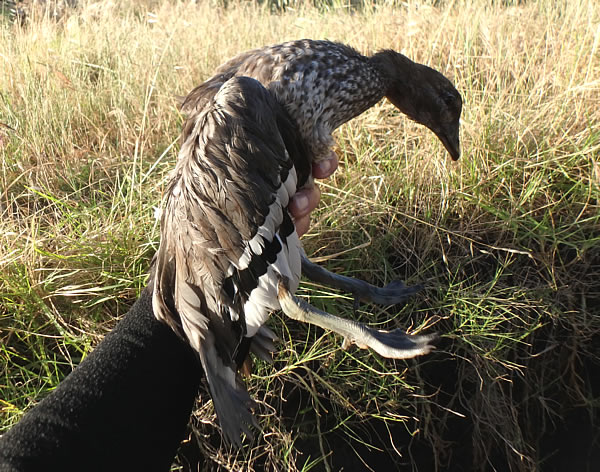
I released it on the sand and it took off quickly.
It paused before taking off again.
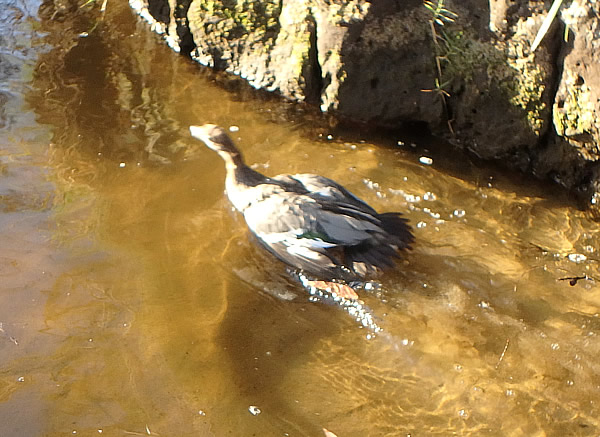
Happy to be alive it swam across the river to the cheer of Jane and Pete.
The Progressive Racing Group
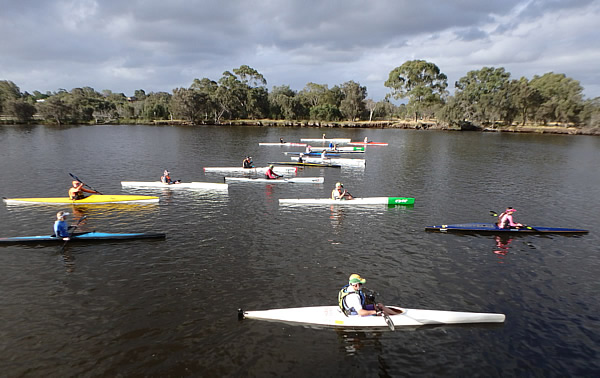
21 paddlers took part in the handicapped race on Tuesday.
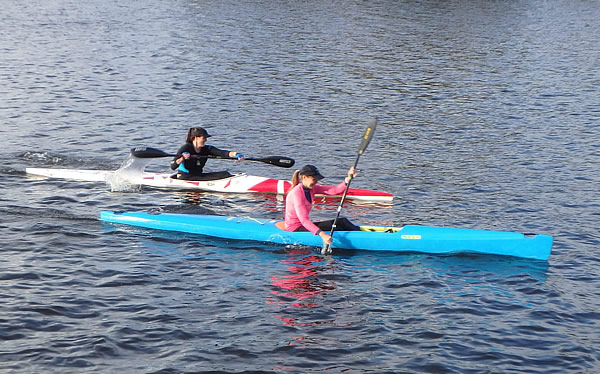
Kate Martin overtaking Marie Andersson.
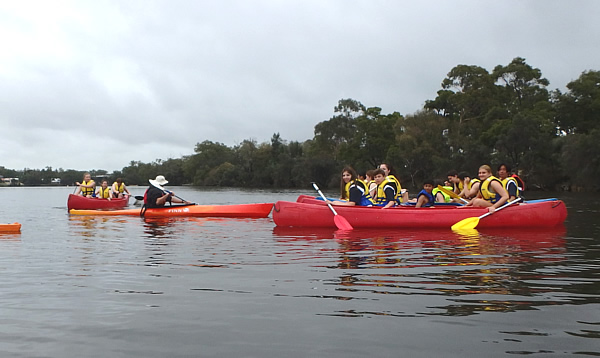
Mt Lawley School getting into the spirit of canoeing.
I wonder how many schools have a canoeing/kayaking program?
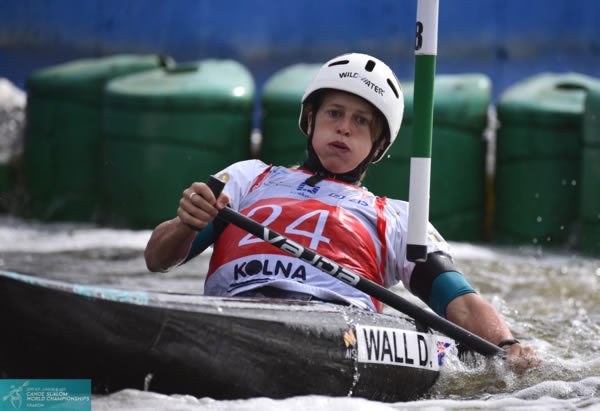
Demelza Wall
Happy birthday for yesterday.
National Team: U23
DOB: 12/11/1997
Hometown: Grew up in Fremantle, WA – now lives in Hobart, TAS
Institute/Academy: Tasmanian Institute of Sport
Club: Derwent Canoe Club / Swan Canoe Club
Coaches: Myriam Fox
Nickname: Melzi
Education / Occupation: Studying Marine and Antarctic science at UTAS, and working as a sea kayak guide and at an after school care centre
Age you started paddling: 11 (2009)
- How did you get into paddling? My sister and friend went to a come and try day and then started classes so I did too
- Does anyone in your family have a paddling background? I come from a very outdoorsy/sporty family. My sister used to paddle and was on the junior team, my brother also used to paddle but now he spends more time on a bike, and my youngest brother still paddles a little bit. Apparently my dad used to take me on the surfski with him when I was a baby!
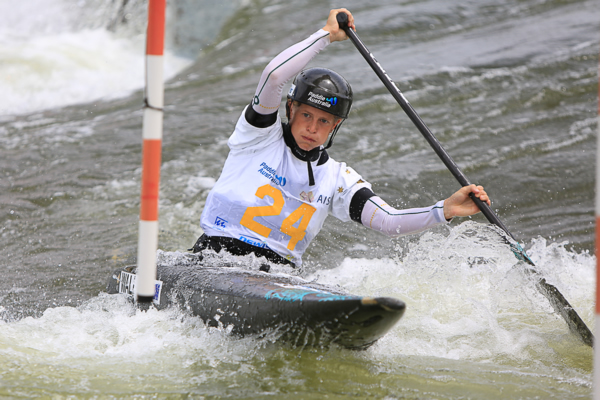
- What has been your biggest accomplishment in the sport so far? U23 worlds in Krakow last year where I came 20th, and also got a bronze medal in the teams race with Kate and Noemie.
- What keeps you busy outside of paddling? Uni, working, sometimes playing rugby 7s.
- Who is the greatest influence on your career? Zlatan Imbrahimbegovic.
- Who inspires you? Cas and Jonsey, two Aussie adventurers.
- How would your best friend describe you? Crazy.
- What scares you the most? Skeletons.
- Do you have any superstitions before you race? I’m not a very superstitious person.
- On your day off…. The beach! Snorkelling, bushwalking, hanging out with friends, or just relaxing at home and getting creative and crafty, and skiing if its possible!
- Favourite place to paddle? Lurea, Tacen, Ivrea, Penrith and Bradys.
- Favourite holiday destination? Ningaloo Reef.
- Favourite song to paddle / train to? Don’t really train with music but my favourite pre race songs are Don’t stop me now by Queen and Hakuna Matata.
- Fun fact about you? My favourite seaweed is bull kelp
- Previous national teams: 2015 Junior team, 2018 – 2019 U23 team
New Zealand Open 2018
Luuka Jones (NZ) took out the women's C1 final. Her 109.69s time was more than 16s in front of Hannah Thomas (Great Britain) with
Australia's Demelza Wall third.
Tasmania 2019 Senior Slalom National Championships
at Brady’s Lake (11th – 13th January).
It was congratulations to ex-WA paddler Demelza Wall for finishing 4th in the C1W final and 5th in the K1W final. Demelza moved to Tasmania because of all the whitewater to train on, which WA lacks, and has since received an athlete scholarship with the Tasmanian Institute of Sport.
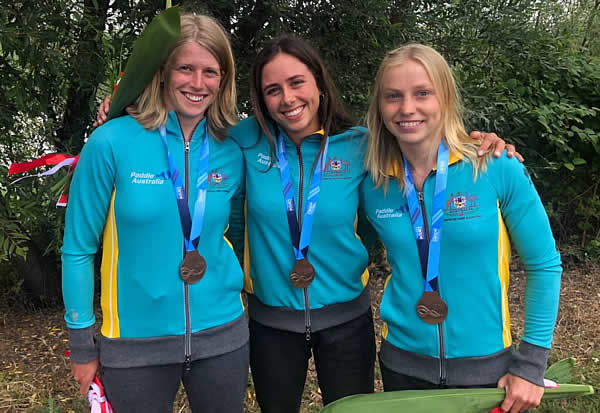
World Championship Bronze Medal
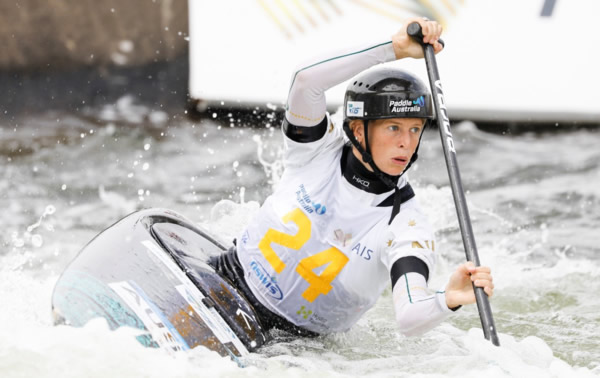
Demelza Wall, Noemie Fox and Kate Eckhardt
win a bronze medal in teams at the under-23 C1 canoe slalom world championships
in Krakow, Poland.
Picture: Paddle Australia
Demelza International Results
2019
20th C1 – ICF U23 Canoe Slalom World Championships, Krakow, POL
3rd C1 Team – ICF U23 Canoe Slalom World Championships, Krakow, POL
2018
22nd C1 – ICF U23 World Championships (Ivrea, ITA)
10th C1 Teams – ICF U23 World Championships (Ivrea, ITA)
2016
9th C1 – Oceania Championships (Penrith, NSW)
46th K1 – Oceania Championships (Penrith, NSW)
2015
22nd C1 – ICF Junior World Championships (Foz do Iguassu, BRA)
Watch an interview with Demelza here:
https://www.facebook.com/auspaddleteam/videos/2363209737023292/
Australian Canoe Slalom Teams for 2020
Junior & U23 World Championships Team - WA Paddlers
Demelza Wall – U23 C1W
Georgina Collin – U23 K1W
George Pankhurst – Junior K1M
Senior World Cup Team
Brodie Crawford – C1M
Steven Lowther – C1M
Ben Pope – K1M
Demelza Wall - C1W
You Must Watch.
Watch some great footage of Australia's slalom team events
https://www.facebook.com/auspaddleteam/videos/2350932241821390/
Genie Collin - competes in the
2020 ICF Canoe Slalom World Cup Pau
12th today 😫 definitely a little sad about two big mistakes that kept me out of the final. But I’m still satisfied with my first World Cup and first race at a senior level, even if it was a ‘corona world cup’ and much smaller than usual. I enjoyed the training and racing in this beautiful place.
Well done to our U23 team paddler Genie Collin who finished 12th in the women’s K1 at her one and only World Cup of 2020 and first race at senior level at the ICF Canoe Slalom World Cup in Pau.
Genie lives and studies in Prague and 2020 has been a challenging year for her as well - COVID-19 event cancellations, European lockdowns plus illness and injury on top of it. But on the bright side, she’s finished her physio degree and has been back in training since September. Great work & stick at it Genie!!
Watch her run here:
https://www.facebook.com/auspaddleteam/videos/genie-collin-2020-icf-canoe-slalom-world-cup-pau/402397217792336/?__so__=permalink&__rv__=related_videos
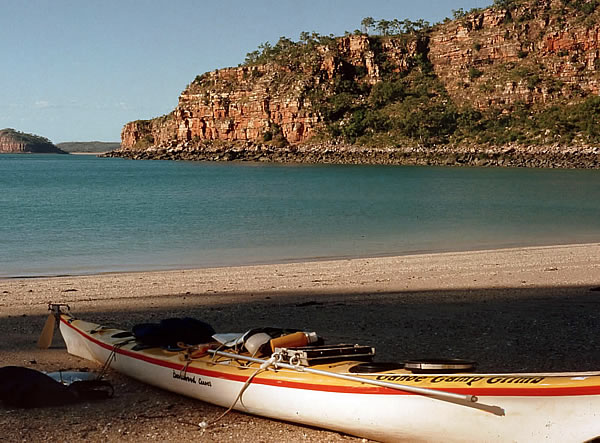
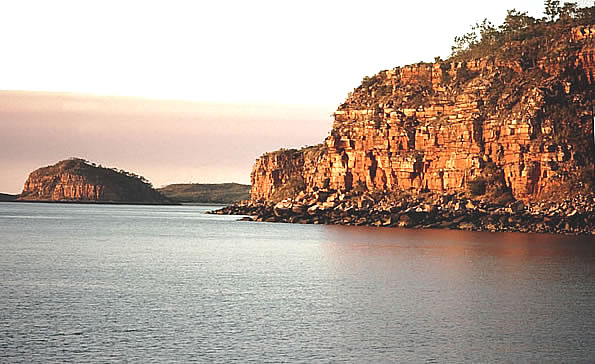
Kimberley Kayaking 1982
part 17
100 Days Solo
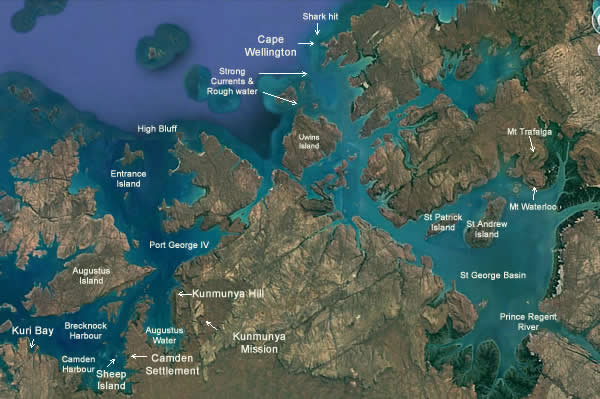
Leaving Kunmunya Mission
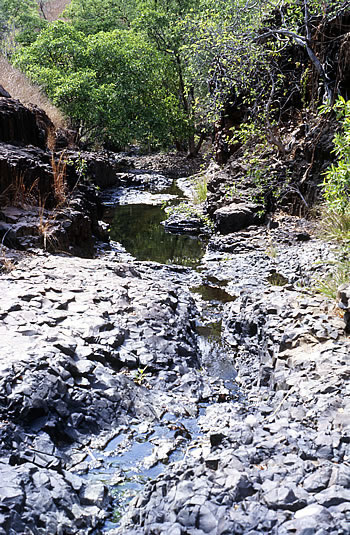
Following a small creek home from Kunmunya Mission gave me more shade and several pools of water and at the junction of two creeks a small running stream flowed but disappeared several times seeping under a bed of rocky boulders. The creek at times was steep with a few large drops and good swimming holes at the bottom of them. When the mangroves appeared a trickle of water was still dripping over the rock bed. The heat was intense and I could now feel the strain
on my body.
A polluted waterhole near Kunmunya old mission site.
Mules were common in the area.
I followed a creek from Kunmunya Mission back to my kayak.
Reaching the open, less vegetated coastline I could visually see my camp lying 1 ¼ kms straight across the bay. Unfortunately I had to follow the coast around so it was double the distance. Because it was low tide and with my energy sapping I tried taking short cuts across the mangroves but the oyster laden rocks and mud won out. I was hot, tired and millions of flies annoyed me and I couldn’t take a footstep without slipping or tripping on the rocks. My
legs were now like jelly, a condition I have never experienced before. I started to get out of breath and my ears kept blocking. I was knackered, shattered and possibly on the verge of collapsing. Finally I had to stop as I staggered up the small grade. I relieved my back of the heavy burden of water and camera and sat for a short time replenishing my water intake. I think I was suffering from the first stages of heat exhaustion? With only half a kilometre to go I knew I had to take it easy but
I really had no choice as I was exhausted and feeling giddy.
My kayak was exposed to the powerful rays of the sun and needing shade I stumbled under a mangrove tree nearby. The tide was 100 metres out and I had told Rod at Kuri Bay that I would return that afternoon. I had no chance of carrying my kayak over the slimy rocks and paddle four hours back to Kuri Bay, my superman strength that I usually had, had been completely sapped by the torturous walk and the burning sun. When I returned to Kuri Bay the following day Rod
told me that I had walked the 15 or so kilometres in 39°.
Reflecting in the shade of my harrowing ordeal, twinges of cramps started forming in my legs. This had been the most exhausting walk that I have ever endured and after a short rest I made myself wash and cool my body. I drank lots of water and ate dried fruits and eventually I had the strength to light a fire to make a beautiful hot drink. My sweaty drenched cardboard stiff walking clothes had to be dried in the sun, they were my protector from the mosquitoes and
sandflies that would attack me later in the day.
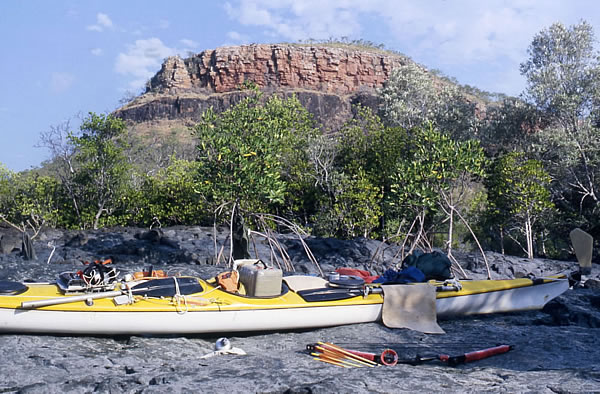
Camped near Kunmunya Hill.
The extremely hot night and the lack of sleep didn’t enhance my enthusiasm to cart my gear over the green slimy rocks and paddle against the wind to Kuri Bay. Before reaching Brecknock Island a mystery object hit me hard on the stern. I checked behind to see nothing other than a ring of ripples. Of course I expected it to be a shark.
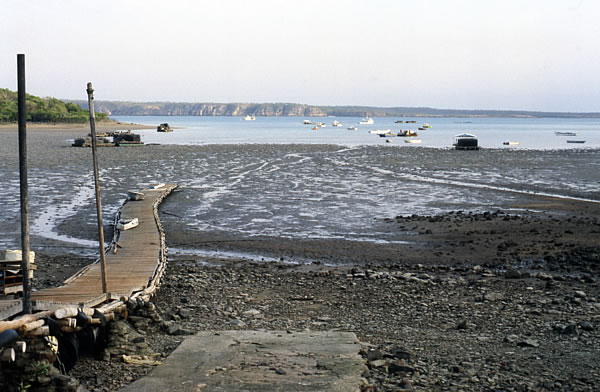
Brecknock Island was the first settlement for Kuri Bay but it didn’t last long. Only a concrete footpath is left visible to the eye. I left it and moved over to Augustus Island and checked a water course circled on my map. My information was right, there was water, so I tipped out my old water and topped up my container with cleaner water.
The vegetation on Augustus Island enticed me to explore another stream that I thought was likely to contain water. I had an ambition to explore as many water sources as I could which I hoped would help me to learn more about the fresh water creeks and the area. The small inlet and narrow mangrove channel posed a tricky entry. Two goanna lizards dived into the first stagnant pool about 20 metres from my kayak. Massive paperbark trees, the largest I had seen so far
dominated the entrance to the chasm. The vertical chasm walls that narrowed and towered over my head, blocked out the sun from penetrating the cool depths. In the quiet of the gully I could hear the sound of trickling water falling over the rocks. Butterflies, not one or two but thousands, that were clinging to the cold rock faces took off and fluttered all around me as I approached. It was amazing, something that I have never seen before. It was just like being in a butterfly enclosure. I just
wanted to sit in this serene setting watching the butterflies but I knew I couldn’t.
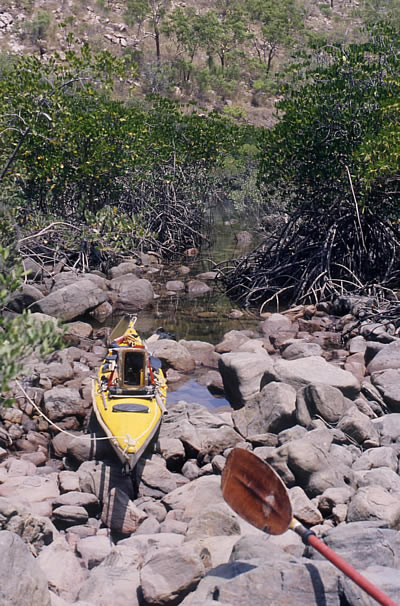
Having only spent minutes exploring the canyon the cunning tide had caught me out. I returned to find the kayak was left high and dry 15 metres from the deep water. The problem was aggravated by oyster clad rocks and mangrove roots that blocked the waterless channel. Dragging the boat over the oyster rocks was too damaging so my gear had to be taken out of the kayak and carried over the rocks and the mud to be loaded in deeper water. It wasn’t easy, my kayak
weighed 40 kg but nothing is easy up here, you have to grit your teeth and just get stuck in. After returning for my gear I loaded and briskly got the hell out of the mangroves to the open water.
The tide had turn and left me high and dry after only being away from my kayak a few minutes. Now I had to unload and carry my gear and kayak to where the water was deep and load up again. It was hard work.
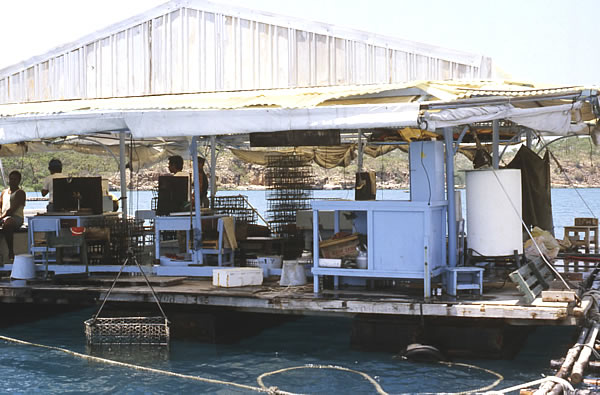
Further along the coast I passed several pearling rafts. The hospitality of Kuri Bay 7 km across the Brecknock Harbor was in my sights. But before arriving a whale surfaced less than 500 metres away and entered my serene setting. As I paddled closer I could hear the water boil before its body broke the surface. I stopped, looked and listened. I could hear noises like a
cow bellowing in a high pitched sound. Being half way across the bay it could only be coming from the whale unless my hearing was playing tricks on me. For 10 minutes I was sharing this majestic land with one of the most magnificent creatures in the world but my peace was then shattered when a power boat skimmed across the water at high speed heading to Kuri Bay.
Pulling up at the jetty, many of the workers were busily cleaning shells on the rafts. John Woodman was there to greet me and offered his assistance with my kayak. When I had unloaded I noticed my left paddle blade was coming apart. The heat had delaminated it, so it had to be fixed before I could leave.
The mail I had been waiting for had arrived on the company boat, Marrinda Pearl. I had asked Channel 7, who was sponsoring me with16 mm films, to send me more 100 foot rolls. The film arrived, but it was all in 400 feet reels and my camera only took 100 foot reels. I radioed for our advice and found that I couldn’t use it so being low on film I was disappointed. With no time to wait for the right film I started preparing for my next leg around to Mitchell
Plateau.
For the evening meal it was real Japanese-style. I even used chopsticks again. It was great. Returning to the quarters the other guys said they were having a barbecue later and the guys on the Marrinda Pearl boat will join us. Despite having already eaten I couldn’t disappoint my Australian friends so it was steak, veges and ice cream. Why am I leaving I thought?
One of the local dingoes, which sneaked around Kuri Bay at night came to grab some of the left overs. It was so tame you could just about hand feed it.
The deep scratches that the kayak received yesterday had to be filled with gelcoat and my timber paddle blades glued and fiberglass around the edges before I could leave. It was my last day in civilization, my equipment and myself had to be spot on for the most dangerous and remote part of the coast. The afternoon gave me time to explore the surrounding area and I followed a permanent running stream at the back of the community. It was the community’s water
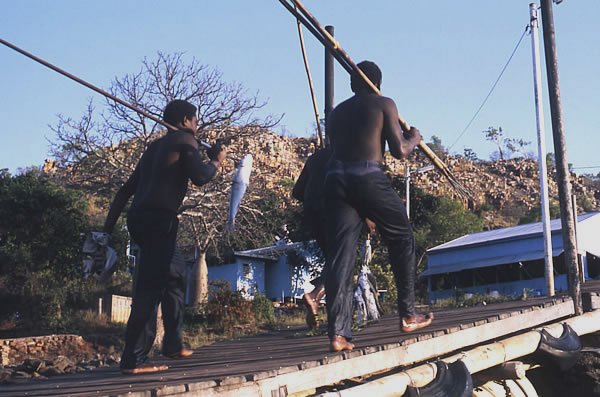
supply and very beautiful, green understory, pandanas palms, small falls and even two dingo pups appreciated it. Back at the wharf I watched the TI’s returning from a fishing trip. They certainly had better luck than me, having a catch of several fish on the end of this spear.
Thursday Islanders back from work.
After a 5.00am shower I walked down to the mess for my last civilized breakfast, of toast honey and boiled eggs. My kayak was loaded with 30 days of food and 35 litres of water. It had to be loaded very carefully and evenly as it was bursting at the seams and I didn’t fancy taking everything out and starting again. At 10.00am when the tide was right, I said my
goodbyes. I was now headed along the most remote and dangerous coastline.
I headed back through Rogers Strait passing Kunmunya Hill and into the wider more open waters of Port George 1V Harbor where the north-west winds stirred up the bay. My heavily laden kayak which virtually had no freeboard spent most of the crossing under water. By the time I camped on the mainland opposite Entrance Island I had paddled 28 km in four hours, that’s nearly 7 km an hour instead of my usual 5 km an hour. It was an extremely beautiful part of the
coast and with the sun setting it produced many spectacular photographs. I was told of a freshwater spring gushing out of the sand on a beach so I checked it out. There was water gushing out of the sand, but I was soon disappointment when it tasted of salt.
As I erected my hammock in the trees four brolgas landed on the beach. When I went to retire green ants had established a strong hold on my hammock so nothing was going to force me to sleep in it tonight, not even the crocs, so I nestled beside my kayak on the beach for extra protection.
I left the relative safety of Port George IV Harbour and headed across the exposed Brunswick Bay to Cape Wellington. Pushing on in fairly good conditions I fell into a trance, my bum became sore, and suddenly I felt down in the dumps. The hardest thing can be leaving people and the safety of a community, but I knew from experience my mood would change once I got back into a rhythm.
At once I quickened my pace, I started singing and tried to shed my sleepiness. I was now in the path of the currents and I had no hope in crossing over the next channel against a tide, so I chose to beach on an island North of Uwins Island for a short rest and find my spirit.
When I felt it time to take on the currents again I left the lee of the islands and entered my last crossing to Cape Wellington where the waves became violent. My full concentration was needed to avoid the breaking waves from capsizing me. At times they built up into a pack, breaking and bombarding me in quick succession. It was sometimes quite frightening watching the
waves race towards me, and then sometimes break on top of the kayak. The roller coaster ride continued for 6 kms, my mood did change I was back in my element and fighting to stay afloat.
Just before rounding the cape I paddled into calmer waters to put my helmet on. Rocky capes are always rough and bouncy and with the currents screaming out against the large north-west waves I had to prepare for any eventuality.
After conquering the cape, I noticed a beach and instantly I was happy. Finding good landing spots can be worrisome. Throughout the trip I haven’t really known where the next beach would be. When no-one can tell you about the country it is really like exploring an area for the first time.
Beach curlews greeted me and rock ledges provided me with a table and a bed. The rock retained a lot of heat so my back would be nice and warm throughout the night. I went for a short walk and returning around sunset, one of the beach curlews was screaming by my ledge. Mother curlew came running over, her long legs striding it out. Very excited and agitated she wouldn’t approach her nest. I ran around the corner to see what all the fuss was about and a quoll had
a baby curlew cornered and started attacking it. My appearance saved the day as the quoll jumped up the ledge and disappeared. The young curlew was wedged between the rock, so I went to find a stick to help it out. But my return had been to no avail, when I returned the young curlew had been snatched. I felt helpless, mother curlew was going berserk stamping, calling and running up and down the beach but there was nothing I could do.
Later I perched on my flat rock ledge and gazed into the moonlit evening watching the tide rise and lapping up the darken shapes of the reef. I could still hear mother curlew cry out for its young one as it paced up and down the beach. Apart from feeling sorry for the curlew I now felt a lot better in myself after falling into a mood this afternoon.
I needed to feel brighter as tomorrow morning I had a 70 km paddle to complete. It was possibly going to be a dangerous trip up the Prince Regent River on an in-going tide on the hope to paddle up to a waterfall at the end of Camp Creek in one go. The possibility of meeting crocodiles along the way was very real. A crocodile survey done in 1978 spotted 189 crocodiles of various sizes in the Prince Regent River, so I knew they were waiting out there somewhere! (In
1987, an American tourist Ginger Meadows was taken and killed by a crocodile in the Prince Regent at Kings Cascade. I was nearby on another trip at the time.)
My aim was to stay at Camp Creek for a couple of days before returning to Cape Wellington and because I was returning to this camp site I would leave 20 days of food here in the hope that the quoll or dingoes didn’t take fancy to it before I returned. Rod from Kuri Bay and coast-watch were the only people who knew of my plans, and because I didn’t know of any landing spots along the way I really had to try to reach the waterfall in one hit. I didn’t want to get
stuck after sunset along a coastline full of mangroves or high cliffs and have no-where to camp.
The morning brought a low tide that had exposed a reef and coral which turned out being slippery, difficult and a dangerous job just getting the kayak and gear to the water. I was happy when I was afloat, knowing that I had lugged all my heavy gear across a reef which could have easily cut and carved me up if I had fallen.
In the early morning light and assisted by a rising tide, I paddled around the calm waters of Cape Wellington, one of the most remote capes in Australia. Then only 20 metres from the rocky cape something suddenly smashed into the back of my kayak like a raging bull. I gained my balance and composure and in horror I glanced behind expecting to see the ‘Incredible Hulk’, or the sea equivalent. I could see nothing but rings of disturbed water, but I just knew it had
to have been a big shark or less likely a crocodile. I was hoping it wasn’t looking for breakfast?
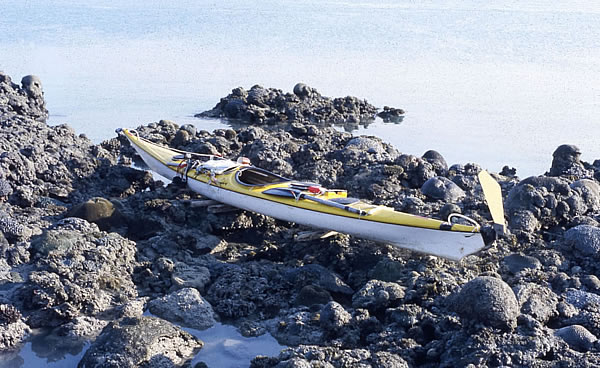
A very low tide means walking the kayak over the slippery coral.
Minutes later I was hit by a shark.
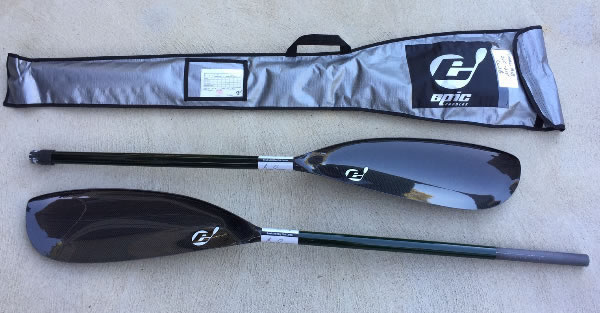
Epic Club Paddles
Small mid and mid.
Club Carbon $455.00
Midwing Club Carbon construction - 737 grams; comes standard with Epic’s Length-Lock 2™ adjustable ferrule technology.
Carbon fibre blade, Green oval fibreglass shaft.
Fully adjustable length & feather.
Includes paddle bag.
Also in Small Mid
The Epic Small Mid Wing paddle is based on our award winning Mid Wing paddle, with a 2% reduced blade surface area. This slightly trimmed-down design has broadened the appeal of the wing paddle, making it ideal for smaller paddlers, cruisers and racers paddling long
distances, and those who simply seek a smaller option to maximize their efficiency.
Club Carbon 702 gms. Full Carbon 652 gms.
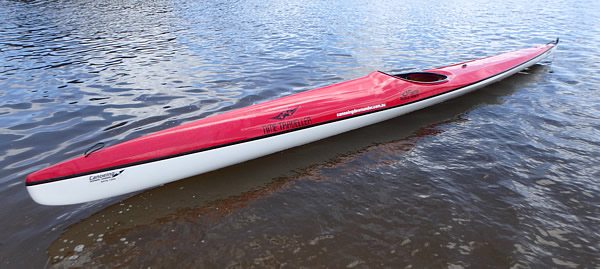
Length 6.0 Metres Width 54 cm Cockpit: Keyhole
The Time Traveller is a stable, fast kayak suitable for most levels.
With rudder and pedal steering.
I'm selling it for a friend.
Used. $1500.00
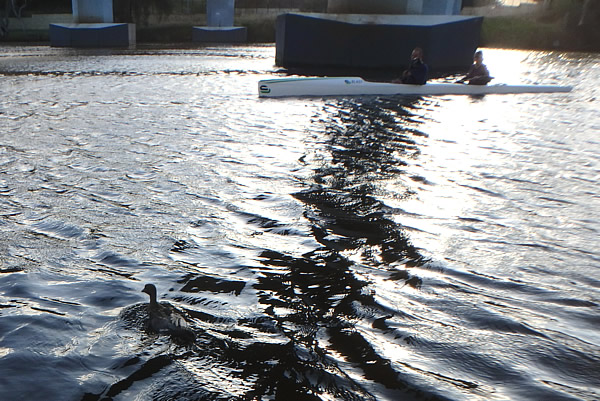
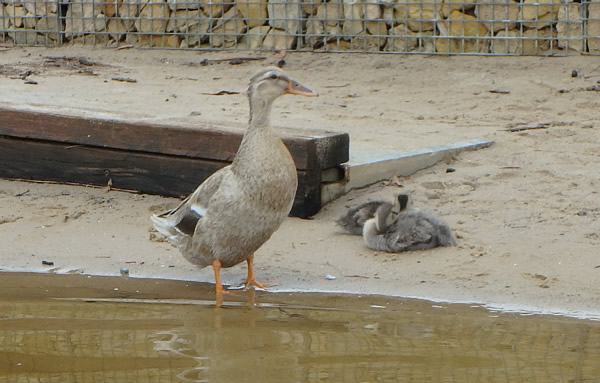
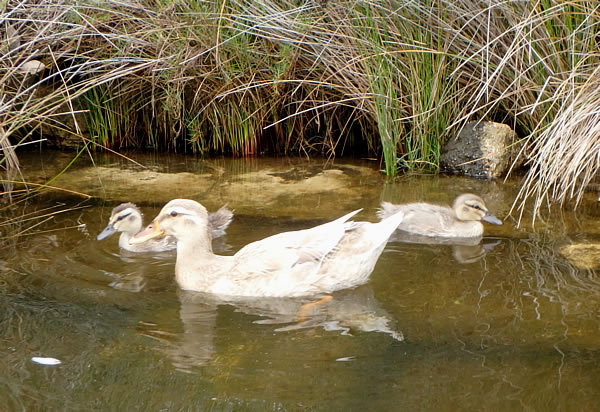
This duck that hangs around the kayak club was a proud mother of 14 ducklings.
A few weeks later she now only has two.
Members have been watching them decline.
I was wondering if the resident Osprey had been picking them off after seeing the Osprey eating something that dropped feathers.
However all along the river ducks have big families but finish up with fewer ducklings after a few weeks.
Paddle WA Live Lighter Sprint Regatta #4
Sunday 29th November 2020 Champion Lakes Regatta Centre
Entries now open now and close Monday 23rd Nov Midnight
All paddlers welcome for division racing. Enter via Webscorer here:
Pairs Enduro
22nd November
Enter & details:
Indian Ocean Paddlers
Races
Summer Series dates are now locked in. We are also very pleased to announce that Brad and Kate Hardingham Realmark have agreed to stay on board as our seasons sponsor. This support for IOP is massively appreciated.
Race dates:
21st November / WCD
28th November / Doctor??
12th December Xmas paddle
9th Jan 2021
30th Jan
20th Feb
13th March
Next race 21st November
|
|
|
|
|
|
|
|
|
|