|
|
|
|
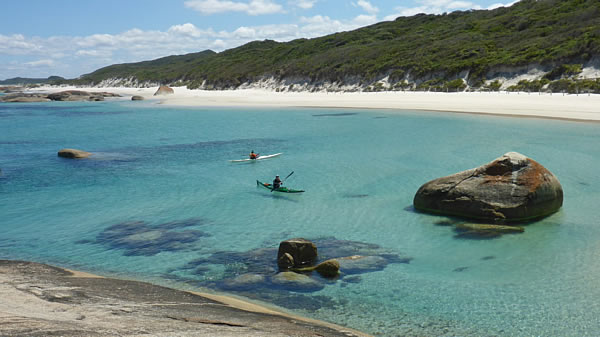
Albany Sea Kayak Club on a trip to Green Pools.
Photo Brodie Soanes.
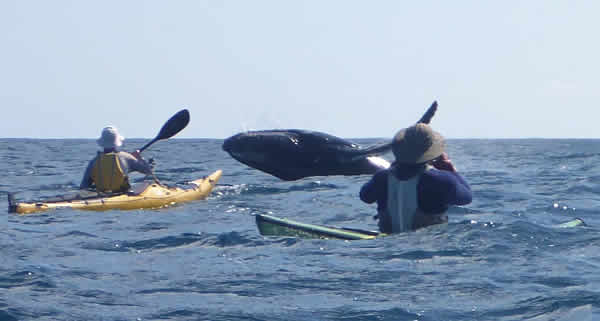
South Coast Kayakers is a new group of paddlers. They are experienced sea kayak instructors and having a whale of a time.
Photo Jenni Harrison.
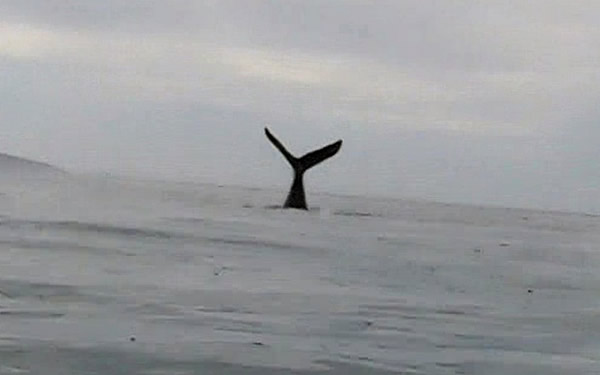
Chris & Colin, Two People's Bay.
A few snaps from yesterday. We nearly didn't launch due to thunderstorms in the area but after waiting for the worst to pass over we were lured along the beach by a whale sighting - and rewarded by a long display of tail waving from a calf while it's mother stayed largely out of sight. A short but memorable paddle.
Photo Chris Fry.
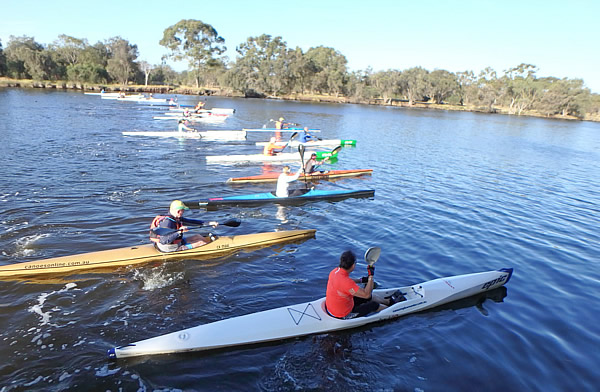
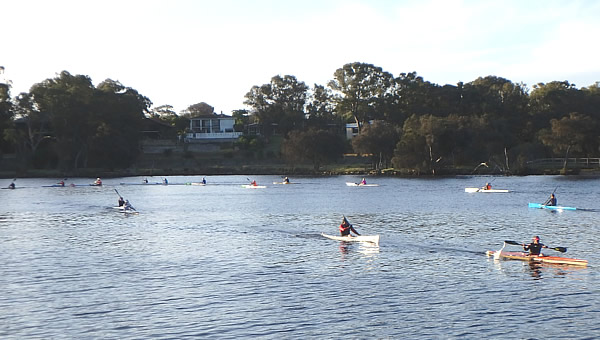
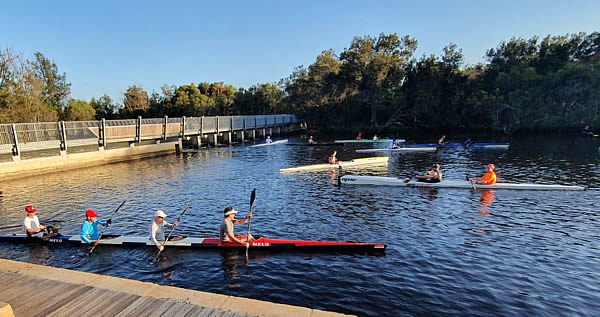
A warm up paddle for 21 paddlers at the Tuesday night training session.
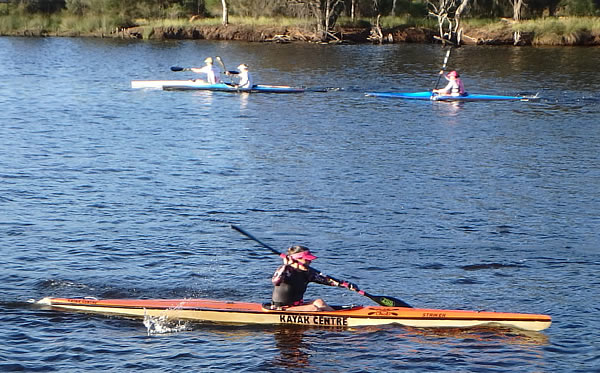
11 women were racing.
We have 27 women in our group..
With one more lap to go the paddlers get closer in the handicapped race.
Isabel Combe gets stronger every week. Her determination is amazing. Again she beats her best PB.
Over 55 Paddlers Club
They usually meet on a Thursday.
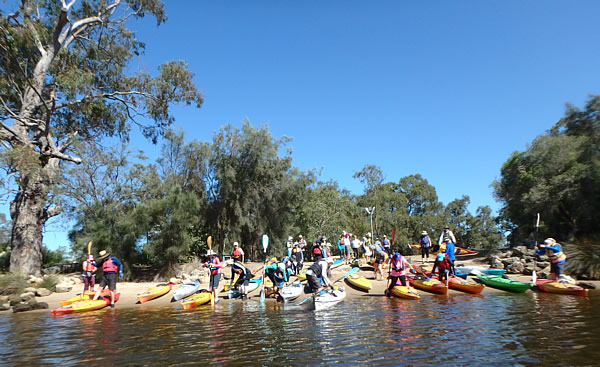
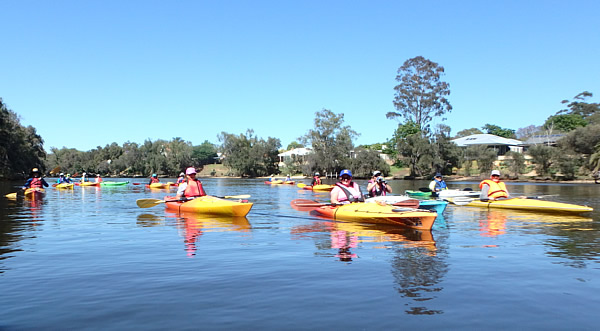
33 paddlers take to the water for a social paddle.
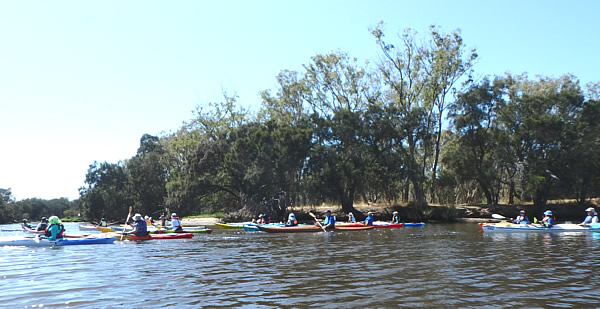
Nearly all the paddlers paddle kayaks.
The paddlers split into two groups. Group 1 is heading into the Helena River.
The second group heading upstream towards Bassendean.
Canning River Canoe Club
Meets Tuesday Night
Kent Street Weir
Tuesday night (3/11/2020) was team boat night.
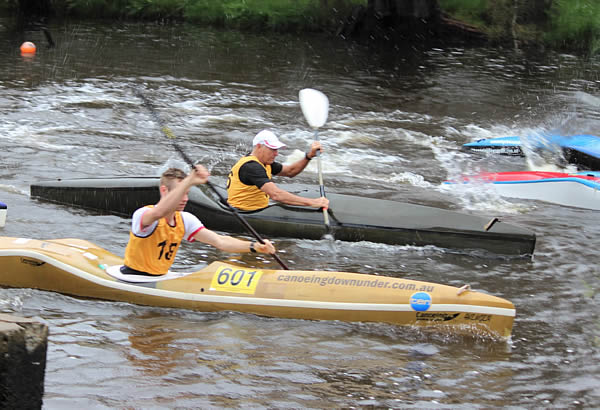
Tonight saw the 2nd round of the Team Boat Challenge. Great to see the K4's and K2's along with the other competitors in their single craft.
The next Team Boat Challenge will be Tues Dec 1 and will again coincide with Pizza Night
Keep the same team or start sharing the experience, the choice is yours and judging by the conversations over pizza, next month's event will be hotly contested.
Click here for the results https://canningriver.paddle.org.au/.
You might just a surprise at some the times by our very young members.
Bevan Dashwood Race 2020
13.7kms
The Bevan Dashwood Race is usually dry and sunny but today the rain came down. Luckily it was quite warm so racing in such weather was a joy.
There weren’t big numbers racing but you only need one other paddler a similar speed to you to make it a good race. I paddled a DR kayak against Luke Dooley, Peter Liddle, Bevan Dashwood and John Breed who were also paddling the same kayak. I think Patrick Irwin was supposed to be there but he must have stayed in bed hearing the rain.
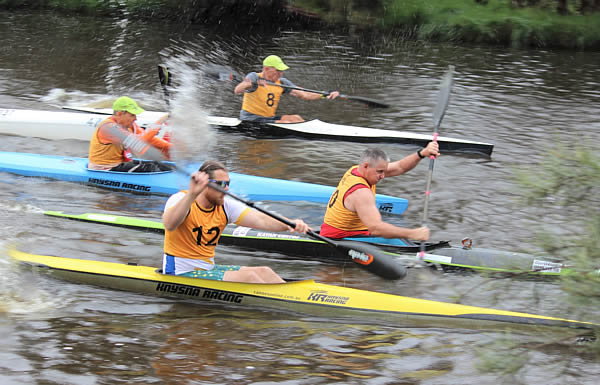
The fastest paddlers went off on the first two grids with the DRs going off on grid 3. Luke Dooley took off with great speed as usual with Pete on his wash. I managed to get on Pete’s wash on his left and Bevan was on his right. Within 15 metres Bevan and I got sucked back off the wash and collided taking a few moments to untangle ourselves and get apart.
In the meantime Peter was still wash-riding Luke and getting a good lift. He eventually fell off but by that time he had established a very good lead.
One of the fast grids going off. With it being a narrow river only 6 or so paddlers were sent off at a time.
Photo Lynette Campbell
The DRs heading off. Luke Dooley and Bevan Dashwood in the picture. Peter Liddle and I are to the right of picture and John Breed is behind.
Photo Lynette Campbell
I gave chase at a pace that Bevan couldn’t keep up with, so I was pleased. However Pete had a good 50 metre lead which wasn’t going to be easy for me to make up. On flatwater Pete is a faster paddler than me, so I wasn’t at all confident that I would catch him, but I’m always closer to him when I’m paddling DR kayak.
I just had to go for him, firstly it would help keep Bevan and John off my back and with enough drive there was a slim possibility I could catch him. To my delight I started to close the gap and by the time we reached Riverton Bridge I was only a couple of washes behind. Then the faster paddlers who were on their way back started saying, ‘come on Terry’ which now
meant that Pete knew I was only a few metres behind, so I expected he would lift his pace to prevent me from catching up.
At the turn of the Shelley Bridge pylon I managed to get on Peter’s wash. I was hoping to rest there but then 12 year old Connor Jacob in his K1 started to pass us. And he had started one minute behind us! Peter went for his wash and I went for Peter’s wash so now I was trying to keep up with them I had no chance to rest.
Connor paddled a slightly faster pace which put more strain on me and tested me further, especially paddling across the shallows. At the short cut channel Connor didn’t go for it, instead he carried on which would lose him a few metres, but Peter and I paddled into the channel. I was hoping Peter would go with Connor which meant I had a better
chance to stay on his side wash, but he didn’t and when we hit shallows and then the narrow channel with over growing trees I had to drop back behind Peter.
I kept directly behind him but then we hit a shallow spot and I lost his wash. I was upset that the lord wasn’t looking after me and when Peter moved out of the channel he was about 10 metres away. Connor appeared about the same time as I did but he was too far away for me to give chase. He then caught up with Peter and Peter grabbed his wash once again and was
away. I thought that may be the last I would see of him, but the lord decided to give me another chance and Doug Hodson in his K1 came up beside me. I grabbed Doug’s rear wash and paddled my heart out.
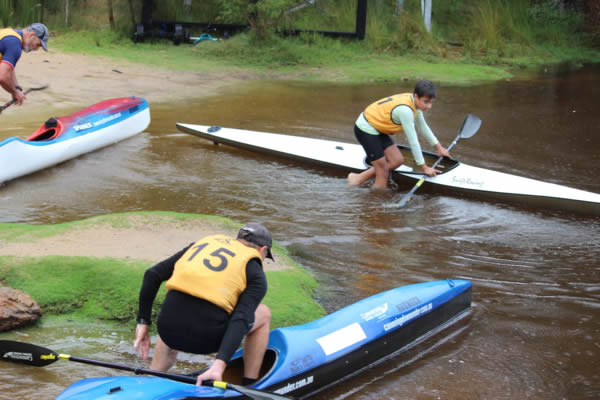
By the time we got back to the start and the portage the line consisted of Connor, Peter, Doug and me. I paddled my DR kayak up the sand to stabilize it to get out quicker and took off on the heels of Peter. (DRs have very small cockpits so they are not easy to get out of quickly so I use my paddle as a brace.) Peter was a second or two slower than me doing the
portage so I managed to get going a few seconds ahead of him but not so far that he couldn’t catch me. I managed to get Connor’s wash and we were away the three of us.
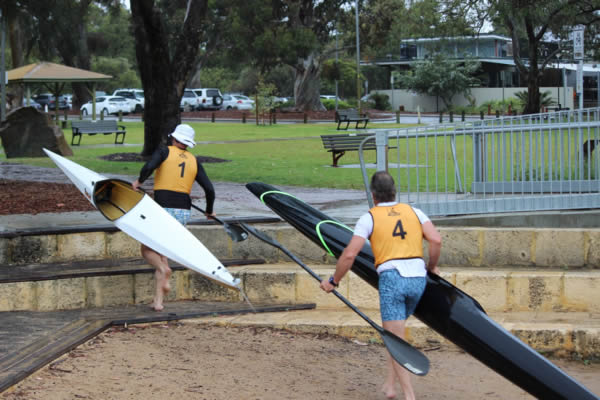
Brett McDonald and David Berglund portaging the weir.
Photo Lynette Campbell
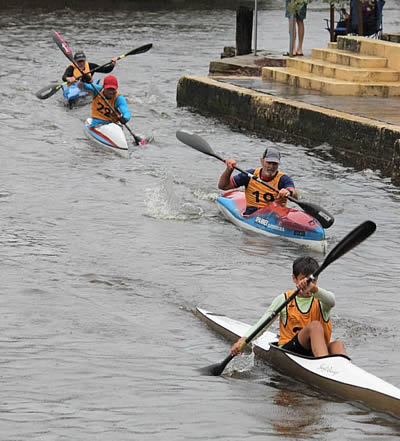
Peter Pawlow, Carlo Cottino and Jane Pankhurst coming to the portage.
Photo Lynette Campbell
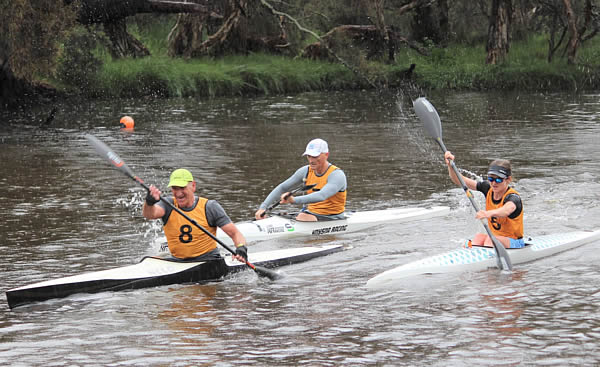
12 year old Connor Jacob, who started a minute behind the DR grid leads Peter Liddle, Doug Hodson and me into the portage. (Doug also started a minute behind.)
Photo Lynette Campbell
I pass Pete on the portage.
Photo Lynette Campbell
About half way to the turn Connor took a line close to the trees. As Peter was on my left I swung out so he didn’t get pushed into them but that messed up the system, I lost the wash and Connor got away as Pete and I fumbled. Pete then gave chase and managed to get on his rear wash, and then I caught up.
Will Lee was the first K1 paddler we saw before the second turn and then Dave Burgland and Brett McDonald several minutes behind him. Luke had caught up with the earlier grid paddlers in his DR kayak and some were getting a ride off him.
Will Lee sails home 4.44 minutes faster than the next K1 of Brett McDonald and Dave Burglund.
Photo Lynette Campbell
At the turn Connor, Pete and I virtually turned at the same time. I was just about to get back on Pete’s side wash when he stopped to take a twig off Connor’s rudder. This caused a dilemma. Peter asked me to wait. I couldn’t sprint away whilst Pete was stopped doing a generous act so I waited. We lost quite a bit of time allowing other paddlers to get
closer and then Connor got away. So now the race was truly between me and Pete and as we were ahead of the other DR kayaks, time stopped wasn’t such a concern.
As Pete and I fought on, unfortunately with about 2 kilometres to the finish line Doug caught up passing to my right, which now meant it was a 3 way fight. I had Doug’s wash and Pete had my wash. Within a kilometre of the finish I started pushing a little harder which caused Doug to push harder and all of a sudden we lost Pete which was quite a
surprise.
Knowing Pete was now no threat was comforting, but it was unfortunate because I would have enjoyed a real fight with Pete, however I still had Doug beside me so I still had someone to fight with. A few hundred metres from the end I picked up the pace even further and the fight was on and surprisingly I managed to out-pace Doug and beat him to the line by a second
and a bit.
What another great race.
Amazingly I managed to out pace Peter near the end.
Photo Lynette Campbell
I had a fight to the line with Doug Hodson and beat him by 1 second.
Doug started a minute behind though and is unable to portage fast.
Photo Lynette Campbell
Sprint Regatta 3
Champion Lakes 2020
The next regatta is Sunday 29th Nov.
Results on Rather Be Paddling
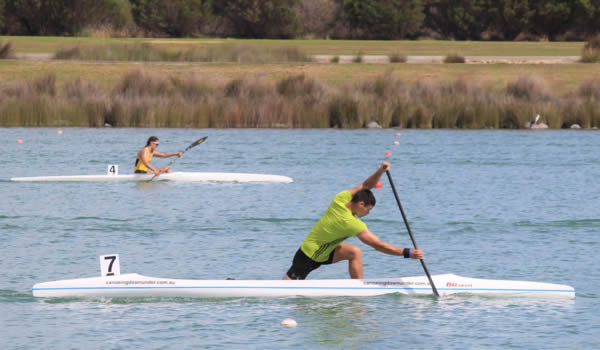
Young Kylan Jegorow looking good (racing my C1.)
As a 15 year old he is paddling exceptionally well.
Photo Lynette Campbell.
Gergely Balazs Nagy (racing my C1.)
Gergely (Gary) won a bronze medal at the 2019 World Canoe Marathon Championships.
Photo Lynette Campbell.
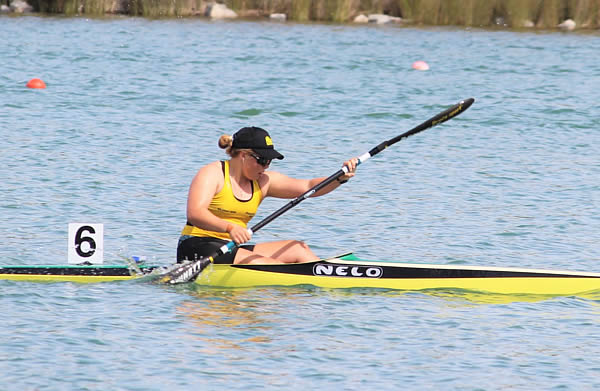
Harriot Brown.
WA Junior Paddler of the Year
Photo Lynette Campbell
Matthew & Nicholas Greed and Brett Cassidy
Photo Lynette Campbell
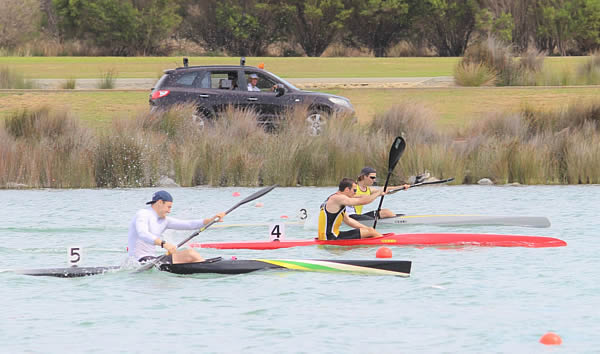
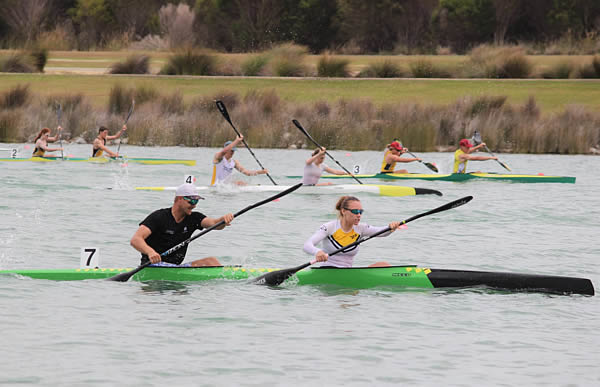
Doubles Race.
Photo Lynette Campbell
A lot more pictures by Lynette are on Rather Be Paddling.
Zlatan
Ibrahimbegovic
WA Slalom Coach
DOB
18th March 1948
How long have you been paddling
for?
Zlatan began paddling over 60 years ago. 37 of these years were in his home country of Bosnia & Herzegovina, and 27 in
Australia.
Significant
achievements
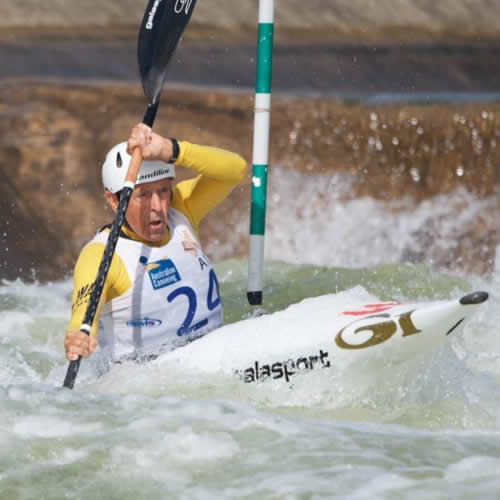
Represented Yugoslavia in the 1972 Munich Olympic Games, finishing 29th in K1 slalom.
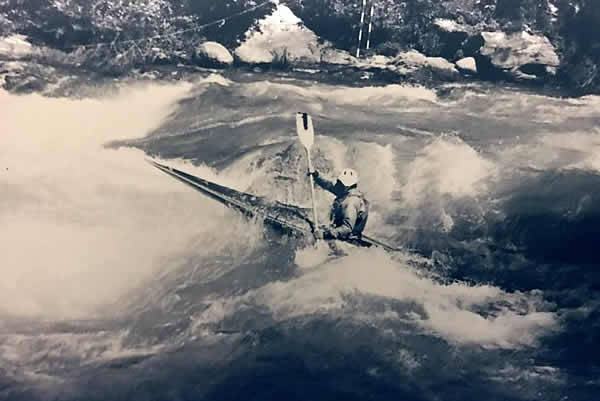
Has competed in five Slalom World Championships and three Wildwater World Championships.
Has coached slalom in Slovenia and Australia, and athletes from Canada, Croatia, Japan, USA, New Zealand, Lebanon and Hong Kong
Current life/involvement in the
sport
Zlatan is currently the head coach for slalom in WA, and has coached many high-performing athletes such as Robin Bell, Kynan Maley, and Robin
Jeffrey.
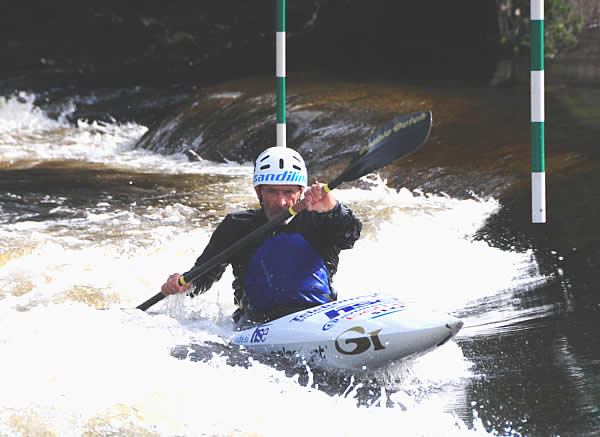
Still an active competitor in the WA state slalom series.
Zlatan Paddling Merano, Slalom Course in Italy.
Merano hosted the1953,1971 and 1983 ICF Canoe Slalom World Championships. This is where the well known 'Merano' move was created due to a tricky upstream gate. This move is now used and well known by many slalom paddlers worldwide.
Zlatan Ibrahimbegovic (WA), Swan Canoe Club won the
Paddle Australia 2017 EXCELLENCE AWARD
The Excellence Award is awarded for services to canoeing in either administration or sporting endeavour over a “significant” period of time and this year was awarded to Western Australian Canoe Slalom coach Zlatan Ibrahimbegovic for his outstanding contribution over twenty five years in Australia
to WA slalom and to the broader Australian slalom community.
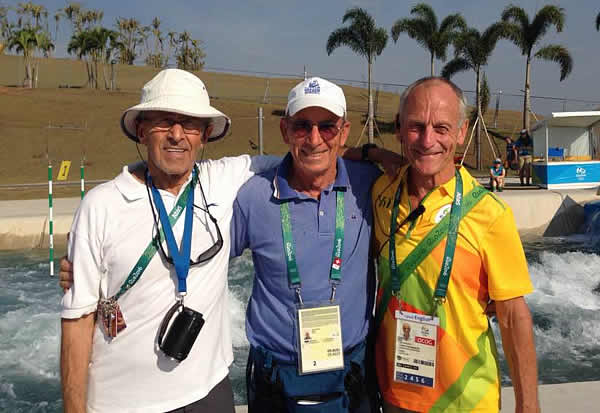
Three musketeers. They paddled against each other in the 1972 Munich Olympics and meet again in the Rio 2016 Olympics as coaches and officials
Zlatan Ibrahimbegovic, Roberto D'Angelo and John Macleod, from left to right.
Zlatan at Brady's Lake, Tasmania.
Kimberley Kayaking 1982
part 16
100 Days Solo
At Kuri Bay Pearling Settlement - collecting food drop.
Watching about 30 Thursday Islanders walk along the jetty and jump into the work boats looked more like a scene in Africa than Australia. They were quite huge people, strong and extremely friendly. Having spent 2 days at Kuri Bay I was eager to do a three day canoeing, exploring exclusion around Camden Harbour. My objective was to visit the old Camden Settlement, the abandoned Kunmunya Mission and explore Augustus Island before returning to Kuri Bay to collect my
gear and some more 16mm movie film coming in with the mail boat that hadn't arrived.
In 1838 an explorer Grey ventured into the Camden Harbour area. He was the first to officially recognise the Camden Settlement potential in this locality. From these early reports, pioneers in search of new lands were encouraged to settle. In 1864 a group of interested settlers from the east of Australia formed the Camden Harbour Pastoral Association. With the capital they raised, a large amount of land would have been allocated. In November of that year the
first ship, the ‘Stag’, set out. They arrived in December with a small amount of breeding stock, ample provisions and farming equipment. They were to be followed by other vessels, ‘Helvitia’, ‘Calliance’ and the ‘Jeannie Oswald’.
The first settlers faced horrendous conditions. The wet had not yet arrived so the land was dry and provided little feed for the stock. The animals began to perish quickly. The ‘Calliance’ arrived with her load of settlers and supplies on Christmas Day 1864. Having suffered some damage to the hull on an uncharted reef, the captain brought the ship close to shore to assess the damage. Unfortunately a sudden storm blew the ship onto rocks where it was wrecked.
The wreck was sold to three men who sold the salvaged materials from the ship.
The settlement limped on, continuing to face many difficulties. By the time the official Resident Magistrate of the North District arrived, a quarter of the stock had died and three settlers had died. Problems, including insects, heat, humidity, tropical ulcers, sharks and crocodiles made life difficult. The settlers did not have any knowledge of local food sources and their relations with the local Aborigines, who could have helped, was not cordial, in fact
there was conflict.
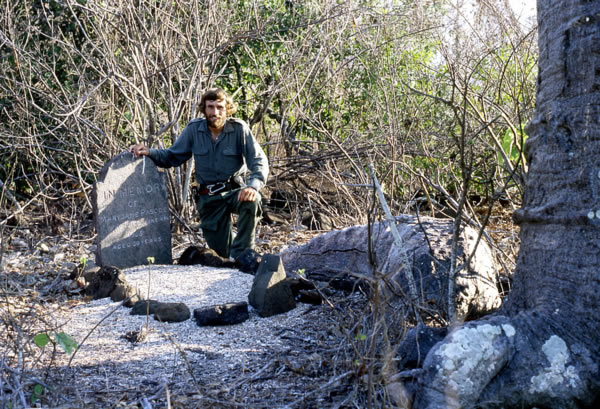
All the people of Camden Harbour had withdrawn from the settlement by October 1865. In the ten months of the Association, nine people died. Six are buried on Sheep Island. Those known are Constable Gee, Jimba, John Meadon, Baby Patterson and MJ Pascoe. The headstone of Mary Jan Pascoe, who died following childbirth is still standing today.
Breakfast of toast and honey certainly got my taste buds going, but it was back to muesli, rice and dried fruit as soon as I left there. Four TI’s gave me a lift down to the water with the kayak. It would have been great to have them along to do all the lifting. Within two hours I had crossed Brecknock Harbor and landed on a steep Shelley Beach of Sheep Island. Behind a boab tree lay the grave of Mary Pascoe. It was in perfect condition and the inscription on the
headstone read Mary Jane Pascoe, died June 4th, 1865, aged 30 years. In fact Mary Jane Pascoe had died of an infection following childbirth.
The grave of Mary Jane Pascoe on Sheep Island. 1865
Wasting no time I returned to my kayak and paddled a short distance across to the mainland with the intention of finding the old government camp. There was no beach, just rocks, most with oysters on. The tide was fairly high but out-going reducing my dragging distance. Without timber rollers the oysters would have ripped the hull apart. The long dry grass prevented me
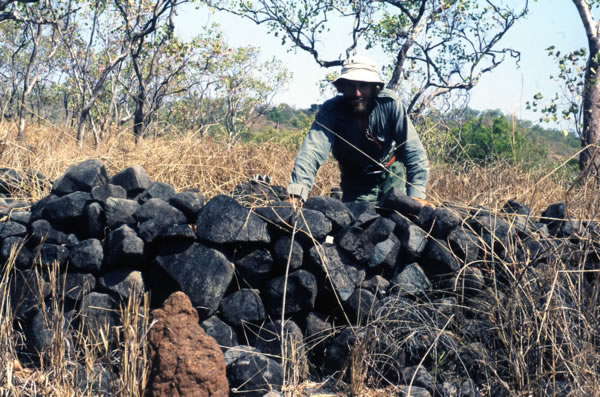
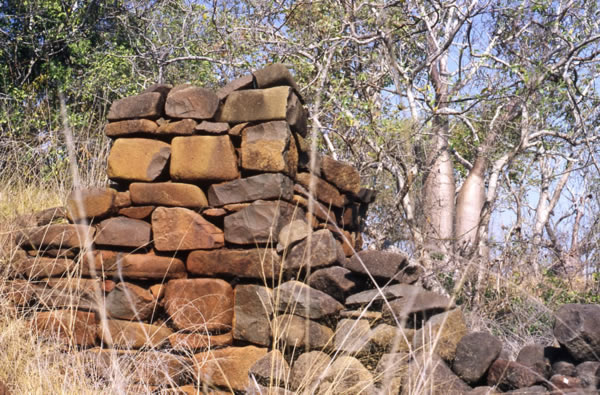
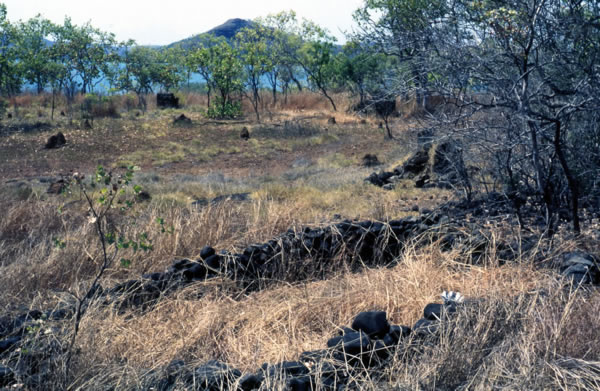
from easily locating the old town so it meant more walking across the tortuous country. Within five minutes I had found an old stone wall. There were four stone walls scattered around the site, a holding pen made of rocks forming a circle and a couple of walls standing alone. The holding pen was about 5 metres across and roughly 2 feet high.
The walls on an old holding pen.
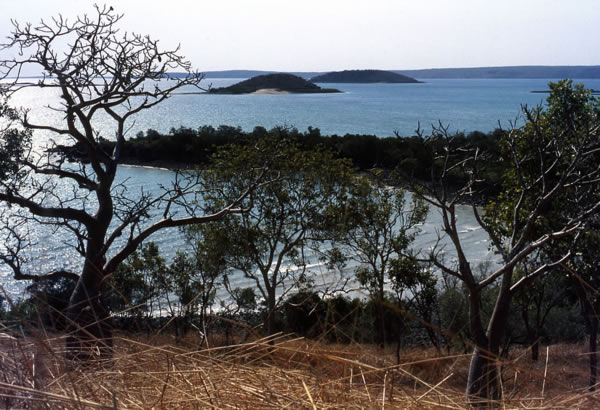
I searched the area and photographed the ruins from all positions until I was satisfied I could find no more. I decided to climb the hill behind to get pictures of the bay and Sheep Island. Mule tracks were all over the country making it a little easier for me to walk over the rugged train. The tracks were like Perth bus routes though, the mule tracks went up and down
the hills but never across where I sometimes attempted to walk. A mule suddenly blocked my way and stared at me. I didn’t know how to react or if it would charge me like a bull. This was the first feral animal I had seen on the trip so far so I was cautious.
The site of the ill-fated settlement.
Further up the hill six more mules looked menacing. I picked up a rock, but before I could throw it they took off over the hill like the wind and neighing as they went. I descended the ridge and crossed a small creek on the way back to the settlement when my bowels loosened up. I wasted no time, I squatted. There were millions of flies probably due to all the mule shit
that scattered the landscape. I soon realised I had no toilet paper so I had no choice, but to use the dry coarse grass if I wanted a clean bum. It wasn’t pleasant.
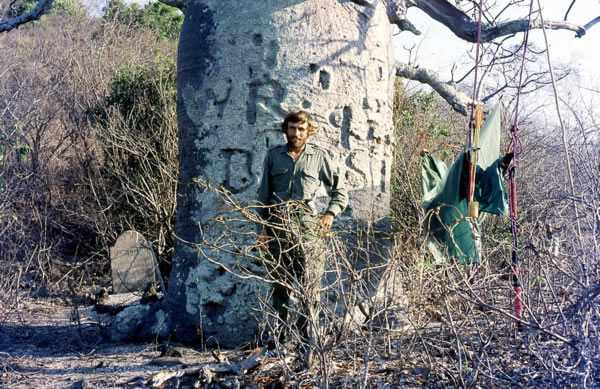
I paddled back over to Sheep Island to camp the night. Apparently there were six people buried there and only one had a grave headstone. I took the liberty to tie my hammock from the bows of the boab tree next to the grave. I hadn’t slept in a graveyard before so I hoped there are no ghosts.
After admiring the sunset through the bows of the boab tree, losing the light and the millions of flies the night became damp. Despite camping in a graveyard I had a very good night’s sleep and my historical camp became a subject of early-morning bird calls especially the screeching from the parrots. The beach curlew that greeted me the previous day was again pacing along the shelly shore.
I camped in my hammock on Sheep Island.
My journey through Rogers Strait heading to Kunmunya on a high but turning tide presented me with some opposition from the current, but nothing like I had been told by the locals. They said the currents could stop a powerboat. Only a few days before I arrived at Kuri Bay a yacht had hit a reef and became stuck in Rogers Strait. Kuri Bay workers and their powerful boats helped to pull it off the reef on a high tide. My nearest camping spot to the abandoned
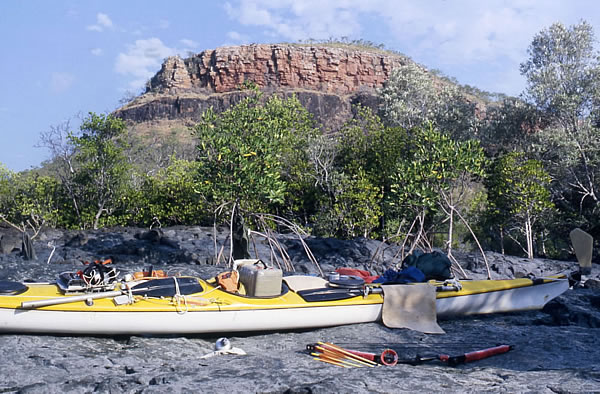
Kunmunya Mission was below the steep vertical cliffs of the Kunmunya Hill. It was a pleasant sight. There was no beach, only a rocky shore lined with mangroves. The high tide enabled me to slice through the mangroves onto a slippery rock ledge. I had no time to lose, once ashore I had to start my 15 kilometre walk to the old Mission and back before it got too late. There was a choice of two routes, the direct one over the hill or a longer route following a creek line. With my pack full of
cameras and survival equipment I decided on the direct route.
The Presbyterian Church established their first mission in W.A. in the south eastern corner of Port George IV Inlet in 1912. After three years of struggle, the Port George mission was relocated to Kunmunya in 1916.
Building materials were transferred from the Port George mission site to Nhorgor Inlet. Additional building materials were brought up from Broome and a rough track was blazed through the hills and across creeks to link the landing at Nhorgor with the Kunmunya site, some 4 miles to the south-east. Over the next few years a church, a Mission house, other houses, store sheds, wells, tanks and gardens were established.
The Worora aboriginals, numbering over 300, embraced the mission. Kunmunya was eventually abandoned in 1950 and by late 1951 all persons and buildings, including the church had been relocated to Wotjulum.
Camped in front of Kunmunya Hill.
I moved up the gully between Kunmunya Hill and another hill to the east, chasing a 2 ½ foot goanna lizard, with the last 6 inches of its tail being white. I can usually walk up the hills without stopping but this time it was too hot and too steep. Once on top of the ridge I set a compass course to the old airfield. Disturbed by my presence a wallaby with a bushy tail
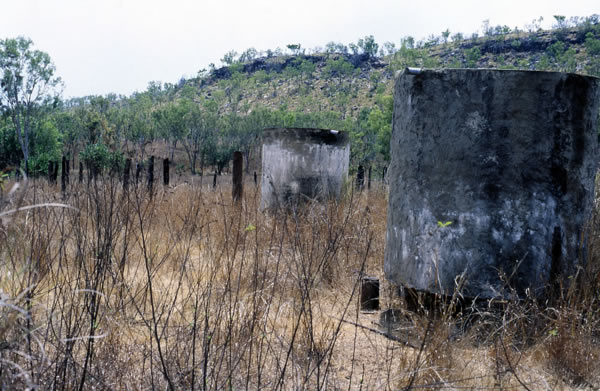
flashed off flying across the rocks and spinifex. I just wished I could run as fast. When I descended the ridge heading towards the old, now very overgrown airstrip a flock of parrots cheered me on. With nothing to see there I followed the mule tracks towards the settlement passing an old aircraft. A corrugated iron toilet with a large and deep hole formed in concrete was in good condition. Behind that there was an old stockyard with a giant clamshell and two old water tanks, which looked as if
they were concreted around steel. A herd of cattle, with a bull that didn’t seem too impressed with my presence stood between me and the other ruins. A big wave with my camera bag and they were off.
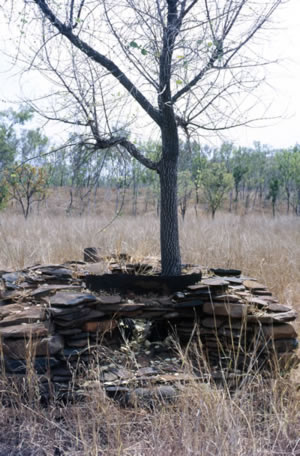
My next stop was at the private toilet, it had no lid covering the large square hole, but it was still in good nick. Close by was a collapsed corrugated building with small rock walls. Other old sheds stood precariously, but an old stone fireplace really took my fancy. It had a tree growing through the middle of it, proof that it hadn’t been used for years. Other
foundations, concrete water tanks, small bath, old wheels were still present, but the larger buildings had been dismantled.
I moved over to the lush pandanas palms and paperback trees that shaded pools of water. Stepping down into the water course a large kangaroos sprung to life and run a few metres to hide in the long grass. Topping up my water containers in the stagnant pools, polluted by cattle and donkeys I headed back over the ridge where I came across an old concrete dam wall that blocked off a creek. Walking pass the waterless dam, three more tin shacks formed the extended
boundary of the mission grounds.
Mules on my track gave the impression that they were going to charge me but after a few forward paces making one hell of a racket, they turned tail and ran away. Within a few minutes I had rounded up seven mules all going in my direction. Crossing the plain and the airfield the mules now nine galloped off bellowing their guts out. Following a small creek home gave me more shade and several pools of water and at the junction of two creeks a small running stream
flowed but disappeared several times seeping under a bed of rocky boulders. The creek at times was steep with a few large drops and good swimming holes at the bottom of them. When the mangroves appeared a trickle of water was still dripping over the rock bed. The heat was intense and I could now feel the strain on my body.
One Year In The Wilderness
In 1988 at this Kunmunya Mission site Ewen McGregor and I walked into the mission to meet Mike and Susan Cusack who were living there for a year. Although they had food, they built their own shack and had to bear the isolation and the discomfort of the weather and lack of water.
You can read about that trip here:
https://terrybolland.wordpress.com/around-the-kimberley-expedition/
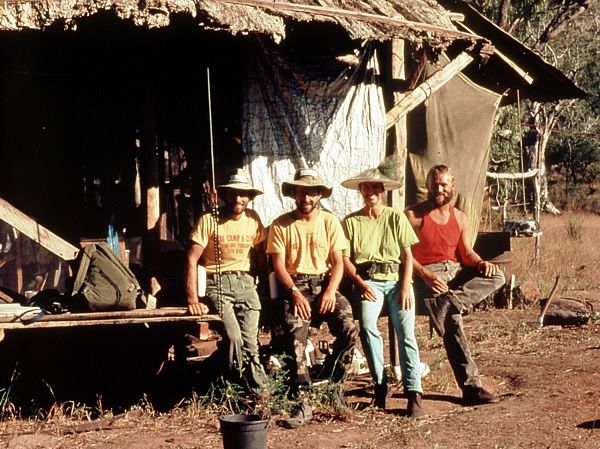
With Mike and Sue Cusack in 1988 at their Wilderness home at Kunmuya.
In 1987 Mike and Susan Cusack, who were chosen from more than 500 applications to spend a year living in isolation at the site of the abandoned Kunmunya Mission in the remote Kimberley.
The concept was the brainchild of Dick Smith, the founder and then-publisher of Australian Geographic, who’d come across the mission while researching Charles Kingsford Smith, who had made an emergency landing in the area in 1929 en route from Sydney to England.
“So in the process of researching that aviation history he found out about the mission and thought, ‘Oh, this would be a good place to drop a couple of poor unsuspecting people’,” Mike jokes over the phone from Victoria.
“It ended up being the driest year for 30 years,” Mike says. “It’s an area that has an annual rainfall of around 1200mm but the previous couple of years there hadn’t been too much at all — we got 16 inches of rain (about 400mm), and half of that was pretty much in one go. So it was a bit dry, and that obviously had its consequences.”
There were the difficulties in finding and carting water, as well as the physical and mental effects of dehydration. Then there was a bushfire, and the sapping tropical heat and humidity, and the sheer physical slog of survival — not to mention the snakes, the feral cattle and donkeys, the saltwater crocodiles and, worst of all, the flies.
However, as Mike puts it, “hope springs eternal”. And there were upsides, too: the waterfalls that appeared after the rain, the characterful “ta-ta” lizards and tree frogs that made the camp their home, the couple’s growing understanding of the landscape, the chance to explore the Kimberley coast in their small boat, and their friendships with the few visitors they did receive, including a memorable encounter with an elderly Worora woman who had grown up at the
mission.
Enter here:
https://www.webscorer.com/register?raceid=226899&fbclid=IwAR17t8t7fDww9ctIpIpJaQSViWOg84WithgloEmtz4O-VfC6tmbwNv5XyvA
Indian Ocean Paddlers
Races
Summer Series dates are now locked in. We are also very pleased to announce that Brad and Kate Hardingham Realmark have agreed to stay on board as our seasons sponsor. This support for IOP is massively appreciated.
Race dates:
7th November
21st November / WCD
28th November / Doctor
12th December Xmas paddle
9th Jan 2021
30th Jan
20th Feb
13th March
Next race 7th November
|
|
|
|
|
|
|
|
|
|