|
|
|
|
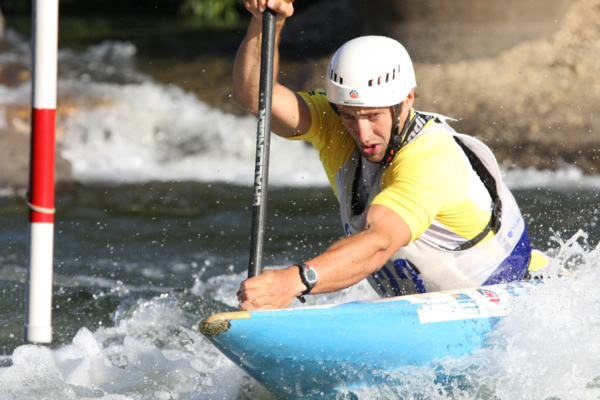
Penrith Whitewater Stadium
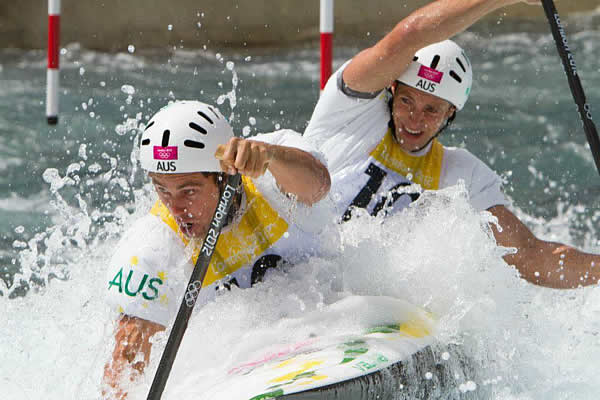
Sydney 2000
20 Years a go
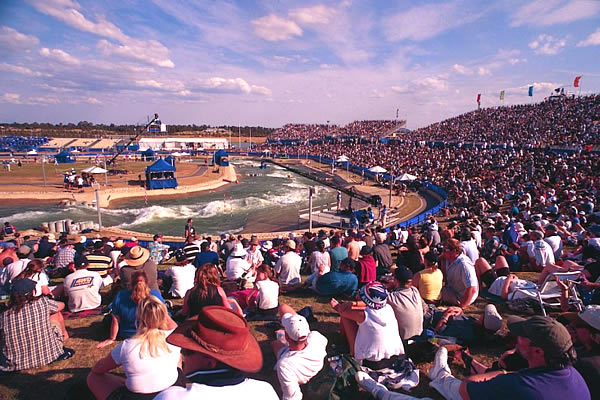
What a crowd
Thursday, 17 September 2020 marks the 20th anniversary of the start of the Sydney 2000 Olympic canoe slalom competition at Penrith Whitewater Stadium. Olympic dreams came to life at the purpose-built “River of Dreams” during 17 –
20 September 2000 with the world’s attention on Sydney and Penrith during this time.
Since then, the Olympic legacy venue has continued to attract the world’s best athletes for training and competition in Penrith, including the flagship International Canoe Federation (ICF) Australian Open in February each
year.
Securing canoe slalom for the Sydney Olympic Games in 2000 took an international effort and set the foundation for a thriving legacy for the sport and community in Penrith to this day.
The paddlers representing Australia in Canoe Slalom at the Sydney Olympics were:
Danielle Woodward, Andy Farrance, Kai Swoboda, John Wilkie and Robin Bell.
Penrith Whitewater Stadium has contributed to the success of Australia’s top canoe slalom athletes:
Jacquie Lawrence, Olympic silver 2008, Robin Bell, world champion 2005, Olympic bronze 2008 and Jessica Fox, who was inspired by Sydney 2000 at the age of six to follow her Olympic dream. Since then, Fox has won two Olympic medals, ten world championship titles and is set for her third Olympic Games come Tokyo 2020+1.
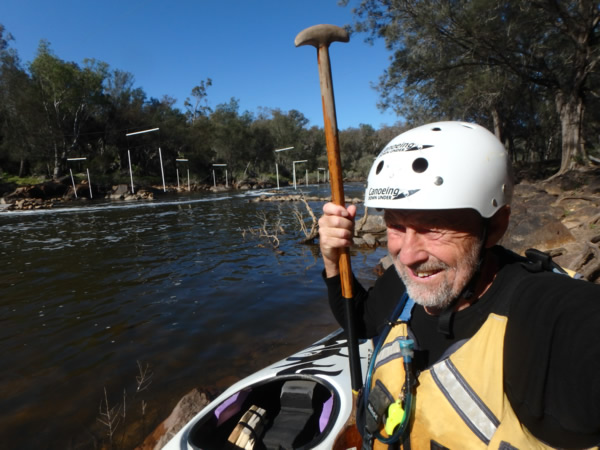
Sunday was the last chance for a bit of C1 whitewater paddling on the slalom course at Walyunga.
This weeks slalom race will be at Ascot Kayak Club on Saturday morning, 8.30am.
Why don't you give it a go.
What is Slalom Kayaking:
Check it out:
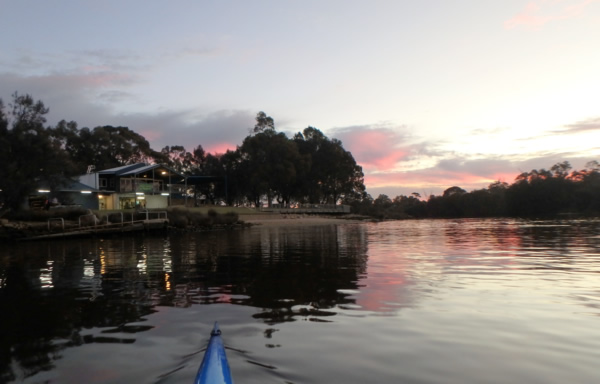
Monday evening really felt it was the start of summer.
It was warm and I didn't need my thermal on.
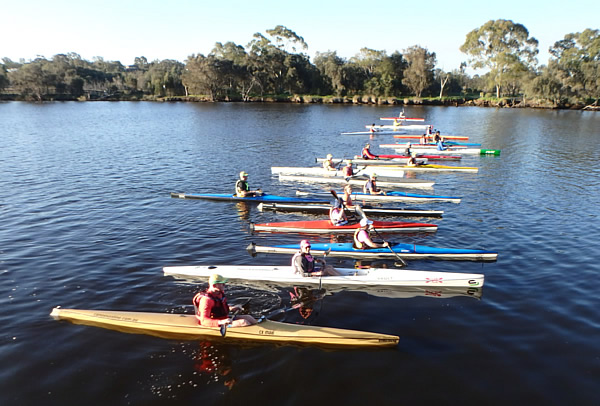
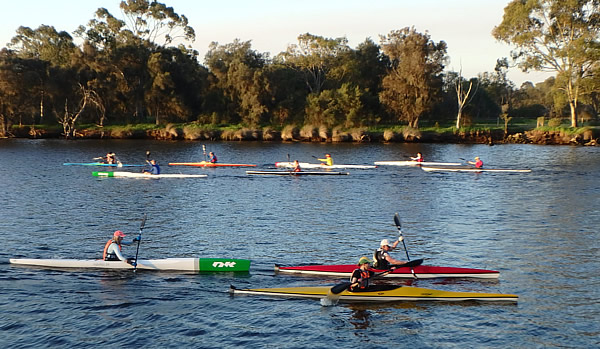
Tuesday: The Progressive Racing Group ready to warm up.
The main race is handicapped with the slower paddlers going off first.
25 paddlers were on the water.
By the end of the race the faster paddlers reach the finish line at a similar time as the slower ones.
Nanga Challenge
The great thing about this race apart from it taking place in such a beautiful area of Dwellingup, is that you are guaranteed to sleep the night after, if you competed in all 3 legs. Paddling, mountain biking and running.
There were the Nasty or Nice courses.
Results:
https://www.webscorer.com/race?raceid=222072&fbclid=IwAR0apt69o6EjLMpY5ViQwbieJg9W35pqWwkolndpmWFkqrqflQeKLkPt1V8
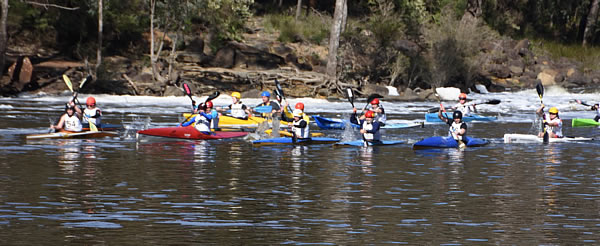
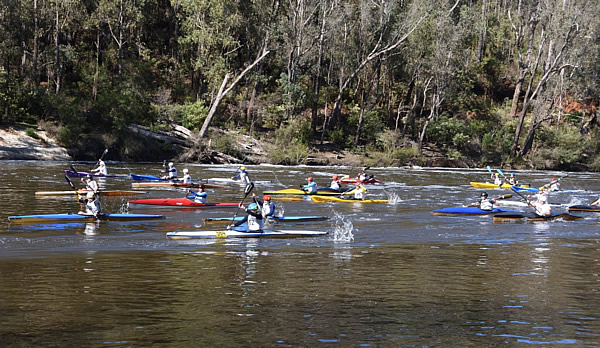
Paddlers take off. Photo Lawrence Greed.
Paddlers take off. Photo Lawrence Greed.
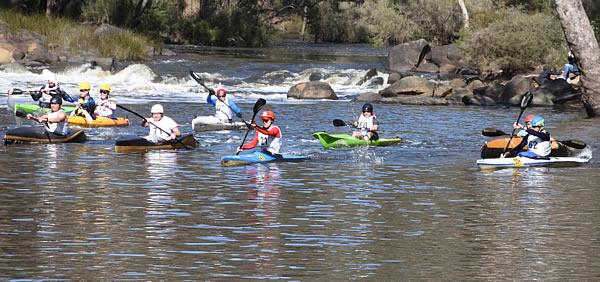
The easy part. Photo Lawrence Greed.
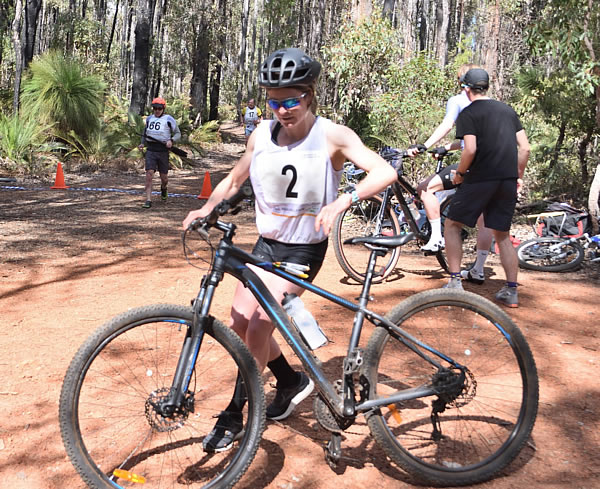
Transition from paddle to bike. Jane Pankhurst ready for the bike leg.
Photo Lawrence Greed.
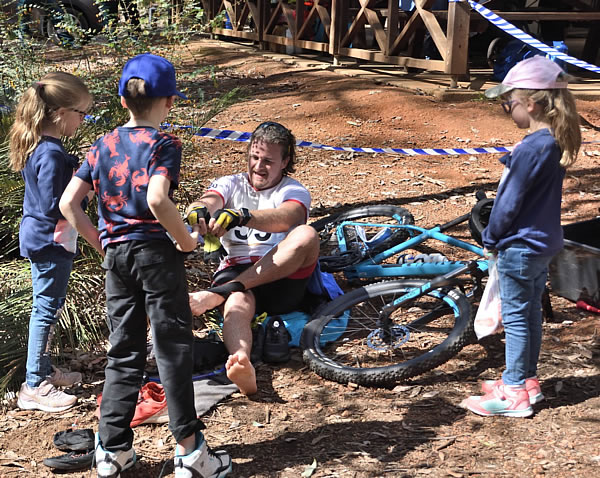
Brad Willoughby in transition. His children are saying, "Come on dad you are wasting time". Photo Lawrence Greed.
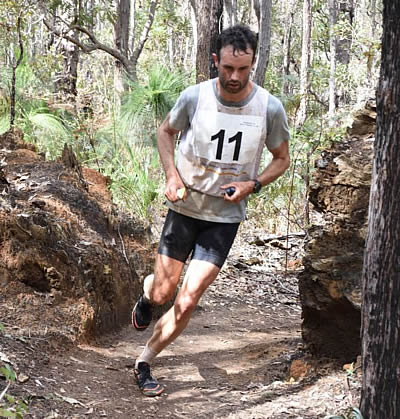
Winner. Andrew Mowlem 3.10.44 over the Nasty Course.
Photo Lawrence Greed.
Ascot Slalom Course
Western Australia has three flat water slalom courses. The one at Ascot, one at Swan Canoe Club and one at Hester Park, Langford on the Canning (Djarlgarra) River where once the Darling Range Canoe Club used to be located. The Hester Park slalom course is more sheltered from the wind and more natural but it is used less as there are no clubs out that way.
These 3 flatwater courses have been extremely important in keeping slalom kayaking alive in WA which doesn't have much whitewater. When we had the Harvey white water course there were lots of slalom paddlers of all ages having the opportunity to paddle white water through the summer months. It was great. We don't have that luxury now.
These flatwater slalom courses have helped to develop Olympians like Robin Bell (SCC) who went to three Olympics and won a C1 bronze medal at Beijing Games. Kynan Maley (SCC) and Robin Jeffery (AKC) competed at the London Olympics and many other paddlers have been to World Championships.
Unfortunately 4 times Australian K1 Champion Lindsay Binning didn't get the opportunity to go to an Olympic games due to there being no slalom events at an Olympics when he was at the top of his game.
Slalom canoeing made its Olympic debut in 1972 in Augsburg, West Germany, for the Munich Games. It was not seen again for 20 years, until 1992 in La Seu d'Urgell as part of the 1992 Olympics in Barcelona, Spain.
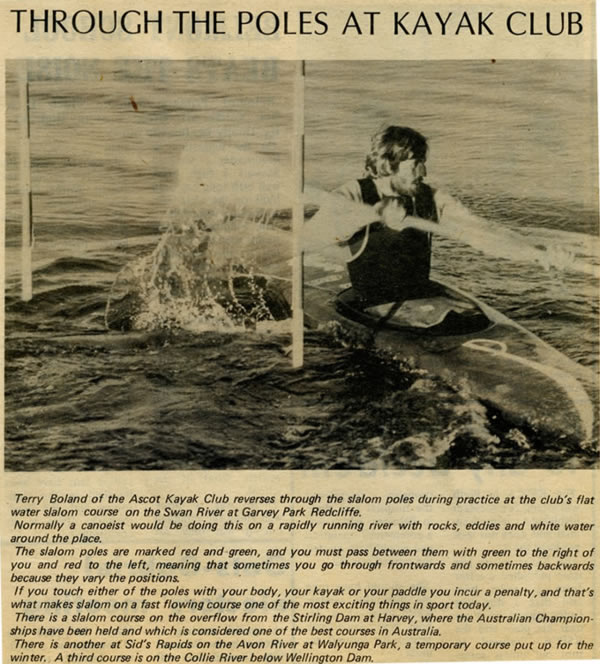
Using the slalom course back in 1979.
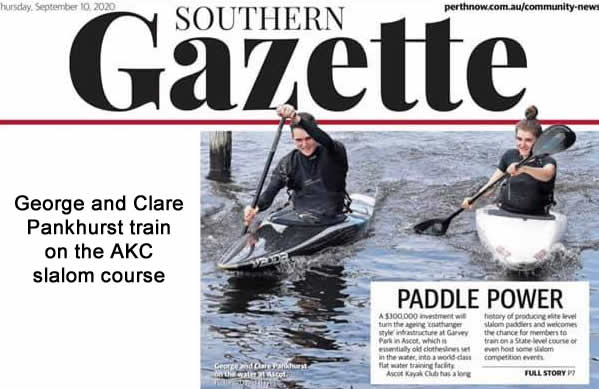
George and Clare Pankhurst, two of Ascot's experienced slalom paddlers using the flatwater course at the moment.
Robin (Robbie) Jeffery
born August 1987
What drives an 8 year old to become an Olympian?
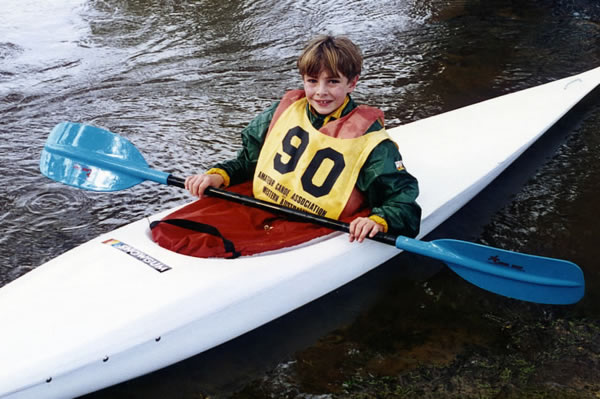
Robbie started paddling at AKC with Steve Pilton’s Canoeing for Kids group in 1995 when he was 8 years old. The following year, as a 9 year old, he had his first experience of white water at Walyunga.
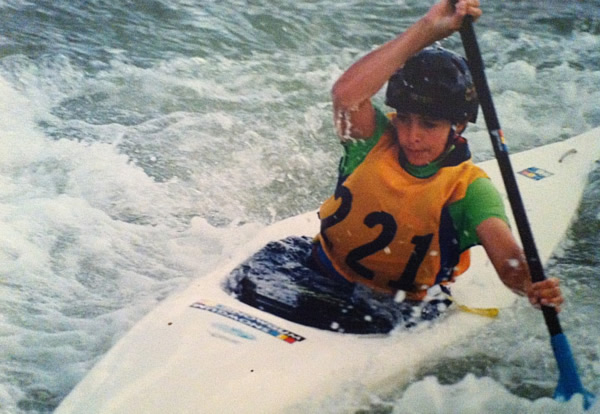
At an age of 12, in the year 2000, Robbie competed at the new Penrith course, and his first ever Australian Canoe Slalom Championships.
A few weeks before he left I taught him to roll.
His first roll in whitewater was at Penrith.
Really excited, he rang me from Penrith to tell me he had made a successful roll.
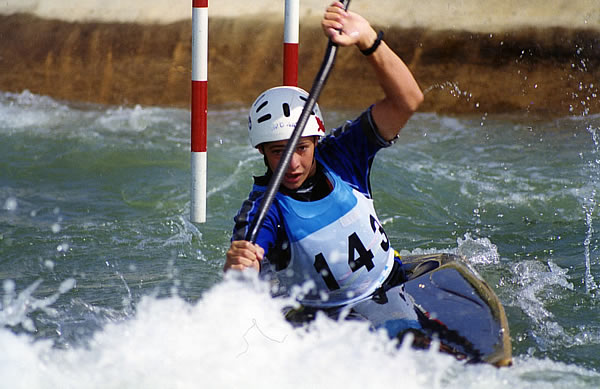
Robbie at one of the junior championships.
He was selected to paddle in New Zealand Olympic Hopes program.
Robbie moved to Penrith in 2005 when he was 17. There are many junior athletes who have to move to Penrith if they want to chase their Olympic dream.
Robbie represented Australia in both C1 and C2 at Senior World Champs from 2009 till 2015. He represented Australia at the 2012 London Olympics, where he came 10th with fellow WA athlete, Kynan Maley.
He retired from being an athlete after 2016 Olympic selection after missing out by the narrowest of margins.
He is now a coach.
--------------------------------------------------------------
In 2001 Robbie was selected as part of the combined WA/TAS canoe slalom team that competed in the inaugural Australian Youth Olympic Festival at Penrith. He was only 13, the youngest by far in the competition. WA’s young gun paddlers like Kynan Maley, Robin Bell and Hew Roberts were all over 18 so not eligible.
In 2002 when he 14 years old he was selected to the Australian Junior Canoe Slalom team and travelled to Poland in July that year to compete in the ICF Junior World Championships.
In the 2003 as a 15 year old he won a bronze medal at the Youth Olympic Festival competing in MK1. Soon after he developed chronic fatigue and had to take the rest of the year off all sport.
In 2004, at the selection races at Eildon in Victoria, he agreed to change to MC1 in order to be eligible for the Junior Development Team that would travel to New Zealand over Easter to compete in the New Zealand Slalom National Championships.
That was the beginning of his career as a C1 athlete and he became a fervent member of the WA C1 cohort of Robin Bell, Kynan Maley and Hew Roberts. As a group, they certainly made WA dominate in this class.
After completing his TEE in 2004, Rob moved to Penrith to pursue his ambition of becoming a constant member of the MC1 team, as a junior, then Under 23 and then Senior paddler. He was a member of one of those teams every year thereafter except one.
In 2010 Kynan Maley and Rob teamed up in Mens C2 and immediately started making an impact on the World Cup and World Championship circuit. By 2012 they had qualified the boat for Olympic selection for the London Games. The 2012 selection races saw them take the Olympic spot for Mens C2, with Kynan also gaining selection in the Mens C1, the first year in which athletes were permitted to
compete in more than one class at the Olympics.
Robbie retired from competition after the selection races in 2016 when he missed selection to the Rio Olympics in the Mens C1 event by the narrowest of margins.
He was appointed Australian Canoe Slalom Team Canoe Coach at the start of 2018 to now.
If it weren’t for Covid-19 he would have been going to the Tokyo Olympics as canoe coach with athlete Daniel Watkins.
He is now coaching and mentoring a number of Australian athletes, including AKC athletes Brodie Crawford and Steven Lowther, and Swan Canoe Club athlete Demelza Wall.
Robbie became the Australian Canoe Slalom Team Canoe Coach at the start of 2018 to the present day.
Aussie Coaches and Athletes checking in for RU OK?Day
Sport is at the centre of many communities across Australia and this R U OK?Day, Thursday 10 September, coaches and athletes are encouraging everyone involved in sport from high performance to grassroots level to check in with one another, and ask R U OK?
It has been a challenging year for everyone, making it even more important for people to stay connected. The Australian Institute of Sport (AIS) and Sport Australia are throwing their support behind #RUOKDay and reminding everyone that a conversation could change a life. This year Australians are learning what to say after R U OK? to keep the
conversation going when someone says “No, I’m not OK”.
Coaches and athletes from sports across Australia are banding together this R U OK?Day to encourage people to have a conversation, including Paddle Australia’s Australian Paddle Team and London 2012 Olympian and National Coach – Canoe Slalom Robin Jeffery.
“I was really motivated to be involved with RUOK?Day, partly because of some of the struggles I experienced after Rio Olympic selection and disappointment I had there. But also, now being a coach as well, and seeing the ongoing challenges that our athletes and coaches alike experience. It shone a light on me on the importance of mental health and
making sure that we are checking in on each other all the time,” Jeffery said about his motivation to get involved with RUOK?Day.
Jeffery has been coaching Paddle Australia’s men’s canoeing paddlers on the canoe slalom team, including Daniel Watkins, who was selected earlier this year to represent Australia at the Tokyo 2020 Olympic Games next year. His advice to other coaches?
“The advice I give to coaches, ask the question, are you OK? Keep checking in, but as well, when you are asking those questions do it in an environment where it’s equal balance of power, so going out of the sporting environment going for a walk in the bush. If you’ve got a shared interest, kicking the footy in the park, it’s something I have been
doing with my athletes. It’s just that catalyst to start conversations and it’s really powerful.
Kimberley Kayaking 1982
part 9
100 Days Solo
I descended and paddled through the channel and islands of Sir Richard Island
at the change of high tide and it didn’t pose a problem at all. Paddling at the peak of high tide was usually the best time to go through tricky areas especially on neap tides because there was less water movement. But on spring tides the change of tide doesn’t last
long and the water is often going out when the incoming tide is coming in.
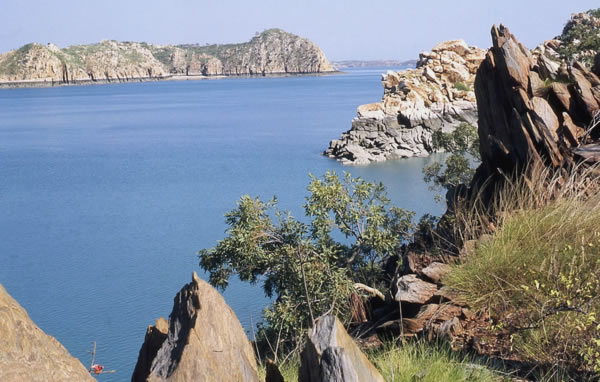
My aim was to camp on Mary Island, a few kilometres after the passage, but its vertical cliffs gave me no alternative but to move across the choppy bay towards Whirlpool Pass. I stopped before the pass and landed on Dunvert Island and immediately carried my
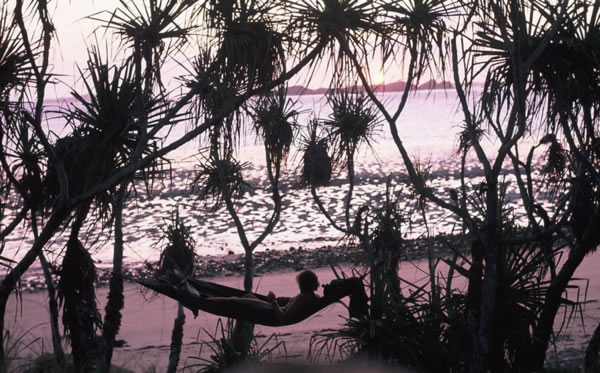
gear above the high water and climbed the ridge to get a higher view of my route ahead. I was trying to get as much of an idea of the currents through the pass as I could. The view again was outstanding. When I returned back to camp I stretched my hammock between two pandanas palms. As the breeze cooled my heated and tired body, and the dry leaves rustled in the wind, I watched the sun disappearing over the ridge. I was very comfortable and contented in my hammock as I was stretched out naked
and drifted into deep thought. I was extremely happy with my trip so far as I had learnt so much, seen so many beautiful places and met lots of friendly genuine people. Nothing seemed to worry me any more and every day I gained more and more confident.
As darkness crept in, the full moon lifted from the ocean throwing a dramatic reflection across the water and lighting up my world around me.
I had a few hours to kill before I could attempt the paddle through Whirlpool Pass. The tide was low so with spear in hand I walked along the shallows before collecting my survival kit and pack for a walk along the high ridge to check the tidal patterns and
currents below. To the north-east I could see Strickland Bay and tucked in between the islands there was the bay called the Graveyard. Apparently many pearl divers had lost their lives there.
I spotted a 3-4 foot snake which demanded the right of way, so I detoured around it. Where was the safest place to be! Was it kayaking with sharks and crocodiles or walking amongst the snakes. They were all deadly. A snake bite out here would be fatal for me
and that was another reason why I always carried my survival kit with my first aid kit, bandages, distress beacon, flares, signaling mirror etc.
By 12.30pm I was ready to tackle the notorious Whirlpool Pass. I left nothing to chance as I timed my passage so I would be in the pass on high tide and with the least tidal movements. With spring tides upon me, by all my readings of the pass, I couldn’t
afford to get it wrong.
The words of Captain Stokes rang through my mind…..Stokes’ Diary, 1837 -1838. We experienced violent whirlpools, the first of which from want of experience handled us very roughly, suddenly wrenching the oars out of the men’s hands and whirling the boat
around with alarming rapidly – and shot down a fall several feet, the boats bow being fairly buried in the boiling current……………………..
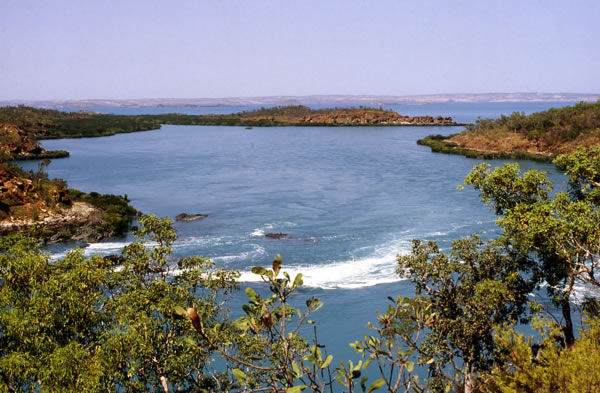
It was yet another beautiful channel with a U bend near the centre. Reaching there I had the assistance of the current, but when I reached the north-east end of the channel the current really accelerated me along and within minutes was throwing me out into
very choppy waves of the open sea. I could see no beach, but as I passed a high point with cliffs on my right I noticed one that would adequately suit my needs. By stopping here it would also give me the opportunity to check out a water hole that Eric Hunter had told me about, which was two kilometres away, on the other end of the island. By the time I had unloaded the tide had started to rip out creating bigger boils and whirlpools as the current
increased.
Camped at the end of Whirlpool Pass.
I pottered around camp and climbed the high peak and watched the water stream out of the pass. It was an extraordinary feeling sitting on the high peak thinking and watching the world go by! This is living. It was truly an amazing experience in one of the most
amazing and beautiful parts of the world.
As I awoke from my nights sleep the moon was just disappearing over a ridge as the sun was rising over the islands. My task for today was to search for the water hole I had been told about and hopefully return with replenished supplies. I liked to have my
supply of water topped up at all times even if I knew another water source was nearby. I never knew if I was going to be stranded for days on an island, so it was important to have good supplies. I would try to carry up to 50 litres of water which equated to 50 kilograms.
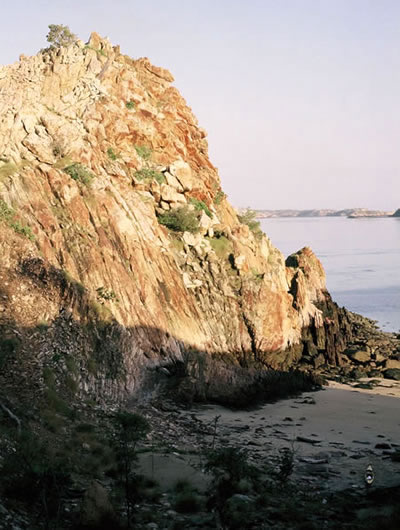
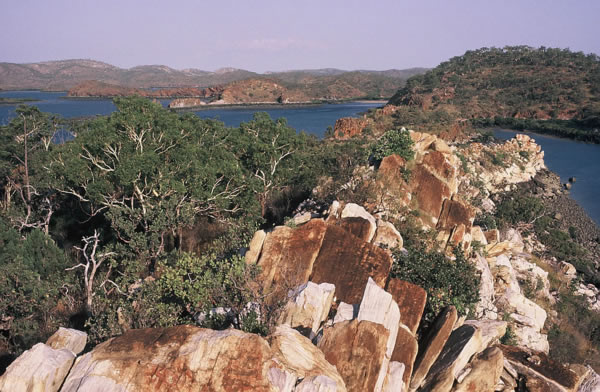
I packed my survival kit and empty water bladders for my walk. I climbed a ridge to find several large mineral stained slabs in a line a few metres apart along the island and pointing up around 160 degrees. They were strikingly stunning and quite remarkable,
but looked very un-natural.
Rock formations on the narrow neck of Chambers Island.
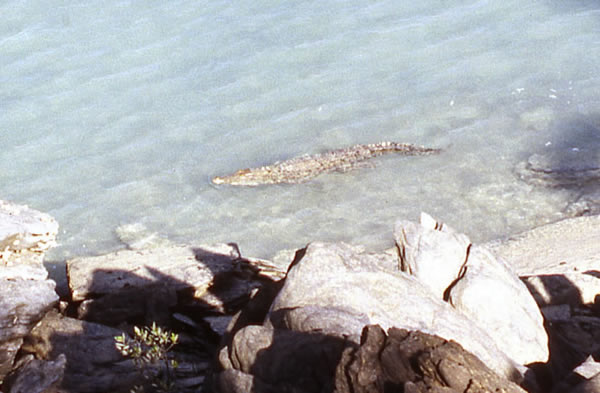
As I walked along the ridge of the narrow neck of the island I could see a school of large mullet swimming beneath me and further along there was a 15 foot crocodile swimming in the shallows next to the rocky shore and only 500 metres from my camp. Its tail swayed, propelling it along at a slow leisurely pace. I started to film it but it was too far away to get a really close up shot. I crept down the
cliff face and moved within 15 metres of it. Mullet started swimming towards it and I expected they were its next meal but as they passed within inches, the croc never blinked an eye lid. Hearing my presence the crocodile quickly sank its body leaving only its head out of the water to investigate its surrounds. It spotted me and it dived at once and sped off under water at a terrific speed.
A crocodile patrols Whirlpool Pass.
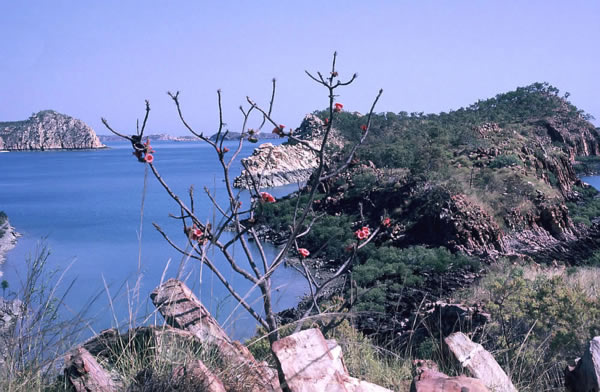
The narrow neck of Chambers Island and Wkirlpool Pass where the crocodile was swimming.
I left the croc to float in the sun further out in the pass and followed numerous kangaroo trails up and over a small ridge to a dry watercourse below. A few metres after descending into the gulley, hey presto, I saw the water hole that Eric had told me about.
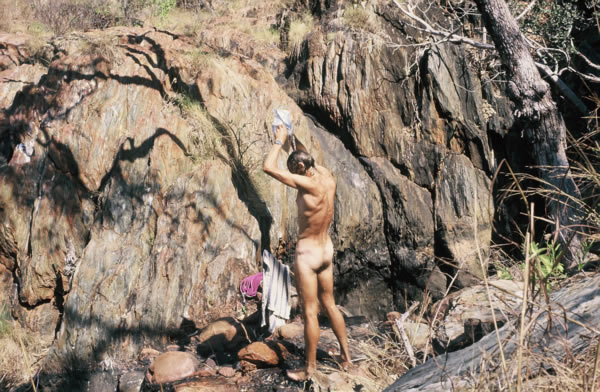
A big lizard sunning itself nearby took off as I approached. The water hole was a round hole about 5 foot in diametre and at that time about a metre deep. In the wet season it would have been deeper. It looked clean, it tasted clean and it was extremely cold, which was a surprise. I filled all my 4 litre wine casks before stripping off my sweaty clothes and teeming the nice cold water all over me. It was lovely and refreshing.
I sat naked in the sun, eating my lunch, relaxing and watching about 15 finches hop closer and closer to the water, but if I gave the slightest movement they flew off again. They say where you find finches, water is always close by. There were also hornets and
flies and they were much braver and insisted that I shared the water hole with them.
Having a shower at the waterhole.
On two other trips the water hole was dry when I checked it.
As I walked back to the camp, this time around the coastline I was soon deafened by the tremendous noise of a large rapid that was created by the incoming tide racing through a narrow channel. It was a perfect place to play if in a white water kayak, although
the thought of crocs would make it just that little more dangerous. As I looked on I heard rustling in the dry grass and as I turned to look a large goanna lizard slowly crept towards me. The goanna was harmless, although some people say they have been known to run up you, thinking that you are a tree. I moved on and then a wallaby hopped away disappearing over the hill. It was the first wallaby that I had seen on an island but I’m sure they are all over the place. On my return I noticed old man
crocodile lazing out in Whirlpool Pass only 200 metres away from my camp.
When-ever possible I tied my hammock from trees, palms and today a boab tree. I felt more secure being up in the air, but in reality a croc could easily get to me if it wanted to as I was only two or three feet off the
ground.
A rapid between Chambers Island and the mainland.
My excursion had taken me 4 hours so at 1.00pm I left against the wind and tide heading through several islands with my destination being Margaret Island. I had time
to paddle to Cockatoo Island, but the wind and tide were still against me, so I beached near Margaret Island. Stopping didn’t mean rest time as I had about 2 hours of unloading and making camp, as well as cooking my own dinner, washing up, and stringing my hammock half way up the hill. What happen to servants!
The moon’s bright light assisted me to pack in the early morning. It was 5.00am and I needed an early start or the falling tide would expose the reef and leave me to carry my gear for several hundred metres. Only minutes out into the calm waters something hit
my stern. I glanced behind but saw nothing. It was a mystery, although I imagined it would have been a shark checking me out.
As I neared Cockatoo Island I could see an ugly scar all along the island. Cockatoo Island was a mine site. It was soul destroying seeing such destruction which was once a beautiful island. They were mining for iron ore and much of the island had been dug away
and sent to Japan, although this open cut mine has produced work for many Australians and boosted the Australian economy. For hundreds and hundreds of miles the spectacular wilderness is virtually untouched so it was so sad to see so much destruction taking place here. A part of my heart slumped into the deep dark ocean.
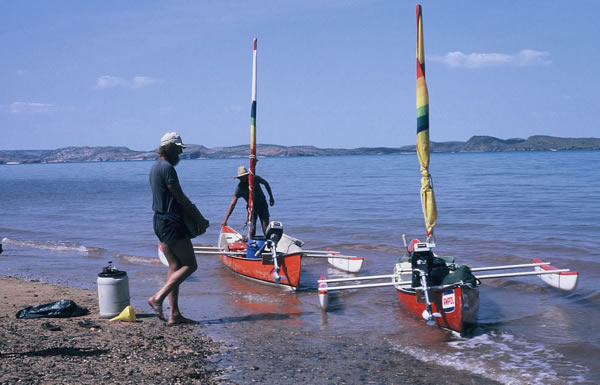
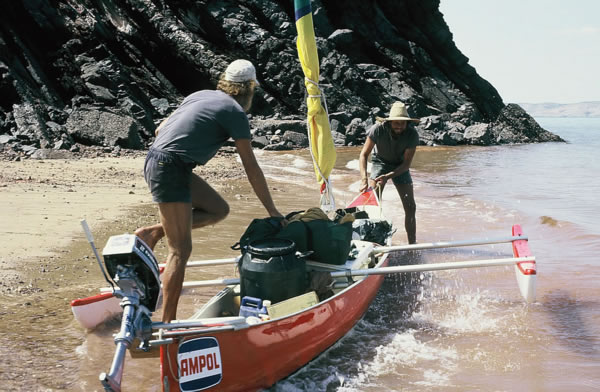
A reef lay between me and the iron ore littered beach, so I waited out from the island for the tide to rise, until I was able to go ashore. Two canoes with outriggers were being brought down to the water. I couldn’t imagine who would be mad enough to use
canoes up in the Kimberley apart from myself. I landed and walked over to the two men. “Malcolm Douglas,” the man said as he shook my hand. “Sean Dixon,” the other replied. I recognised Malcolm from all his books and films and Sean from a canoeing magazine. Sean told me they had just come down one of the rivers in Walcot Inlet and went out to the Montgomery reef and now they were heading for Derby.
The canoes were fitted with outriggers, a sail and a small petrol motor that they used most of the time on the ocean. Malcolm was making another film for the TV and he said his schedule was tight. I watched them pack their gear and leave having a few problems
with a motor that had been swamped the previous day.
Malcolm Douglas and Sean Dixon loading their canoes and ready to leave.
Malcolm Douglas and Sean Dixon about to leave Cockatoo Island.
I would have loved to have a few hours with these intrepid explorers, someday we may cross paths again. They left and the canoes became smaller to my eyes as I unloaded, but soon after the buzz of a motor started to get louder. Malcolm was back. He had
forgotten his dog. He whistled and his dog came running down the beach and jumped into the canoe and off they went again.
As soon as I had unloaded I went to see the island manager and asked him if I could stay a night. He said I could and organized a tour of the island for me. Huge machines were working in the extremely deep open pit mine. It was interesting to see the mining
operation but it wasn’t a pretty picture.
With the iron ore beach being close to the houses the locals used it as a sun bathing platform rather than swimming. A lady and her kids were enjoying the peace and quiet and relaxation. Another had the same idea, but she brought her dogs and they were running
riot. The beach at the back of the island was much more pleasant as it was sand.
Go Paddle & Camp
The Blackwood River
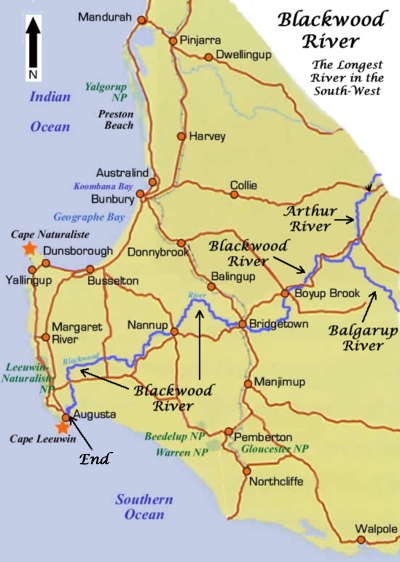
The Longest River in the South-West
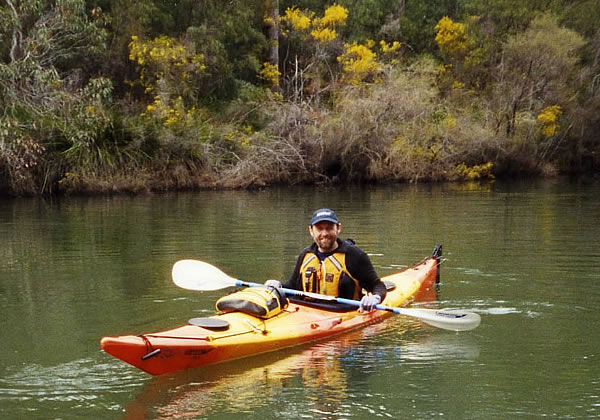
This is the time of year that the Blackwood River is best paddled. There are over 300kms of river to explore, the most popular being the lower reaches through the Jarrah/Marri forests downstream of Nannup.
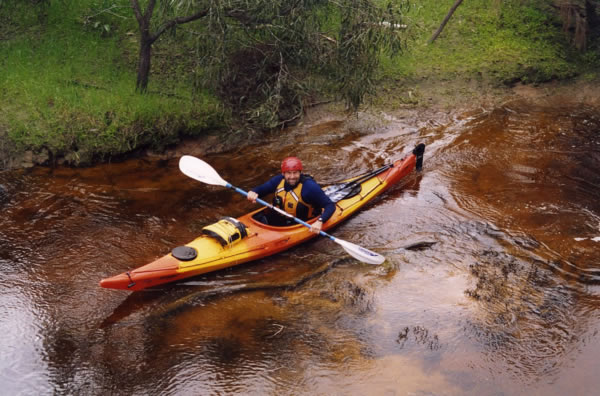
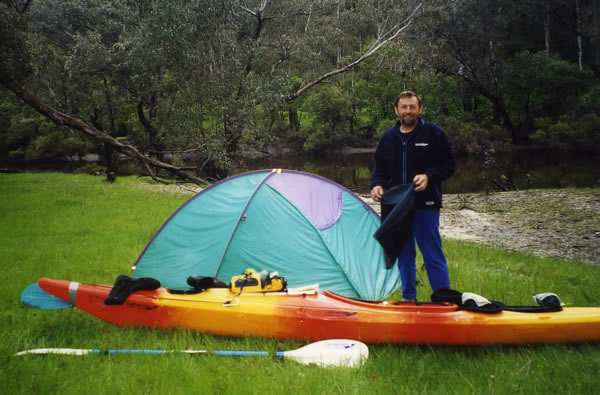
In the 1980s I would paddle sections of the river several times a year taking groups on paddle camps. In September 2005 I paddled the entire length of the Blackwood and some of the Arthur River which runs into the Blackwood River.
To do a trip you need a kayak with storage areas for your tent, clothes, food etc.
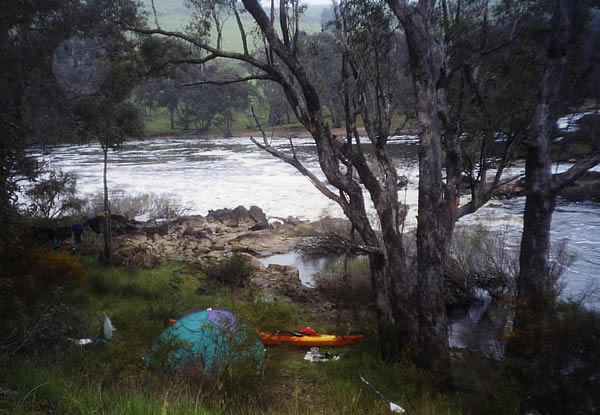
I took a Gecko Kayak which was ideal for my 8 day journey.
There were always camp spots along the river.
This time of year the bushes are more colourful.
Although you are not in a true wilderness it feels that way, especially in the forests where you will see no-one.
There are two big rapids upstream of Bridgetown and 7-8 grade 2-3 rapids for 7 kms downstream of Bridgetown. Other than that there are a few small rapids.
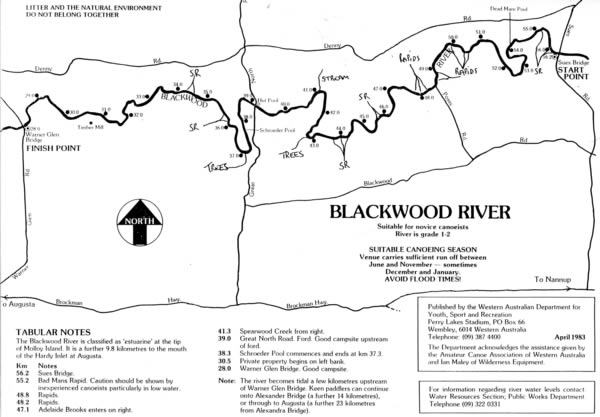
This map is from Sue's Bridge to Warner Glen Bridge.
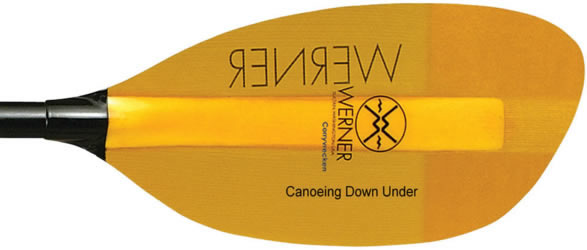
CORRYVRECKAN
2 PIECE STRAIGHT SHAFT
Special - size 210cm only
two piece paddle
Usually $550.00
Special $400.00
210cm only.
Werner one of the best paddles in the world
Lightweight and strong
Indian Ocean Paddlers
Races
Summer Series dates are now locked in. We are also very pleased to announce that Brad and Kate Hardingham Realmark have agreed to stay on board as our seasons sponsor. This support for IOP is massively appreciated.
Race dates:
19th September
10th October
24th October
7th November
21st November / WCD
28th November / Doctor
12th December Xmas paddle
9th Jan 2021
30th Jan
20th Feb
13th March
|
|
|
|
|
|
|
|
|
|