|
|
|
|
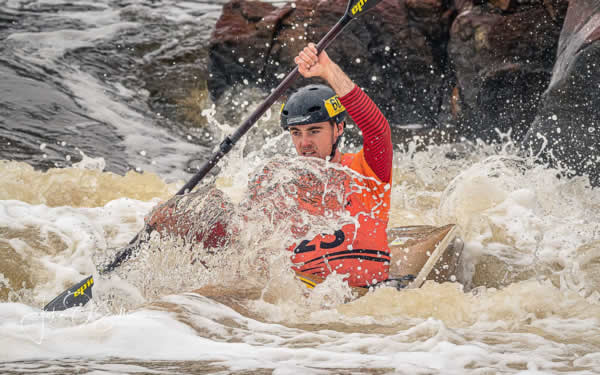
The State Wildwater Championships are on this weekend at Bridgetown.
The State Slalom Championships are on Sunday 30th August at Walyunga with a training/coaching day on Saturday.
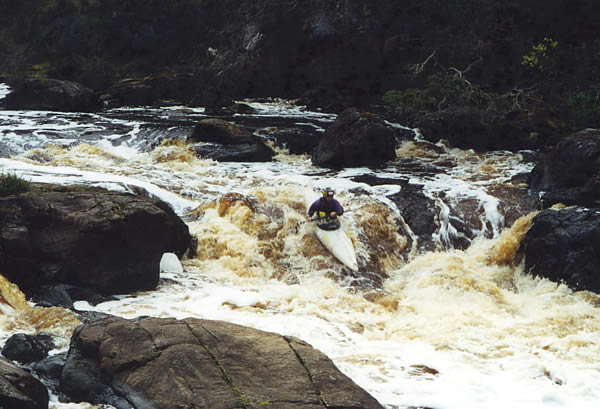
On the Frankland River a few years ago at Circular Pool.
Have you been on a river trip lately.
The Epic container is very close.
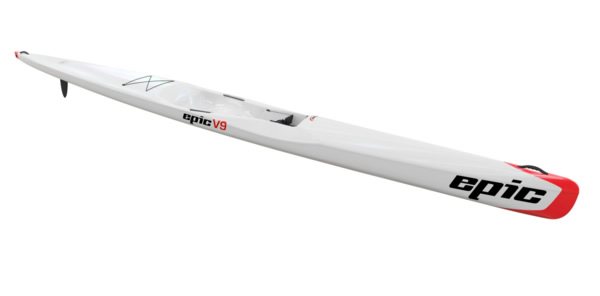
If you are looking for an Epic Ski give me a call.
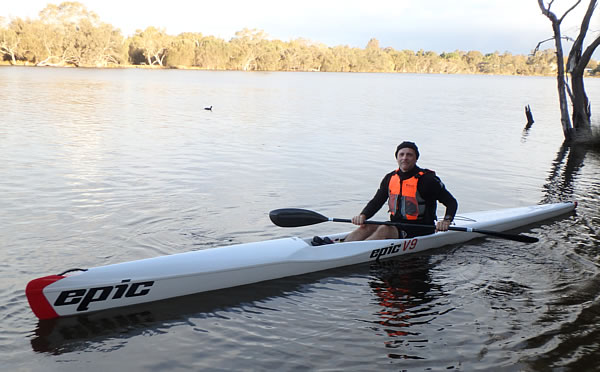
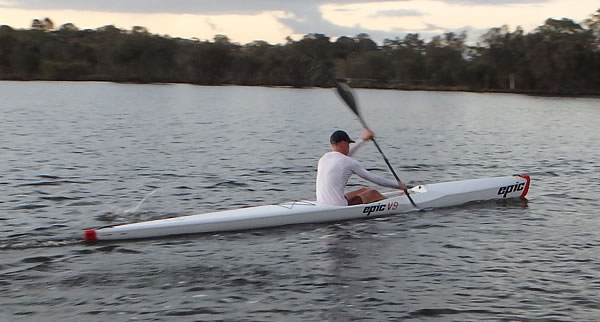
Anthony Clarke takes the new Epic V9 for a spin.
V9 SPECIFICATIONS
Length: 5.79m (19'0")
Width: 49 cm (19'3")
Depth: 32 cm (12'6")
Capacity: 120 kg (265lb)
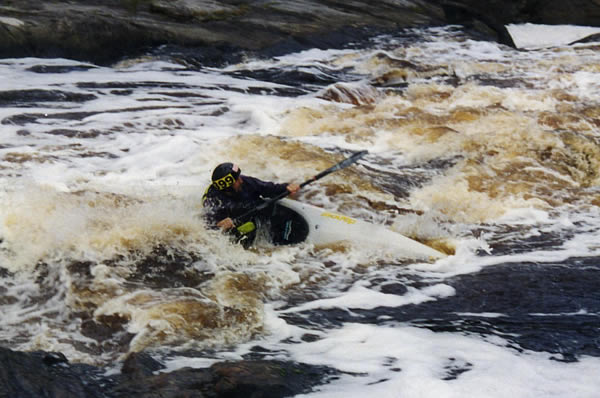
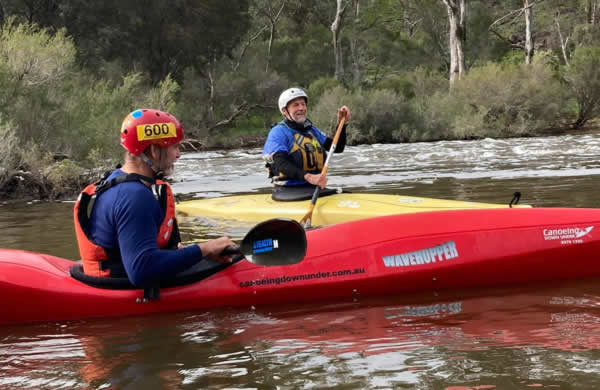
It had been years since I paddle C1 on white water so I thought I would give it another go in my plastic C1. It was a bit harder to paddle than a lightweight composite one that I was used to, but I managed and I hadn't forgotten how to paddle it. With Peter Liddle.
Photo Jane Liddle.
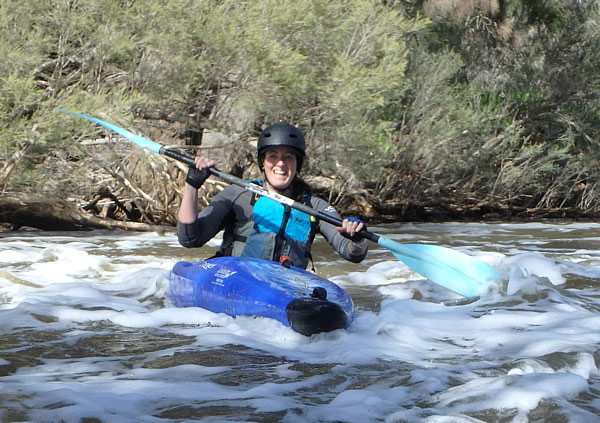
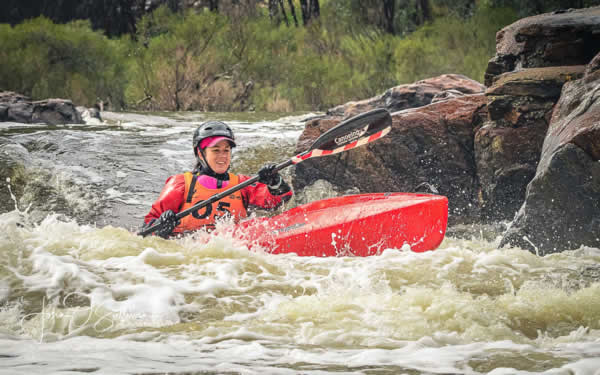
Isabel Combe at one of my whitewater training sessions for the Progressive Racing Group.
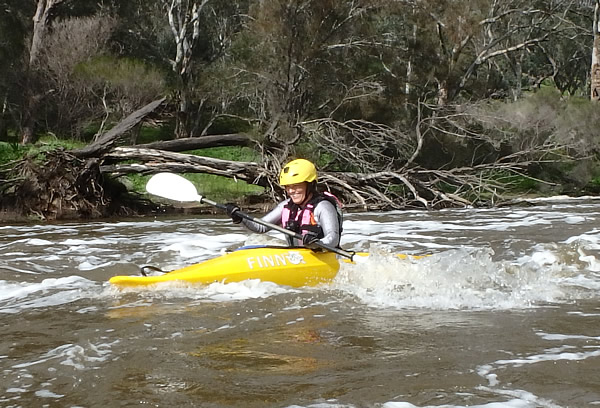
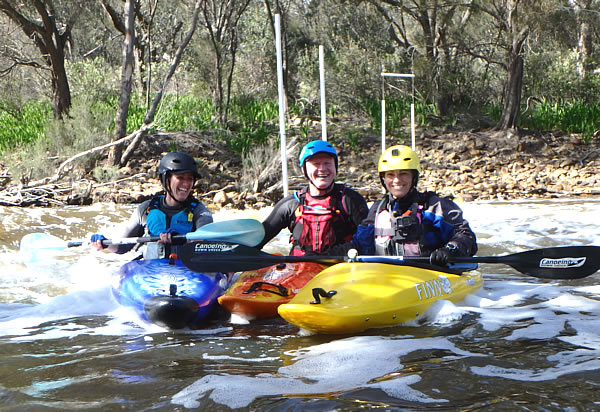
Kate Martin enjoying the white water in a short kayak for the first time.
When I help others to be happy, I am happy.
Kate, Tom and Izzy.
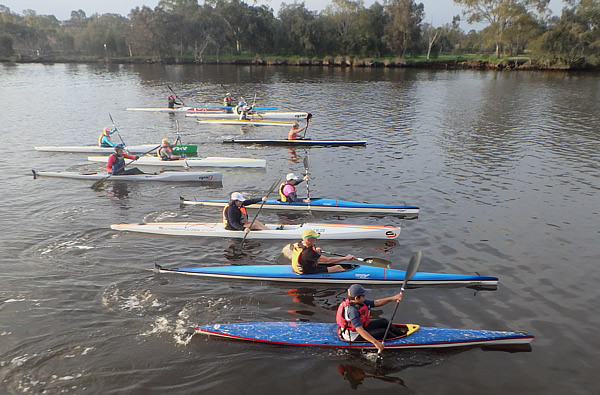
It might be wet, it might be cold but the AKC Progressive Racing Group are always out there on a Tuesday evening. (Although some stayed at home).
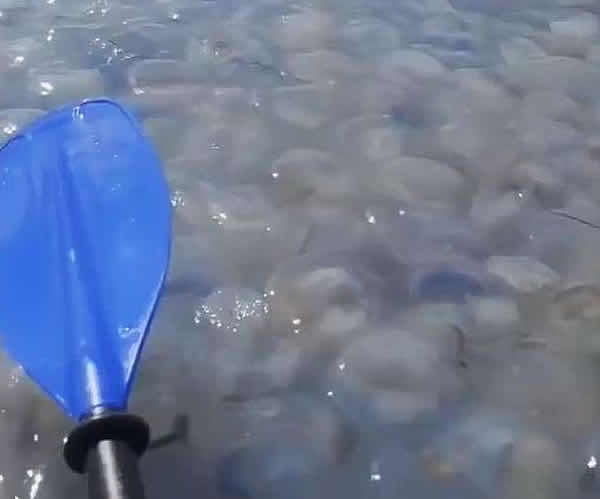
A mass of jellyfish
A group of canoeists had a more eventful trip out to sea than expected when they came across a massive swarm of jellyfish.
The canoeists were forced to paddle through the fish in the Sea of Azov off the coast of Berdyansk, in the south-eastern Ukrainian region of Zaporizhia Oblast.
Video footage, posted on YouTube on August 15, shows the swarm of jellyfish, which were the size of dinner plates, covering the surface of the water.
Wild Water Sprints
at Bells Rapid
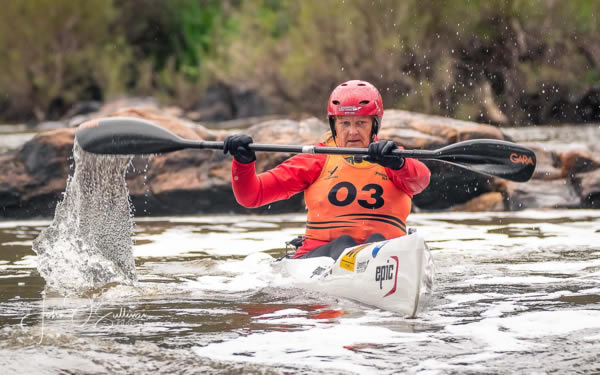
Steph Beddon looking relaxed as she powers down Bells Drop.
Photo John O'Sullivan.
Wendy Burdett in full concentration as she approaches the drop.
Photo John O'Sullivan.
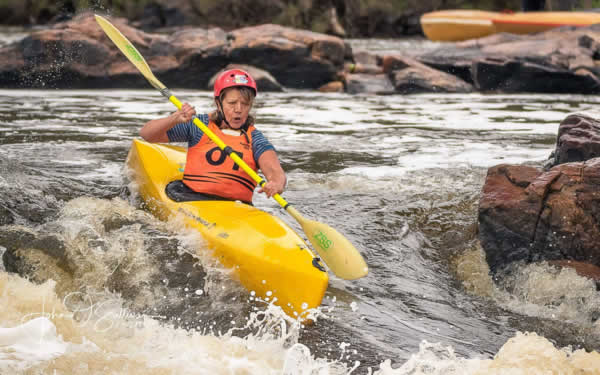
Jeanette Busch takes Bells Drop in her stride.
Photo John O'Sullivan.
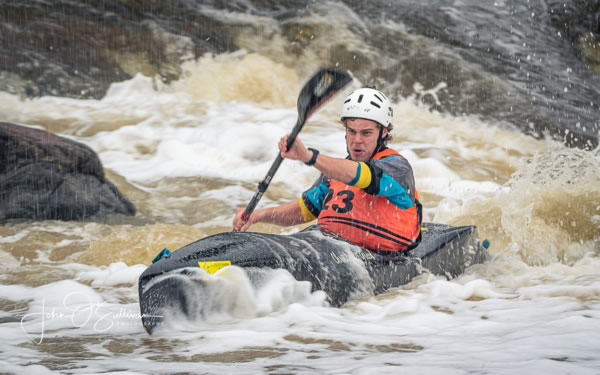
Off he goes. Christopher Greed is out to beat Luke Dooley. Being more of a short distance racer this is his chance.
Photo John O'Sullivan.
Like a lightning bolt he speeds towards Devil's Slide.
He was close but Luke beat him by .8 of a second.
Photo John O'Sullivan.
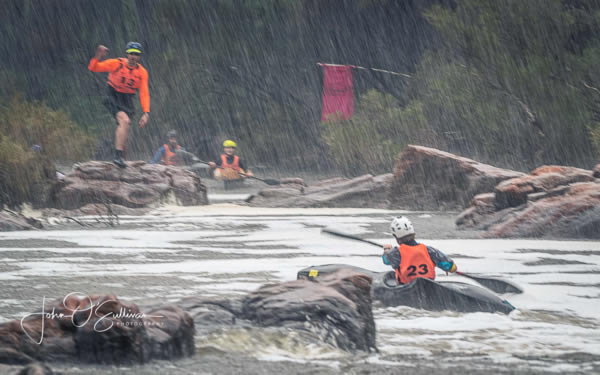
Luke Dooley holds off his competition but Christopher Greed, David Burdett and Harry Lanley were all less than 3 seconds slower.
The State Wildwater Championships are this weekend at Bridgetown so can they beat Luke.
Photo John O'Sullivan.
Results here:
Kimberley Kayaking 1982
part 5
We returned to our camp near Lombadina and by now I was pretty confident that if I ever became stranded along the coast I had a better chance of surviving. With all the things I had learnt over the last week I thought it was time for me to go out in the bush
and look for honey.
For an hour I paced along the edge of the salt flat checking every paper bark tree, but finally, weary as I was, I detected a very small hole, not much bigger than a ball point pen with a type of black volcano funnel entrance and with tiny bees entering and
leaving. I must admit I didn’t expect the hole to be as small as it was.
The branch was about ten inches in diameter, a large portion of it being bark or hollow so it only left me with 3 inches to chop through. It wasn’t something I would do everyday but knowing what to do and how to find a bees nest may be important if ever I
found myself in a survival situation. The honey was very tasty in the rice pudding for supper.
I was now pretty pleased with myself as a honey hunter, a spear maker, a fisherman and having learnt so much about living off the ocean so I was full of confidence and ready to move on with my journey north. I think being brought up on a farm, having worked
with farm animals and in the fields, helped me to be a more practical person. Only last year I worked in a butchers shop for a few days skinning sheep as part of my trip preparation.
To leave my gang of museum friends and Bardi Elders, who had taught me so much and who I respected enormously, was a sad affair, but I knew I couldn’t be sheltered from my daunting task that lay ahead for ever. It was time to move on and face the wild, and the
wilderness ahead of me.
When I was back on the water it seemed strange to be paddling again after being shore bound for over a week. My day’s destination was Cape Leveque. It wasn’t long before I could see a high structure, which at first looked very much like a water tower, but
suddenly it turned into the Cape Leveque lighthouse. I pressed on struggling against the tide, before stopping for a few minutes to eat dried fruit and have a drink, which acted as a pick-me-up, and allowing me to develop a racing speed towards the beach at the south end of the cliffs. Securing my helmet I raced towards the beach on the back of a wave. The wave dumped heavily on the beach a few metres ahead of my bow as I rode the rising waters to shore. The backwash dragged the kayak sideways
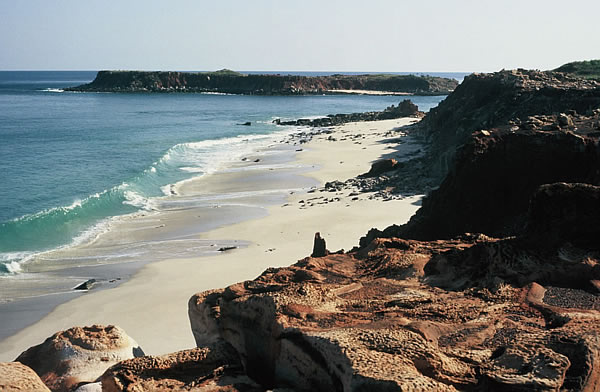
down the steep beach before I had a chance to get out. Within seconds the next wave hurtled me back up to the safety of the beach and to where I camped beneath the ochre coloured cliffs.
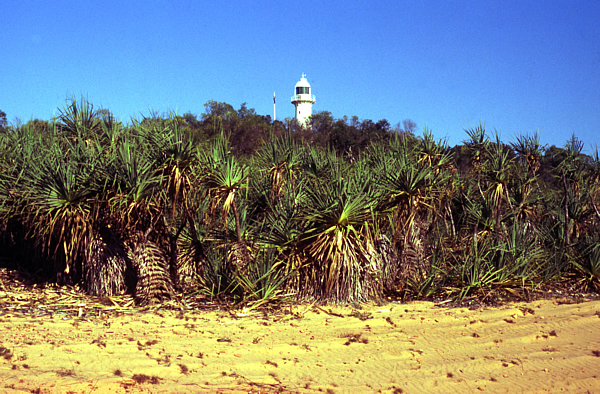
The dumping surf of the rising tide awoke me to a new morning. The light from the lighthouse had been skimming the ocean all night warning ships off the rocky reefs along the coast. Walking from my hidden camp behind the cliffs, I moved towards the oasis that
surrounded the lighthouse. Coconut palms, deep green grass and vegetation, watered by a powerful sprinkler system. The green vegetation contrasted with the dry local bush.
I found the lighthouse keeper and he allowed me to have a look around the lighthouse and fill my water bottles before heading back to my kayak and moving off again. I was a little concerned about the dumping surf. It was the worst that I had come across so
far. As the waves broke in quick succession, I couldn’t imagine getting through them without being bowled over. I fastened my helmet and counted the larger waves. There was a pattern and in-between each pattern there were one or two smaller waves. When I noticed a flat section, I quickly dragged the kayak down the beach into the shallow water. The water slop between the waves hampered my efforts to enter my small cockpit, but with no time to lose I paddled like fury punching through a wave
towards the calmer waters. I was safe. (A Nordkapp cockpit is very small unlike the cockpit of today’s sea kayaks and it’s near impossible to enter the kayak without using the paddle as support).
The crashing surf at Cape Leveque.
The lighthouse stood proudly on shore as I passed through the gap between it and Leveque Island. I left the stunning colourful cliffs and crossed the bay with the coastline being sandy. For some reason my wrists started to ache as I closed up on Swan Island
but the sight of a dugong, some turtles and a dolphin took my mind off it. The surf was dumping furiously along the coast so I had no intention of stopping before entering the King Sound some 15 kilometres away.
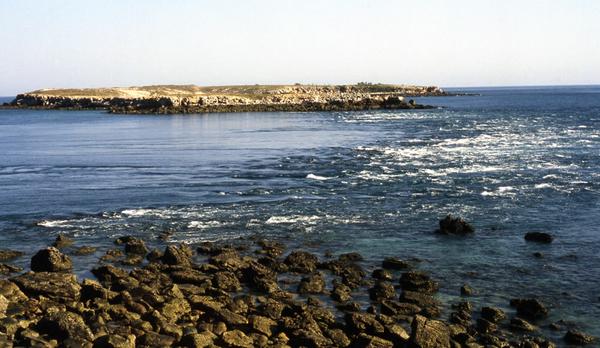
As I approached Swan Island standing waves formed a barrier across the passage between the island and the mainland. It looked pretty scary at first although it was calmer close to the exposed rocks near the shoreline but the current was still rushing at a
terrific pace. I had paddled a lot of white water rivers, so I found it quite easy although being way out here, it still got the adrenalin pumping. As I paddled out of the current and into the King Sound it was like entering a forbidden world. The massive tides in front of me would now control my movements and the crocodiles would certainly keep me alert. It was like closing one door and opening another.
With the tide pushing into the King Sound at a terrific pace I took advantage of its power and paddled on to One Arm Point where my food parcel was waiting at Ron and Margaret Peason’s home. Ron and Margaret were working in Camballin when I worked there and
Ron being a teacher was also friends of Bill Grogan my friend in Broome. I left my gear on the beach and walked into the community and found Ron’s home. Ron and Margaret warmly invited me to stay for a few days.
Tidal rapids between Swan Island and the mainland.
As I walked around the community to get my bearings and to find out where everything was, I came across two girls fishing near the point. The tide was racing through the gap between the mainland and some islands at a terrific speed. I arrived to find they had
their lines snagged and one of the girls wading out in the water up to her ankles to retrieve it. It looked a little dangerous and I didn’t really want to act the hero and volunteer to wade in and untangle it, so I suggested they cut their lines. They didn’t like that idea so I moved into the water next to her. As we both waded further a school of fish suddenly came jumping up over the rocks towards us with four white tipped reef sharks following close behind. We leaped out of the water
instantly as the sharks physically bounced over the rocks determined either to catch the fish or us. It was a frightening and unforgettable experience and just to see the terrifying look on the girls faces was equally as frightening.
I left them to it and returned to the community and met Eric Hunter one the most respected Aborigines in the community. Eric invited me to go out onto the reefs to collect trochus shells. I was not only keen to go trochus collecting but I was also keen to view
the famous and formidable tidal rapids of the King Sound before I attempted to cross it by kayak.
I met Eric down at the beach near where his powerboat was anchored. The trouble was the boat was anchored 100 metres from the beach, because of the high tide. The situation was simple; take off your shirt and swim. With huge sharks around and the possibility
of a huge crocodile, I was pleased when Eric volunteered to swim and fetch it.
The morning was still and the sea was like glass as we sped through Pancake Passage hitting turbulence’s that shook the boat. With a powerful motor and Eric’s skill he was able to keep the boat in full control as we crossed over the currents. He slowed when we
entered shallow water and at the same time he saw a turtle. Being short of meat, he cut the engine, picked up his spear and waited for the perfect shot at the turtle, but it never came; the turtle was too smart. (Only Aboriginals are allowed to hunt turtles.)
We moved through Meda Passage with the vertical cliffs of Sunday Island to the east and Roe Islands to the west. There used to be a mission on Sunday Island and a lot of sacred ground, so the elders asked me not to go there when I’m paddling through the
area.
The fast ride and the fun of turtle hunting was over when the tide was at the right level for us to work, so we moved to the northern corner of East Roe Island, the last island before Sunday Strait. Approaching the point I saw the frightening tidal power. Huge
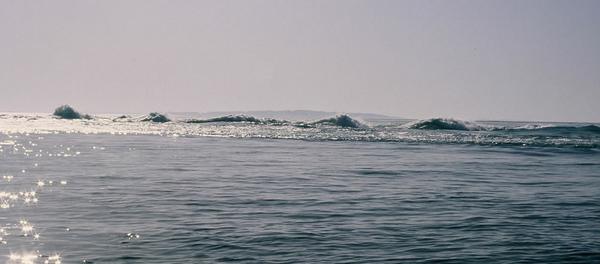
rapids were created across the Sunday Strait as far as the eye could see. Standing waves were more than 2 metres high and frequently a wave would explode even higher. The speed and force of the water was incredible and I knew after seeing this, that all the unbelievable stories I’d heard about the area were true. Tides in the area vary by more than ten metres. With the enormous volume of water flowing into the King Sound which is strewn with islands and rocky outcrops, no wonder the currents
exceed fifteen knots. The King Sound has the second highest tides in the world, the highest being in the bay of Funday in Canada.
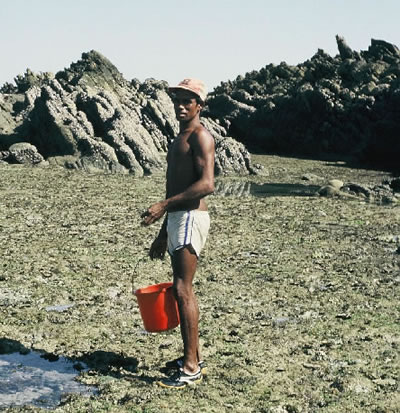
Once landed on the reef, we had to work quickly before the tide changed. Eric issued me with a bucket to collect the trochus shells that were scattered amongst the rocks and reefs. The shell is cone shaped and is used to make jewellery and buttons. In the late
1980s the Indonesians hit the news for poaching them in Australian waters. The meat from the shell can be eaten, although the ones I tasted were pretty chewy, but I’m sure they would taste delicious in a survival situation.
Standing waves metres high.
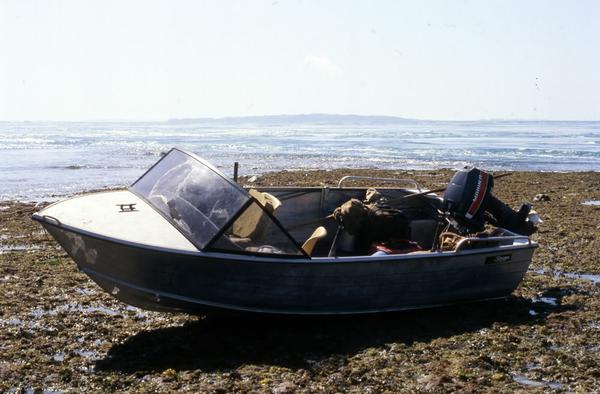
The tide leaves the dingy stranded. We have to wait for the tide to return.
Foraging in the pools and under ledges for the shell was a worrying business as blue ringed octopuses and other little deadly creatures waited patiently in the shadows. But being out here on the reefs watching the tide change by the minute and trying to avoid
being stung or bitten was quite exciting.
Our buckets, then bags soon became full and Eric was pleased with our few hours work, bagging approximately $180.00 worth of shell. On our way home we checked the trochus population on Hunt, Sunday and many other islands which would be collected on another
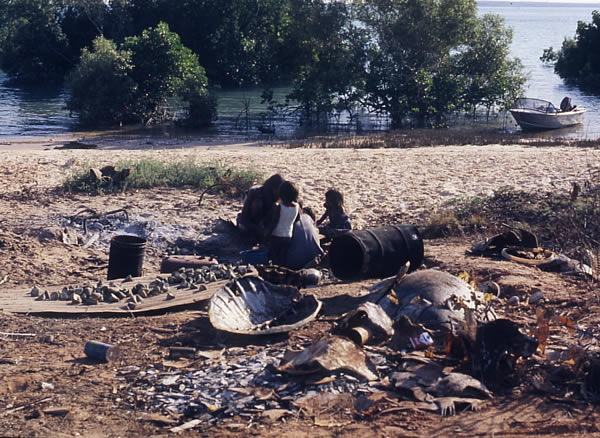
day. Later that day we boiled the trochus shells to extract the animal inside.
Eric with his bucket collecting trochus shells.
The trochus being cooked. Turtles were also eaten.
Back at Ron’s and Margaret I was fed and given great hospitality. Ron was the local headmaster and up here the school started early and finished early giving Ron lots of time to go fishing. Ron is a very successful and respected fisherman. I remember in 1973
when I worked in Camballin, 80 kilometres east of Derby Ron was also the headmaster there and there weren’t many days when he didn’t come home, from going fishing, without a huge barramundi.
School had finished so it was time to go for a ride with Ron. We hopped into his dingy and he adjusted the throttle and powered across to Swan Island, about 9 kilometres from One Arm Point. He wasted no time rigging up. “Get your camera ready”, he shouted
above the roar of the engine. Within minutes he had caught two big mackerel, but the sharks had a feast of them before Ron could reel them in.
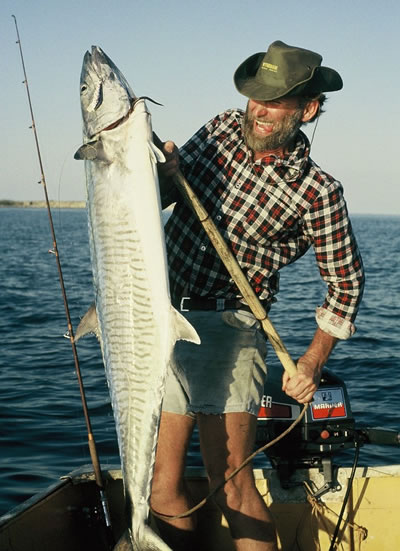
I never imagined that fishing could be so exciting. Ron latched onto a large mackerel that leaped repeatedly out of the water. The 30lb mackerel looked like a helicopter in my camera lens. After Ron had reeled it into the boat, I waited for his next leaping
torpedo. My wait was short; he soon hooked another mackerel that rocketed towards the cloudless sky, with a shark in full pursuit. The water was boiling as the shark was determined to steel Ron’s prized catch. Ron had already lost two mackerel so he was quick to gaff the fish only moments before the shark approached the dingy. The excitement kept on coming and I just couldn’t believe what was going on. No wonder he loved fishing and being in the Kimberley. Soon after the rich red sunset on the
horizon stopped our fun and signalled our speedy return to One Arm Point.
Ron with one of his big mackeral.
Ron was keen to try different kinds of fishing so the next day we took out my compound bow to see if he could shoot a fish with a bow and arrow. This time we headed for some islands across
from One Arm Point and floated around the shallows. Ron stood on the bow of the boat and I steered us through the mangroves. Ron saw a fish, he aimed and shot, but he missed. We soon found out that it wasn’t easy to shoot a fish under water with an arrow. Ron tried several times, but with no luck. The arrow didn’t seem to penetrate in the water far enough or it was because he just couldn’t judge the refraction. But it still felt good being a hunter even though we returned home being
unsuccessful.
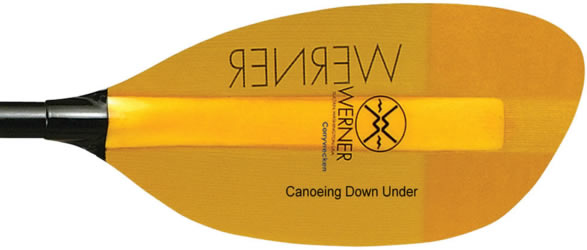
CORRYVRECKAN
2 PIECE STRAIGHT SHAFT
Special - size 210cm only
two piece paddle
Usually $550.00
Special $400.00
210cm only.
Werner one of the best paddles in the world
Lightweight and strong
Canning River Canoe Club
Nomination Race
Sunday, 20 September 2020 from 09:00-12:00
The race where you don't have to be the fastest to win. Nominate a time for the distance you would like to paddle and the people closest to their time will be the winners.
Note: NO WATCHES OR TIMING DEVICES ALLOWED ON YOUR CRAFT FOR THE RACE.
|
|
|
|
|
|
|
|
|
|