|
|
|
|
Kimberley Kayaking 1982
part 4
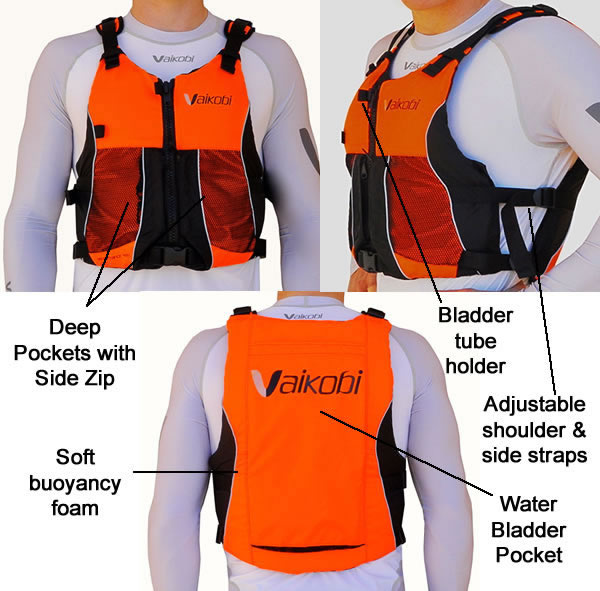
As the days passed I became more confident in the things I did. Soon I had a routine worked out and was always busy. My own priority was my own safety. My lifejacket and survival vest were always worn whilst paddling. Even if I had to survive by myself without the boat, the survival jacket contained water, food Eltar distress beacon, flares, compass, heliograph mirror, fishing lines, mask, snorkel and
every conceivable safety device. Small things, habits practiced, pleased me. I washed at least twice a day and attended to any cuts so they didn’t become infected.
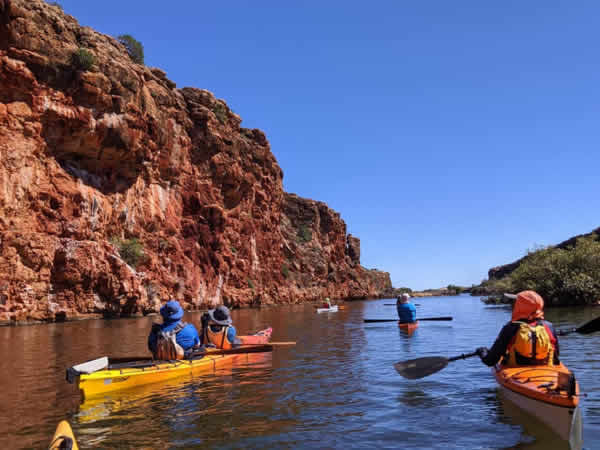
The cliffs might not be high but they certainly impressive.
At the same time as I was heading north New Zealander Paul Caffyn was paddling around Australia and was in the area paddling south. I was hoping to meet up with him, but with all my detours we missed each other which was a real shame. He was going so well I
was expecting seeing him virtually walk on water.
Only the eagles and hawks acknowledged my leaving across the very choppy Pender Bay. The waves hitting my bow splashed into my face leaving a mixture of salt spray and blockout cream to creep into my eyes. The irritation and blinding effect made me squint
uncomfortably towards the sun. As well as chafing under my arms and around my waist the crossing was far from enjoyable. Most of the chaffing was caused by the salt spray drying on my clothes, which in turn felt like cardboard. It became very important to change clothes every day and wash the salt from them regularly.
As the tide receded, the bay became shallower causing reefs with breaking waves to appear. I suddenly became trapped inside them and had no alternative to head out to sea trying to escape the shallowing waters. My fear was to be trapped on a sandbar in the
middle of the huge bay. As I cut through the breaking waves other reefs ahead were appearing at an alarming rate. The tide was going out in front of my eyes. I continued paddling over several more breaking waves towards Cape Borda landing about 400 metres from the beach.
I unloaded the kayak and dragged it on the sand flats and walked to an old stock yard. After finding two fresh water soaks I returned to watch the tide creep up pushing my kayak towards the beach. It looked quite funny as it moved closer to my camp on its
own.
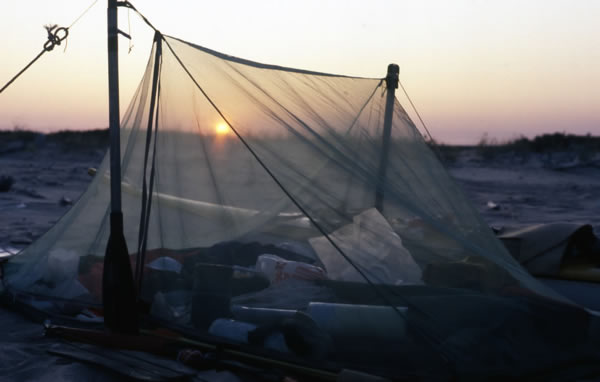
My mosquito net tent was practical in the dry season.
Specially made by Ian Maley of Wilderness Equipment.
I used my spare split paddle as poles.
I woke early to a moon on the horizon reflecting its light and its shape in the shallow water that created a multitude of moons across the bay, similar to the Stairway to the moon in Broome.
Once through the breakers I headed towards Tilbata Creek and Shag Rocks. Vapour clouds screened the sun, the glare forcing me to squint and fall into a trance. My limbs felt heavy after hard days of paddling but within two hours the breaking waves around
shag rock forced me to liven up and be more alert. The coastline became rugged, the rocky cliffs being battered by the pounding surf and the increasing wind ruffled the weedy sea.
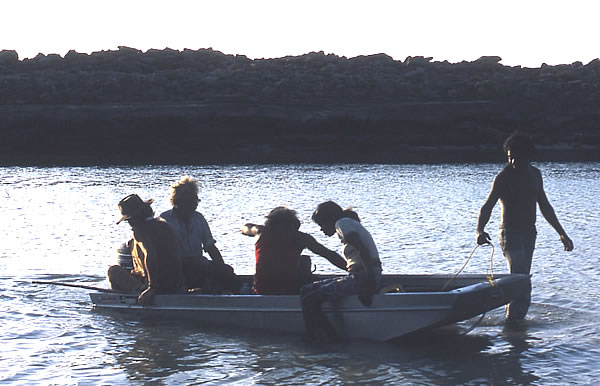
I continued along the coast half asleep and when I saw two figures in a tiny flat bottom dingy in the ocean opposite a creek I thought I was losing my mind. The dingy was so small I didn’t believe it was on the ocean. As I drew closer I realised that there was
an Aboriginal man and a white man in the boat. I eventually pulled up to boat and met Sandy an Aborigine and Paul, from the WA Museum, who were fishing. We talked and as I was interested in what they were doing, they invited me to spend some time with them, so I jumped at the idea.
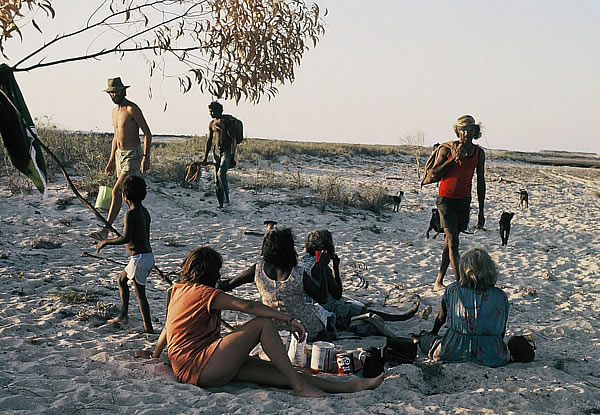
On shore I met Min who was also from the Perth museum, and Aboriginals Ester, Sandy’s partner, Aunty and younger Aboriginals Peter and Burnadet. They were teaching Min and Paul the traditional ways of fishing and hunting. Sandy and Peter had caught a turtle
earlier, so in the afternoon I watched it being dissected and later that day we had turtle, fresh fish and beautiful oysters for dinner.
Paul and Min sitting, from the museum sharing life with the Aborigines and learning the old ways of survival.
Five people in a flat bottomed tinnie was quite a load.
When morning arrived I went spearing crabs with Peter and Burnadet. We devoured fish and crabs for lunch and then caught 12 reasonable sized fish in 1 ½ hours, mostly blue bone and rock cod, and had a feast for our evening
meal.
For my next valuable lesson Sandy was going to show Paul and I how to make a spear so we walked out to a wattle tree forest to find a slim but straight sapling. On the way Sandy spotted several native bees entering a small hole in a tree branch. The bees were
black and smaller than the common fly and apparently unable to sting. To get to the honey though, Sandy had to chop at the limb of the tree with his tomahawk to get to the nest and collect the honey. The honey tasted superb mixed in my rice pudding that night.
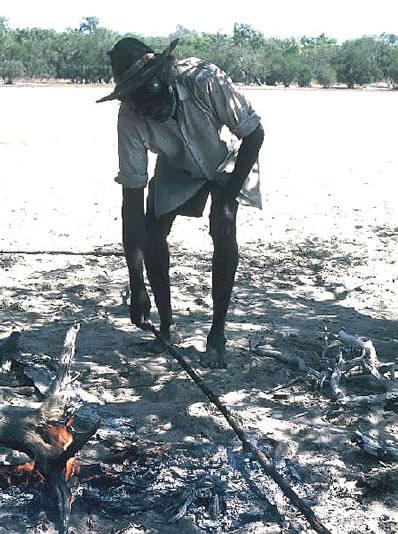
After selecting three of the straightest saplings from the forest, Sandy took his tomahawk and cut them down before trimming their branches. We returned to camp and lit a fire. As soon as it was giving out a hot constant heat Sandy put his 8 foot sapling in
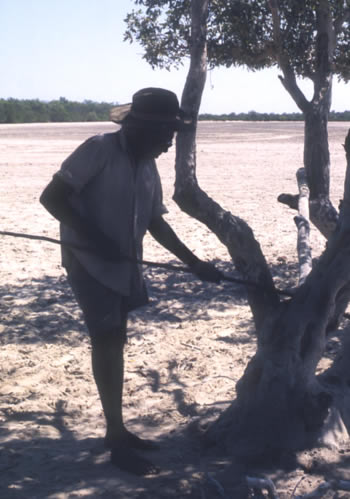
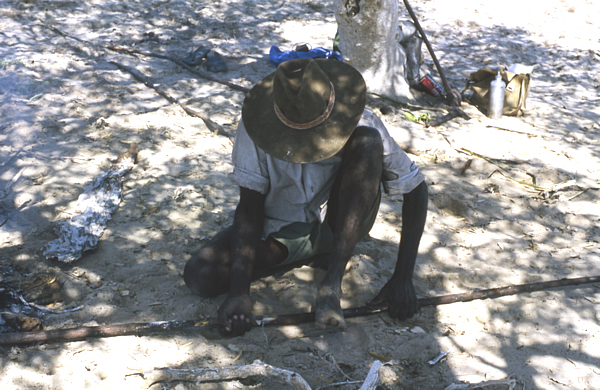
the fire at the point where it needed straightening. The spear was heated at that point and then taken out of the fire and placed between a fork in a tree and then Sandy put pressure on the part needing straightening and held it there to cool. Every time it cooled it got a little straighter. Sandy repeated this over and over again until the spear was straight. When the spear was perfect, a steel rod was bound to the end but first the rod was made hot and a ridge was burnt into the end of the
spear for the rod to fit perfectly and firmly. Before steel rods the Aboriginals just heated up the end of the spear to harden it. Things have changed. Sandy also used his bare feet to bend the heated spear. He didn’t seem to be effected by the heat, but I wasn’t game to try it on my tender feet.
It was a slow process but it worked well. Having seen Sandy make a spear it inspired me to give it a go but first I had to walk back to the small wattle tree forest, which was over an hours walk away. When I started looking for a sapling I soon realised that Sandy had taken the straightest ones so my choice was a little more limited, nevertheless I cut two wattles just in case one went
wrong.
To make a spear Sandy places the wattle sapling in the fire where it needed straightening.
Whilst it's hot he places it between tree branches to straighten it.
Although hot Sandy can use his bare feet to keep the pressure on the bend to allow it to cool down in a straight position.
Back at camp I made a fire but my first attempt to straighten a sapling failed as I left my first wattle in the fire too long and it started to roast. My second attempt turned out to be quite professional for a novice, and I was quite proud. It took several
hours to make it though as the bark had to be taken off with my pocket knife, it had to be fired and straightened several times and then a groove along the point had to be shaped with my knife and then the steel rod had to be heated to burn a better seat into the spear. To finish off I wrapped copper wire around the metal rod to keep it in place. Hey presto – my own spear. How clever was that.
From then on I carried the spear along the outside of my kayak and when I went bush I carried it at all times. It became a friend, a protector, a walking stick and whenever it was close by I felt more secure.
My survival course continued. Our next lesson was to watch Sandy do a spot of fishing, but this time he wouldn’t be using a fishing line, he would be doing it the traditional way and spearing a fish from a tree. Paul and I sat in a dingy in the creek about 20
metres from where Sandy had perched himself on a mangrove limb. He sat there several metres above the rising tide with spear in hand just waiting for the tide to rise and the fish to arrive. For over an hour he waited, and we waited and watched as the tide flowed up the creek and crept higher and higher. Sandy’s eyes were glued to the water which eventually started to cover the mangrove limb and then reach his waist. We couldn’t believe how patient he was. We could see fish swimming below him,
but Sandy made no attempt to spear them. By this time I was getting a little bored as there was nothing happening and we had been waiting a long time.
Then when the tide was full, Sandy’s left hand started to guide the spear underwater and his right hand slowly stretched to the top of the spear. Suddenly – wham! He plunged the spear beneath the water and fell in after it. For several seconds Sandy was under
the water and the surface was a mass of bubbles. We didn’t know if Sandy had speared a fish, or if Sandy was drowning?
Suddenly Sandy’s head broke the surface. He had a large grin on his face and to our surprise he still had his thick spectacles still in place. Moments later he raised his spear and on the end he had a large Trevally fish. Because his spear was barbless, he had
no choice but to dive in and place his hand over the end of the spear to prevent losing the fish. Keeping one hand over the spear though made it difficult for Sandy to swim to the dingy. It had taken him nearly two patient hours to spear the fish, it was a big one and he didn’t want to lose it. We didn’t realise until later that Sandy was only after the Trevally fish and not the other fish that had swam beneath him. For generations Sandy’s relatives have stood on that particular mangrove bough
to spear Trevally fish.
Peter and Sandy bringing home some fish.
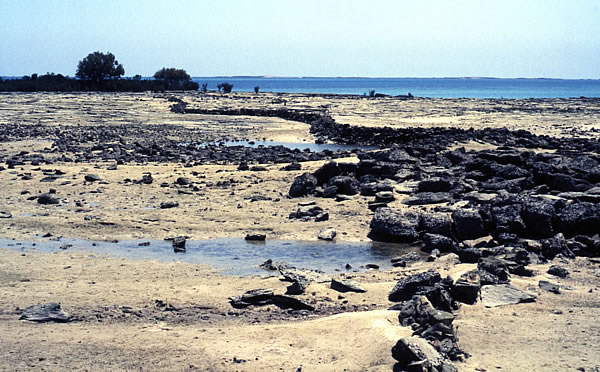
We returned to camp for another fish lunch and then Paul mentioned he had a special task for us to do. There was ancient old fish trap at Karrakacka Bay, near Swan Point, which he wanted to survey before it fell into worse shape than what it was at the moment.
They were hoping to build a scale model later back at the Perth museum. Our drive took us over a rough bush track over a salt plain, a dry billabong and finally over sand dunes, where we came to an abrupt halt. At the dunes we had to let the tires down to give the vehicle more traction, but as the vehicle climbed the sand dune, a branch from one of the scrappy trees became lodged under the 4 wheel drive and ripped a hole in the fuel pipe on the reserve tank allowing the fuel to drain away.
Paul’s surveyors tape saved the day as it was lashed repeatedly around the gash to seal it up.
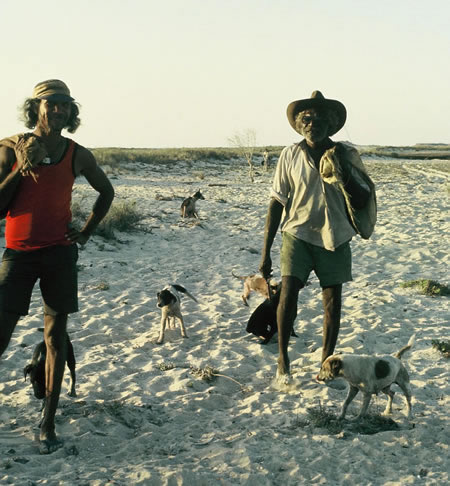
Sandy and Ester had brought their dogs which had lost a large amount of hair and were scratching most of the time. This didn’t seem to worry Sandy and Ester as they were their companions and they slept close to them at night as well as finishing off any scrap
food or fish heads that were left over.
An ancient fish trap at One Arm Point.
A wall of rocks to catch fish as the tide goes out.
The tide was in so I spent the morning crabbing, trying to shoot fish with my compound bow without luck and I explored a beautiful area around the billabong. It would have been a great place for Aborigines to live.
By the afternoon the tide was out so it gave us our first chance to survey the fish trap. The trap was a wall and made completely of stone that spanned between two rocky islands. When the tide came in, fish would swim over the wall and when the tide went out
the ones that got trapped by the wall were just picked up. Pretty simple really. When the trap wasn’t in use, a hole was made in the wall to allow fish to move in and out freely.
Paul brought his surveyors level so I held the staff and he took levels of the trap at different points along the wall and the surrounding area so he could build a scale model once back in Perth. We just managed to take all the levels he needed just before the
tide started to rise again. There was another trap at One Arm Point, which is in better condition and it occasionally gets used.
That evening Sandy caught us an octopus and stingray which we had for our evening meal. The stingray took a bit of preparing because it had to be soaked in sea water and then in vinegar to get rid of the mercury in its body. Fried in the wok and accompanied by
some vegetables it became a magnificent meal.
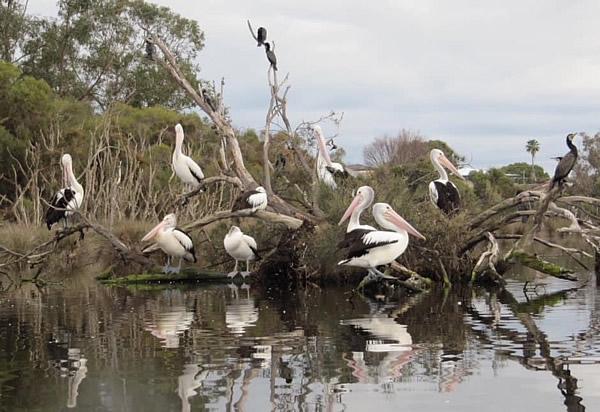
Pelicans on the Canning River. Photo Diane Greenaway
|
|
|
|
|
|
|
|
|
|