The Avon River Rapids
How did they get their names?
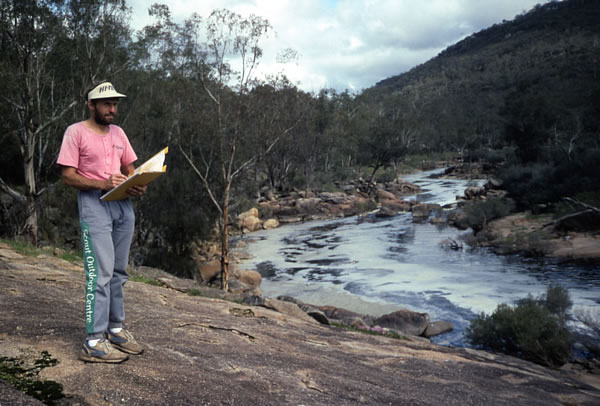
Only 9 rapids had been named before I sketched the rapids. I have given names to the other 45 rapids that didn't have names. I have given general names to the easy rapids and scarier names to the more dangerous ones. Although Bells, Emu Falls, Super Chute and Moondyne which I didn't name, are difficult rapids.
Posselts Ford: is one of the original names. Usually the starting point for a paddle down the Avon Valley.
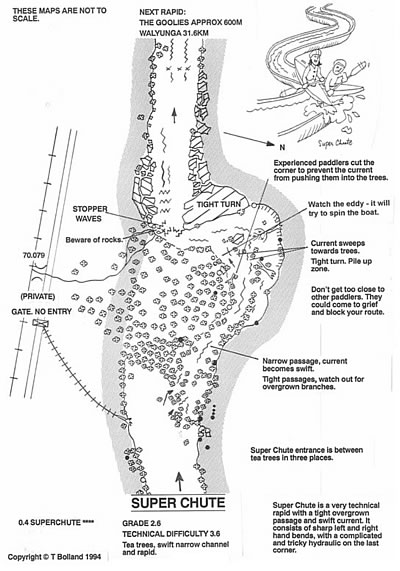
Super Chute: is one of the original names. This is a tricky S bend rapid. Lots of capsizes happen here.
Goolies: Named because of the two big roundish boulders in the rapid that looked like….!!
Narrow Neck: Named because of the narrow turbulent drop that reminded me of a neck.
Quarry Bend: Named because there is a quarry nearby.
Rice Pud: Named because I love rice pudding and I was thinking about it at the time.
Stodgy Porridge: Named after camping nearby and having porridge for breakfast.
Razorback 2: Named after seeing a wild pig whilst mapping the rapid. It has some sharp rocks and has two routes down, one either side of the island.
Scorpion’s Tail: First part of Emu Falls. Named because of its shape.
Shredder: Second rapid of Emu Falls. Named because of how this set of drops and rocks chew up paddlers and spit them out.
Washing Machine: The third rapid of Emu Falls. Its original name. One of the most difficult rapids on the river especially when it is low.
Ford Cruncher: A ford with many sharp rocks. If you paddle over the main lip you will certainly hear a crunching noise as you scrape over the rocks and hit the rocks at the bottom.
Dugite: An easy rapid near where I saw a snake.
Big Stump: There is a big tree stump on the left side of this small rapid.
Bonebreaker: This is a serious rapid. Named because several paddlers have broken their boats as well as a bone or two in their bodies and it just had to have a name to reflect how dangerous it is.
Raging Thunder: Another fairly serious rapid. The water thunders down the rapid at a raging pace.
Helipad: A helipad was located there.
Hammerhead Haunt: Hammerhead Rapid has two channels so it creates an island. This island reminded me of the nose of a Hammerhead Shark.
Accelerator: A long rapid named because of its fast current that accelerates for 200 metres with-out a let up.
Moondyne: An original name. The area nearby is called Moondyne. This is a tricky rapid.
Devil’s Den: A T-tree channel that used to be a little too dangerous to use. It is part of a T-Tree rapid that has three routes.
Easy Street: A channel just beyond Devil’s Den that is much safer to paddle. It can be shallow when the river is low.
Side Winder: A small rapid that used to have a tree at the bottom of it and many paddlers used to hit it sideways. The tree has now gone.
The Wall: A rapid, which on approach has a high rock wall on the left side of the river.
Hart’s Thicket: Named after Hart’s Farm that is nearby. It used to be one of the trickiest small T-tree rapids on the river. They used to be thick now they have thinned out and less dangerous.
Spaghetti Junction: A section of intermingled T-trees that were once very thick and reminded me of a plate of intertwined spaghetti.
Hypothermia Turn: A small rapid roughly half way between Posselts Ford and Bell’s Rapid. Many paddlers who have capsized become hypothermic around this area.
Racey Lane: It is a small swift rapid which water rushes down a fairly narrow channel. A fun racey rapid.
Crocodile Carcass: I was thinking about my crocodile experiences when paddling in the Kimberley and the name Crocodile Carcass sounded good.
Feral Cat Corner: Fast running water in the shape of an S-bend. Good fun rapid. I saw a feral cat running away here, so I thought it was a perfect name.
Deadly Mistake: This rapid is very technical and over the years many paddlers have made some huge mistakes resulting in injuries and boat breakages. A rapid to fear.
Tea Strainer: A section of T-trees with a small rapid, that used to be very thick and difficult to paddle through, but most of the trees have gone and much easier to paddle.
Blackhole: A rapid with a hole at the bottom right sometimes so big I could imagine paddlers disappearing into it and never to be seen again.
Spinning Moon: At the time of mapping I was thinking about the night sky and Spinning Moon sounded a good name for the rapid.
Heartstopper: A rapid that once was so feared it was a heartstopper.
Scared Rabbit: This rapid is spread and at the time of sketching I just imagined it being like a scared rabbit.
Lookout Rapid: One of the original names. Named after the Lookout Hill that towers above it.
The Passage: A T-tree rapid which used to have a narrow passage. It is more open now.
The Fortress: A rapid that has a high section of rock which on approach and with some imagination can easily be mistaken for the walls of a fort.
Championships: An original name. In 1972 the rapid was used for a National Slalom Championships.
Redback Run: Another long two part rapid that is spread out. I felt that on this rapid a Redback Spider could run fast and free. And I just love the name.
Syd’s Rapid: An original name after one of the early kayakers.
Double Scoop: The first rapid at Syds with two drops which reminded me of two scoops of ice cream.
Messy Middle: This is the centre part of Syd’s Rapid which can be very messy to paddle.
Syd’s Drop: Original name. The main long drop of Syd’s Rapid. Can be very challenging.
Dual Carriageway: A T-tree section that once had two main very narrow channels. Today only one of these channels is used.
Pebble Race: A shallow section of river that is very pebbly in low water above the Walyunga National Park picnic area.
Viper’s Tongue: A rapid that has a small drop that reminded me of the tongue of a snake. A slalom course is erected on this rapid.
The Chute: An original name. The water is compressed between two large rocks. Opposite the Walyunga Lower Pool picnic area. A great area to play on.
Strangle Hold: A T-tree section that once was very narrow although it has widened the swift current can still make it tricky to paddle. The trees used to grab novice paddlers and cause a lot of capsizes.
Casuarina Corner: A rapid that has a bunch of Casuarina Trees on the corner.
Terminator 2: In the days of fiberglass kayaks, this rapid used to break up a large number of boats and terminate a paddler’s journey. It is still a very tricky rapid. There are two channels. The right is the most popular.
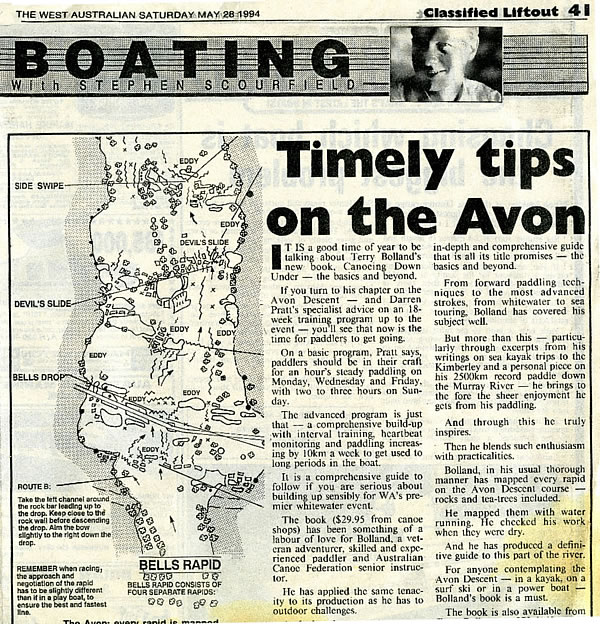
Bells Drop: Original Name. Bells Rapid is made up of several rapid sections as below.
Devil’s Slide: This is one rapid so many paddlers, no matter their experience can come unstuck. Some paddler’s end up having devilish nightmares thinking about this tricky drop.
Side Swipe: This is a small S shaped rapid. In low water paddlers often Side Swipe a rock that is around the bend that they can’t see until they hit it.
Dogs Breakfast: This rapid is just full of rocks with no defined path. It is hard to paddle it in lower water levels without hitting a rock. It’s a real Dog’s Breakfast.
Bolland’s Ebow: This is the last rapid on the river. I thought after putting in so much work on the maps that I should name a rapid after myself.