|
|
|
|
3rd July 2020 CDU Newsletter
658
The Avon Descent Cancelled.
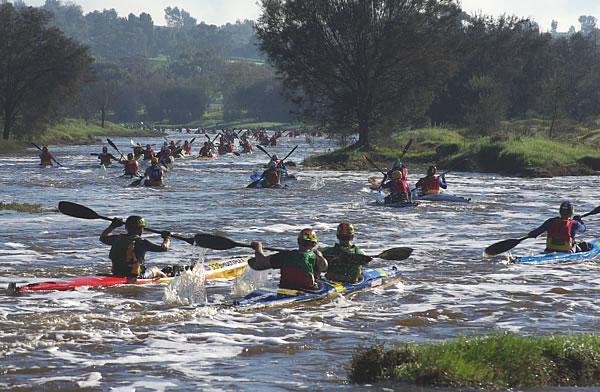
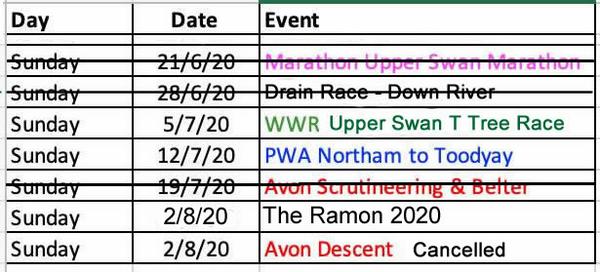
With the Avon Descent cancelled I hear that some paddlers are going to paddle the river that weekend anyway. Many will have made accommodation bookings and are dedicated to paddle it no matter what.
Paddle WA have decided to organise a Flat Water Race on the same weekend of the Avon Descent as a replacement race for the Avon Descent though on flat water.
It is called 'The Ramon' to honour one of WA's paddling greats, Ramon Andersson.
Sunday 2nd August
Middle Swan Bridge to AP Hinds Reserve, Bayswater
It is the Northam to Toodyay Race next weekend (Sunday 12th July).
But will there be enough water?
Gone are the days the Avon Descent was so popular.
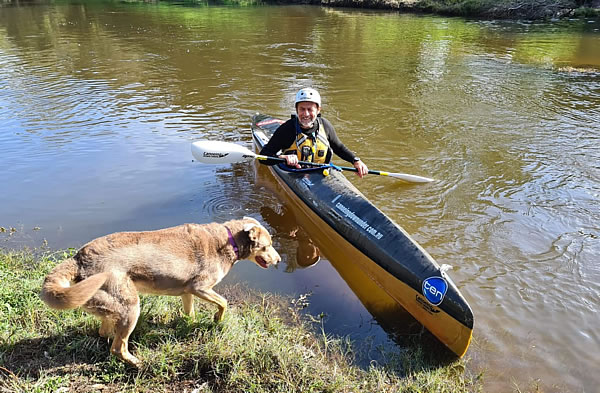
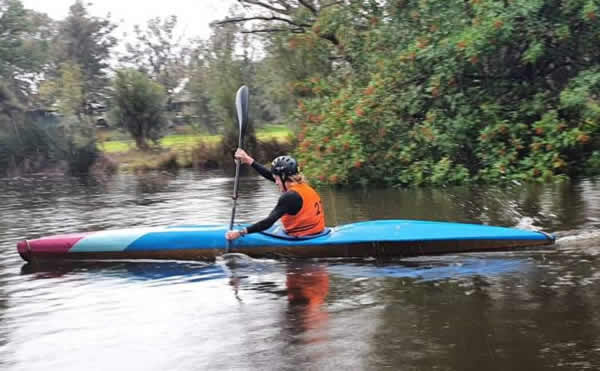
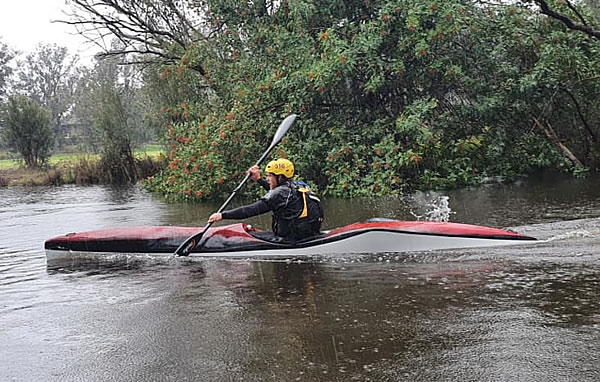
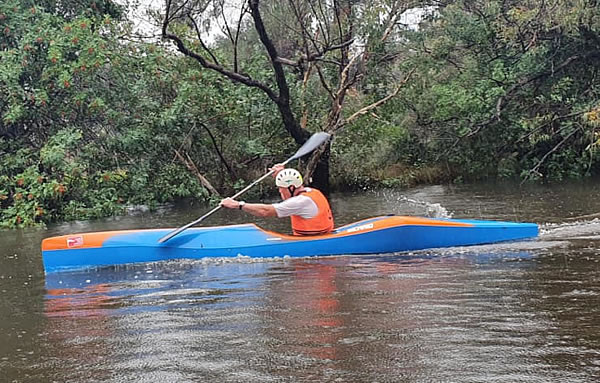
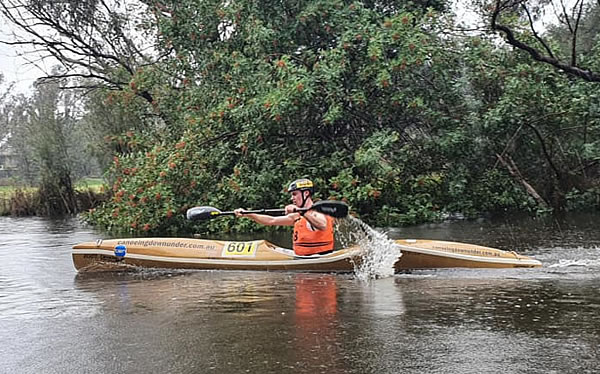
On Wednesday I tried out my old Down River Kayak and get some practise in for this Sundays Race from Bolland's Elbow to Amiens. I met Kris Smith and his partner's (Steph) dog.
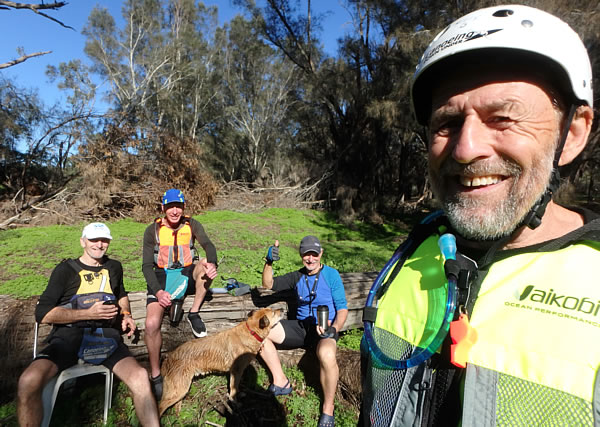
On Thursday I paddled up from Amiens and came across these three vagrants having morning tea, Dave Tuplin, Kevin Johnson, Patrick Irwin and his dog.
When you get to their age they need extra breaks, a sit down and some nutrition every two hours.
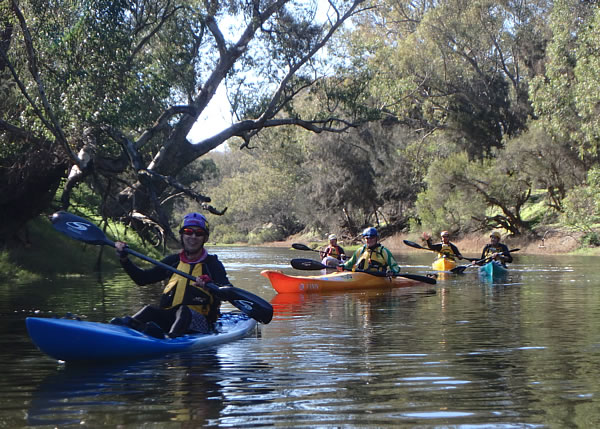
Another over 65 year old crowd (except for Steven) paddling the
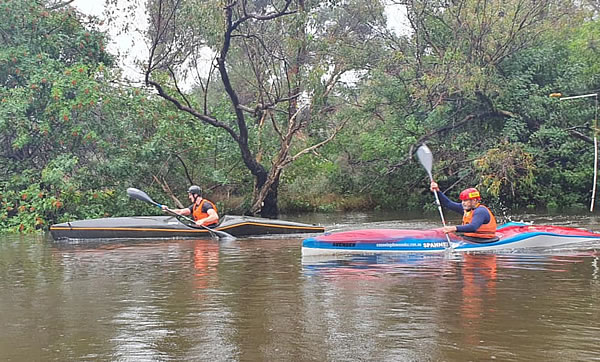
Upper Swan T Trees on Thursday. More members of the Ascot Kayak Club.
Steven, John, Alan, Vince, John & Steve Coffey who is not in the picture.
This section of river is going to be super crowded on Saturday morning because of paddlers practising for the race being held on Sunday.
Remembering Tim Fry
Tim was my support person on my 24,000km Kayak, Walk and Cycle around Australia.
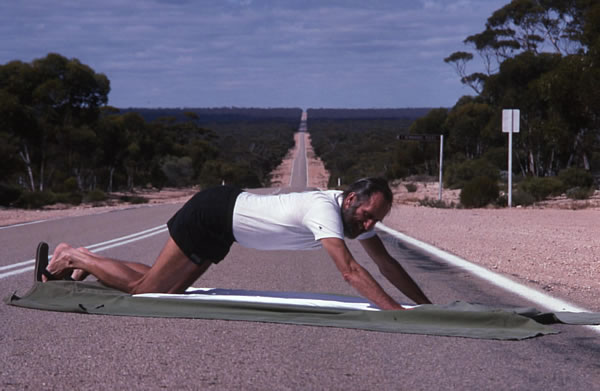
Tim folding his swag on the Nularbor.
Tim died in 1996 cycling across Australia.
He had just cycled across America
At the time of his death I was paddling from Geraldton to Kalbarri, walking the Zuytdorp Cliffs and paddling from Steep Point to Carnarvon.
I found out he had died after stopping at the Dirk Hartog homestead.
Read section below.
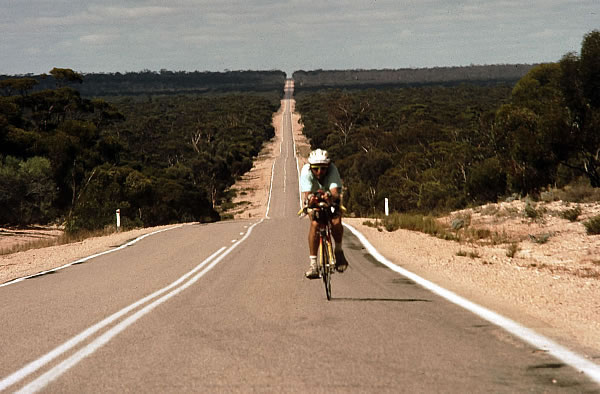
This cycle section from Melbourne to Perth across the Nullarbor and via Esperance, Albany and Augusta was 4300kms.
As part of my kayak, walk and cycle around Australia in 1990, I cycled 16,000kms
I found out Tim had died while on a trip and stopping at the
Dirk Hartog homestead in 1996.
I had just paddled from Geraldton to Kalbarri, walked 220kms along the Zuytdorp Cliffs and I was now at Steep Point the most westerly part of Australia.
I cast off by kayak from near Steep Point, the north end of the Zuytdorp Cliffs and focused on a wreck near Cape Ransonnet off Dirk Hartog Island. There were rumours that the boat had been transporting drugs when it ran aground. Seemingly there is some justice in this world!
Reaching the southern point of Dirk Hartog Island, I was greeted by two eagles perched on their nest and a little further, on a small off lying island, an eagle took to flight. Immediately gulls moved in to pilfer the nest for eggs or chicks, but the eagle continually swooped down to protect it.
The island with small cliff line now shielded me from the big swells, but a breeze coming from the southeast, gave me a lift up the coast. The island’s shore seemed to have more eagles and cormorants on it than on my last visit. Reaching the homestead, the only inhabited building on the island, I was greeted by Kieran, the island manager, a young lady who was the cook and a male work friend. Kieran told me that Jenny (my wife) had
rang so I immediately contacted her.
Jenny had some very bad news for me. My good friend Tim had died after being knocked off his bike crossing Australia. The funeral was going to be in Melbourne and a memorial service in Perth on Saturday in a couple of days. Tim had been my support crew for one year on my Around Australian trip. He had also supported me on several smaller trips and was going with me to the
USA. Now he was gone.
Tim was great person and loved to help anyone. He was a massuer for several local high profile paddlers.Tim had just cycled across USA and was cycling across Australia, an adventure he had always dreamed about. He had a clash with a car in Victoria.
The cook had a fresh sandwich and a cold coke waiting for me when I returned from the phone call. I found myself with a big lump in my throat and holding back tears as I told them the news. I was stunned and couldn’t really believe it.
After lunch I left the homestead and continued my paddling journey. Close by, a small island nature reserve was packed with birds, cormorants, pelicans and a lone eagle flying overhead. A huge flock of Cormorants were in a feeding frenzy further out. I paddled towards them, tears rolling down my cheeks with memories of Tim flooding back to me.
I continued my journey north though filled with sadness, passing Notch Point and Quoin Bluff South. I finished my paddling at 5.30pm on a small beach surrounded by cliffs, north of Herald Bay. It was an unusually peaceful night with not a breath of wind. I sat there staring into the ocean and at the night sky, recalling the great times Tim and I had spent together.
Read the full account of this trip here:
https://terrybolland.wordpress.com/cliffs-reefs-and-remote-islands/
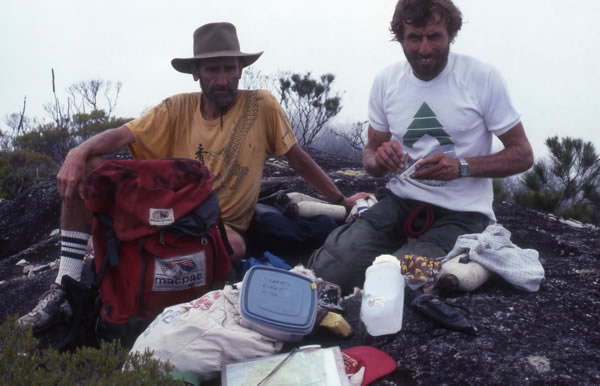
Tim and I on top on Mount Bowen the highest mountain on Hinchinbrook Island.
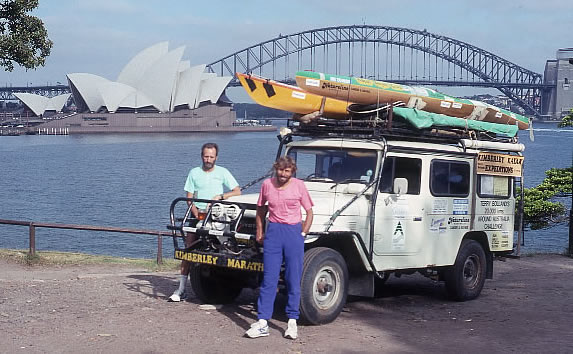
Rest day in Sydney.
The truck carried 2 kayaks, 2 bikes, 3 spare wheels and all the camping gear for a year.
Read about the trip here:
The World of the Albino Ray
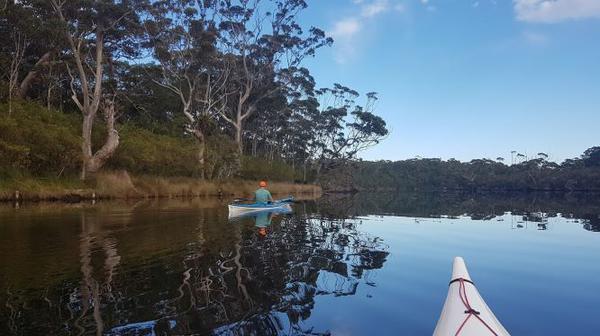
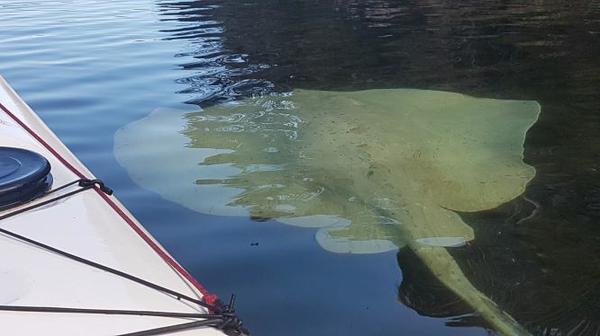
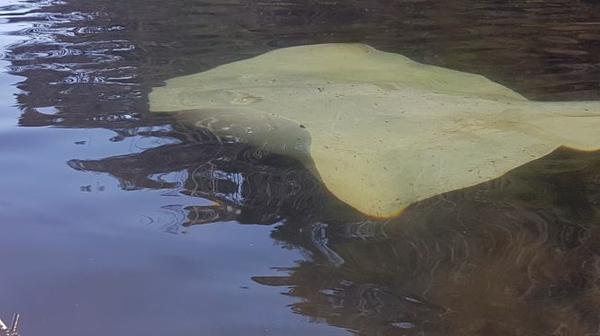
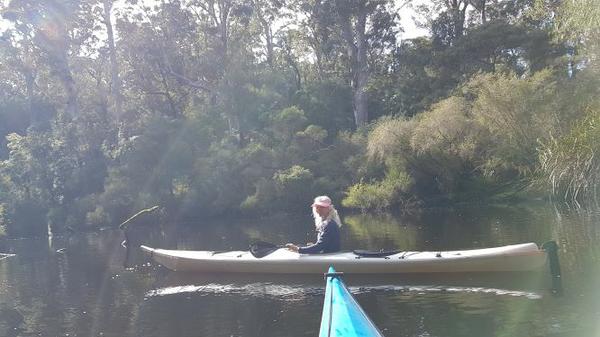
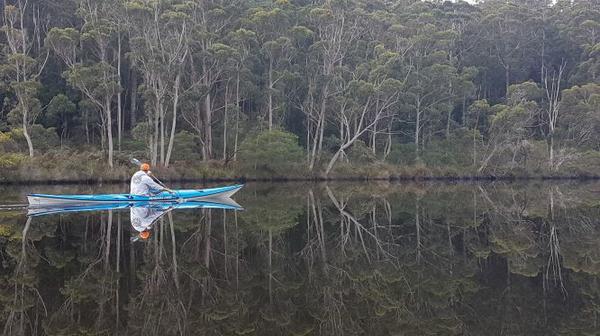
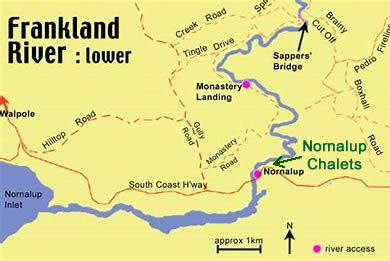
Mark and Charmaine Turnbull spent two weeks at Nornalup next to the Frankland River. They were very lucky to see a white ray.
They stayed at the Nornalup Riverside Chalets.
Mark on the wider part of the Frankland River.Photo Charmaine Turnbull.
What an incredible albino ray. Photo Charmaine Turnbull
Lucky to see such a ray. Photo Charmaine Turnbull.
Charmaine. Photo MarkTurnbull.
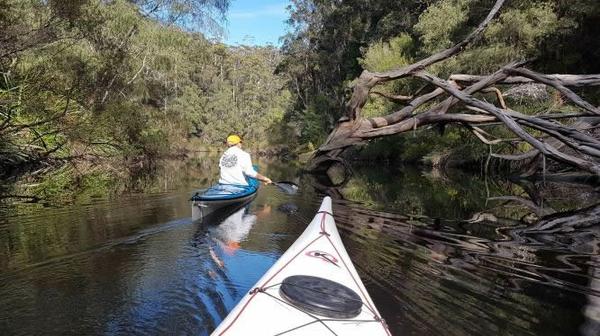
Mark heading upstream. Photo Charmaine Turnbull.
Mark heading further upstream. Photo Charmaine Turnbull.
In summer it is hard to get much further upstream than Monastery Landing because of logs and limited water.
The Drain Race
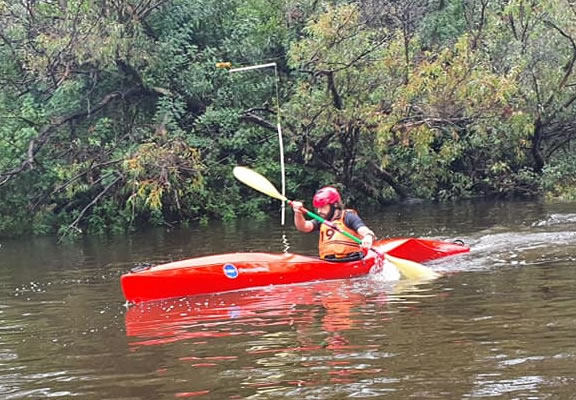
We had been waiting for rain and we got it on Sunday at the Down River Drain Race on the Canning River and for the first time in a long time it created a little bit of current for the event.
Hester Park, where the race was held was once the venue for the Darling Range Canoe Club which used to be a strong slalom and down river club. The club no longer exists. There is still a flat water slalom course there which is used by the WA slalom committee.
There was a hype of activity when I arrived with paddlers getting dressed, sheltering from the rain or having a good chinwag with other paddlers. Chris Smith, Dave Worthy and Peter Gigengack were the main organisers for the day and a couple of tents were already set up to shelter paddlers from the rain, and it did rain. Luke Dooley brought his vehicle over and
pulled out his weather shade which helped to get all paddlers under cover for the briefing.
With nearly 39 paddlers it was a good turn up, although there were a few regulars missing but we had the two fastest Down River paddlers in WA there, Luke Dooley and Dave Worthy so it was surely going to be a good race. Luke might be younger, faster and have good white water skills but Dave is wise, more experienced and will give it his all to win. There would
also be great duals between other paddlers who were not as fortunate as being as fast as those two.
Rafael Avigad in a wavehopper. Photo Isabel Combe.
Jane Pankhurst. Ladies winner. Photo Isabel Combe
First though we had to paddle 3.3kms upstream to the start. Wendy Burdett was so excited that she picked up the wrong boat and started paddling away on Matthew Jones’s ski instead of her own. Epic V7s do look alike, but there were differences. Once the giggles had subsided and Matt had his own ski back it was time to head upstream.
Although the race is generally for Wild Water kayaks and Wavehoppers sundry boats like the V7 or kayaks with rudders are welcome. Claire and George Pankhurst paddled a Wild Water C2 which is rarely seen nowadays at Australian wild water events.
Although most of the course was open there were 5 or 6 sections where the river narrowed and paddlers had to duck under trees or go around snags so a little skill was needed to negotiate the tighter sections of the course. With the heavy rain it was pleasing to see a current even though it wasn’t very strong.
These tighter sections would be an advantage for the more experienced paddlers. I for one had to be smarter and use my experience to beat other paddlers because many of the paddlers were faster than me on the flat. These sections though weren’t too difficult, but low branches, snags and tight turns could create havoc for the unwary, as several paddlers later
found out. Some capsized.
Paddling upstream to the start was an advantage because at the tight sections I could look back to view them and try to memorise those sections so when I’m paddling in the race I know where I’m going to go or how I’m going to approach them. Steve Stasiuk was going one better and paddling each section up and down from a race perspective.
Josh Richards. His first season in a Wild Water Kayak. Photo Isabel Combe
We all arrived at the start and gathered and waited for the first paddler to go off. The sundries and the slowest paddlers go off first. It was a long wait for the faster paddlers but it did mean we could chat and catch up and tell stories. The rain pelted down just after some paddlers had taken their warm clothes off, so some shivered, but warmed up during the
race.
Bec Florisson and the automatic clock started sending paddlers off at one minute intervals which was needed to make sure paddlers didn’t catch up with the paddler in front of them before clearing the difficult sections. It was a bit unfortunate for John Breed as a man in an open canoe was paddling down river just before his start. Of course the canoe got stuck
so John lost a few seconds trying to get around him.
Once the sundries and the Wavehoppers had gone off with cheers and bangs on kayaks from other paddlers it was the turn of the faster composite kayaks to take to the race track. It finally got to my turn with Josh Richards being sent off one minute ahead. In a 4km race he is two minutes faster than me so I had a challenge on my hands to beat him. By the time I
had paddled out of the narrow sections I could see I had gained on him, which was pleasing to say the least, but I had to try not to lose distance on the more open section and I didn’t. Having Josh in sight kept me paddling hard and with the help of a little current the race was over quicker than I had anticipated. I beat Josh by 35 seconds. To my delight I beat 4 paddlers that were a lot faster than me in a flatwater race. This course was flat water but it had a few tight sections.
Dave Burdette (third place) passing Peter Liddle at the finish. Photo Isabel Combe
It was going to be interesting to watch Dave Worthy and Luke Dooley come over the line. Dave who started one minute ahead of Luke came over the line like a steam train, or should I say a bullet train leaving him to count the seconds between him and Luke. Luke looked upright and relaxed, although he would have been giving it his all. The countdown was close, but
we didn’t know how close until the results were read out later.
Dave Worthy stretching out. Photo Isabel Combe
Overall winner Luke Dooley. Photo Isabel Combe
Many of the paddlers who went off first were already changed when I had finished and were hooking into bread and soup tastily prepared and served by Ross and Wendy Burdett. The rain had eased a little and it wasn’t long before we were all eating bread and hot soup.
Kris soon had the results ready and Luke turned out being the fastest paddler on the day beating Dave by 4 seconds with Dave Burdett taking third place being 28 seconds behind Luke.
Luke Walkemeyer was first in the Wavehoppers with Emanuel Carabott second and Rafael Avigad third.
Thanks to the organisers and volunteers, Kris, Dave, Peter, Bec Florisson, Sue McDougal, Ross, and Wendy, it was another great race.
Next week it is the Upper Swan T Trees Race between Bolland’s Elbow and Amiens Crescent.
Full results here: https://www.webscorer.com/racedetails?raceid=216052
Upper Swan Wild Water Race
Bells Rapids
Bolland's Elbow to Amiens.
Schedule · Sunday, 5 July 2020
08:30-09:00 Race Check in
09:00-09:15 Race briefing
The Mississippi River Expedition continued
Part 16
A trying day: 48 degrees in the shade
I followed the bike path along the river for a couple of miles and then moved across to the major road heading up to Baton Rouge the capital of Louisiana, but my eventual goal on this section of my trip was Denver and the Rocky Mountains.
I passed a lot of industry when I paddled the river from Baton Rouge to New Orleans and now I could see the same smokestacks of the chemical plants in the distance, but this time from the highway. The road verges were littered with glass, metal and pieces of rubbish. This was puncture
territory at its best and it was one of the untidiest roads that I had cycled on. It was also hot, stinking hot, the roads were busy and the trucks belched out fumes that polluted the air that I needed to breathe. I felt suffocated every time a truck passed by and I began to wilt under the hot draining sun. The open road was both shade-less and grubby. Swamps or bayous as the locals call them ran beside it. Stagnant water, pitiful vegetation and a few shady trees formed the basis of the
countryside, but the temptation to take refuge under the trees in that mosquito infested area was far from my mind. My journey had taken a dive for the worst as my surroundings simulated hell. Portrayed as a land of backwaters and bayous full of alligators and leeches, it had now become a reality, a part of my journey in the Deep South.
The heat radiating from the bitumen drove the temperature higher as the minutes went by. I was really feeling the strain, I felt dehydrated and dizzy. It felt as if the oxygen was being sucked away by some giant vacuum leaving just the pollutants for me to inhale. With each gasping breath
I tasted the toxic fumes. All I could think about was reaching a cool place, some service station or a shop which sold cold drinks or ice. Just somewhere, just anywhere with shade!
I eventually reached a service station, which was like an oasis in the desert. Within moments I had bought ice, placed it on my forehead and lay on the warm concrete under the shade of the service station roof. I felt a multitude of things, dizzy, hot and helpless with limbs that were like
jelly. As the ice blocks melted, water dripped down my face and onto the concrete, which upon reaching it, immediately dried. It was 48 degrees in the shade, the hottest heatwave in Louisiana and Texas in history. People walked by me and said nothing. I could have been dead and they wouldn’t have noticed. I lay there for two hours before finally rising from the dead and back on my feet. Thank goodness I felt better and back in control of my body, which allowed me to get up and cycle on at least
a little further. As I cycled away I almost felt like a new man again!
I had stocked up with ice and headed north, but the oppressive heat soon had me reeling. A car full of young people screamed and threw a coke bottle at me as they were driving by, but luckily it missed. I took refuge under a highway bridge and drank water from my water bottle but it was
hot and horrid as the ice had melted. Another car full of youths yelled as they sped by, but I was spared the coke bottle this time. I had no choice but to move away from the shady, but hot bridge. I couldn’t relax there as it was just too hot. Even my water, though really too hot to drink quickly disappeared, as I continually drank in an attempt to keep hydrated.
Within minutes of being back out in the sun, the signs of heat exhaustion became very apparent. I was feeling dizzy and on the verge of collapsing and I knew I had to cool down, so sleeping on the side of the road tonight wasn’t an option. I had to find a motel to cool down my body’s core
temperature. I struggled on to Sorrento and stopped near some caravans and asked where I could camp, hoping they would suggest there, but disappointingly they didn’t.
After five months on the road I booked into my first motel at Gonzales. There were several motels lining the road into town but I chose the very first one. Although I needed to check out the prices, I had less energy than a drowned rat and my mind and body wanted to go no further. I was
devastated with the $65.00 price, and the unpleasant women on the desk, but I was desperate to take refuge in an air conditioned room and so I took it. As I made myself at home my body started to repair itself. By 9.00pm when I had taken a lengthy cool bath and recovered from my blurred vision and dizzy symptoms of the day, it was still a very hot 40 degrees Celsius outside.
I couldn’t believe how happy I was just to lie on the bed in the air conditioning and watch a program on Lewis and Clark on Discovery Channel, who were the first to explore the entire length of the Missouri River. (In 2006 I paddled the full 4000km length of the Missouri
River.)
Being away from the torment of the heat was complete and absolute bliss. I slept well that night but there were more difficult hot days ahead.
Sunday 12th July
Broome Terrace, Northam to Duidgee Park, Toodyay
Life jackets and helmets are COMPULSORY
Due to the presence of whitewater only paddlers older than 16 are permitted to race
This event takes place on the first 30km of the iconic Avon Descent race, including the famous Glen Avon Rapid! Please note there is a compulsory portage around Extracts Weir.
Registrations close 11.59pm Thursday 9th July, no late entries will be accepted.
The Ramon
Sunday 2nd August
Middle Swan Bridge to AP Hinds Reserve, Bayswater
Registrations: 7.45am-8.30am
Briefing: 8.30am
First Grid: 9.00am
Entries close 11.59pm on Thursday 30th July.
|
|
|
|
|
|
|
|
|
|