|
|
|
|
10th April 2020 CDU Newsletter 646
|
Happy Easter
We are so lucky that we can still paddle and enjoy being on the water.
Can you imagine being locked up in an apartment in an Italian city for weeks.
We are in trying times, many people have had their plans for this year dashed and its hard to imagine if we are going to be able to plan a holiday away next year.
At the moment we live on our memories.
But having a holiday for all those people who have lost their jobs and have nothing to keep them afloat, will be the least of their worries .
So lets hope Australia can get back on its feet as soon as possible.
*************************************************
One of people who receives this newsletter said his went to spam and found it in Junk mail box. If you ever go more than 2 weeks without seeing a newsletter you might want to check your Junk Mail.
*************************************************
Do you see dolphins on the river.
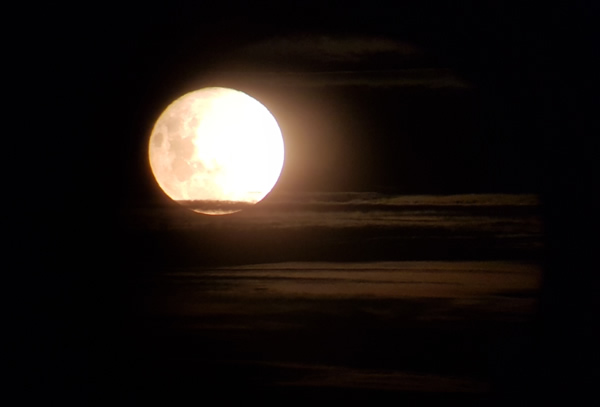
The moon on Wednesday night coming up over the water of Augusta taken
by Alaine Davin with her phone.
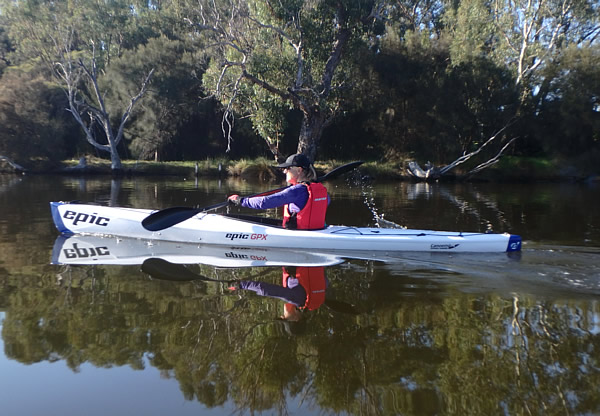
The calm Thursday morning gave out great reflections.
Why Not Check Out Your Surrounds When Paddling!
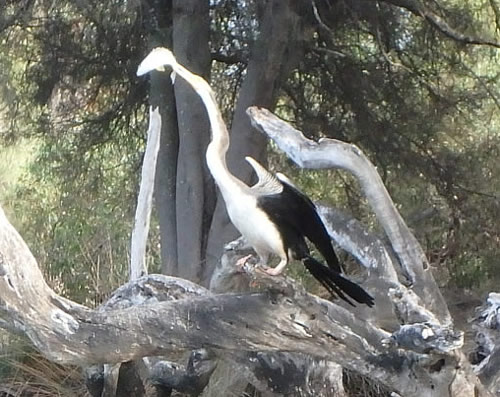
The river is always busy with bird life if you go at the right time. But you need to look around you to capture it at its best. Even on a hard paddle its still possible to look towards the trees and see the birds tucked away. For those paddlers who pass by without noticing, why not have a good look around now and then.
The camera I carry is only a point and shoot camera as its hard to carry a camera with a big lens when paddling my racing kayak so the photos are not as sharp as they could be, but they are better than nothing.
There has been a few times when I have pointed the camera towards a bird and I get the wobbles in my racing kayak. Luckily I haven't capsized yet.
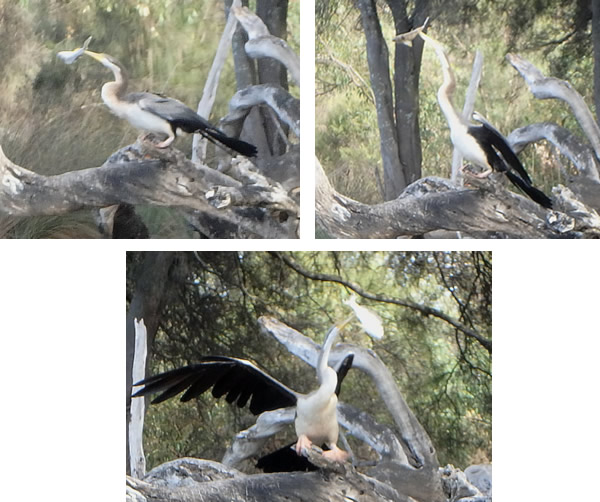
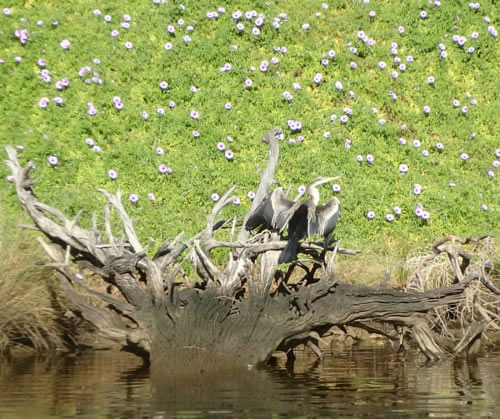
A Darter has caught its dinner, now all its got to do is try and get it down its gullet.
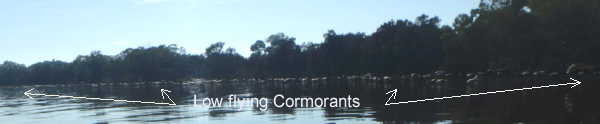
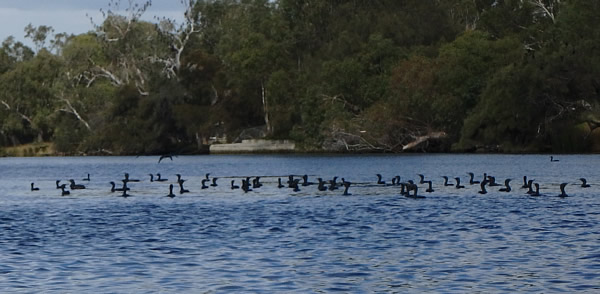
Thursday morning a huge line of cormorants flew by me about one metre above the water.
Every year, about this time they invade the Swan River in their thousands.
They are usually after fish.
Last year about fifty pelicans followed.
It a great sight when hundreds of cormorants start fishing in huge flocks.
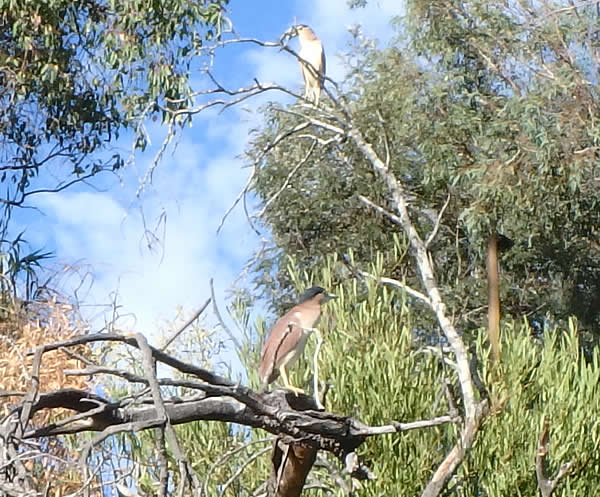
Night heron. See if you can spot one of these whilst paddling.
|
Return to Dirk Hartog Island
Ken Burton
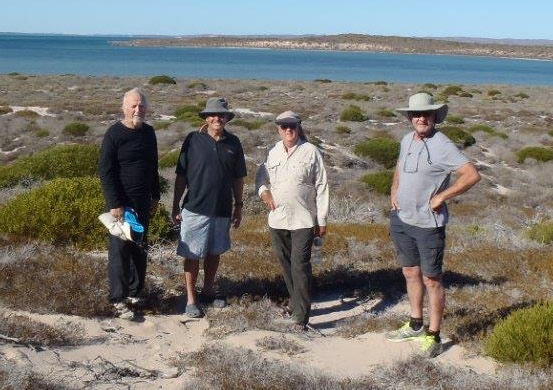
“For the last eight years a group of paddlers (Kevin Piper, Hugh Maclean, Ken Burton, Cliff Burton and Lance Connop) have ventured over to Dirk Hartog Island (DHI) departing from Denham townsite. We stay at the Bay Lodge Resort on the first night after driving up from Perth and leave the beach at 0830 the next morning.
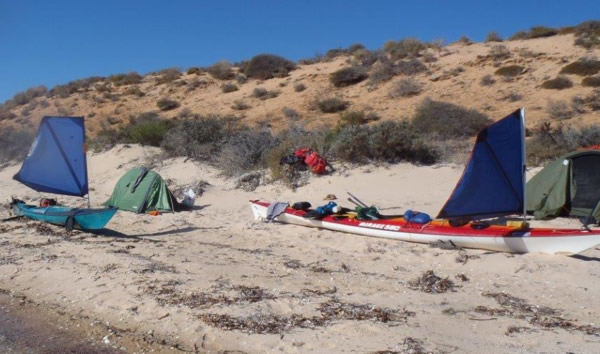
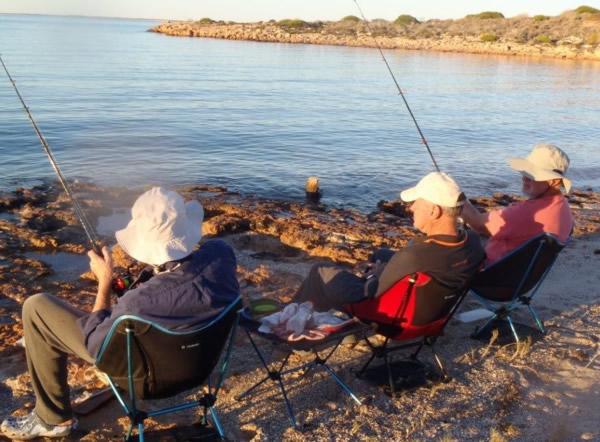
It usually takes about three to four hours to reach our first lunch stop on Heirisson Prong and then weather permitting we continue to Bellefin Prong and set up camp. Next morning we paddle over to Big Bay on DHI and set up camp. This is usually the first time we fish and it’s very successful with Red Throat Emperor, Baldchin Groper, Bream and very big Flathead readily catchable!
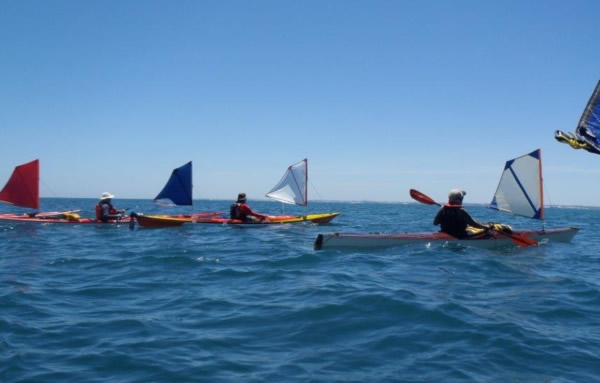
Each day we endeavour to paddle 15-25 kilometres to new campsites or take long walks on this pristine island Wilderness. We see no other people on the island, only the occasional fisherman while paddling. The small kayak sails are a great innovation and add an element of fun to paddling.
Hugh Maclean, Kevin Piper, Ken Burton and Lance Connor
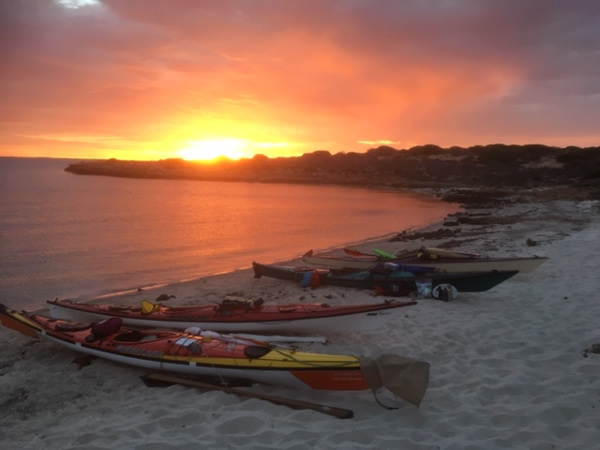
As you can see from the photo’s the kayaks of choice are Mirage 580’s and 582’s except for a wooden strip cedar Chesapeake 5.5 metre made by Cliff. As we have to take drinking water ranging between 25-35 litres each, all camping gear and food the total weight on day one is between 50-60 kgs per
kayak.
On day seven when we paddle back to Denham we make sure we camp on Heirisson Prong the night before! On one trip we camped on Bellefin Prong and with the wind, tides and huge seas against us, we had an epic 5.5 hour paddle back to Denham. We were all completely stuffed!
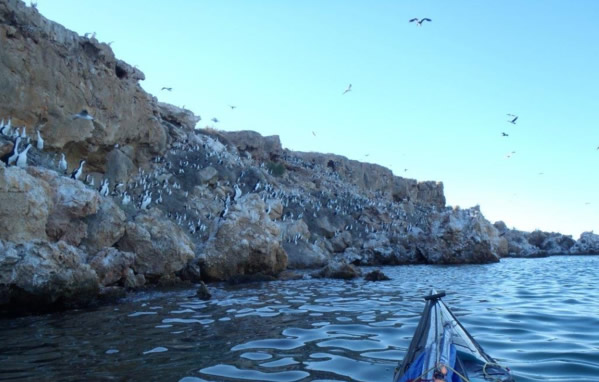
Cormorants live on the rocky shores.
The sunrises, sunsets amid occasional storms provide memorable pictures and moments for the group. We have had to postpone our trip this year due to the Corona Virus outbreak but are hoping we will be able to another trip in 2021”.
After cleaning the kayaks, packing all the equipment away we go to the local Hotel for drinks and dinner and stay at Bay Lodge before an early rise and drive back to Perth.
Ken Burton
|
The Mississippi River Expedition continued
Part 4
Thursday 2nd July
I had a good night’s sleep on the island a few hundred metres from outskirts of Minneapolis. There was no dew so the tent was dry for once, most probably because I was under the thick canopy of trees. I was away by 7.30am passing under a highway bridge with 18 kms to go before reaching my first
lock at the city of Minneapolis. As I came to the last long straight before the city, barges of sand were being unloaded and scrap metal and wheat were being loaded. It was my first taste of the river being used as a working river and as it was new to me it was interesting to watch the diggers, the cranes and the work in progress.
I saw a building that I thought was a boat shop, so I went ashore to see if it had a telephone, but it turned out being a bar with no telephone in sight. I walked down the road to what looked like another shop, but it too turned out being a bar. I opened the door and saw all the early drinkers staring
my way and as I was dressed in my canoeing gear, booties, stripy thermal etc I didn’t have the courage to go inside to check, so I closed the door and walked back to the kayak.
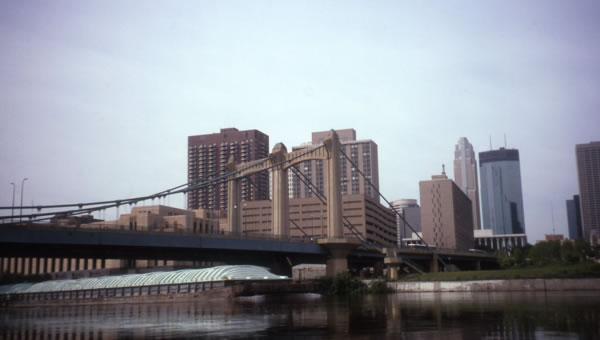
Back on the water I was now getting a good view of the city and on the last corner before the lock there were dredging operations going on which I had to avoid. Sky scrapers stood shining before me. I paddled closer to an island bank as a barge started coming my way. As St Anthony Falls came into view
I was unsure what to do and which way to go as the middle of the river had a fairly strong current with the water flowing over a big ‘A’ shaped weir. The roar of the river was frightening and I certainly didn’t want to get dragged over it as it looked like a long gradual drop into a dangerous churning weir at the bottom.
The city of Minneapolis appears.
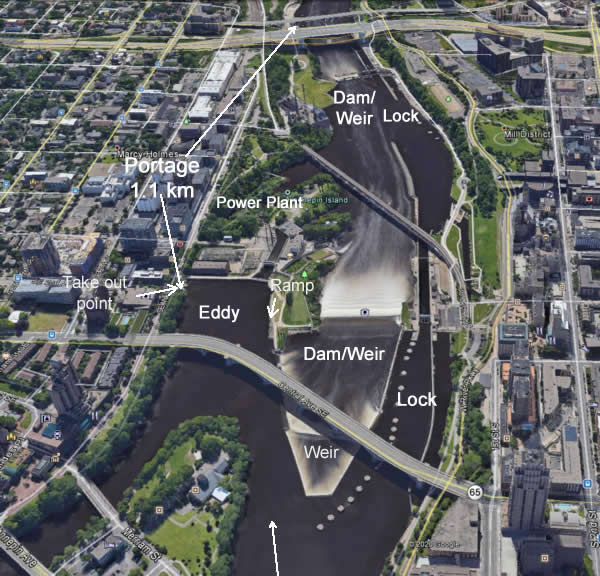
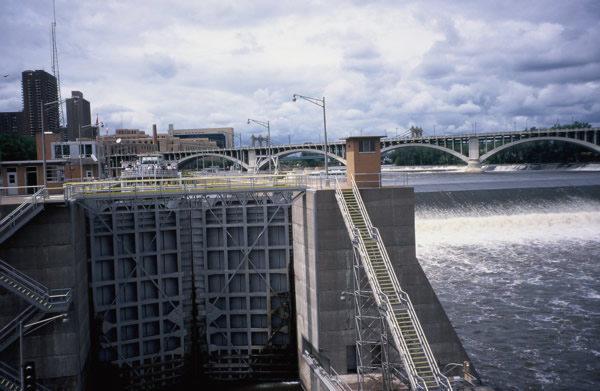
The St Anthony Lock on the far right side was the highest on the Mississippi River, it lifts and lowers boats up to 50 feet / 15 metres. With the barges using it I didn’t really know if I was allowed to use it as well, so I made a quick decision to go to the left towards the left bank and into a
big eddy of water which looked the safest place to be. Once in the square shaped eddy I decided to paddle to an abandoned boat ramp on a jutted out piece of land on the right side of the eddy with the thought of portaging over the piece of land and put in below the weir. However after I checked I realised it was private property and there was too much turbulence and white water at the point I was going to launch. The big building at the end of the eddy turned out being a power plant with a water
intake beside it to the right, which I needed to keep away from.
A bird's eye view of St Anthony Lock & Lower St Anthony Falls Lock.
Over on the left and the street side of the eddy there were some steps that rose up to a road, so I decided to paddle across and use the steps to get out. I lifted the kayak up onto the pavement and on the other side of the road were some cafes and shops. People walked by looking towards me with
puzzled faces. I asked a guy showing some tourists around how to portage and not only did I have to portage St Anthony Lock there was another lock 800 metres downstream, so now my portage distance was going to be at least 1.1kms.
I walked my gear along the road to the river’s edge by treading through a work site below the second dam. The river edge was full of concrete bits, rocks and steel rods and far from ideal to launch from, as waves were lapping harshly against them, but I had no choice. I returned for my kayak getting
some money out of an ATM and I rang Jean and left another message. My food drop was now in doubt as I haven’t been able to contact her.
As soon as I had the kayak on my shoulder a women started talking to me and then a teacher. My kayak felt heavy so I asked the teacher to walk with me whilst talking, the sooner I got the kayak off my shoulder the better. I reached the steep embankment and dropped it onto a concrete slab and loaded it.
I then lowered the kayak off the slab and into the turbulent, surging water. It worked better than I thought, but then I had to get into the kayak!! It was extremely hard to hold onto the kayak with the waves surging up the bank so I struggled, but when a chance came to leap into the cockpit between the surges, I did. The waves pushed me sideways back onto the rocks and concrete causing my rudder to get a bit of a hammering, but somehow I managed to paddle away to find a calmer spot. Phew that
tested me. I put my spraydeck on and paddled away slicing through the tail end of the dam’s turbulence. It wasn’t the easiest portage I’ve had.
Looking upstream towards St Anthony Lock. A tourist boat about to drop 15 metres.
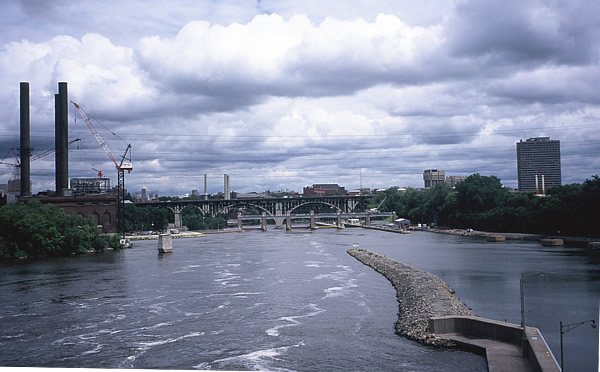
Looking downstream towards Lower St Anthony Lock.
There were rapids and a high waterfall here before the dams.
I was away and paddling under an old railway bridge which has been converted into a cycle/walk path used a lot by university students as the university was beside the river and in no time I was passing under another 6 bridges before reaching the next lock 8.5 kilometres away. The shore line was packed
with trees with a few parks and a rowing club taking prominent positions. There were cliffs at the point of where the dam and hydro power station were situated and from afar it didn’t look as if there was a good way to portage. All I could see was cliff and a steep wall which I assumed prevented me from getting to shore on both sides.
Having done the huge portage earlier I was determined to use the lock this time which was on the right side of the river, the power station was on the left. A man standing on the high concrete wall stood waving at me. He had three plastic bags in his hands. I thought who the heck was he! Was he
okay? Then he lifted one arm and said, “I have your food”. Clarke was Jean’s son, the women I had met on my bike ride and I had been trying to get in contact with. I had asked her to hold a food pack for me and bring to the river when I reached the city. Apparently she got my messages but couldn’t make it, so she got Clarke to come instead.
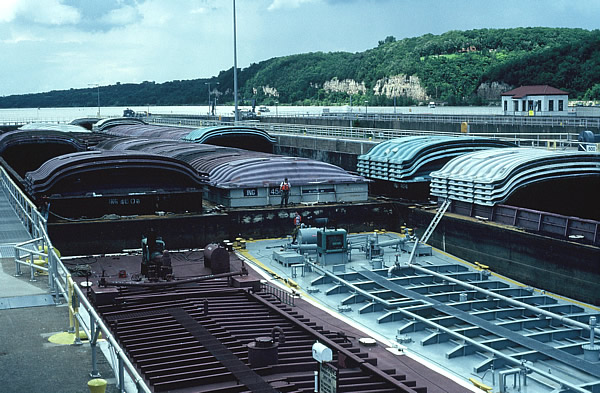
I was about to have a word with Clark and get my food when the lock keeper waved me into the lock. As the doors were closing I hurried in wondering how I would get my food now. When the doors slammed closed I felt tiny and insignificant being penned inside next to a huge barge.
Clark stood at the top of the lock, had a word with the lock-keeper and grabbed a rope that was hanging down into the lock, tied it around the plastic bags and lowered them into my lap. Like it happens every day. The crowd applauded and just like that I had my food. It was just amazing, I hadn’t
planned it this way and it happened so quickly. With the food in my lap it was not the time for capsizing.
I talked to the barge guy as the water was being released and he told me that paddlers weren’t usually allowed in the lock with a barge, but it happened here, however it was the last lock that it would happen. As soon as we reached the river level below, the doors opened and I was free to leave first.
That was Lock number 1 on the official guide and my first lock experience apart from going through locks on the Murray River in Australia.
As I paddled out of the lock some kids shouted good luck as I left, it made me smile and I gave a wave. I was disappointed though that I wasn’t able to talk to Clark and thank him, but it all happened so quickly. I was now happy as Larry with all the food I had.
There were some sloppy water downstream of the lock and as the power boats came out they made the water even more turbulent. I moved over to the left side of the river and attempted to land at a park which was a little difficult with all the food in my lap but I managed to keep it dry.
Although it didn't fit too well I packed it away without taking all my dry bags out. I had lunch and reflected on what had happened in the lock.
I left the picnic area with a strong current and locked in by trees on both sides of the river. Parkland and a walk path appeared on the left, which looked busy with walkers and runners. I was soon awarded with spectacular views of the city of St Paul, which I wasn’t expecting, an arch bridge
with the sky scraper buildings in the background and a huge cathedral over to my left.
Just before reaching a marina a paddle steamer cruised by, my first of several I will see on the Mississippi. I pulled into the marina and found a pontoon to get out, but with the pontoon being half a metre above the water and with a fast flowing current, it did have its challenge. A man on the pontoon
kindly held my kayak whilst I tried to climb out, but every time I stood up the current would push the kayak away so it was a real struggle to get out, but I did.
I filled my water bottles from the toilet and when I returned a family in a boat had left me a pack of biscuits on my paddle. I started talking to them and I asked if they had 25 cents so I could buy a cool drink. They gave me one of theirs instead and asked if I wanted anything else. I was happy with
what I had. Another man I talked to told me he had bought a huge paddle steamer and was using it as his home.
I left the marina and paddled out into a strong current. The city of St Paul was right there. The current swept me under three bridges and passed bridge pylons at a frightening speed. The water piled up on the upstream side of the pylons as well as attracting debris so it was a place to
keep clear of. Beyond the bridges both sides of the river was cluttered with lines of barges that spread over a kilometre downstream. Between them working barges criss-crossed the river ferrying and establishing a pod of barges, that later would be moved downstream to other towns and cities loaded with cargo or fetching cargo. These pods were often made up of 12 to 30 non-motorised barges which were lashed together and pushed with one powerful towboat. Some of the fuel related pods
had lesser barges. Each barge was 60 metres long and 10.6 metres wide. A pod of 15 barges, 3 wide, 5 long would be 300m long by 30 metres wide. With the weight, width and length, these pods were lethal weapons, not only to other river traffic but more so for smaller craft such as row boats and kayaks. I had to watch out as the river now turned into a working river.
The Mississippi River barge system ships about 500 million tons of goods each year.
The barge industry is the largest segment of the U.S. domestic maritime industry, employing more than 33,000 Americans and providing $100 billion in economic output each
year.
A typical inland barge has a capacity 15 times greater than one rail car and 60 times greater than one semi-trailer truck.
As I was passing the airport I noticed some polystyrene foam near the river bank floating with other rubbish. I had been looking out for some foam so I could make two small outriggers for my kayak to give me more stability when crossing lakes or when the river was really rough. The outriggers
would create a wider kayak making it more stable kayak.
Back home in Perth I had not only made the kayak cockpit bigger, I had also fibreglassed an alloy tube in front of the cockpit. This was to house a length of round alloy that slipped inside the tube and extended 50 mm each side of the kayak. This length of alloy would then hold the 50mm thick x 50cm
long foam block. I cut a round hole in the polystyrene foam just big enough so it would slip over the piece of alloy and bingo I had an outrigger on either side. The foam was good quality so it didn’t break up.
There were 32 kilometres to go before reaching Hastings lock with a 10 km lake forming upstream of it just to slow me down. The locks had traffic lights before each gate. Red was for stop, green for go. It was on red so I waited and got talking to a couple in a boat who later gave me a map book of the
river. As soon as a barge had come out of the lock it was our turn to go in. We were in and out of the lock in no time, I passing through the town of Hastings, the town of Prescott and the St. Croix River. It became very cloudy and very dark and although I had only done 85 kms it had been a big day, so when I saw a beach a kilometre or so below Prescott I camped. It rained as I was falling to sleep writing my diary. Bed at 12.30am.
Kayaks are not allowed in the lock with a barge. You can understand why.
They take up all the space.
Friday 3rd July.
There was a huge storm that came over in the night. The river was straight forward, with a good current, and on my right were lots of channels, sandbars, islands and lakes. Most of the lakes were hidden from my view but a few channels off the river connected them. It wasn’t long before I reached
dam/lock number 3. I had a bit of a wait but otherwise it all went smoothly and I arrived at the town of Redwing at 12.00 noon. I took the opportunity to do a little shopping so I pulled up near the town jetty and went hunting for film, camping fuel, a torch, a telephone-card, bananas, bread rolls, cheese and sunglasses.
Back at the kayak I had several people talking to me as I ate cheese rolls. I wondered why there were so many cyclists and boats around, but it was the weekend of 4th of July and a holiday. I loaded my extra provisions into the kayak, but it listed to one side, so I had to reload and I
finally got away by 2.30pm. I had spent 2.5 hours there. The city was named after the early 19th-century Dakota Sioux chief, Red Wing.
I headed downstream and later met up with the couple who had given me the map book. I soon entered Lake Pepin and my speed slowed considerably. Being a holiday there were heaps of power boats throwing up big washes and what a pain they were. Many charged passed me with no courtesy at
all.
The lake was 2 to 3.5 kms wide and 35 kms long, my progress was so slow and my neck started aching. Dead fish were scattered, which wasn’t a pleasant sight and the beginning of a narrower river seemed so far away. Lake Pepin is a natural lake formed thousands of years ago due to sediment building up at
the mouth of the Chippewa River downstream of the lake.
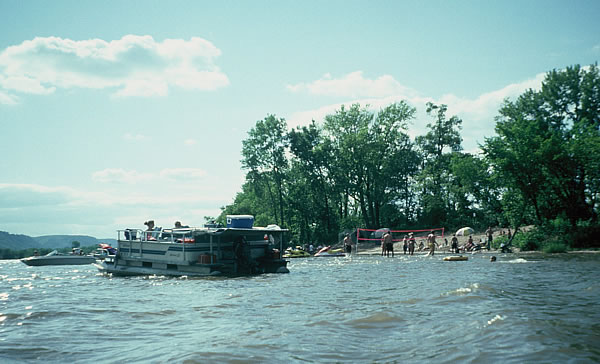
I finally reached the river entrance as the sun was going down and a storm was brewing. With the choppy lake behind me there were now dozens of people camping on the river beaches. The Mississippi became a tent city and the people were readying for a party. Many were playing volley ball and games and
later they would be setting off fireworks.
I passed the Chippewa River on my left and beyond it the land was intersected with many channels that spread the low land like branches on spreading trees. I thought I had got rid of all the boat washes, but no they were back and they were bad.
By the time I got to Wabasha it was nearly dark but I found a nice camp spot in a park next to the marina without many mosquitoes. Disappointingly I only paddled 80 kms. Bed 12.45am
People enjoying 4th July celebrations on the river.
Saturday 4th July.
There were a few boats leaving the marina at 6.15am and despite having good camping conditions it took me 2 hours to pack up, have breakfast and get away. I arrived at Lock 4 upstream of Alma as a barge was going through which meant I had to wait 2 hours before my turn. I would have portaged, but it
didn’t look easy. A family on a house boat, which had broken down fed me ham sandwiches, grapes, cherries, strawberries, raisons and muesli bars. They got going, said goodbye and broke down 100 metres away.
I was annoyed that I had wasted 2 hours waiting, but at least I got a good feed. Once through Lock 4 the river was full of islands to lock 5, 23 kms away. I portaged over a spillway with the thought I could get back in on the other side easily, but it was very slippery and difficult to
do.
A house boat with a family that fed me.
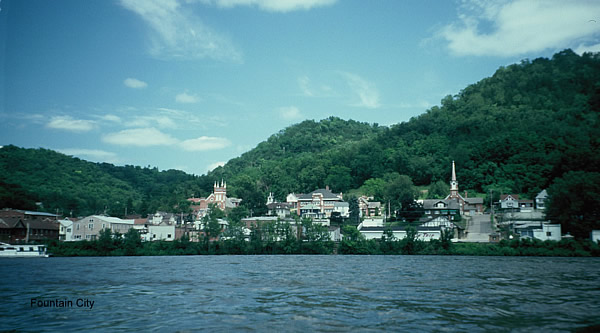
The river had several channels heading off the main channel through a low wooded area creating lots of islands. I stayed with the main channel passing Fountain City which really was a picturesque quaint village with a couple of
churches and a green hilly backdrop, tightly woven with trees. I paused to take a photo. The scenery along this section was quite special.
When I see a place like Fountain City I expect it to be big but in the US that's not the case. A city is often small but it has powers.
So in the United States, an incorporated city is a legally defined government entity. It has powers delegated by the state and county, and the local laws, regulations, and policies are created and approved by the voters of the city and their representatives. A city can provide local government services to its citizens.
The city of Winona was only 12 kms away, I moved passed slowly taking in the small city and wondering where the Winona Canoe Factory was. It would have been great to have called in but the fact that they didn’t know me and that it was 4th July and one of the biggest holidays in the USA I
floated by being ruffled by the number of boats on the water.
I came to another dam and another wait. I was getting some rest sitting in the kayak waiting but I wasn’t making the miles I wanted, but the alternative was to try and portage around the locks which can be difficult and be up to a kilometre long. Some dams had high steep walls and fences so it was near
impossible to portage around them.
The boat traffic was bad again and when I approached Lock 7 several boats were motoring inside. I was several hundred metres away when they were about to close the gates, but the lock keeper noticed me racing and waited until I got there. The people in the boats clapped their hands as I moved inside. I
felt like a rock star.
When I settled in I put the stabilisers on the kayak as I knew there would be a mad rush of powerboats leaving. I’m always told to leave first which is worse than going last because I get every speedy powerboat pass me. Once out of the lock I kept close to an island and put my light on as it was
getting dark. Lots of boats were milling around and getting ready for the firework display. I paddled to an island close to the city of Lacrosse where the beaches were crowded. With little option I sat in my kayak shattered and watched the display from it. I was chilled, in fact cold and the mosquitoes were attacking me, so I must admit I soon started to lose interest even before the show started. I shivered and scratched as the sky suddenly lit up with an array of colours and a barrage of
bangs. The display was getting better but despite the excitement I soon started to nod off, but capsizing wasn’t an option, the water was too cold.
About 20 minutes later the bangs, the beautiful patterns and the showers of fading fireworks suddenly stopped. At once there was a stirring of voices and the sound of boat engines echoing across the river.
I was actually happy that it was all over as I really needed to get on shore and get warm. Immediately I paddled a few metres to a crowded beach upriver and asked some guys who were on the beach and very drunk if I could camp on their beach. I thought it might be a bad idea but it was dark and I didn’t
have any idea where the next beach was. They said yea come ashore. Suddenly they pulled my kayak up the sand with me in it, which wasn’t the best for my kayak, but it didn’t matter. I found a spot to the side and started unloading and one of the guys who could hardly stand up insisted he helped me. Again, I didn’t really want his help, as I was concerned about my gear, but I got it.
I needed to go to the toilet so I sneaked into the bush hoping no one else was on the same mission. I was soon free from the burden I was carrying, but I was tired however I managed to erect my tent and hide away from the party and all the pissed people who were celebrating. It probably wasn’t the
safest campsite to be on a party night, but I was too tired to care. I wrote in my diary until I fell to sleep hearing nothing in the night. I must have slept well.
|
|
|
|
|
|
|
|
|
|