DRAW STROKE (PULLING)
The Draw Stroke (pulling) and Sculling Draw Stroke, mentioned later, are used to move the kayak sideways, and are particularly useful for side-slipping towards the bank. They can also be used to line up the kayak in rapids and to avoid boulders and obstacles.
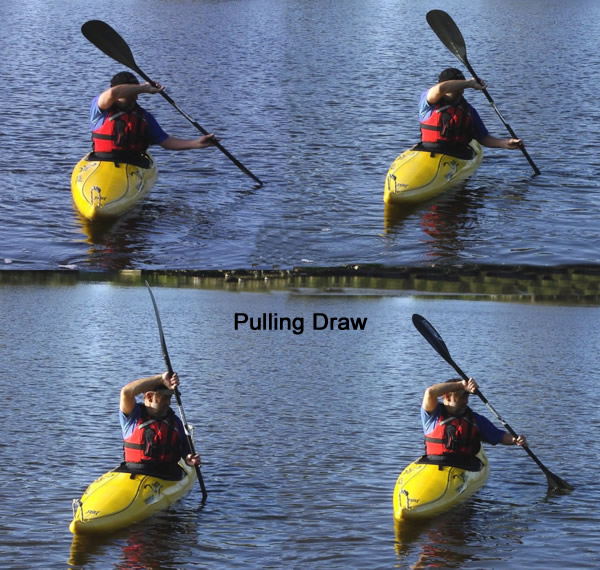
- Sit up straight and rotate your body slightly in the direction you wish to side-slip towards.
- Raise your top arm (the arm that is furthest away from the direction you intend to draw towards) so that it frames your face. Keep your forearm no lower than your forehead and your top hand should remain steady over the side of the boat you are drawing towards.
- Reach away from your hips with your lower arm extended and plant the blade deep into the water.
- With the blade face parallel to your kayak, pull the paddle towards your body between your hips and mid-thigh. The kayak will then side-slip towards the blade as you pull on the paddle.
- It is important to keep your top arm high and framing your face until the entire stroke has been completed. Your top hand should remain steady over the side of the boat and only move
on the Recovery Stroke. Ensure the paddle remains as vertical as possible to produce the maximum amount of power.
- Before your blade hits the side of the kayak, pause, turn the blade through 90 degrees by rolling your wrist inwards, and slice the blade away from the boat to its original starting position.
****************************************************
An alternative method of returning the blade, is to slice the blade fully out of the water and replace it in the starting position.
Water should pass under the hull and not run onto the deck as the boat slips sideways. To achieve this, keep the boat level or raise the boat's leading edge very slightly.
COMMON PROBLEMS
1. The paddle is too
horizontal, causing the water to spill off the bottom of the blade and resulting in a loss of power.
Solution: Keep the top hand high so that the paddle remains
vertical.
2. A curve shaped paddle
does not slice back to its original starting position in a straight line.
Solution: Slice the blade back in a slightly forward arc
motion, keeping the drive side (face) of the blade facing the stern.
3. The boat's bow or
stern swings sideways instead of remaining parallel to the paddle.
Solution: Ensure the paddle blade is pulled directly (at 90 degrees)
towards your body between your hips and mid-thigh.
4. The wind and
current causes the boat to swing off course.
Solution: Adjust your stroke by drawing towards the bow or stern, depending upon which way the boat is turning. If the bow is turning towards the drawing side, try drawing the paddle slightly towards the stern; if the stern is turning towards the drawing side, try drawing slightly towards the bow.