Enjoy the CDU Newsletter

Published: Thu, 01/04/18


5th January 2018                                                CDU Newsletter 558
CDU Newsletter
Terry 0417 977 330
 
Good news - The dolphins are back in Bassendean waters. Wednesday night as we raced up to the railway bridge at Bassendean I and several other paddlers saw two dolphins. I was in too much of a hurry to follow them further up river but it was good to see them back having been absent from this area for several months.

The next morning, Thursday as I paddled to Barkers Bridge with Justin he spotted a snake a little upstream of the railway bridges just passed Fishmarket Reserve. I wasn’t sure where it was so I stopped paddling to see it swim only millimetres from my bow and as I glided with my paddle blade skimming the water, in a bracing position the Tiger snake which was less than half a metre away just missed my paddle blade.

Before then Justin had been telling me he had seen a snake in the water upstream from Middle Swan Bridge, at his horse paddock in Upper Swan and at his mum’s property in Bridgetown.  No wonder he scooted away from the snake when he saw it.
 
Only in the US
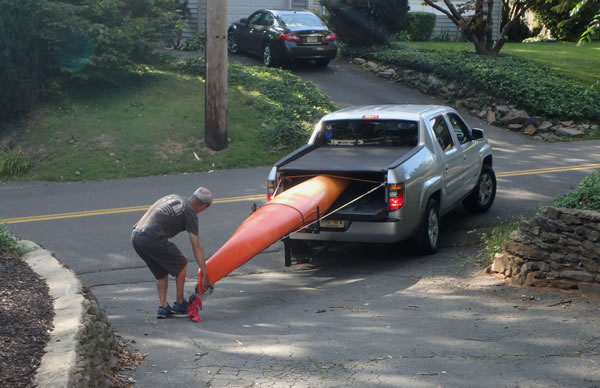
Lucky for John he sold his kayak before we returned to Australia after our big trip across Canada and the US. Here John holds his kayak up to stop it hitting the ground as the buyer drives down the slope. Nearly 3 metres of kayak is hanging out the back of the  tray. Although we were concerned that he had to drive over an hour in busy New Jersey traffic, that wait for 'no man', the buyer had no concern.
​​​​​​​
We never did find out if he got it home without losing it, having an accident or being booked by the police.
 
To Wear or not to Wear - a PFD

It is very rare for me to be paddling without wearing a PFD nowadays. Some paddlers seem to think I am crazy wearing one especially in the heat. I’ve always wore one when paddling on the ocean, in whitewater and on expeditions but I decided at the age of 60 that I really should be wearing one even on the flat water. I paddle a lot alone and even racing I can be a long way from the next paddler so it just seems sensible to wear one. Even if you are young you might suffer a medical condition whilst paddling and when you are over 60 well who knows what’s going to happen. If I had a heart attack or something I would rather be wearing a PFD to keep me afloat rather than sinking to the bottom of the river to be found bloated a few days later. At least when you wear a PFD you stand a chance of living and I really do want to live a lot longer.

I’ve now worn a PFD continuously for 6 ½ years every time I go out which can be twice a day sometimes or when we paddled for 66 days I was wearing one for 6 to 10 hours a day. I don’t see it as a hindrance but as a life saver although that can’t be totally guaranteed.

I have a water bladder in the PFD so I am always hydrated, it has a pocket for my camera so I can take photos, it has a pocket for money and a pocket for a knife so it is more than a life protector.

I haven’t had a life threatening medical problem so far in my life but who knows what's around the corner, even the fittest athlete’s keel over.

If I can save my own life I think it's worth wearing one.​​​​​​​
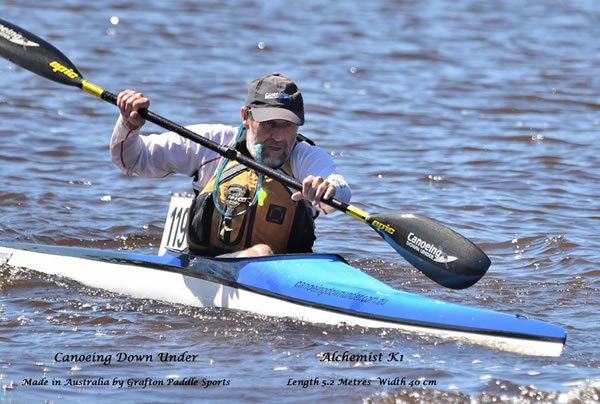
 Why not set your sights to compete in the Australian Marathon Championships in South Australia in May.
The Alchemist is the ideal kayak.
​​​​​​​
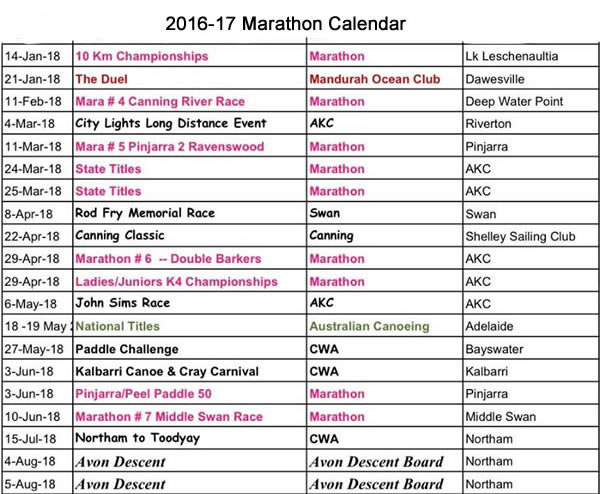
10km Championships
14th January 
Lake Leschenaultia
 
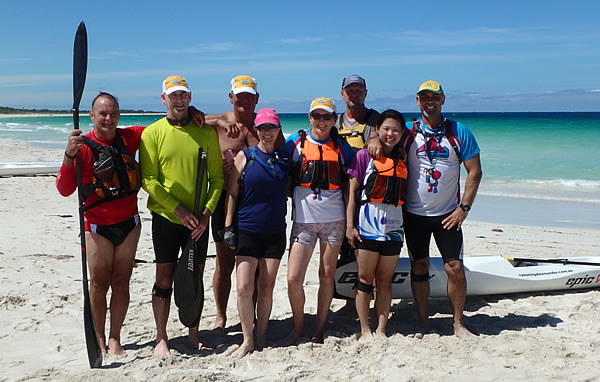
 Boxing Day at the Beach. 
A few of us enjoyed a few hours at the beach on Boxing day. The ocean looked flat but it was more testing than it looked.
Peter, Ray. Mike, Anne, Jane, Chris, Fifi and Jason. Michael was still paddling. 
 
Back Home
 Barbara was happy to see her daughter Julie home for Christmas. Julie was once a regular at CDU training and Ascot Kayak Club and was often seen pulling T2 around. She now lives in Belgium and works in Paris. 
It was good to see Kirt Lanadi back in a boat with his father Vince. Kirt was once a top junior paddler but adult life and family saw him move down south. I see he still has those paddling qualities. 
I had the pleasure to do a social paddle with John Gilmore, his daughter and her boyfriend on Wednesday morning. John started paddling several years ago whilst waiting for his daughter to finish rowing. He and Bruce McWhirter joined our CDU Avon Descent group around 2003.
 
A Wild River

The river around Bassendean - Bayswater this Christmas holidays has been wild with speeding power boats, boats pulling biscuits, water skiers and jet skis, all of which are not allowed upstream of Maylands in the 5 knot zone. At the end of the day, after a few beers they seem to be worse

In fact it’s been the worst year for speeding power boats in the 40 years that I have been paddling in the area. Living on the river means I can see every power boat pass by my home even if I’m not paddling.

When we were paddling across Canada it was very rare to see a boat speed in a restricted zone. In fact John and I couldn’t believe how considerate they were in a speed zone. Before and after the speed zone though, they just went ‘hell for leather”. It was very common to see boats going at very high speeds out of a speed zone to all of a sudden slow down to 5 knots when entering a speed zone. Why the Canadian boaters complied with the law and WA boat owners don’t is a mystery.

Two weeks ago near Ascot Kayak Club three paddlers were driven at and beer glasses thrown at them. The boat was going that fast they had no time to get their number.

Another day a boat’s wake capsized a paddler, the occupants just laughed and continued to do circles around the paddler and kept chopping up the water.

Last Monday at training there were several boats speeding by and when paddlers told them to slow down they took no notice. Even on Wednesday as we were racing there were several speeding boats and one guy was water skiing.

There was also a boat pulling a biscuit/ski tube going around the Fishmarket Reserve corner at Guildford. This is not only dangerous for paddlers and other watercraft but there are several tree snags that the biscuit could get caught on.

​​​​​​​The section of river outside of our home seems to be a popular section for towing tubes/biscuits. They just keep going in circles with the constant wash continually slapping the fragile banks. The kids seem to be enjoying the ride but the parents won’t be so thrilled if their child is caught on a tree snag and seriously injured.

If nothing is done to police the river there is bound to be a serious or even a fatal incident.
 
 
DR Paddling Around the Buoys
starting 12th Jan at 6.00am 
It's that time of year when we dig out our Down River kayaks or Wavehoppers and start practising around a section of buoys. These sessions really help develop skills and are a huge asset to any paddler no matter what discipline they paddle.

Kayaks best for this training are DR kayaks or Wavehoppers without rudders, but Finn kayaks, a 415 or other kayaks 4-5m long that are manoeuvrable can be used.

If you don't have a kayak and want to give it a go just give me a call on 0417977330.

Start date: 12th January.
Day: Friday mornings 6.00am to 7.00am
Venue: Claughton Reserve, Katanning Street, Bayswater.

Cost: Free
 
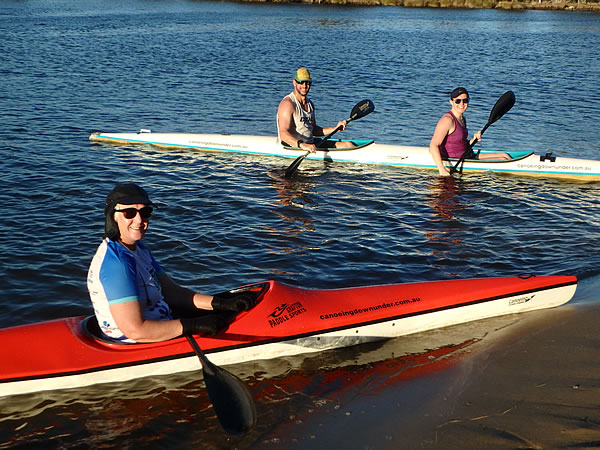
Epic Kayaks, Skis and Paddles 
 
 
Thursday Evening Paddling at Ascot Kayak Club

On the turn

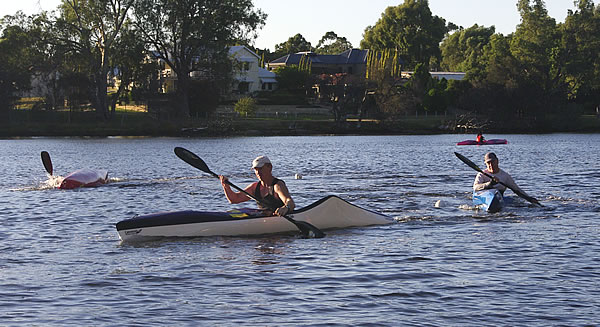
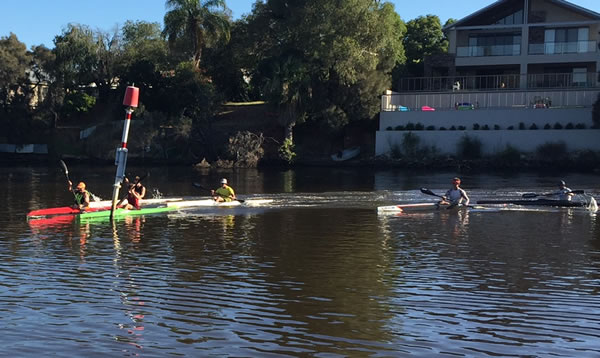
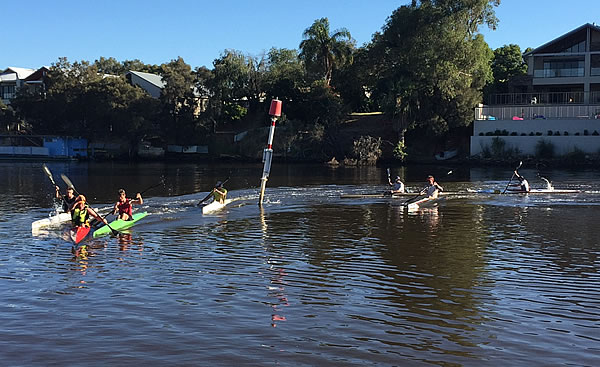
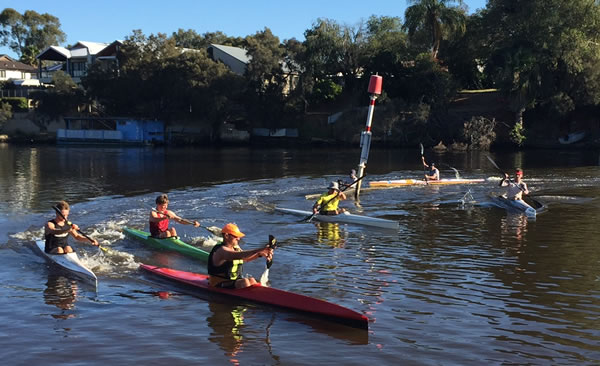
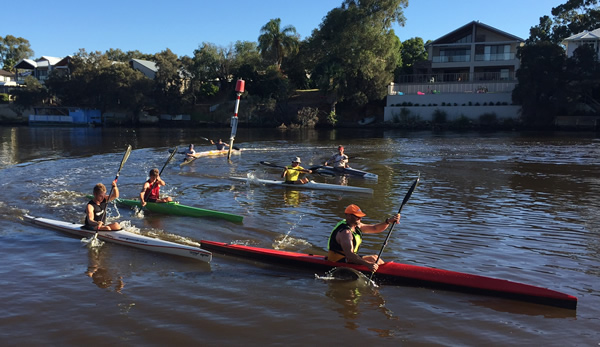
Being able to turn well around a spit post is very important for paddlers racing on the Swan and Canning Rivers. More often than not many races involve tuning at a spit post so if you are good at it you will gain valuable time. It is a skill that needs to be practiced.
 Young Jeremy Alderson (green kayak) tries  to out manoeuvre his dad Mark (red kayak.)
Jeremy didn't do a tight enough turn so he is too close to his dad, veering too wide and has to back off to avoid a clash with dad. Luke Dooley is on the outside and will have to paddle further and Bernard (white kayak) had to slow but did a tighter turn.
 Mark is able to accelerate away and although Bernard (white kayak) had to slow down at the beginning of the turn he does a sharper turn and isn't that far behind.
Luke manages to accelerate so the fight is on for the finish line.
 
Surely Something Has to Be Done
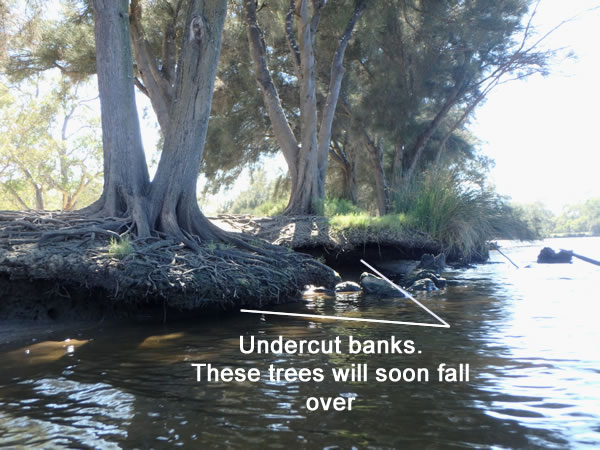
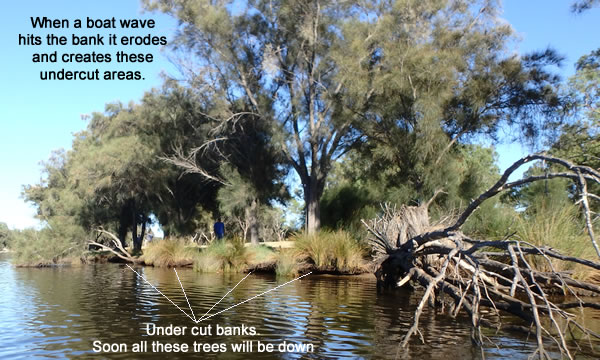
If you have paddled between Garrett Road Bridge and Guildford Bridge you will see dozens of trees toppling over due to bank erosion. With the amalgamation of several departments it’s a mystery to who looks after the foreshore but whoever it is they are doing little to nothing to solve the problem in this area. My understanding is that the shire usually look after the area several metres above the river banks and the de-funked Swan River Trust looks after the river banks. It does seem however that there is little co-operation between to two bodies so nothing gets done.

Every day two large tourist boats motor passed the Ascot Kayak Club. I can’t imagine what the tourists think about our eroding banks seeing beautiful trees dying or falling into the river.

Due to the neglect over the years it will now cost millions to get the banks back in proper shape and as we are told money is tight will any thing be done.

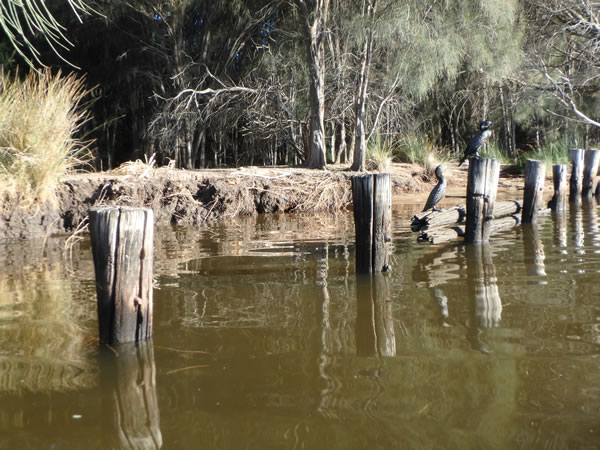
Several years ago timber walls were erected in some places but no one serviced them so pole after pole became loose allowing the boat waves to creep behind them and erode the bank. The best way to stop the banks from eroding further is to reduce boat wash.
Just look at the cavity under these trees. Once these tree topple there are no tree planted to take their place.
Why is there no action to save these trees and the riverbank is very concerning.
Several years ago timber walls were put in place along parts of the river banks. Over time poles came loose and allowed boat wash to get behind them. The poles were never replaced which would have been quite easy if it was done straight away. Some sections of river bank have eroded several metres in the last 15 years.
 

State Sprint Championships

January 21, 2018
---------------

Mandurah Duel

January 21, 2018

-------------------

Next Marathon Race


​​​​​​​10km Championships
14th January 
Lake Leschenaultia


The Doctor 2017: Rottnest Island to Sorrento Beach
“The best ocean race in the world, apart from cutting right instead of left”
​​​​​​​Luke Dooley

The conditions for this year’s doctor could not have been better from my point of view with winds exceeding 25 knots in an almost perfect direction with swell to match. I was paddling a double ski with Ray Smith; a partnership decided after a few successful practice runs in the weeks leading up to the event. After nutting out all the problems and getting myself used to steering a 7.5 metre long double which filled with 60kgs of water every on wrong move, we were confident and excited to take on the roaring conditions; or at least I knew I was!

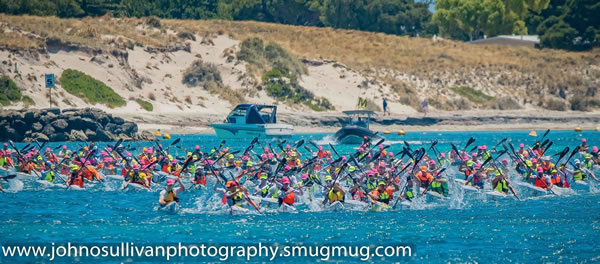
The ferry ride over to Rottnest was far more lively and enjoyable that last year as everyone was getting excited and gearing up for the already pumping seas. After arriving on the island, it wasn’t long before it was time to paddle back as the wind was already in and looking like it was going to be a massive improvement on last year’s flatwater heat marathon. We headed over to the army jetty where the crowd was gathered. I was checked in immediately after Hank McGregor and was able to watch his warm up routine. I was under strict instructions from Ray to treat it as if it weren’t a race and catch as many runs as possible to preserve his energy over the longer course. That seemed a lot easier of a task before lining up on the start grid with over 300 entrants!

Before two o’clock we were off and racing. It was a very exciting start and we managed to power past a surprising amount of people with ease. We had to head around the green spit post at the end of the bay before we swung north east back to the cardinal mark and Sorrento. I had been advised by Darryl Long just before the start to take the left hand turn nice and wide as there was a seriously strong current capable of slamming boats into the post. The tip paid off greatly and we had a safe passage around the mark while keeping Ray’s delicate ski damage free. Unfortunately for the start of the women’s race, the leaders hadn’t been given the same advice as me and two out of the three leaders were slammed into the post, sustaining damage to their skis.
There was a lot of wash for the first kilometre or so which made getting a clean run on the waves very tricky. The other problem was finally getting a run and finding a seemingly stationary ski right in front of our bow, forcing us to abandon the run like a surfer when somebody drops in on a good wave. It became quite frustrating as we were sweating it out trying to find a run and being denied at every opportunity. The added length and reduced turn ability of our double ski added to the frustration when singles cut us off from all angles. I also had to remember that I couldn’t charge straight through the field as my orders were to preserve Ray’s energy as much as possible; especially in the early stages. I looked down at my foot strap after seemingly no time at all and was amazed that we’d already completed four of our twenty eight kilometres. We were rocketing!

We began to find a bit of rhythm and got onto some good runners. The slightly side on wind coming from the south made it a little tricky and added to the difficulty of cutting right instead of left. It was soon after that I looked up and was amazed at how quickly all the other paddlers had disappeared. We could see not one out of the three hundred plus skis.

Everyone seemed to completely vanish in the massive waves. It wasn’t until about fifteen kilometres later, just before the cardinal mark, that we saw another paddler. We saw absolutely nobody for over an hour; left, right in front or behind us. There weren’t even any SUP boarders visible, not a sole around.

We were beginning to get a few good runs but it wasn’t as smooth as I hoped it would be as the cutting right instead of left component was really challenging my skills. I had become pretty good, even in the double, at just peeling off and lining up wave after wave during our practice runs, however trying to do that on my opposite side was really challenging. My struggle unfortunately began to show the nearer the cardinal mark we got. Because I hadn’t been cutting right enough, our approach angle to the mark was way too north which mean we had to deal with an increasing amount of side on waves. This made the ride very uncomfortable and reduced our average speed by an entire kilometre per hour from 14.5 to 13.5. It also meant we were catching fewer and fewer waves, increasing Ray’s workload.

The final five kilometres before the mark were very uncomfortable as I was sliding from side to side on the massive water lubricated seat and was battling to control the rudder pedals which felt impossible to move and ineffective in steering. We edged closer and closer to the mark however it seemed to take an age to get there. The mood did begin to lighten though when I realised that the second we’d round the mark, the wind was blowing in such a direction that would allow us to reach Sorrento at warp speed with little to no paddling effort.

Five hundred metres out from the marker, we saw our first head. A SUP paddler was visible just in front of us. Then another popped his head up, and another and another. Within seconds, we’d gone from not seeing a single paddler for over an hour and now suddenly there were dozens of them all cutting in and heading for the turn. Finally, we rounded the cardinal mark. The pain was now over and all I had to do was guide our boat onto the safety of Sorrento Beach. It was in those final eight kilometres that we experienced our biggest waves and roughest sea as we made our way over the underwater reef shelf.

The waves were absolutely enormous. They were picking up our seven and a half metre long double and shooting us forwards, nearly positioning the stern vertically above the bow. The waves were also moving at an alarmingly fast rate which was very frustrating as I struggled to keep the bow from burying itself in the wave in front, which would slow our boat speed and fill us up. There were a few extremely frustrating moments when we came off the back of a roaring wave and ended up with two full cockpits, weighing the boat down and severely hampering our progress. To add insult to injury, the single skis around us seemed to experience this problem far less and shot right by us, leaving a trail of rocketing bubbles behind their rudders. We were forced to slowly build up the momentum until we finally emptied and were able to hop back on some more waves. It took several attempts on one occasion which took all of my patience to remain calm. I tried not to think of being in the V14 which would have suited the faster runs perfectly and would have had no problems with filling up.

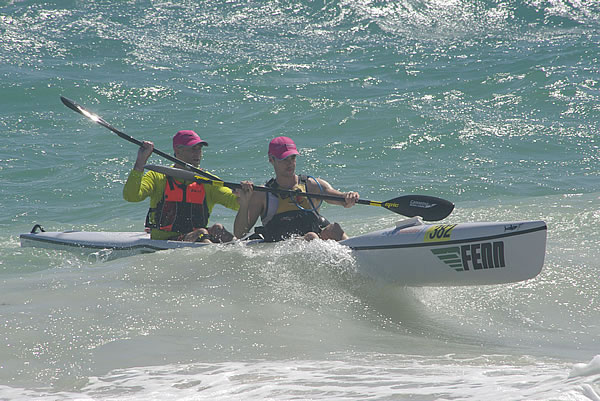
Thankfully we eventually got some movement back and soon found ourselves bounding over the water faster than even the powerboat hoons which tear through Ascot! We were absolutely belting along and I loved every second. The speed of the boat was just immense and on several occasions, I felt as if I’d hardly paddled for minutes, just lining up run after run, using the rudder to navigate the waves. A few were even beginning to break kilometres out to sea and certainly had some zing on them with the twenty seven knot average wind speed we had behind us. On one of the waves I even managed to break my own PB of fastest ever boat speed. Instead of 24.7kms/hr, my new top speed was 27.9kms/hr without even paddling! We were now paddling almost faster than I could run. I began to think of some of the other less experienced paddlers out there who, unlike me, would not have loved the conditions so much. I began to imagine how scary conditions like these would be for beginner paddlers, especially so far out to sea. I just hoped that there would be no accidents as it could very quickly and easily turn nasty.

In what felt like about three seconds, we were beginning our landing on Sorrento Beach. It just amazed me how the five kilometres leading up to the mark felt like three quarters of the race and the final eight K’s had been over and done in the blink of an eye. Our landing was effective, although not quite the perfect exit I’d achieved in the past. I ran up the beach, handed in my number and was amazed at how strong I was still feeling. I was also amazed at Ray’s ski as I realized that for the whole twenty eight kilometres; I remained completely comfortable in the seat with no sore bum whatsoever! I was very pleased with the seat which was almost on par with my Epic. The final cherry on the cake was seeing Darryl come onto the beach a few seconds behind us. I began to realise that we’d done far better than I’d imagined; even with my failure to cut right.

We hit the beach.
​​​​​​​
Boats and boards of all shapes and sizes continued to roll onto the beach with paddlers looking increasingly tired as they moved up the shore. Our time of just over two hour was very impressive and I would be very interested to see what it would have been if I’d done a better job of cutting right. Hank McGregor came in 17 seconds behind the winner, Australian Cory Hill which was a very impressive effort to do the twenty eight kilometres in just over 1.5 hours.

There were a few nervous moments however as we were standing on the beach at the finish, looking out into the turbulent waters. Skis began to roll onto the beach with no sign of the paddlers which was a very alarming sight. The rescue chopper began sweeping and hovering, life guards on the beach got out their stretchers and rescue boats out at sea appeared to converge around a position. We on the beach stood in silence as an empty red tip Epic V10 double rolled up from the surf with the back bungy straps pulled and stretched, looking as if somebody had tried to use them to hold onto the boat as it was ripped from their grasp. The boats kept coming and we ended up with five unmanned skis on the beach. We began to breathe again when we saw paddlers wrapped in blankets arriving ashore on the rib boat. I later learned that several flares were pulled and numerous rescues were made because of inexperienced paddlers coming to grief in the dangerous conditions.

The most amazing and scary rescue story of the day went to a man who was rescued because of a nearby navy submarine. He fell off his ski about fifteen kilometres into the race and in the process; his leg leash was snapped by the wind pulling the boat away. He was now left more than fifteen kilometres from shore in the open sea with only a paddle and a PFD. He then tried to deploy his flare which failed to ignite due to the wet powder. After both of his safety devices had failed, he decided to try and swim to an oil rig in the distance against the roaring sea. After ten minutes, he was exhausted and had gained no ground. Things were looking pretty grim for the older paddler until he spotted something large and black pop up in the water nearby. It was a surfacing submarine. He was then picked up a few minutes later by a powerboat which had been called to his position by the sub after they’d seen him waving his paddle in the air. He was very lucky to be rescued and certainly had some stories to tell.

It was a very challenging race in conditions certainly not suited to beginner ocean paddlers. There were a total of 23 DNF’s and 345 finishers, all paddling craft of different shapes and sizes from different positions. I was glad to have paddled the double ski with Ray as we had a ball throughout nearly the entire race. It also turned out to be a great opportunity to better my own paddling as I learnt many invaluable down winding skills, especially during our practice runs. The most important of those skills was learning to conserve energy and catching as many waves as possible, all the while remembering there’s almost always another wave right behind you which is often more beneficial to wait for. The whole experience was eye opening from start to finish and I look forward to putting more similar experiences into practice.

Luke Dooley
 
 
Link    |    Link    |    Link    |    Link​