|
|
|
|
Celebrating 50 Years of Paddling The 1980s Although I started paddling in the 1970s and had paddled in lots of different places around Australia, joined the Ascot Kayak Club, become an
Australian Canoe - Kayak Instructor, held a World 24 hour distance record, competed in two Avon Descents, became a competent slalom and wild water paddler, took part in the Wildwater and Polo Championships in Tasmania, I was just as active in the 1980s. So in the 1980s I continued being an Ascot Kayak Club committee member as well as being President
for 4 years. (Became an AKC Life Member in 1989). I came third in the 1980 Avon Descent with Steve Pilton (we were second in 1979). and in 1983 I won the ‘OLEGAS TRUCHANAS’ Paddle Australia Canoeing Award. In 1981 after competing at the Nymboida (NSW) Wildwater & Slalom Championships I went to Europe to watch the World Slalom and Wildwater Championships in Wales, paddled in the Commonwealth Slalom Championships in Scotland, drove around Europe and paddled at the Augsburg Olympic Slalom Course, as well as sea kayaking in the English tidal waters to practise for the Kimberley expedition that I had in my sights. Back home I was solo sea kayaking around the
south west to get used to being alone and the stresses it causes when under pressure. In 1982 I was well into sea kayak training, white water training at Harvey and preparing and organising an expedition to the Kimberley. There was hope of being joined by a paddling friend who was in the army, but the army said it was too dangerous for him to go, so I went
alone.So my first solo expedition to the Kimberley in 1982 started at Broome and finished at Mitchell Plateau, a 100 day journey. At the end I dug a hole and left my kayak up at Mitchell Plateau as I couldn’t bring it home. A park ranger dug it up 6 months later and I used it on two other expeditions to the Kimberley.Then in 1983 after paddling at the Australian Slalom & Wildwater Championships at Harvey I sea kayaked from Lake Argyle, Wyndham to Mitchell Plateau. In 1985 I with Tarquin Bowers and Joh Mustard paddled the Drysdale River in the Kimberley. In 1987 I paddled with Ken Cornish from Derby to the Prince Regent River to retrace George Greys overland expedition and paddled back to Broome as you would have read in the
last few newsletters. In between all these trips I was competing in the Avon Descent in K1 and C1, teaching people to paddle and doing lots of other paddling adventures as well as volunteering and being the president at the Ascot Kayak Club.This brought me to 1988. Whilst Australia was celebrating its Bicentenary, Ewen Macgregor and I ran, kayaked, backpacked and cycled 3500 kms around the most beautiful parts of the Kimberley which you will read further down. So the 1980s for me were just amazing. Check out:-
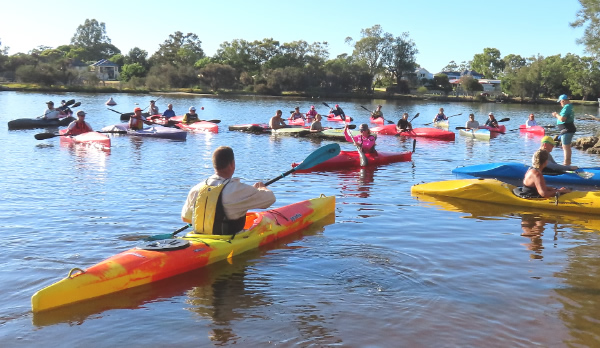
The Ascot Kayak Club Avon Descent training program will be starting soon. If you are interested put your name forward so you don't miss out.
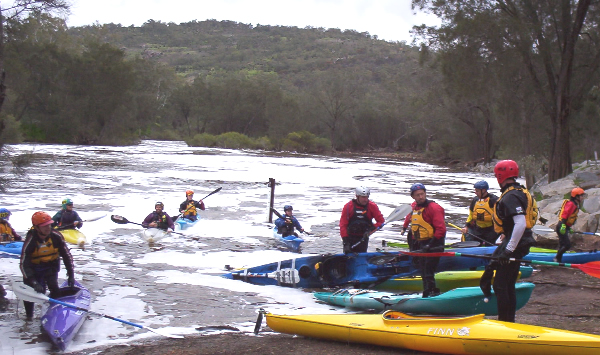
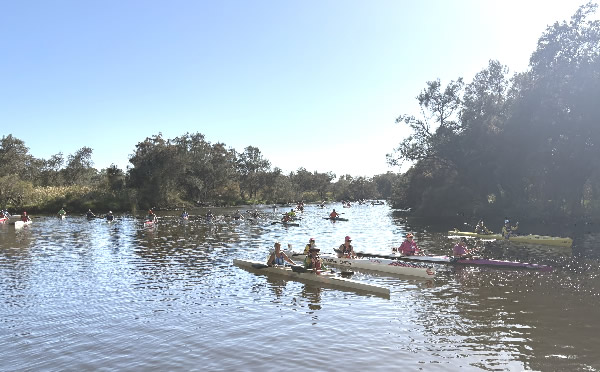
At the end of a Avon Valley paddle. Canoeing Down Under used to train up to 100 paddlers in a year to compete in the Avon Descent. I wonder where they are now?
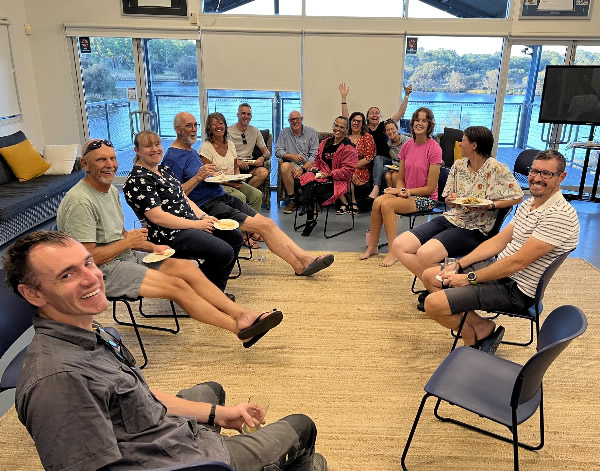
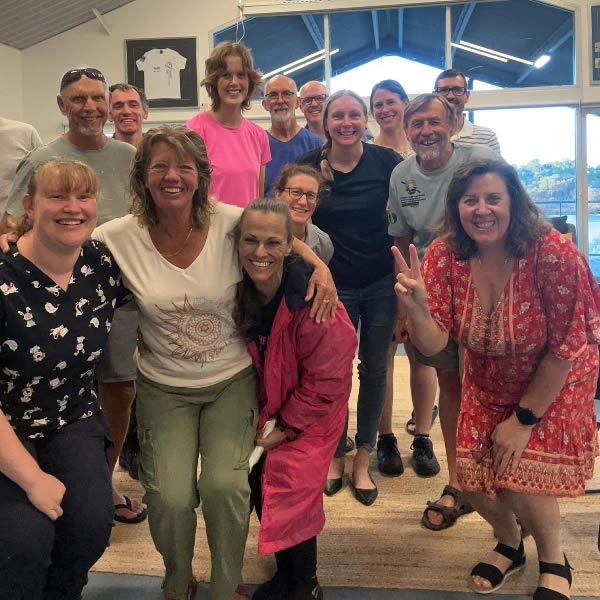
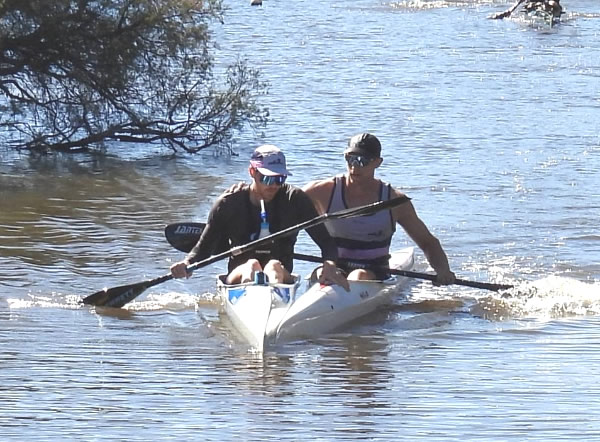
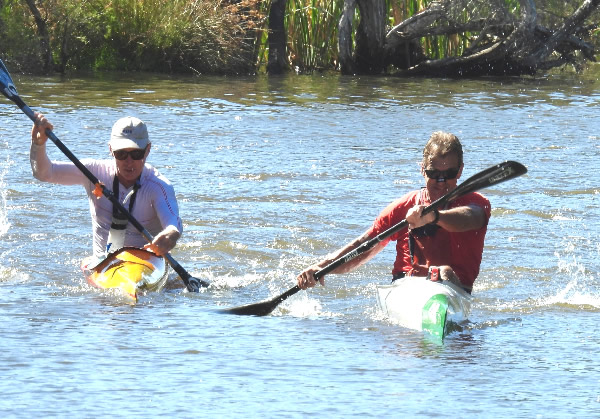
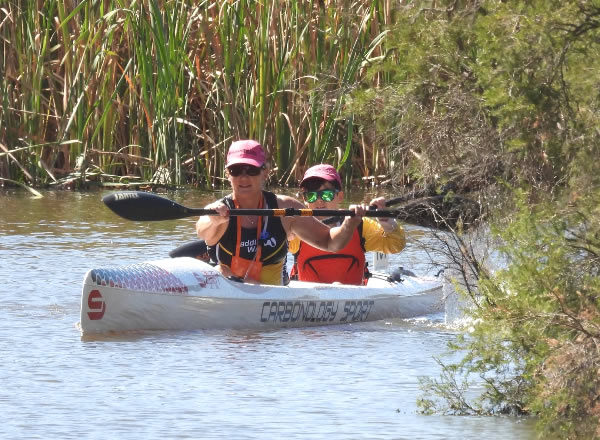
Please note these are real people and not generated by AI! Some of the Ascot Progressive Racing Group having a social gathering after training.
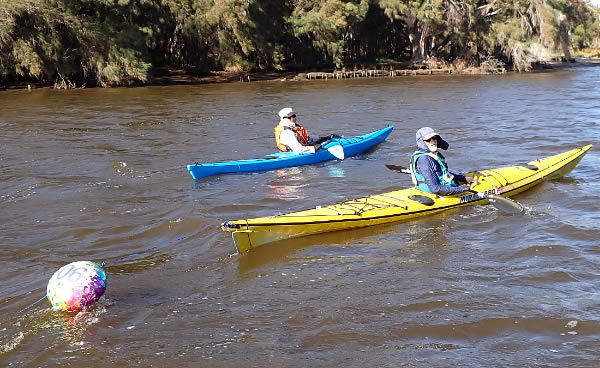
Happy 90th Birthday Wolfgang On a paddle on Tuesday I saw a group of paddlers in the distance. One kayak was towing something so I was keen to catch up to see what it was. On closer
inspection I saw it was Wolfgang and he was towing a birthday balloon with the letters 90 on it.
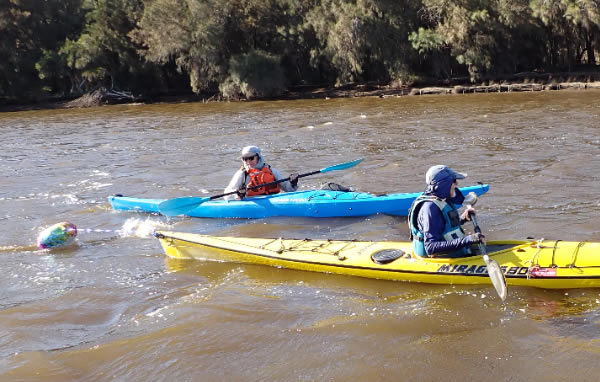
I called out to Wolfgang wishing him a happy 90th birthday. He was surprised that I knew as he hadn't realised that his mates had tied the ballon on his kayak without him realising.
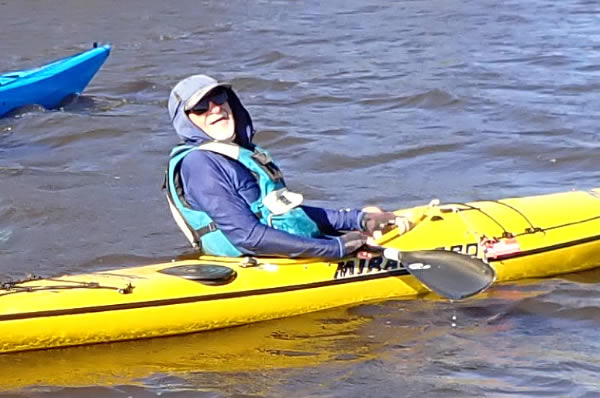
Wolfgang burst into laughter when he looked back and saw the balloon.
He said he wondered why it felt harder paddling than usual. His mate later took it off and Wolfgang's speed increased considerably. I just hope I'm as fit as he is if I manage to live till 90.
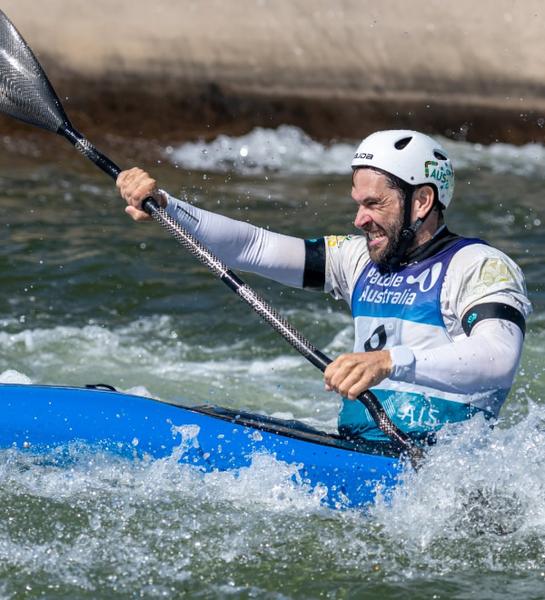
2026 Australian Open Slalom Championships Congratulations! WAs Ben Pope K1 - Gold Noemie Fox K1 - Gold
Ben Pope giving it his all.
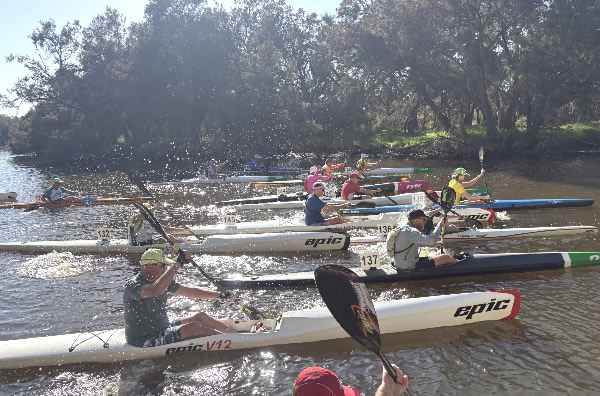
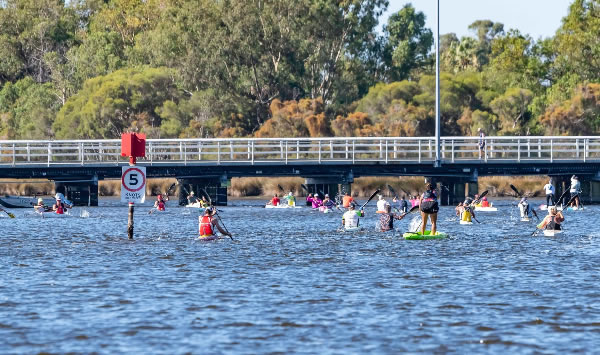
Paddlers started a 500 hundred metres downstream of the weir where the river was a little wider.
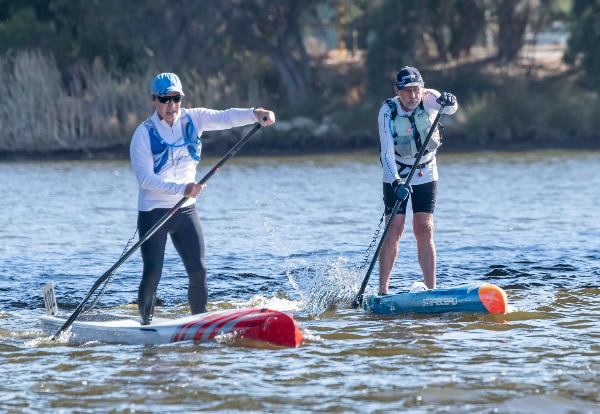
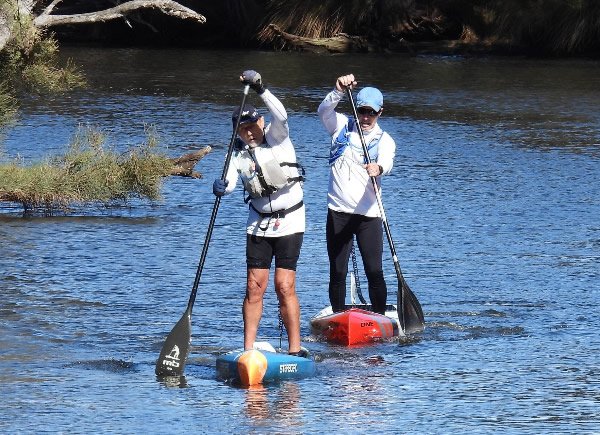
Declan and I after rounding the bridge pylons. Photo Gordon Innes.
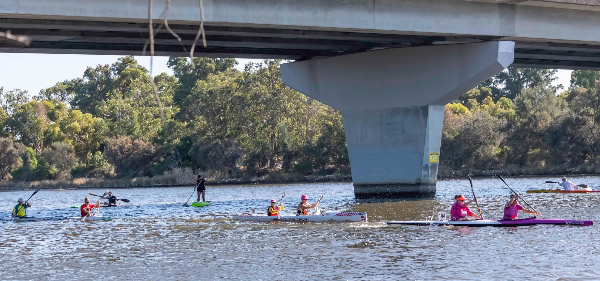
Shelley Bridge turn. A quarter of the race done. Photo Gordon Innes.
Being chased by a load of paddlers as we head back under Riverton Bridge. Photo Gordon Innes.
Approaching the weir and just under the halfway mark. I somehow managed to keep in front and beat Declan.
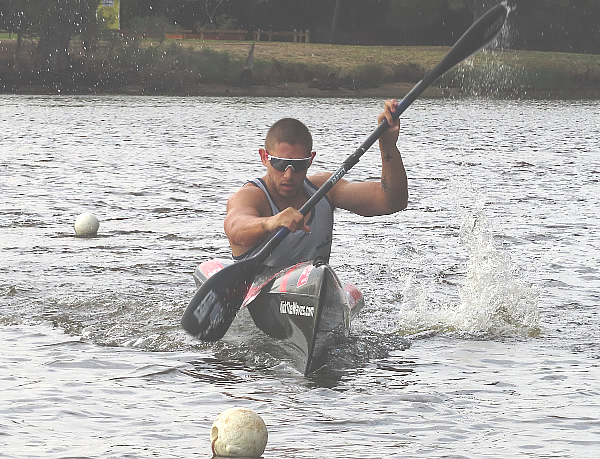
Coran Longwood and Harry Langley at the finish line. Coran beat Harry by 2 seconds and won the race. Photo Michelle Lloyd.
Grant Pepper and Dave Berglund approaching the finish line. Photo Michelle Lloyd.
Jade Lane and Will Lane. Photo Michelle Lloyd.
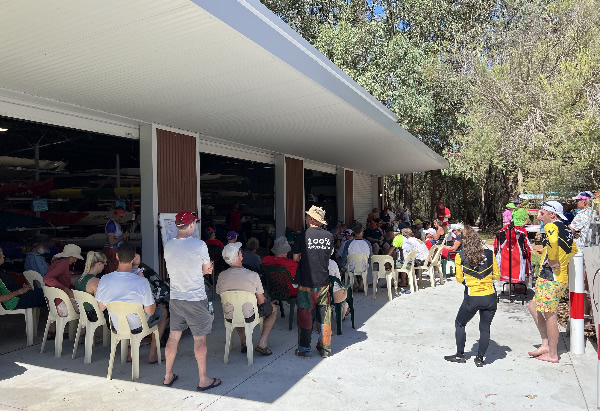
Results and prizes at the new Canning River Canoe Club - Club storage shed.
The next buoys race will be in May and the start of the winter white water series.
Harry Langley who is off to the World Wild Water Championships this winter won all the summer series races he entered.
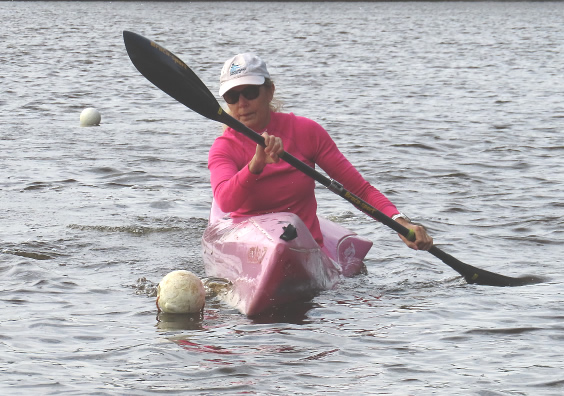
Marie Andersson female winner of Monday evenings race and several other races.
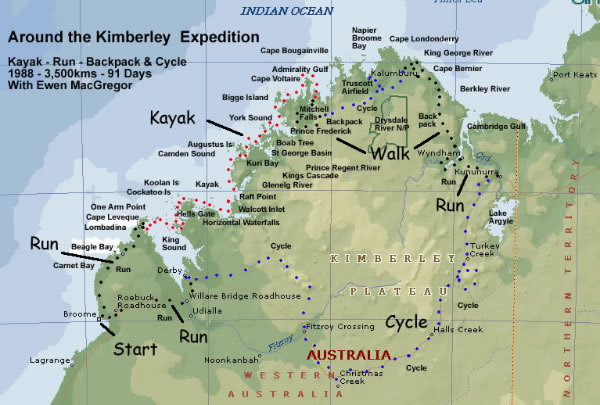
Celebrating 50 Years of Paddling Year 1988 Kimberley Kayak Expedition #5 After four expeditions in the Kimberley I was determined to plan another, bigger, better and harder expedition. My plan was to go around the Kimberley, starting and finishing at Broome, keeping to the most isolated regions and using four different disciplines: Run 445km
Kayak 700kms
Backpack 420kms
Mountain Bike 1930kms The most important objectives of the expedition were firstly
to explore the areas around the Mitchell, Hunter and Roe Rivers and secondly to retrace the movements and find material evidence of the two German aviators, Bertram and Klausmann, who became stranded along the Kimberley coast in 1932. We aimed to push ourselves to the limit, to have minimum rest days and achieve high milage over a three month period. Dreaming up such an expedition was easy. Finding
the money and companions willing to put themselves under severe pressure for three months was much harder. Eventually I convinced an experienced white water kayaker Ewen MacGregor, who had recently migrated from the UK that it would be a trip of a lifetime! Two of Ewen’s friends, Duncan Hepburn and Dennis Sproul, also from the UK agreed to be our support team. Ewen, Duncan and Dennis had no idea
where the Kimberley was and what to expect. For my part, being an Adventure Pursuits Instructor and having already completed four previous Kimberley expeditions, I was the only one who had some insight into what lay ahead of us.
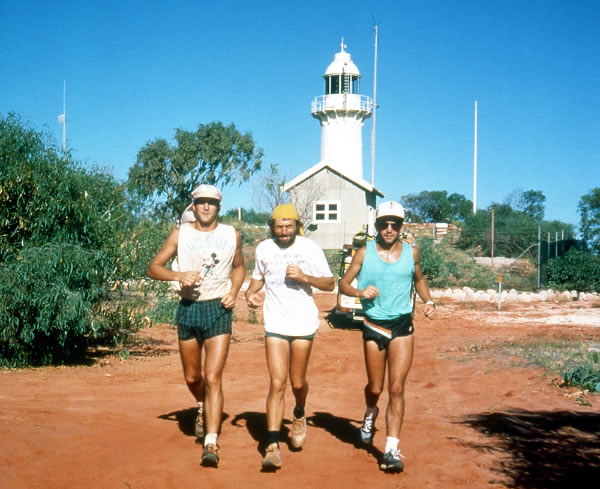
To start the Kimberley, run, kayak, backpack and cyle I ran 225 kms from Broome to Cape Leveque on dirt road. Ewen and Dennis joined me in stages. At 7.30am on 25th May 1988 in Broome, Ewen and I warmed up for a
225 kilometre run to Cape Leveque and the beginning of a gruelling 3500km challenge across rugged and unrelenting, yet magnificent, Kimberley terrain. Broome was still quiet. There was no fanfare for our departure, only Duncan and Dennis witnessed the start of our daunting marathon. By 1.30pm and in 36 degree heat, Ewen and I had run 35 kilometres along a dusty corrugated track. At our
refreshment stop we were hot, exhausted and we both sat in silence. Ewen’s pace had slowed to a stagger and by the look on his face he could collapse at any time. I broke the silence. How do you feel, I asked. I’m feeling dizzy and just feel like dying, he
muttered. This was the first day of our gruelling journey. As Ewen fell victim to the extreme heat and conditions, Dennis kept me company, running the next 40 kilometres. When it became dark it was extremely hard to run on the ruts, the corrugations and the sand patches, so we walked. The moon helped enormously as it gave us just enough light to see our feet and get our fatigued
muscles to our first nights camp. The highlight of the day was when a lady Moya Smith stopped to talk to us. I had met Moya in 1982 on my first trip. At the time Moya was learning the old traditional ways of hunting and fishing from the Aboriginals and I stayed with them for 10 days trying to learn as much as I could. The elder Aboriginals Sandy and his wife who taught Moya and myself the traditional ways were in the car with her. A thick mist in the night had dampened all our gear and when we took to the road it was like running through a tunnel of mist. When the mist disappeared with the sun the mysterious morning vanished and the birds started singing. At the 40km mark Ewen felt the full force of the scorching sun and decided to retire again. When we got close to Beagle Bay the boys drove into the community to have a look at the church with a pearl shell
alter whilst I ran on. Soon after the turn off the road deteriorated even more making the running even tougher than it was. To make matters worse we didn’t have ice or cold water so it was harder to quench my first. It had been another really hot, tough day and by 8.00pm, when it was cooler and dark I had run 80kms. My third day on the track I only had to run 65kms but I knew it was
still going to be a tough day. With the birds singing and some cattle roaming we slowly entered the heat zone and by the end of the day when the sun was setting over the quivering blue Indian ocean we arrived at the Cape Leveque lighthouse. With 225 kilometres behind us, our dream of resting under the palm trees of Cape Leveque was very welcome.
Run, kayak, backpack, mountain bike, backpack, cycle and run.
No time was lost before Ewen and I commenced our 700 kilometre ocean paddle along one of the worlds most treacherous coastlines. Tides in the King Sound are among the highest in the world, exceeding 10 metres with two high and low tides per day. Swift currents reach speeds of 12 knots in many places. The coastline is isolated and crawling with
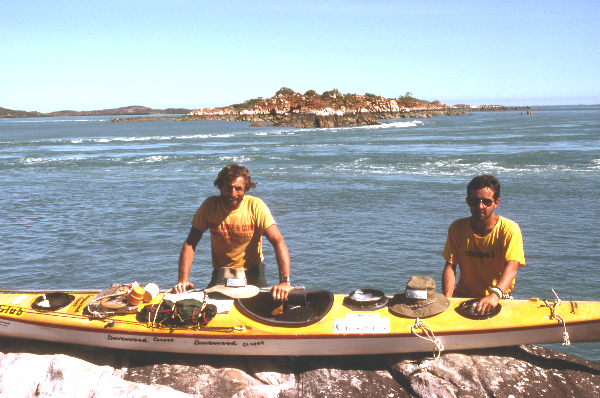
sharks and crocodiles. It was truly a wild, wondrous coastline. To reach East Sunday Island, our first camp site, we had to paddle across several swift currents between the islands. It was a good introduction to the Kimberley but being experienced white water paddlers we took the strong currents in our stride but admittedly the crossing that we had to ferry glide across were must
bigger than river ferry glides. We settled in at our campsite and planned the following days paddle. The tides were on springs which meant they were at the highest and fastest of the month so the 15km crossing was going to be a challenge. I awoke to a howling wind from the north-east and drifted in and out of slumber for the next few hours. Signs were not favourable – giant tides, fast
currents and now a gale. As we rose a red glow emerged behind Mermaid Island and finally the sun appeared to reveal massive white caps that dominated the huge expanse of water of King Sound. Swift tidal currents forged past our reef and the rocky island beyond. Conditions were far from ideal for such a treacherous crossing. For the next hour we carried our gear down the beach in
silence, lost in our own thoughts. The tedious job of loading the kayaks was completed some distance from the water’s edge as the tide was rising at an alarming rate. Every piece of equipment had its place and failure to load it correctly would mean unloading and starting again and we had little time today to do that. The silence between us continued until we were both satisfied with
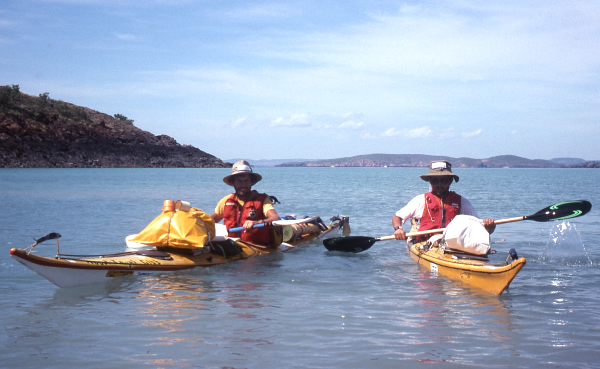
our preparation and ready to leave the safety of the shoreline. The kayaks sat deep in the water, fully loaded with 140 kilograms of camping gear, food packs, fresh water, radio, battery and solar panel. We wore buoyancy aids and survival jackets jammed with emergency equipment, including a distress beacon, flares, mask and snorkel, signalling mirror, fishing, fishing line, matches,
compass, spare food and 700mls of water. Separated from our kayaks we hoped to be self-sufficient for a few days, although water would be our biggest concern.
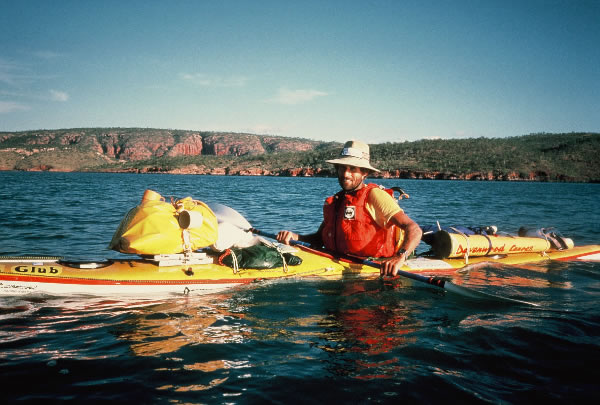
We were loaded down to the hilt.
As we rounded the lee of the island, the wind and currents created a mass of towering waves which pounded us from all directions. The ride was wild and far more difficult than handling river rapids with its safe banks on either side. A big wave hit our boats and Ewen said that he nearly went over. The further we moved from the island the calmer the
ocean became, although it still wasn’t an easy ride. We could have waited a week for the neap tide, when they create less current but it was much more exciting to cross the sound on spring tides and a much faster currents. Mermaid Island, our destination 15kms away was lost in the haze, but as we closed on the beckoning golden beach, the swift currents swept us south-ward deeper into
the open waters of the King Sound. Realising that it was an impossible task to reach Mermaid Island, we focussed our effort on Long Island which was several kilometres to the south. Failure to reach there would mean spending the night out in the open ocean drifting with the currents towards Derby, so after a short water stop we paddled as strong as we could and our efforts were eventually rewarded, although we missed Long Island and landed on Fairway Island just west of Long. This was the last
small island that we could land on before being swept into the massive open ocean of the King Sound so it was a relief to have landed. We climbed the highest hill to check out the tide and saw the swift currents fly by the island at a rapid pace. It was a sight to see. When the currents eased we jumped back in our kayaks and paddled across to Long Island to camp. As the days passed we
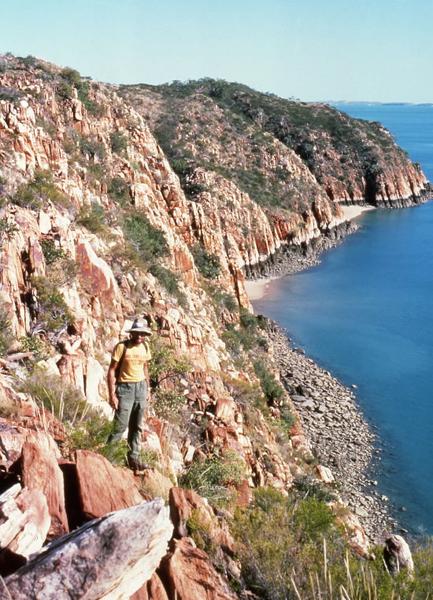
appreciated the beauty of the magnificent coastline which was indented with hundreds of bays and islands. The high cliffs, rich in colours and a variety of peculiar patterns dominated the unpredictable ocean, riddled with treacherous reefs where fish leaped in silver cascades and turtles floated peacefully in the habitat of the lurking salt water crocodiles. The grandeur of the surroundings certainly eclipsed the pain of paddling and the anxiety caused by the sharks hits, crocodiles and the
foaming rapids we had to negotiate.
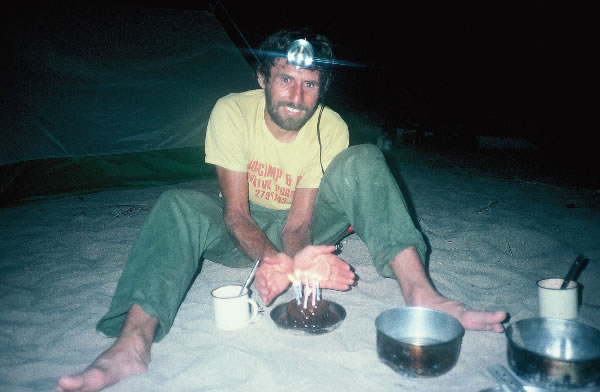
On June the 3rd intensely folded rock formations dominated our camp site and my birthday beach. I was 37 years old. Ewen a chef by trade, fished under a spectacular red patchy sky oblivious to the lurking crocs that could be watching him. In the dying light he hooked a small shark, which he cooked in garlic. Plum pudding in a rich sauce with
glowing candles followed, providing a wilderness birthday meal I will never forget.
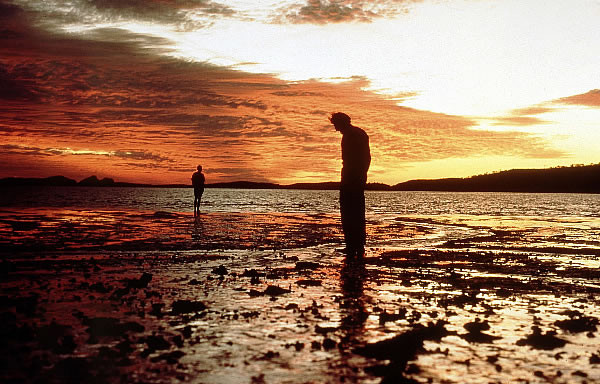
Ewen at the water's edge trying to catch a fish for my birthday meal. He caught a small shark instead.
A beach between Cockatoo and Koolan Islands. Ewen had carried a plum pudding in a rich sauce for my birthday cake. I was 37 years old.
At Koolan Island we visited our friends Lee Vernon and Norm Lindus who were holding our food packs. I first met Norm in 1983 at King George River on my second Kimberley trip. He was helping an old friend of mine Mike and his family to sail a yacht to Darwin. Then on my 1987 after stopping on Koolan Island, Lee who was a keen naturalist, invited Ken
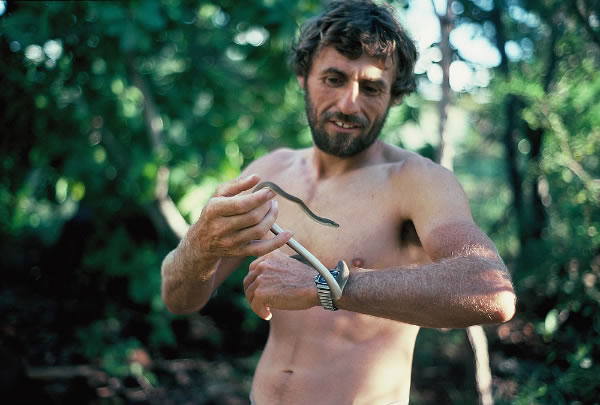
and I to drop in for dinner. When we arrived, Norm who I only met briefly 4 years earlier, greeted me at the door with a python wrapped around his neck. We were both surprised, when in conversation we realised we had met before. Since then we had kept in contact. Their home, overlooking the ocean was a haven for injured birds and animals. Two yellow throated minor birds and Dave the
dove were three of their regular visitors which flew into their home through open shutters. They were also educating the community about snakes. Preserving the animals and environment was an important part of their lives. The morning we left an olive python had made his home in one of the bird baths.
As we said goodbye to lee and Norm with kayaks jammed packed with gear, they insisted we took a freshly baked fruit cake, which Ewen fitted between his legs because we had no other place to put it. We pushed on, leaving a large colony of
white bellied sea eagles hovering and made camp further along the coast opposite the Traverse Islands. Ewen hadn’t taken the opportunity of washing in the light, and mosquitoes savaged him as he walked around in his shorts. After dark he strolled down to the beach to wash. The water was lapping gently into our cove. Nothing could be seen in the dark shadows of the ocean, so it was out of sight out of mind. When he returned to camp I politely warned him again about the dangers and crocs and to always wash away from the water, especially at night. We had only been canoeing for about ten days and it was Ewen’s first trip to the Kimberley. So far he hadn’t taken my warnings about the hostile environment too seriously, despite his kayak being hit by sharks twice already. Maybe the beautiful scenery and excitement of the trip was leading him into a false sense of
security. Small things, like infected sandfly or mosquito bites can turn into a major problem. I emphasised, taking precautions, just being in a kayak in the daylight is a risk, washing at night is suicide. As Ewen listened to the old man giving him advice, a rocket flare
near Koolan Island lit up the sky. Somebody must be in trouble but what can we do in kayaks at night. I tried my radio but couldn’t make contact, so we had to wait for the following morning to inform the authorities about somebody possibly dying out there. Our concern was not needed as there had been a flare demonstration on Koolan Island. My words of wisdom hit home the following
morning as we passed Helipad Islands on our way to Walcott Inlet. It was here a crocodile attacked Ewen’s kayak!
The coast heading towards Walcott Inlet. Loaded to the hilt.
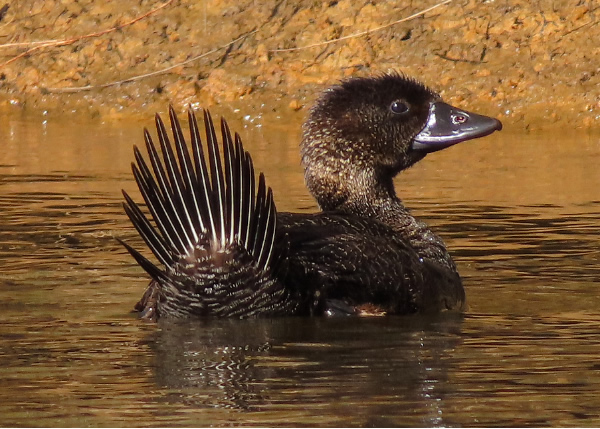
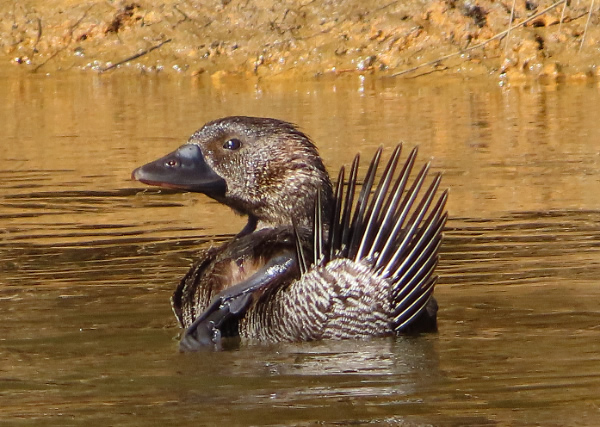
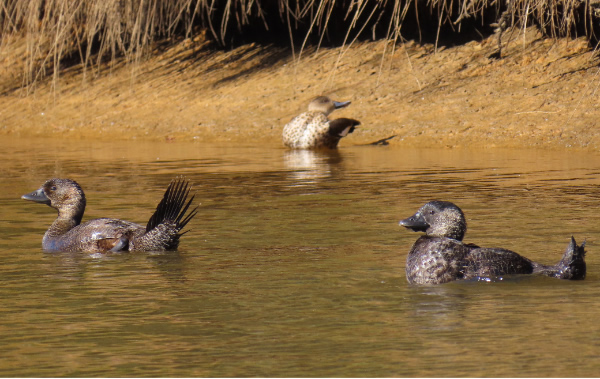
Musk Duck The male Musk Duck is the largest of Australia's ducks and has a powerful build. Musk Ducks get their name from the strong musk odour produced from a gland on the rump. The female is smaller than the
male. The male is decorated with a large bulbous lobe of skin hanging under his bill. This sac increases in size at the start of the breeding season. The female also has a much-reduced lobe on the underside of its bill, only visible at a short distance. The bill is dark grey in both sexes and the eye dark brown. The tail is a collection of long, stiff feathers, which can be held
in a fan-shape.
Musk Ducks are excellent divers, and search underwater for the majority of their food. They mainly feed on animals, including aquatic insects, crustaceans, snails, shellfish, fish, frogs and ducklings, but some seeds of aquatic plants are also eaten on occasion. The male Musk Duck has an energetic courtship display. He raises and fans the tail over the back, inflates the lobe on the throat, splashes water with vigorous kicks of his feet and throws his head back while uttering a loud whistle.
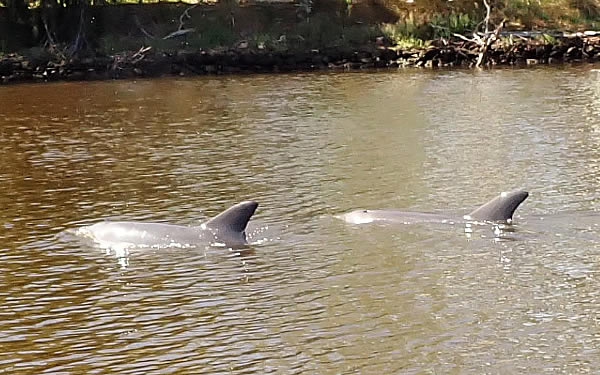
3 - 5 dolphins are still coming up river.
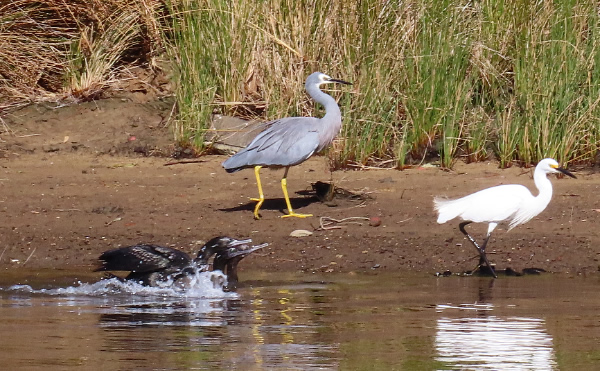
Little Black Cormorants, White Faced Heron and an Egret.
ARE YOU INTERESTED?
Ascot Kayak Club Avon Descent Training Course Basic flat water strokes Advanced flat water strokes & skills Skills for preparing for white water Fitness sessions Rolling for kayak paddlers Lectures & Lots of Advice
Equipment
Intro to moving water & white water skills More advanced white water skills on grade 2 water Avon Descent Safety and Competency Assessment & more Contact Terry Bolland 0417977330 Email: terry@canoeingdownunder.com.au
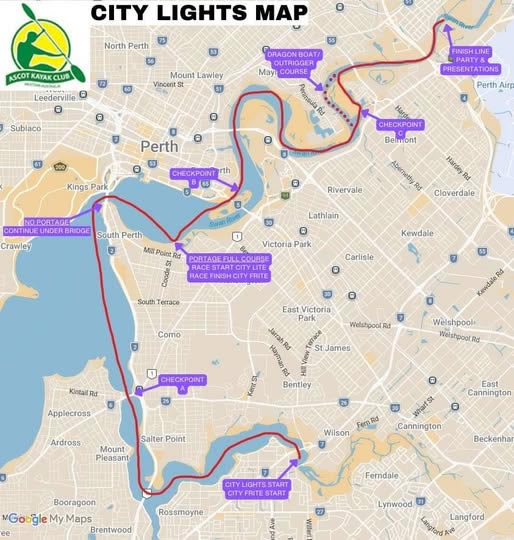
CITY LIGHTS 2026
Registrations are OPEN! Race day March 7th We have 3 amazing race options for you this year, and even more categories to give more paddlers the chance to grab some glory! Dont leave it too late to enter - there is a LOT to organise so the sooner we get
entries rolling in the better! Any Ski paddlers who find flat water a bit dull, we have the new Rough Rider (CITY FRITE) race covering the usually rough first 12km of the course - come get some! AND, finally, note that the full course portage has been moved! I know
some of you love to get smashed by wind and waves to run 5 steps at Point Belches, but most (including our volunteers) dont enjoy the experience - so - this year you will be running around Coode St Jetty - you may even see some snack choices there as you jog past - and SMILE for a photo with the City in the background! "Its not about going the furthest or fastest, its
pushing yourself outside of your comfort zone and feeling you are living life to the fullest" https://www.webscorer.com/register?raceid=420476)
2026 Paddle Australia - Canoe Sprint National Championships March 11th - 15th We wrap the season with Nationals in the West - high stakes, high energy, and the crowning event of the sprint calendar. We invite all paddlers - from juniors to elites, from Masters to first-timers - across every discipline to come together as one community. Whether you’re chasing
National Titles, looking to challenge yourself, or racing for the sheer love of it, you’ll be welcomed and celebrated. All information and entries can be found at https://regattas.paddle.org.au/
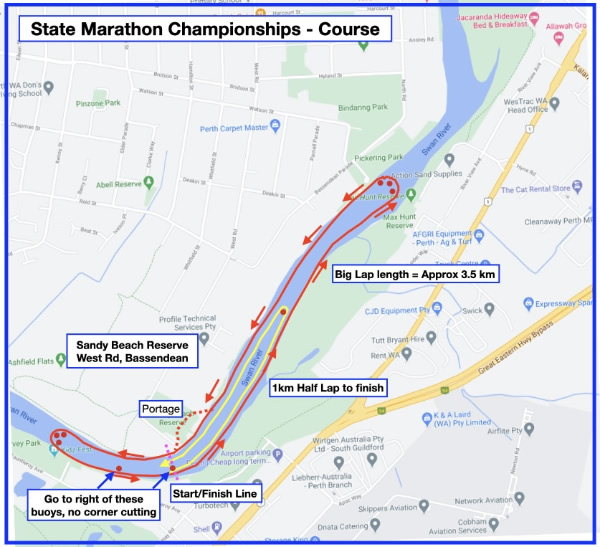
WA Canoe Marathon Championships 28th 29th March 2026 Sandy Beach, Bassendean. Great course, great portage, great eats & great coffee !!
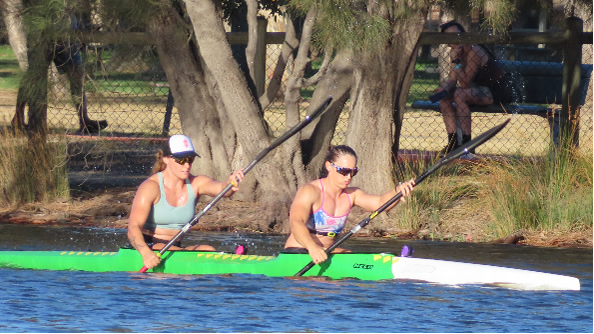
Jaime Roberts and Selma Alibegovic training on Thursday evening.
|
|
|
|
|
|
|
|
|
|