|
|
|
|
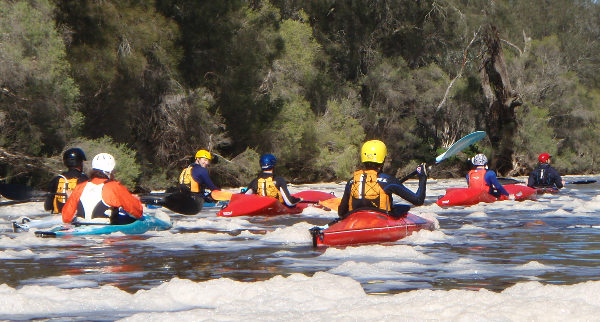
With the WA WIldwater Summer Races all but over and with the Avon Descent fast approaching I am running an Avon Descent training course for Ascot Kayak Club members. So if you are interested in taking part please let me know. A few details are at the bottom of this newsletter.
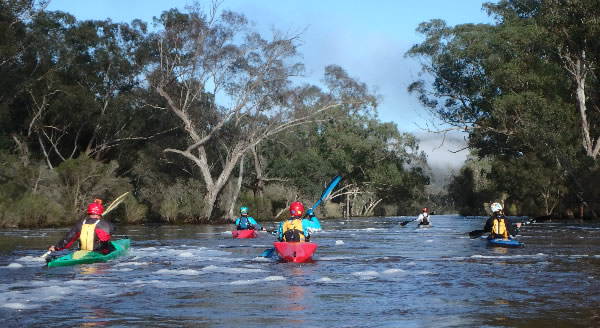
Paddling the Avon Valley.
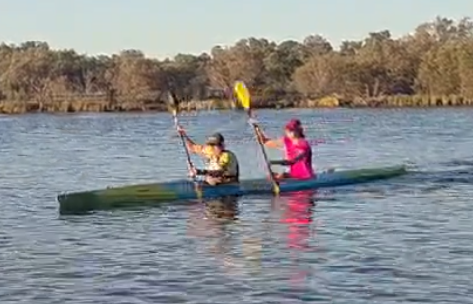
Selena Lloyd and I at the Ascot Club race Wednesday evening. We are entering the City Lights Race together. Photo Izzy Maddison
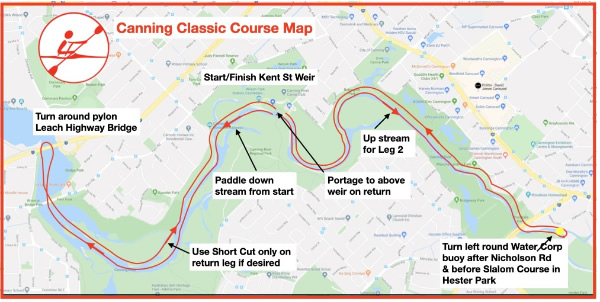
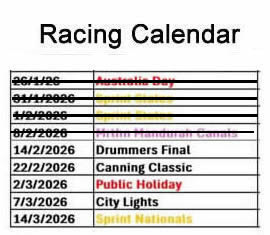
If you have forgotten about the Canning Canoe Club's, Canning River Race it is on this Sunday. See details below.
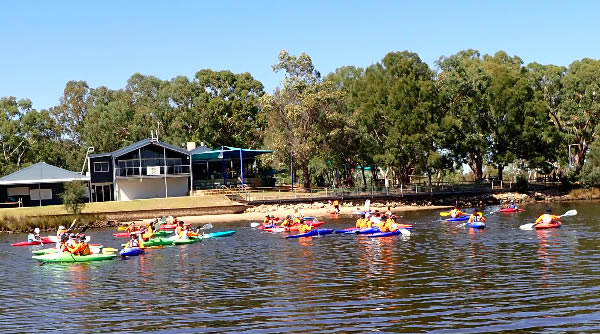
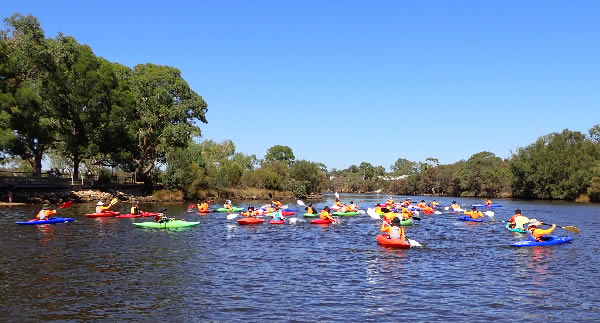
WA WildWater Summer Race The last Wildwater Summer Race will be held at Ascot Kayak Club this Monday 23rd February at 5.15 - 5.30pm time. Come along and give it a go. Suitable for beginners who can paddle a kayak without a rudder.
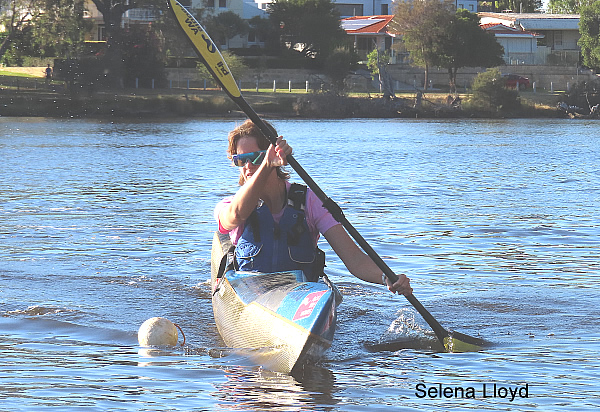
Selena Lloyd at the Wildwater buoys training.
School students having fun.
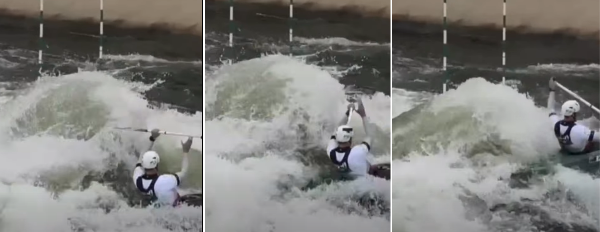
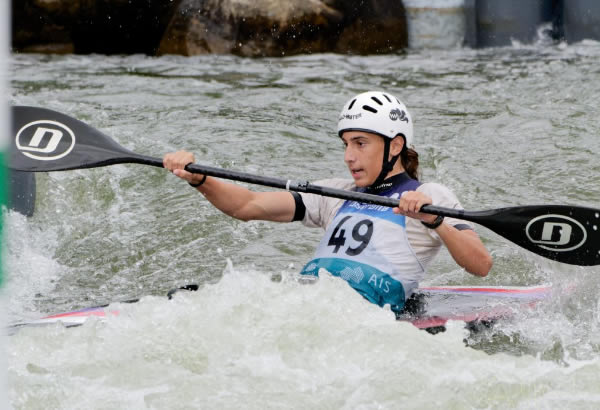
Australia's Kaylen Bassett 4th place at 2026 Penrith Open
Have a look at the first moments of Kaylen's video. And how quick he changes his paddle from his left side to his right side as he crosses the wave. I was impressed. Check out the video here:- https://www.facebook.com/reel/882693897977812
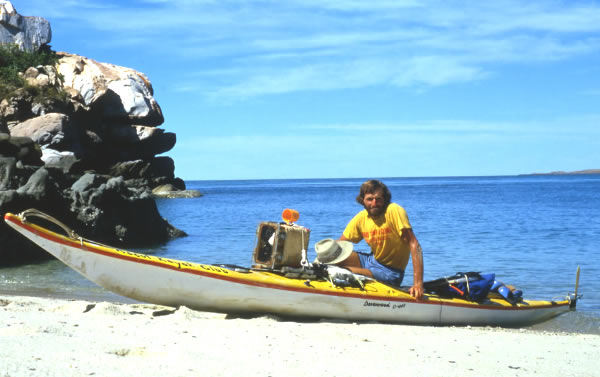
Celebrating 50 Years of Paddling Year 1987 Kimberley Kayak Expedition #4 cont.....
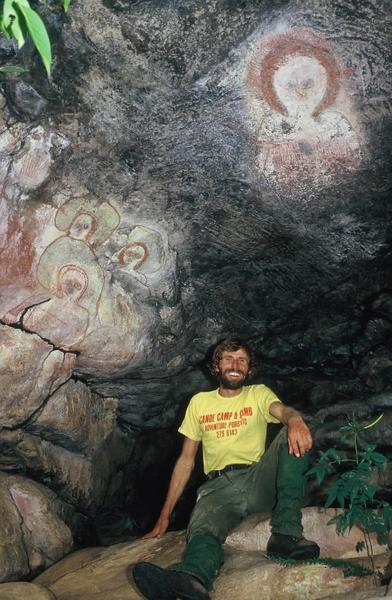
At the 26th March Cave that Grey found. We did the walk on half rations as we couldn't carry all the gear and water we had.
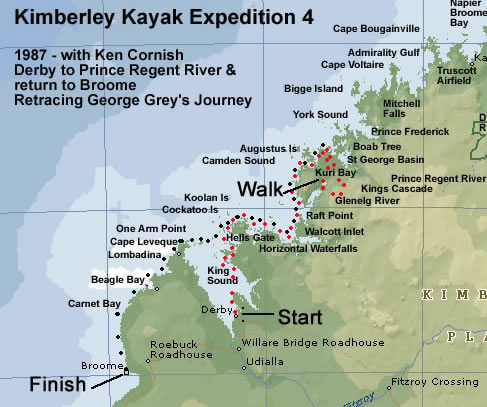
We started our journey at Derby and paddled north to the Prince Regent River, retraced George Grey's overland journey and the paddled back to Broome.
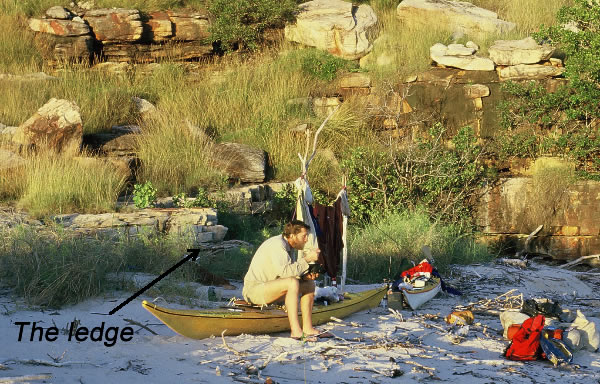
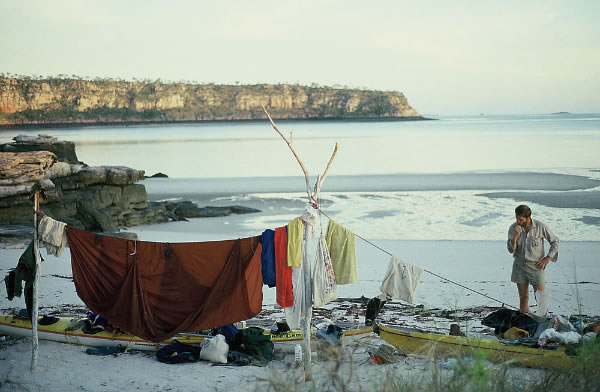
In the early morning darkness, toilet duties took me along the beach, while Ken busily hauled his gear off a rock ledge. There was a slight chill in the air and the dew had dampened the sand and grasses around me. I dug a hole in the sand and squatted and as I looked out towards the calm ocean and silhouetted cliffs, I day dreamed. A tinge of
sadness streamed through my veins at the thought of leaving these unique surroundings. It seemed hard to believe that we were the first to retrace George Grey’s 1838 inland expedition and we were at the same place as Grey was exactly 149 years to the day. Now after weeks of exhausting paddling and backpacking we only had 24 more days of paddling back to our finish destination, Broome. As I quietly gazed out over Hanover Bay, studying the stars and the faint shadows of the cliffs, my tranquillity
was suddenly shattered by a loud cry from Ken. Terry a snake has slithered up my leg, he yelled. Expecting the worst, I rushed over to Ken immediately. As I went through the snake bite procedure in my mind, I wondered if Ken had been bitten by a deadly King Brown snake common
to the area. If he had, how long did he have to live? I was hoping he was just joking, but it was no joke, I could see a huge snake coiled in a cavity below the rock ledge he was sleeping on. Ken was calm and he felt no pain or discomfort which was promising, but not knowing how long the venom takes to react did cause for concern. With my torch beam I scanned his leg. It was riddled
with scars from infected mosquito bites but I couldn’t find any snake puncture marks hidden among them. I shone my torchlight into the cavity to see a giant of a snake that looked like a non-venomous python. That was good news. Occasionally it would flicker its tongue, look me straight in my eye and probably wonder what all the fuss was about. His bulging head gave way to a slender
neck and then its body increased in size and again started decreasing nearer its tail. Its eyes looked friendly and its small but dark nostrils a few centimetres from its mouth were lightly pulsating. It looked light brown in my torchlight.
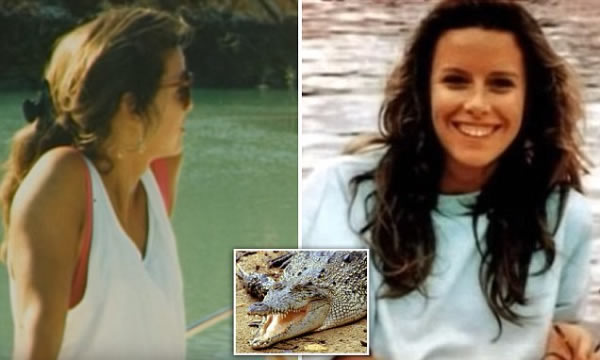
The snake that slithered up Ken's leg came out from under the ledge. Days earlier Ginger Meadows had been taken by a crocodile.
As Ken was feeling no ill effects and we couldn’t find a puncture wound, he sighed with relief. He must only have brushed against it. How lucky were we. We were way in the wilderness hundreds of kilometres from the nearest hospital and if Ken had been bitten by a poisonous snake his chances of living would have been pretty slim. As a little light started to bring life to the morning the snake started to uncoil and uncoil and then it started to slither from out of the rock cavity. Its head looked huge but its body started to stretch out and stretch out and when its whole body left the cavity it was at least 3 metres long. Time passed by and Ken suffered no ill health so within the hour we were ready to leave the shores of this unique and beautiful country and head south with fond memories of Grey’s and also our own epic overland trekking expedition in mind.
Grey left this beach 149 years ago.
We left the same beach on the same date April 15th, but 149 years later that Grey finished his expedition. As we started our three week canoe journey south we followed the cliffs to High Bluff pushing against a strong tide. Behind us was the entrance of Prince Regent River where Ginger Meadows was taken by the crocodile. Once around High Bluff we
stopped on the sandy beach which was the first beach that Grey landed on in this area, so we have been everywhere man!
We head for Kuri Bay and then towards Koolan Island.
The following day as we moved passed Becknock Island a charter boat carrying a few tourists on their way to fish up the Prince Regent River stopped and offered us a couple of beers and some nuts. One of the group said don’t I know you and when I looked carefully it was John McPhee who I had met with his wife on the Eastern Queen coming over from
Singapore about 14 years ago. Ken couldn’t believe it, he said where ever you go you seem to bump into someone you know. We arrived at Kuri Bay at lunch time so we was treated to a curried rice meal and then washed our clothes, had a shower, trimmed my beard and noticed how thin my face and body was. Luckily it was then dinner time and we were treated to a fantastic salad and an
omelette. To finish off we had some toast . Later on, back at our quarters Ken was still hungry so he made damper so we had damper and jam for supper. It was Easter Saturday and we had 2 eggs, bacon and six slices of toast. When you haven’t eaten bread for so long you just want to keep eating it. We stayed another day to check over our boats, do more cleaning and pack all our food
packs. When you have been on half rations for 22 days you just want to eat. It was Easter Saturday when we left the comforts of Kuri Bay. We had been treated like kings and we were so grateful now we had to go back to dry foods and a lot of hard paddling. So thank you the management of Kuri Bay, Bob Haddock and the hospitable people of workers.
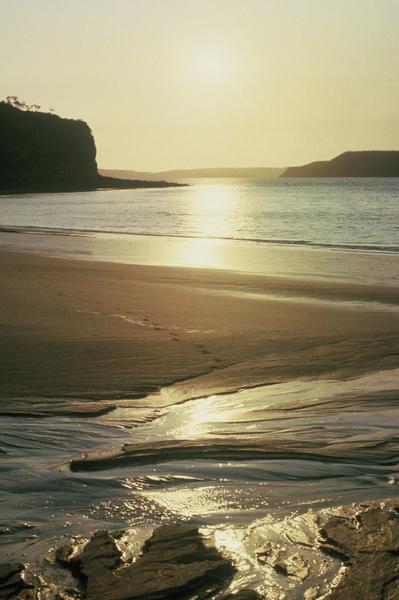
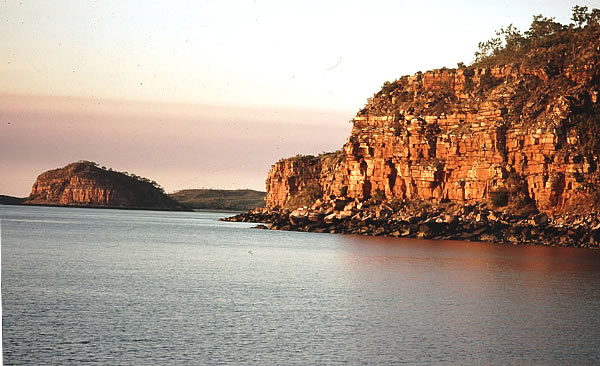
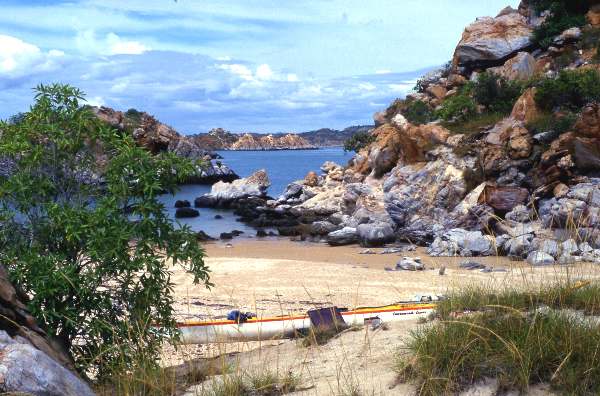
The Kimberley Coast is just full of spectacular scenery.
Just before Battery Point a crocodile started chasing us from its territory. We could do nothing but to paddle as fast as we could and although it kept up, it didn’t try to attack. Then as we were paddling to Hall Point Ken was hit by a shark so it was a good time to camp. Ken was tired when we landed and seemed to be a little moody so I kept my distance. He had been suffering from a bad back most of the trip so I don’t know if it was reoccurring. I gave him a massage or two on the way to the walk area to try to ease the pain but he wasn't keen to continue with them, even if it helped. Ken hadn't paddled every day in his training so he wasn't used to it and his back suffered. Since the walk our
ankles have been swollen, but they were slowly going down now. We landed and had nuts and raisins and later had a 4 course meal, rice, rice pudding, instant pudding and biscuits. Ken was soon snoring and what a racket. I laid back and watched the stars and a satellite whizzing across the sky. Laying there couldn’t have been better. Scrubbing our pots the following morning the vibrations attracted a crocodile which suddenly came close to our beach. I immediately moved away from the water’s edge. It perched itself in a foot of water for 40 minutes before disappearing. We took off keeping a close eye out but it wasn’t the croc that was going to test us, the tide was streaming into Doubtful Bay when we were crossing it to get to Raft Point. The current was going
faster than we could paddle so we had to do a big ferry glide. We eventually got close to the point put we were still being pushed over a kilometre into the bay. Luckily we paddled into a bit eddy and was able to slowly crawl back to the beach at the point. I was having stabbing pains in my side and Ken had hurting legs, bum and back pain so we were both having fun. A few days later we
arrived at Koolan Island and bought marmalade, cheese, chutney, fruit, chocolate biscuits some cruskets, as they didn’t have bread. We stayed at Bob’s place and the following morning Bob’s wife cooked us breakfast, bacon, eggs and toast. Then we had 3 bowls of cornflakes and to finish off with our coffee we had six biscuits each.
Ken had decided to fly home when he reached Koolan Island because of his sore back and put the kayak on a State Ship back to Perth.
Ken made the decision to return to Perth because his back was giving him hell and he had achieved his main objective, so he felt to punish his body further was unnecessary. He put his kayak on a State ship leaving Koolan Island and flew to Derby and then to Perth.
It was a bit of a blow, however I was used to paddling alone so I wasn't fazed. By 9.20am Sunday 26th April, I left Koolan Island for a 10 day solo paddle across King Sound on a 10 metre spring tide. On an overnight visit to Cockatoo Island I met with Vic Cox. Vic had lived in the Kimberley for years and had once been a crocodile shooter. He also had a big pet crocodile (if you could call it a pet) living in his back garden behind a fenced enclosure that was. Vic
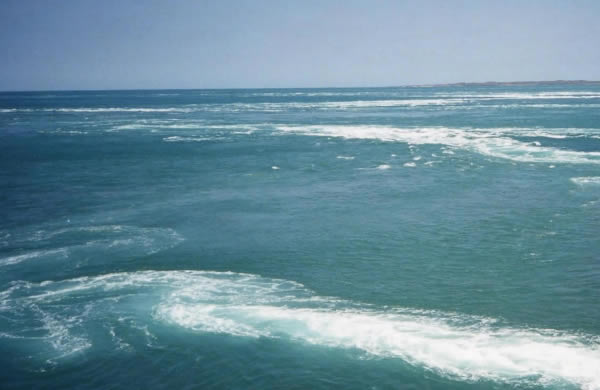
was the person who had found the American Ginger Meadows, after a crocodile attack. The police tried to find her body but failed so they called Vic to help. Vic found the body up a nearby creek under some mangroves with two arms missing. After an interesting time with Vic I crossed the dangerous currents of King sound, negotiating wild waters that are only believed if seen or
experienced. (I would need to write several more pages to relay the excitement of my incredible crossing on the biggest of tides, but unlike many other parts of the trip, unless I write a book I can only gloss over most of the experiences.) Wednesday 29th April. After looking at the currents I had something to think about. I knew it wasn't going to be easy crossing the King Sound on
the highest of spring tides. It could even be a do or die situation or a do or get washed out to sea situation, well maybe not but I would have to keep my wits about me. It was 13 kms direct from High Island and my camp to East Roe Island. I got there, but a lot happened along the way.
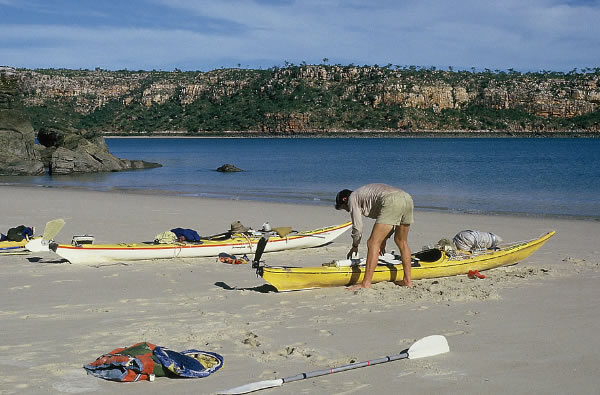
The tides were that high many of the beaches were under water.
A perfect campsite with stunning views.
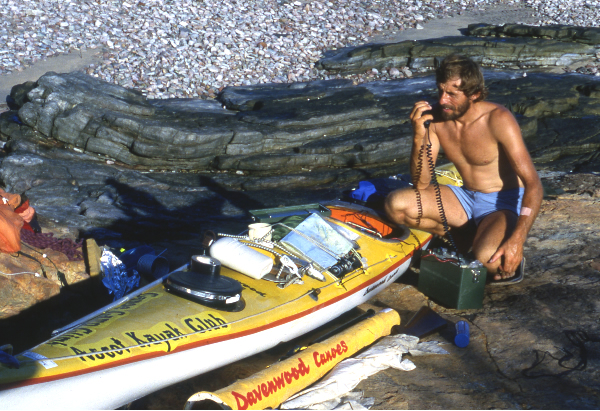
A solar panel charges my Flying Doctor Radio.
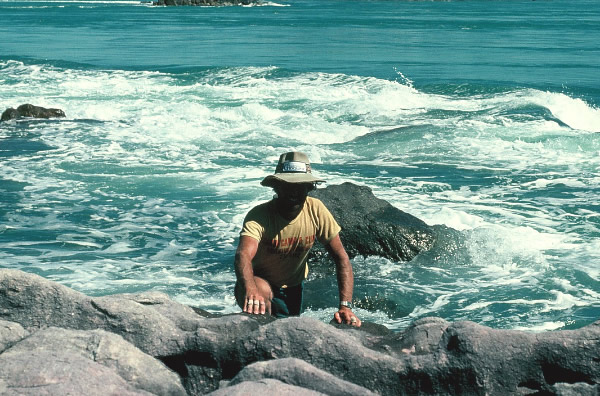
When you are tackling currents that are travelling at 3-4 times faster than you can paddle you have to be pretty confident and have good white water skills.
To get to an island on the other side of King Sound is 12 kilometres. With the fast currents it's impossible to go in a direct line.
Leaving the King Sound area, with all its bays, islands and currents it was like entering a new world as I now could follow a long coastline to Broome without the threat of being washed away. At Cape Leveque I stopped to replenish
my water supply for the last time, and was invited out for a meal that included dugong and turtle steak that had been captured by the local Aboriginals. My last 225 kilometres to Broome against a persisting current was one hell of a hard slog. Jay, the flying doctor radio operator at Derby, was still my life line to the outside world and on the last night of my 9 week expedition
I invited her to a party on a remote beach north of Broome. Unfortunately to my disappointment, she was unable to attend, so I sat there alone, looking out to sea, reflecting on yet another priceless expedition to my favourite part of the world. The next day, as the sun beat down on the lazy tourists of cable Beach, I arrived in Broome to a solitary welcome. Another expedition finished
without any fanfare.
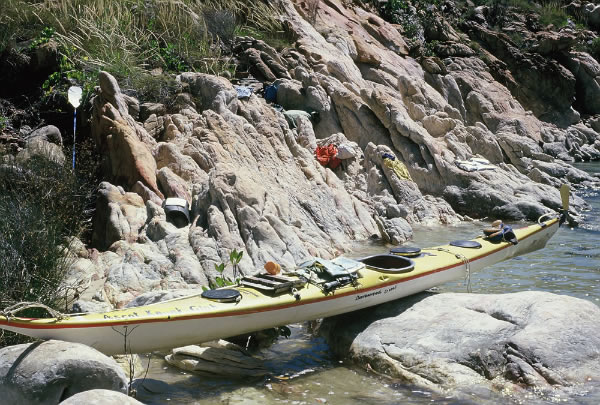
On this trip I carried a Flying Doctor Radio and made radio schedules to the base informing them of our position. It was a big item that I had to carry inside the cockpit between my knees.
A Nordkapp kayak has a very small cockpit so it was a
squeeze and it wasn't easy to get in and out.
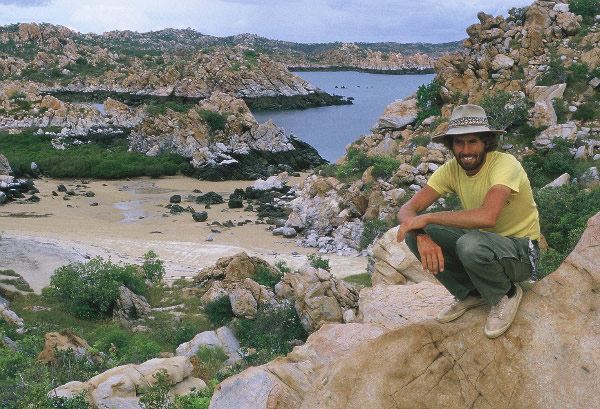
Being alone in a special place is pure magic. Seeing the Kimberley by kayak is such an amazing experience. I have paddled around the Kimberley coast 5 times as well as the Drysdale River.
And walked many kilometres inland.
Ginger Meadows The Deadly Crocodile Attack On 29th March 1987, she and her friend Jane Burchett set off to visit King's Cascade aboard a luxury boat, Lady G. The 24-year-old was from Snowmass Village in Colorado, a famous ski resort town. After their Australian adventure, they planned to continue to Papua New Guinea. The boat was operated by skipper Bruce Fitzpatrick and a small crew when it reached
the stunning yet crocodile-infested waterfall. Despite warnings against entering the water due to its dangerous inhabitants, Ginger and Jane chose to take a risk and go for a quick dip. The captain soon spotted what appeared to be a four-metre saltwater crocodile stealthily
approaching the two oblivious women. Before they could comprehend the situation, they found themselves trapped waist-deep against the waterfall's wall. Jane later recounted the terrifying events that unfolded next for Ginger, reports
"It swam right up to us and had its mouth open. Then I took my shoe off and threw it at it and hit it on the top of its head and it closed its mouth. Because the crocodile was in front of us maybe Ginger thought she could swim to the shoreline and get away," she said. However, Ginger was no match for the speed of the colossal creature and quickly found herself in a dire predicament. Jane added: "She let go of my arm, jumped off the ledge, took two strokes and it grabbed her around the waist and pulled her right under the water. Then he pulled her up out of the water right in front of me - I looked her right in
the face, she had her arms in the air and she was looking right at me. Then it pulled her back under the water." And it was gone. Her body was discovered the next day, which would have been her 25th birthday. Chief Inspector Arnold Davies of the regional police station in the Port of Broome stated that her remains were placed inside a body bag, which was positioned at the front of a
23-foot rescue boat. "After travelling 15 kilometers (9 miles) up to the mouth of the river, a large crocodile leapt out of the water about four feet and snapped the end of the body bag, trying to tear it," he reported. The boat's crew anticipated another attack by the crocodile after it vanished beneath the water, but nothing further transpired.
Penrith Whitewater Stadium February
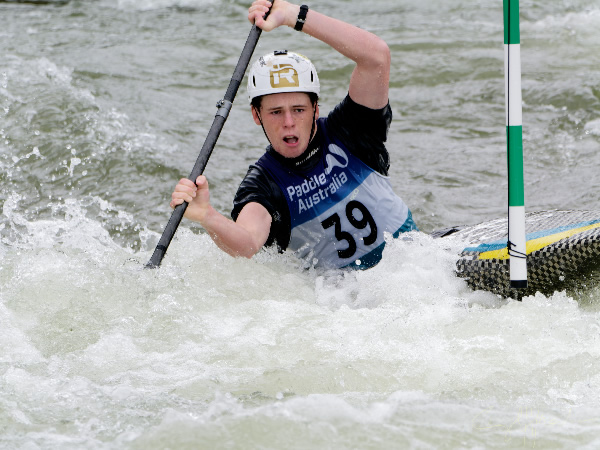
13–15 The 2026 Penrith Open once again delivered world‑class racing, attracting a deep field of international competitors alongside Australia’s top paddlers. Despite the fierce competition and challenging conditions, our WA athletes produced outstanding performances across Slalom C1, K1 and Kayak Cross, showcasing skill, resilience, and exciting potential for the season
ahead.
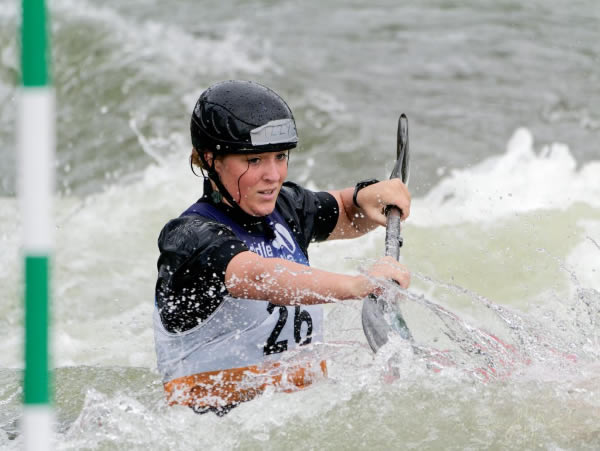
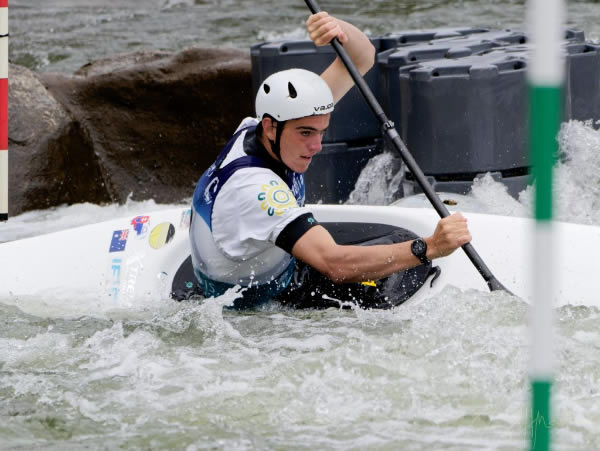
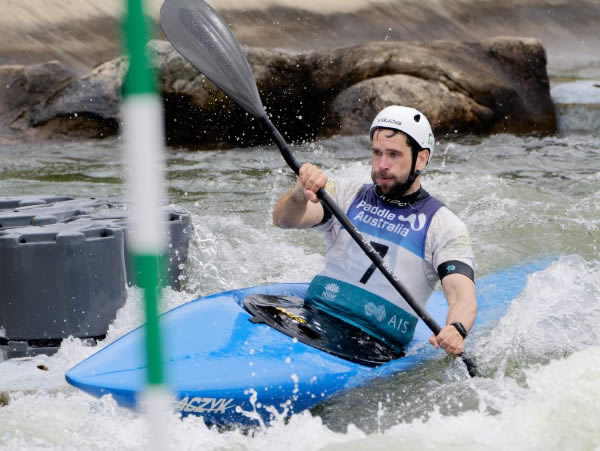
Kai Stafford Kai: 13th Australian U18 K1 - 8th Australian U18 C1 Photo Cheryl Mackie
Rhys Macrea Rhys: 5th Australian U18 K1 - 11th Australian U18 C1 Photo Cheryl Mackie
Izzy Florisson 2nd‑placed Australian U18 C1 - 1st Australian U18 K1. Photo Cheryl Mackie
Hunter Florisson Ranked 6th Australian U23 C1, - 7th‑ranked Australian U23 K1, Photo Cheryl Mackie
Ben Pope Ranked 5th Australian K1 open. Photo Cheryl
Mackie
Against a fiercely talented international field, Western Australia’s athletes delivered standout performances, personal bests, and podium finishes across events. From Izzy’s dual U18 successes to Rhys’s Kayak Cross victory and Ben’s top‑ten K1 result, the 2026 Penrith Open was a powerful testament to WA’s growing depth and high‑performance
potential. Source Paddle WA.
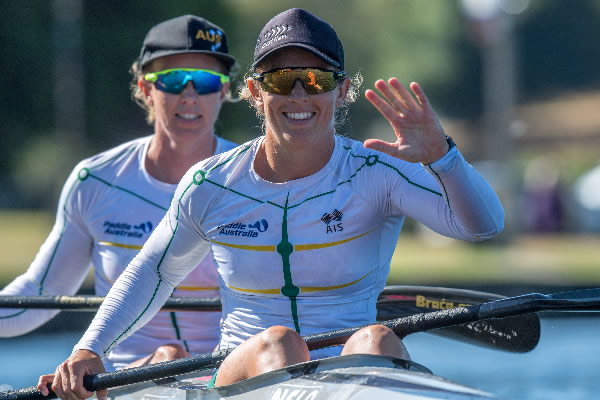
Jaime Roberts Tokyo Olympian In 2012, Jaime Roberts was crowned WA state ski champion in surf lifesaving and switched to flat-water paddling the following year. She was inspired to aim for the Olympics after listening to the radio call of the Australian men’s K4 1000 gold medal-winning race at London 2012. “I was driving a truck on a mine site up in the Pilbara… it was such an exciting few minutes that finished with the men crossing the line first. From that moment onwards, I decided to give
kayaking a crack and see if I could make it to the Olympic Games,” Jaime said. Jaime was noticed by the Western Australian Institute of Sport Head Coach at the 2013 WA State Kayaking Championships, and this put her on a path to success. In 2014 she
represented Australia at the elite level for the first time, competing at the World Cup and World Championships. An Australian Surf Life Saving Championships finalist in ski events, Jaime represents the Mullaloo SLSC and has also represented Australia at the Lifesaving World Championships. Between 2017-2019 she was named on the Australian Canoe Sprint Team racing in both the K2 and K4 events.
At the 2019 World Championships, Jaime joined forces with Olympians Aly Bull, Alyce Wood (nee Burnett) and Jo Brigden-Jones to secure Australia four quota positions for the Tokyo Olympics after qualifying the K4 with a seventh place in the final. Jaime realised her Olympic dream after she won K2 500 silver (with Brigden-Jones) and finished sixth in the K1 500 at the 2020 Australian Canoe Sprint Championships. Jaime graduated University with a degree in mining engineering, has a graduate diploma in education and a certificate 3 & 4 in fitness teacher. When she isn’t paddling, Jaime is a casual
high school teacher. Jamie made her Olympic debut at the delayed Tokyo 2020 games, in the Women's K-4 500m and K-2 500m disciplines. Paddling alongside her in the K-4 event were fellow Australians; Cat McArthur, Jo Brigden-Jones and Shannon
Reynolds. The squad would remain competitive in the first two stages of the event, with advancements to the quarter and then semi-finals, with a best time of 1:36.407. In their semi-final race, they would edge off France to keep their medal hopes alive and advance to the A Finals. There they would achieve a time of 1:39.797, and an overall 7th placing at the
event. Nowadays you can still catch Jaime, who is always chatty and has a big smile on her face as she paddles by on a kayak or a ski.
******************************
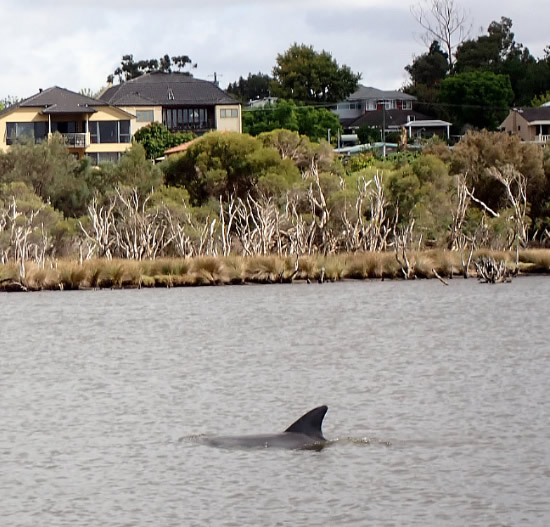
The dolphins are still up-river this week.
ARE YOU INTERESTED?
Ascot Kayak Club Avon Descent Training Course Basic flat water strokes Advanced flat water strokes & skills Skills for preparing for white water Fitness sessions Rolling for kayak paddlers Lectures & Lots of Advice
Equipment
Intro to moving water & white water skills More advanced white water skills on grade 2 water Avon Descent Safety and Competency Assessment & more Contact Terry Bolland 0417977330 Email:
terry@canoeingdownunder.com.au
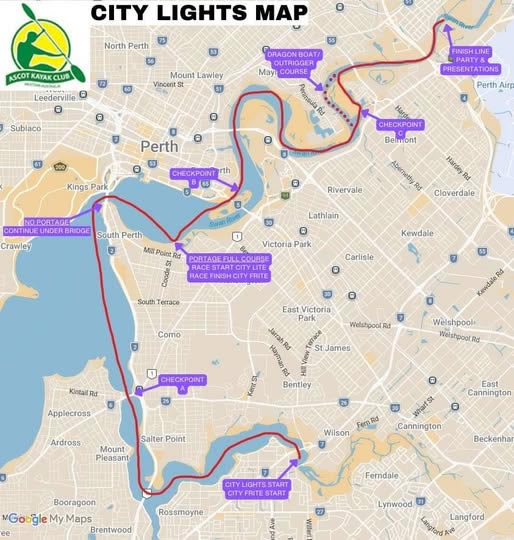
CITY LIGHTS 2026
Registrations are OPEN! Race day March 7th We have 3 amazing race options for you this year, and even more categories to give more paddlers the chance to grab some glory! Dont leave it too late to enter - there is a LOT to organise so the sooner we get
entries rolling in the better! Any Ski paddlers who find flat water a bit dull, we have the new Rough Rider (CITY FRITE) race covering the usually rough first 12km of the course - come get some! AND, finally, note that the full course portage has been moved! I know
some of you love to get smashed by wind and waves to run 5 steps at Point Belches, but most (including our volunteers) dont enjoy the experience - so - this year you will be running around Coode St Jetty - you may even see some snack choices there as you jog past - and SMILE for a photo with the City in the background! "Its not about going the furthest or fastest, its
pushing yourself outside of your comfort zone and feeling you are living life to the fullest" https://www.webscorer.com/register?raceid=420476)
WA Canoe Marathon Championships 28th 29th March 2026 Sandy Beach, Bassendean.
The 2026 Paddle Australia Canoe Marathon Championships will be held from Friday, 10 April to Monday, 13 April 2026.
The event will take place at Molonglo Reach in Canberra, Australian Capital Territory (ACT), hosted in
conjunction with the Burley Griffin Canoe Club.
The 2026 Paddle Australia SUP National Championships will be held from 9–11 April 2026 at the Burley Griffin Canoe Club in Canberra, ACT. This event includes sprint, technical, and distance SUP racing. Note that the related Paddle Australia Canoe Marathon Championships occur from 10–13 April 2026 at the same venue. Key details: - Location: Molonglo River, Canberra.
- Dates: 9-11 April 2026.
Training open on the 8th.
|
|
|
|
|
|
|
|
|
|