|
|
|
|
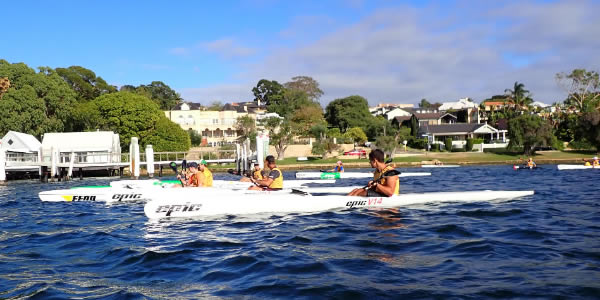
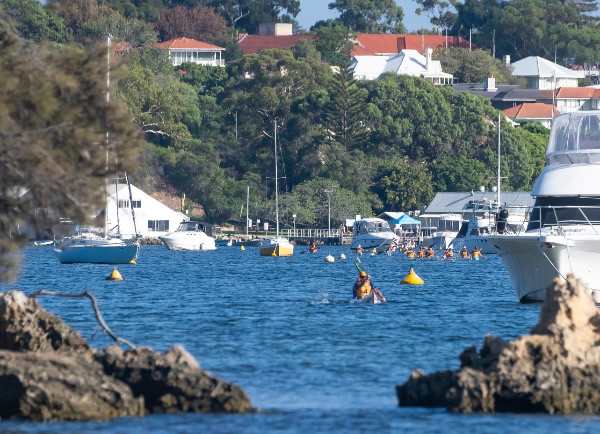
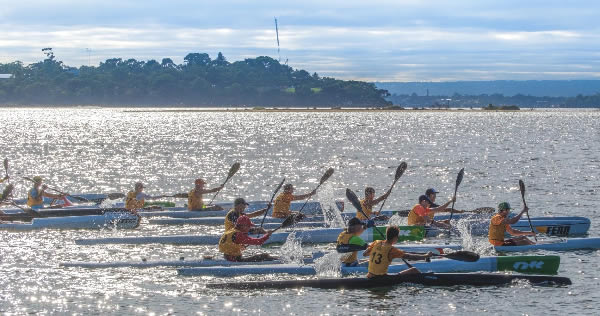
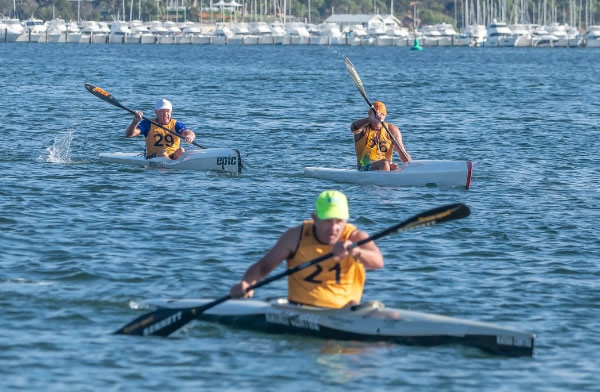
My Avon Descent course is going extremely well with some very keen paddlers wanting to make sure they have the advanced flatwater skills before heading into white water. And it appears with the cyclone coming down the coast the white water won't be far away.
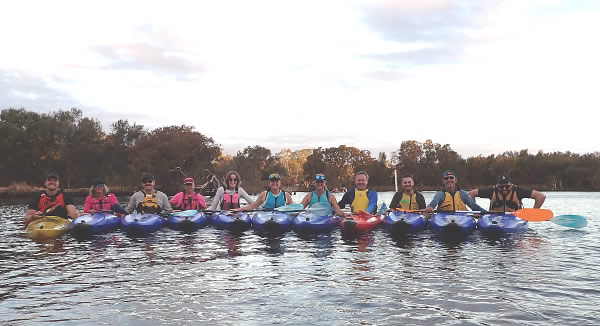
11 of the 18 paddlers who are doing my Avon Descent training course.
Coming Events WA Canoe Marathon Championships Due to the cyclone racing on Saturday has been cancelled. Singles are Now on Sunday 29th March 2026 Sandy Beach,
Bassendean. ****************** Easter 3rd - 6th April ****************** Australian Canoe Marathon Championships 10-13 April in Canberra. https://www.webscorer.com/register?raceid=413527... ****************** John Sims Race 19th April 2026
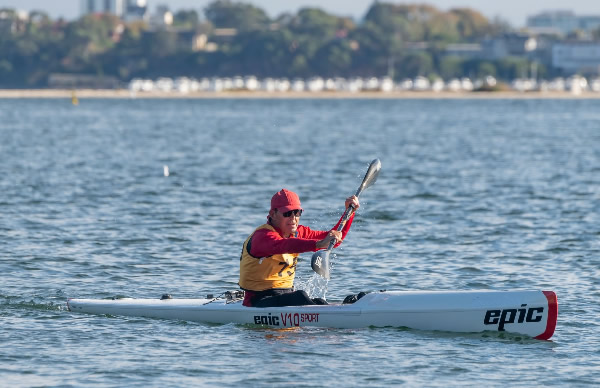
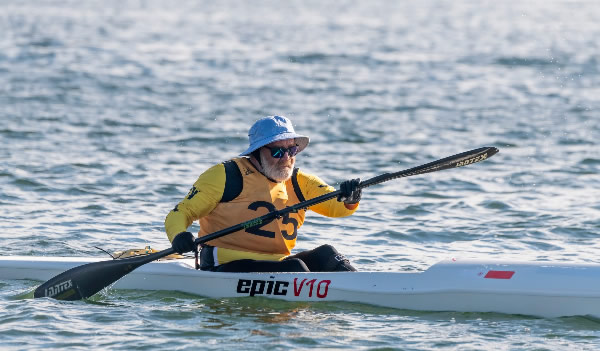
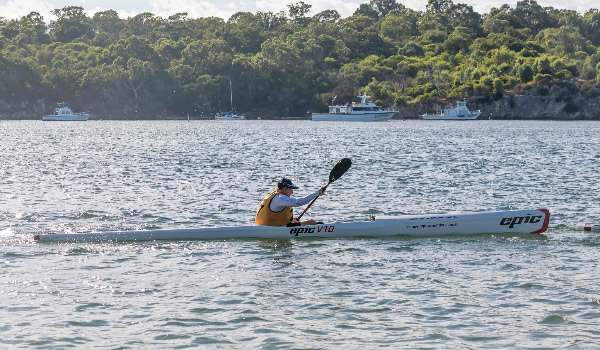
It was a near perfect day. I have raced the Rod Fry Race in a C1, an open double canoe, a double Epic ski and today I was using my Epic V10. Robin Jacob and Doug Hodson were my main opposition. Ron Clarke would be as well as he is my age
but I have never beaten him on a ski before and although he has had a few injuries that might slow him down, he is still really fast and I don’t expect he will wait for me. The doubles took off first then it was my group, all the male skis. Murray Latham who is 73 sat to my left with Ron 75 to my right. The start line was a bit of a squeeze but we managed to take off without incident
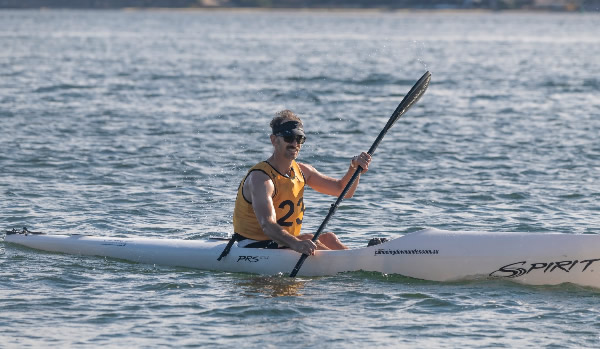
because Murray and Ron shot out of the blocks like superman and left me behind with a lot of space! Robin was well over to my left and Doug was well over to my right. Both were slightly ahead. By the time I paddled 50 metres I could see I was the last one in my group. I even saw Murray Cox in a heavy plastic Spirit PRS ahead of me and Murray hadn’t been paddling long.
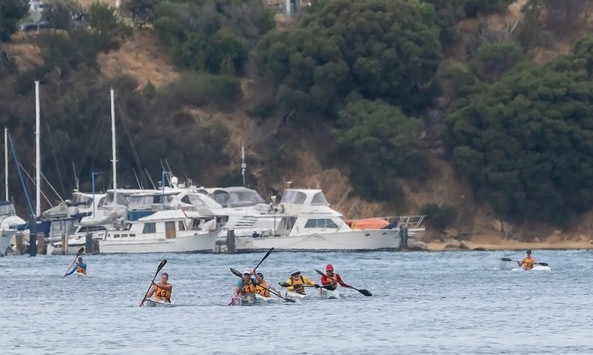
The race gets underway. Photo Gordon Innes
John Hilton, Warren Southwell and Ron Clarke. Photo Gordon Innes
A few hundred metres before Chidley Point, which was quite crowded with race spotters, people and the odd fisherman I converged with Robin. Being up with Robin gave me some hope of keeping up even if I was on his tail, but Doug and Murray were further ahead and Ron and Murray were well gone, never to be seen again. Even before we got to Point Roe, the next right turn and shallow spot in the river Natasha Leaversuch who left about 2 minutes behind said, hi Terry as she flew by like a Concorde passing a Cessna aircraft. My concentration was squarely on Robin though and not letting him get away and hoping he would be trying to catch Doug and taking me with him. A little happiness came to me when we passed Murray as we crossed Point
Roe shallows. Apparently he got slowed when he hit a rock with his rudder. At Point Preston, just after the Swan Yacht Club the incoming tide got stronger and a couple of big boats came through leaving some big waves which slowed Robin down and gave me an opportunity to pass him. I don’t think Robin enjoyed me being in the lead so it didn’t take him long to come up beside me once the
waves had gone.
Doug Hodson ahead of me. Photo Gordon Innes
Murray Cox in a Spirit PRS was also in front of me. In fact I think everyone in my grid was in front of me! Photo Gordon Innes
As we closed in to Chidley Point corner I managed to converge with Robin and get on his tail. Photo Gordon Innes
I couldn't let Robin get away. Photo Gordon Innes
Natasha Leaversuch passed me like I was standing still.
She ended up being the 7th single over the line. Photo
Gordon Innes
Nearing the turn point at Fremantle Bridge the water shallowed and as we turned the tide was in our favour. However instead of going out into the middle of the river to take advantage of the faster water Robin kept closer in. I then had a choice to dare and leave him by heading into the centre of the river to take advantage of the current or keep
tailing him. I decided to keep with him. Robin was still aware that he hadn’t shaken me and kept doing sprints when I was in la-la land thinking about other things. Although he kept leaving me behind I always caught up when I sprinted after him. He sprinted several times and at one point I thought of letting him go and take an easier paddle back but I just couldn’t. Nearing Point Roe on the way back we were getting closer to Doug. I let Robin go when he started to paddle closer to shore. A few minutes later he changed tack, crossed my path and headed out into deeper, faster water where Doug was paddling. I took the risk and took a shorter path across shallows at the point and in doing so I managed to get in front of Robin and Doug. Although I was happy to be
ahead, I knew they wouldn’t let me get too far away. Soon after Anne Harris and Aurora Leaversuch started to pass, Anne on my left and Aurora on my right with Robin on Aurora's wash so the race was back on. Anne and Aurora then put the pressure on forcing Robin to drop back a little but I managed to keep on their second wave and lose sight of Robin. I didn't know how far back he
was though.
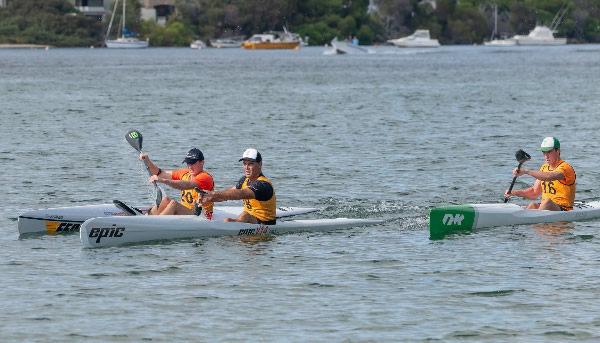
The leaders, Harry Hewitt 1st, Travis England 3rd, & Charlie Hewitt 2nd. Photo Gordon Innes
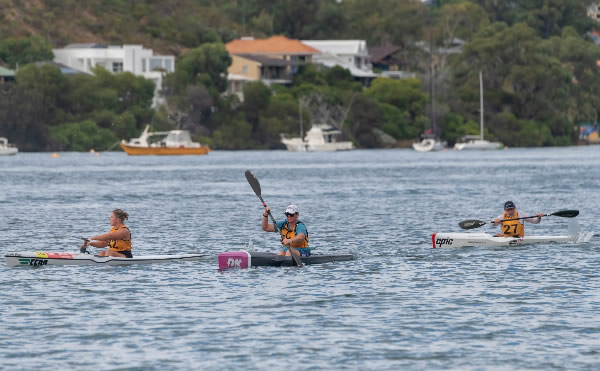
Anne & Aurora pass Robin, Doug and I. Photo Gordon Innes
I managed to keep close for a while. Photo Gordon Innes
I managed to stay a couple of boat lengths behind Anne and Aurora for a while but soon started to lose them but at Chidley Point they took the safer deep water turn and I cut the corner in the shallows and caught back up to them. I managed to stay with them for a few hundred metres, but eventually they lost me. At this point I just had a kilometre to go to the finish line and after a sneaky look over my shoulder I saw that Robin and Doug were further back than I had imagined so I just had to keep up a good pace to beat them. I knew they wouldn’t give up though so I couldn’t really relax, but lucky for me I crossed the finish line before them a happy chappy. I was 15 seconds ahead of Doug and 17 seconds
ahead of Robin. The hardest part of the race was carrying my ski back up the hill but I was rewarded at prize giving with some of the best home made food you will ever taste. Swan Canoe Club know how to put on a great spread. Results
here:-
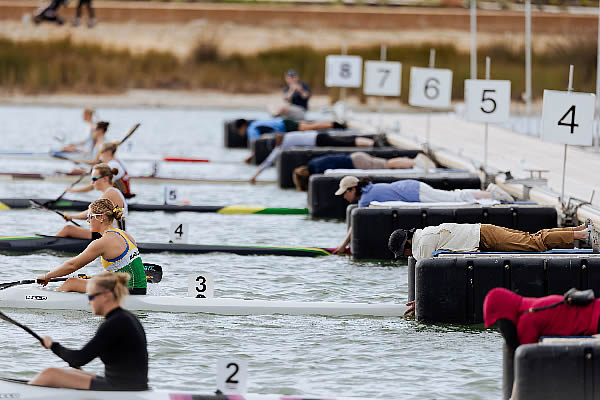
Australian Sprint Championships, Perth
Boat holders lie down and adjust the kayak so all paddlers are in a straight line. This can be difficult when there is a strong side wind, which there was.
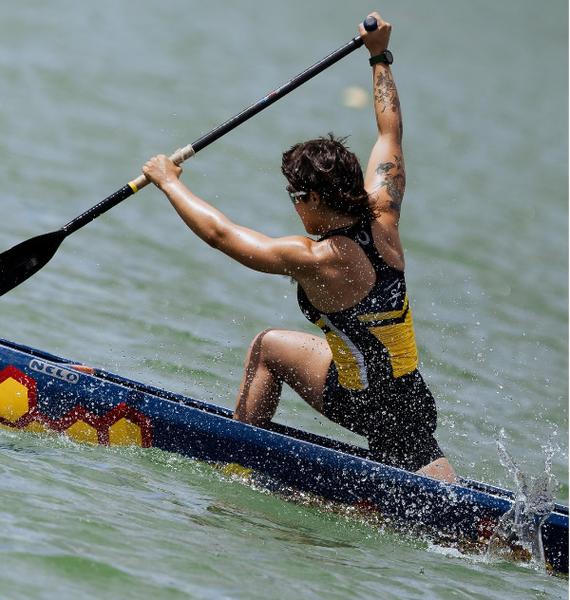
Local WA Canoe paddler Gen Stanley at the championships.
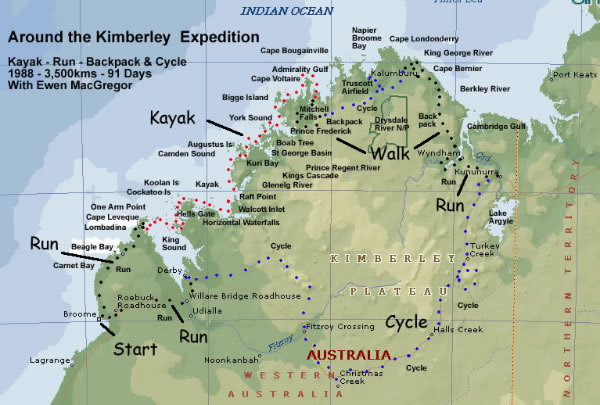
Celebrating 50 Years of Paddling Year 1988 Kimberley Kayak Expedition #5
Run, Kayak, Backpack, Mountain Bike, Backpack, (Retrace Bertram & Klausmann), Backpack, Mountain Bike, Run, Cycle and Run.
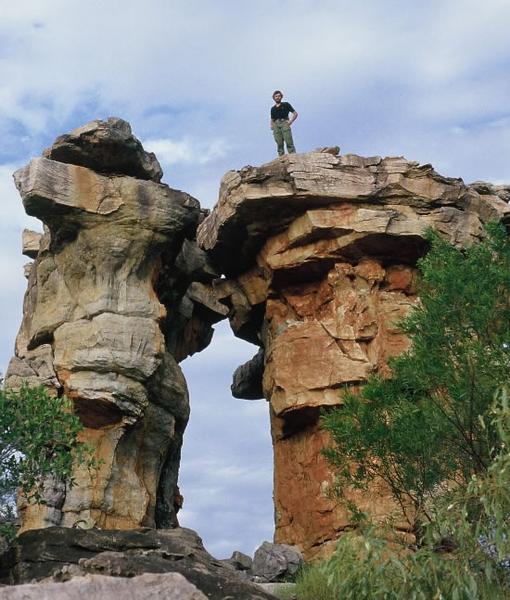
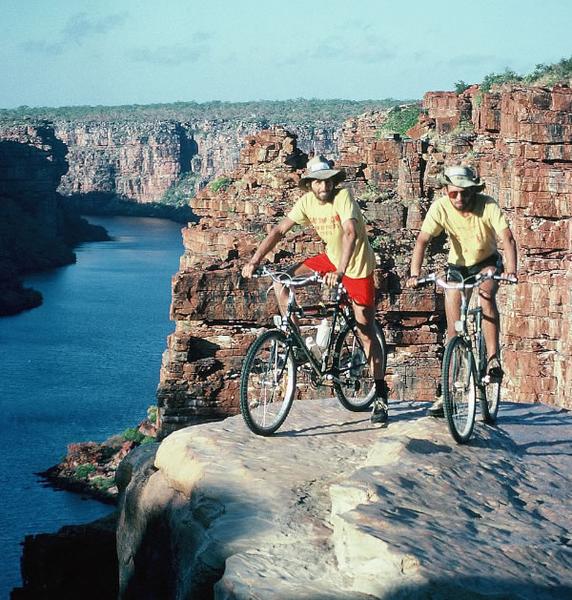
I just had to climb up for a photo.
With our arduous thirteen day walk finished Ewen and I jumped on our mountain bikes and cycled 450kms over deteriorated tracks towards the King George Falls, detouring 50 kilometres to buy an ice cream at Kalumburu Mission. The track leading into King George Falls is rarely used so for 200 kilometres we bounced over boulders, dodged rocks and sank
pedal deep into soft sand. Small trees growing in the middle of the track were fortresses for green ants. To disturb them was fatal as their nippers sank deeply into our flesh. Sweet revenge was to brush them off further along the track and give them a long walk home.
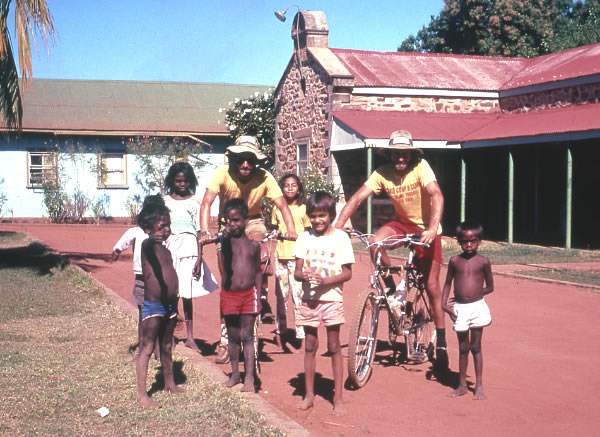
We detoured 50 kilometres to Kalumburu for an ice cream. I had paddled into Kalumburu on my 1983 trip.
With Ewen nursing a buckled wheel due to a branch getting in his spokes, we arrived at King George Falls. The dry season denied us the beauty of a huge amount of water from tumbling majestically into the glistening saltwater river below but we were treated to massive 80 metre vertical sandstone cliffs that extended 12 kilometres to the Timor Sea.
In the distance a few wisps of smoke from a recent bushfire hovered in the cloudless sky. It was a stunning scene.
It was just amazing to have cycled into King George Falls.
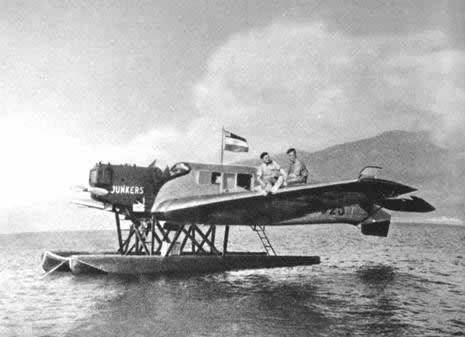
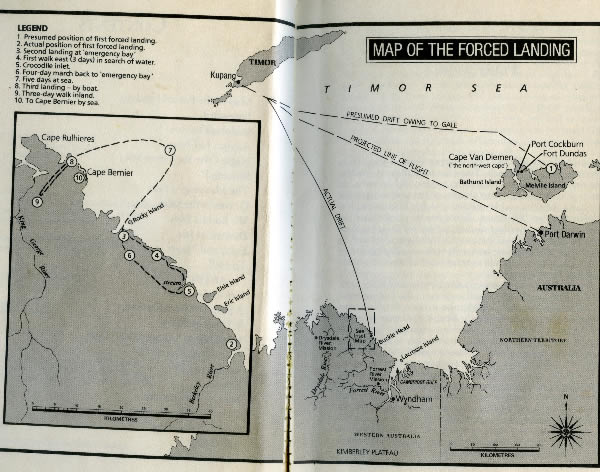
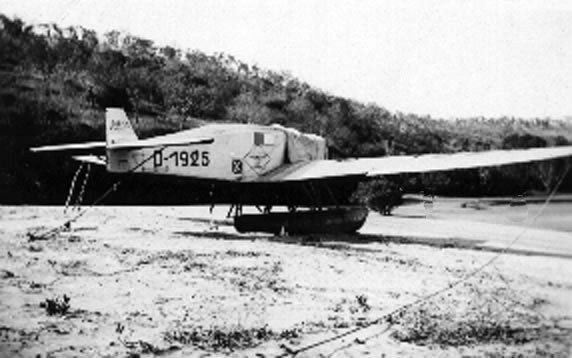
Our objective now was to retrace the steps of one of the great survival epics of Australian history. In 1932, two German aviators, Hans Bertram and mechanic Adolf Klausmann, force landed their seaplane, Atlantis, on a remote part of the Kimberley coast. They were attempting to circumnavigate the world in a Junkers W 33 seaplane. Due to being blown off course and with litle fuel to go on, the two men were at the beginning of what was to become a remarkable fifty-three day struggle to survive in a hostile environment, a struggle which was to bring them to the brink of madness and near death. They first landed
in a bay east of King George Falls. Here an Aboriginal man visited them. After some discussion they decided not to stay there but use the rest of their fuel to head further west. Unfortunately they only managed to fly a few miles so they landed in another bay. With no food and water they were still very isolated so they decided the only hope of survival was to walk back to where they had met the Aborigine. Leaving the plane on a beach they started their walk back to the first bay. However after stripping off their clothes to cross a creek they lost their clothes after a crocodile chased them. They then decided to give up that plan and return to the plane and take off a float to use as a canoe and try and paddle to civilisation. Making little progress in the ocean they eventually had to come ashore and attempted to walk overland which was also unsuccessful.
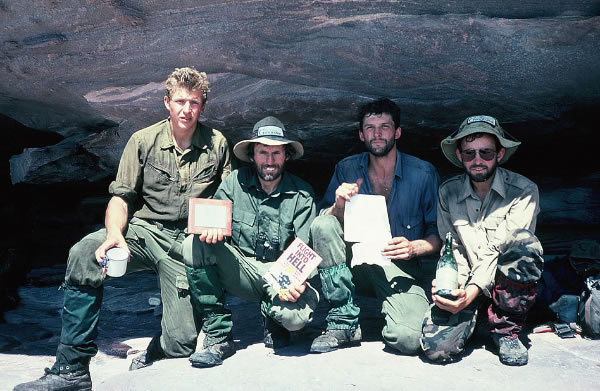
Eventually they decided to give up all hope of trying to leave the place so they found a cave to camp in and waited. Luckily they were eventually found by an Aboriginal search party. Armed with a copy of Bertram’s book, ‘Flight into Hell’ we walked overland from King George Falls to find the cave at Cape Bernier. The cave is where the aviators spent their final
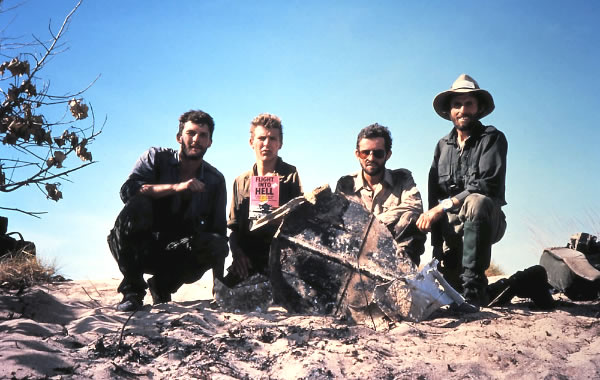
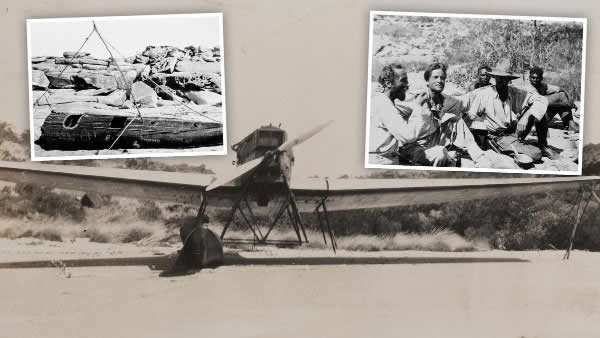
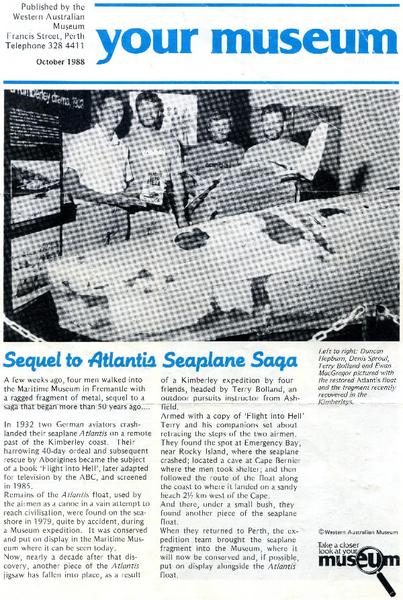
days before being rescued by an Aboriginal search party. It was on July 19th, 1988 when we found the cave, well it was more of a big rock overhang. We were quite proud to be sitting in the same cave that Bertram and Klausmann had spent starved and waiting to be rescued all those years before. Our next objective was to find the place where they had come ashore in the float that they used as a canoe so we continued walking west along the coast for about 2 ½ kms. Our perseverance paid off, Ewen noticed a tint of aluminium smothered by sand close to a bush. Incredibly it turned out to be part of the bulkhead from the damaged float in their attempt to paddle to civilisation. (The float was left on a beach when they decided to walk overland to find help. When
they realised they weren't where they thought they were on Melville Island they returned to the float which had now been damage by waves pushing it up the rocks.) We were ecstatic with the find. The chances of finding something after 56 years seemed impossible. The area where we found the bulkhead matched the description in Bertram’s book, including the lifesaving waterhole beyond
the adjacent ridge. A small cairn had been built higher up the beach and we wondered if Bertram had built it?
We found the cave that Bertram & Klausmann had been using as shelter and waiting for some hope of rescue.
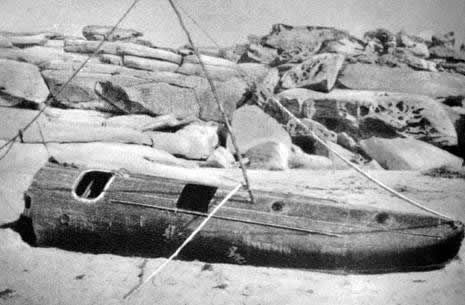
We found part of the float that had been cut off due to the float being damaged and sustained a hole or two.
After retracing one of their inland walks back to the King George Falls we loaded the bulkhead in the Toyota and Duncan left for Wyndham, leaving Dennis, Ewen and I to trek 240kms across a vast Kimberley wilderness heading towards Wyndham the hard way. Whatever happened now, our nearest remote outstation was 200 kilometres
away.
A team from the WA Maritime Museum found the damaged float 46 years after the saga, in October 1979.
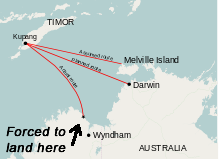
At midnight on 14/15 May 1932, German aviators Hans Bertram and Adolph Klausmann set of from Timor in an open cockpit Junkers seaplane (model Junkers W-33), named Atlantis, in order to make the first night flight to Australia. Darwin was
an estimated 250 miles and seven hours flying time away and in their estimate, the fuel supply would be more than sufficient.
Counting on breakfast at Darwin, they carried no food or water. They became disoriented during a violent storm over the Timor Sea and force-landed
out of fuel on the desolate Kimberley coast the next
day.
During ten days of intensive searching rescue parties concentrating in the Darwin area failed to locate any trace of the missing aircraft and the official searches were reluctantly called off.
From the book Flight Into Hell. A great read.
They took the float off the plane to use as a canoe.
Hundreds of miles to the west of Darwin and totally lost, the German aviators, became desperate due to the lack of food and water, so they removed a float from their seaplane and attempted to paddle - sail to safety. The improvised sail and rudder proved un-manageable in high winds and strong offshore current so after five gruelling days
paddling the Bertram & Klausmann headed to shore. An attempt was made to walk out overland, but found no human habitation in what seemed a limitless expanse of inhospitable bushland. They then made a final effort to save themselves by using the stern half of the float (which had been damaged) but it proved to be of no use on the open ocean so they came ashore again and
found a cave to take shelter. They were luckily rescued by Aborigines some 53 days after the start of the ordeal.
We took the bulkhead to the museum in Fremantle.
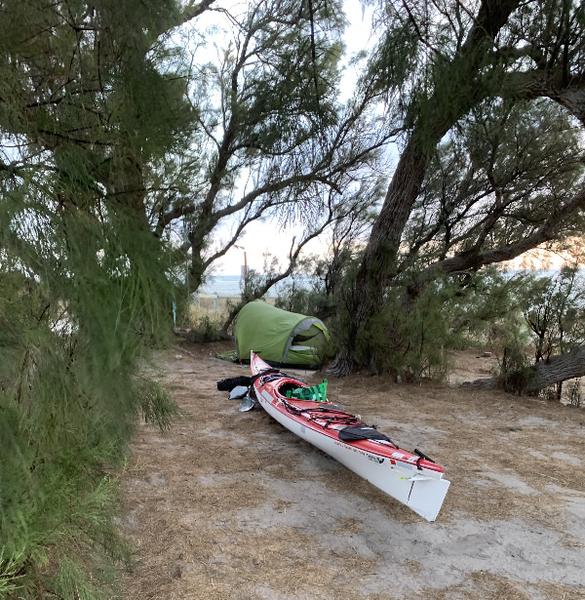
Perth to Kalbarri Luke Dooley Tuesday morning was the day of the big swell. I woke up and agonised over what I should do for another half an hour before concluding that I should at least try to make some progress. I knew that I would be able to get out to sea where I was safe because I was camped in a spot with an outer reef which stopped most of the shore break from preventing my departure. I gave myself a comparatively easy target of 45 kilometres for the day which would see me arrive at
Greenough River Mouth around one o’clock. As I waited at the gap in the reef for a break in the sets I was shocked to see a larger wave heading straight for me. I figured I was in deep water where the sets weren’t breaking but I was soon proved wrong as a wave broke just in front of me and the whitewash picked up my kayak and flipped me over. I was forced to bail out, flip the kayak over and hurriedly remount before another wave pushed me to shore. Thankfully I was able to get back in and paddle
like crazy to get the nose pointed perpendicular to the waves and punch through the last wave of the set. I was then left with a cockpit full of water and no spray deck on but I knew that I was still in the break zone and trying to bail out before the next set came through was not an option. I therefore pointed to nose straight out to sea and paddled with water sloshing all through the cockpit as hard as I possibly could to get behind the breaking surf. After a tense minute which felt like hours
I found myself out in the safety of deeper water and began bailing out with my hand bilge pump and sponge. Thankfully I had not lost or damaged anything in the capsize and I set off for Greenough River Mouth with a roaring easterly wondering if I’d made the right decision to paddle today. After several hours and many mountainous wave troughs that temporarily blocked my sight of the
coast I made it to the point I’d been dreading; the Greenough shore break. I checked the maps as I approached and figured I’d stay in deep water and analyse the waves before finding a route in. After another kilometre I figured I was past the mouth and stopped to check the map. I realised that I had indeed paddle a few hundred metres past the mouth and that I was unable to even gain a visual line of sight to the beach because the waves were so big they were completely blocking my view. I tried
paddling closer to get a look and as I edged forward, still 700m offshore, I heard the flutter of a wave crest behind me. I looked over my shoulder and was horrified to see a tower of water over my head with a fluttering band of white on top. Somehow the waves were breaking even beyond where the charts said they were supposed to and I was right in the path of a monster. In a panic I paddled as hard as I possibly could in reverse, straightened up and felt my tail go in the air then crash back
down sending my bow sky high as the wave roared through and broke just in front of me. I looked back again and realised I would have to keep going as a set of three more waves did the same thing before I was able to get clear, paddle far away from any break zone and reassess. A bit shaken, I looked at the map and realised I was not going to be able to get into shore until I reached Geraldton Marina which was another 15 kilometres away. I knew I wouldn’t be able to make camp there and it would be
too late in the day to continue further so I made a phone call to my Aunty Kim who lives in Geraldton and asked I could stay with her for the night on short notice. Thankfully she was happy to help and I paddled inside the safety of Southgate Reef where I was protected from the worst of the monster swell. I then realised the shore break inside Southgate was a lot more welcoming but I decided that I had plenty of energy left, despite being confined to the cockpit and not being able to get to my
lunch and so I would continue with plan B to Geraldton Marina.
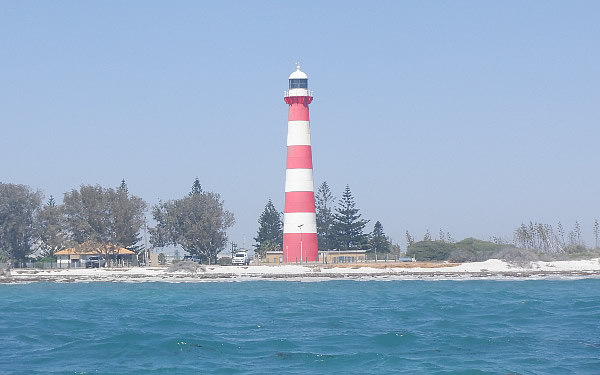
I rounded Point Moore and after marvelling at the lighthouse I made my way into the boat ramp with the southerly wind now pumping. Despite the wind change the temperature hadn’t backed down from 46 and as I finally got out of my kayak at 3:30 in the afternoon having paddled for 60 kilometres non-stop, I took a moment to have a good stretch out. I
rang my Aunty and she said she wouldn’t be finished work for another hour so I took the opportunity to run a few hundred metres to the shops and managed to finally replace my missing camping stove; no more cold half rations! I got back to my kayak and realised that the wind was blowing a perfect direction for me to scoot another 10 kilometres across the bay to Glenfield beach which was just a few hundred metres from my Aunt’s place. I was finally able to finish what was supposed to be an easy
40km day with a short walk up the hill to Aunty Kim’s place. I had paddled 69 kilometres in a 3.5m swell and 46 degree heat with only the snacks in my day hatch to keep me going. I slept well that night.
Little Bay Horrocks campsite for two night.
The next morning after my final water refill I carried the kayak back down to the beach for the 40km paddle to Horrocks. It was Kim and Brett who were there to send me off today and it was looking like another challenging one. The forecast was for 47 degrees and although the swell was a much more manageable 2.2m, the morning easterly was roaring. I
got underway and my speed was the slowest it had been all trip. I usually managed 8.5 to 9.5 kilometres per hour on a good day but today I was barely managing seven. The easterly wind was pushing me out to sea and as I lurched along, the waves continually lapping sideways over my deck became a real nuisance. Every half hour I had to sponge out my cockpit because my spray deck, which was not in any way new when I had begun the trip, had developed a bigger hole at the back which water was able to
seep through. To add to my frustration I had to turn my bow westward to be parallel with the waves because if I took my spray deck off while sideways to the waves they would spill over the sides and fill me up just as quickly as I could sponge out. This made progress extremely slow. I was continually being pushed slowly out to sea by the wind as the hours went by but this didn’t faze me as I knew it was forecast to swing WSW later on in the day and a little distance from the shore would prove
advantageous. Sometime in the morning as the easterly was raging I was passed by a couple of cray boats pulling their pots in the dirty green water. One came closer to take a look at me in my kayak but continued on when they saw I seemed to be in control. They must have wondered what on earth I was doing this far up the coast in a kayak. As the day wore on the easterly dropped out and the heat of the day really kicked in. I was eagerly anticipating the wind changing and pushing me the last ten
kilometres. As I passed Bowes River Mouth in the distance I became increasingly hot and bothered about the lack of distance I was covering. The forecast sea breeze never really came in and what would have been a perfect day out fishing in a powerboat was a bit of a slog for me. Finally I came alongside the picturesque town of Horrocks and with only five kilometres to Little Bay Campsite I thought the going would become easier. Unfortunately progress was still slow and I was probably a little
fatigued from the difficult morning and the enormous day before so when I arrived at Little Bay I decided to take a short cut straight over the reef rather than paddle another 500m around the point. Thankfully I had assessed the conditions correctly today and I rode into my home for the next two nights ahead of schedule on the last wave of a gentle set.
|
|
|
|
|
|
|
|
|
|


 and Canada
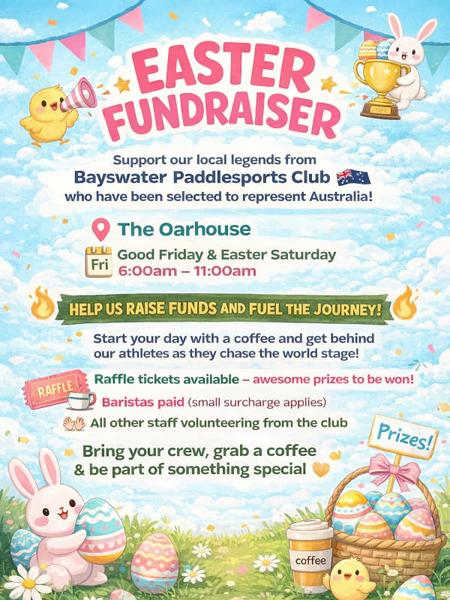
  to represent Australia and we need your support to help get them there!
 Coffee from 6–11am
 Raffle tickets + awesome prizes
 Good vibes for a great cause