|
|
|
|
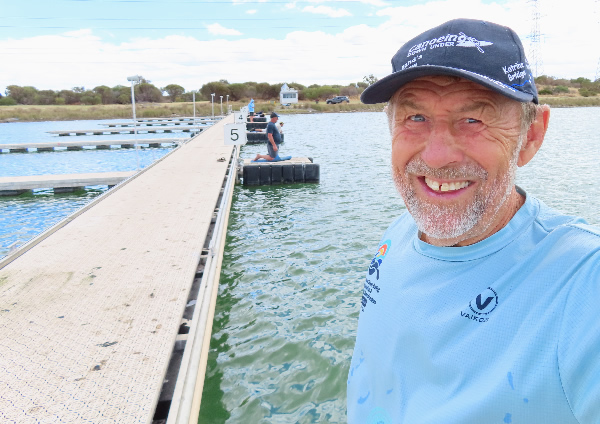
The Australian Canoe Sprint Championships were last week. The crosswind was dreadful virtually every day. I volunteered on Friday to hold paddlers who were racing the 1000 metres. Paddlers back up to a pontoon and every lane needs a person to hold their kayaks. Many paddlers had no idea how to do a draw stroke to keep
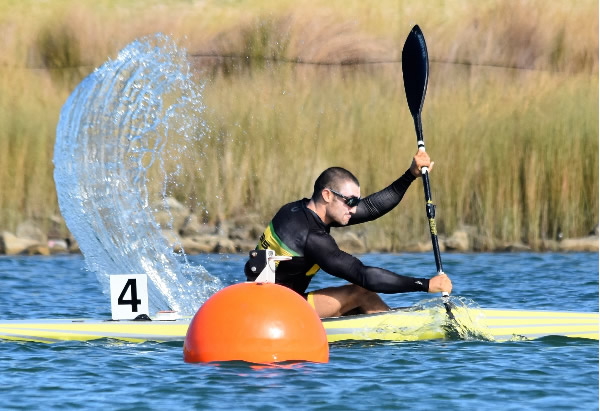
themselves straight. With the crosswind being so strong it wasn't just a strain for the paddlers but also for the holders who tried to keep their bow facing forward by adjusting their kayak. I want to thank Connor Jacob who made it easier for me to hold his kayak because he knew how to do a draw stroke and keep his kayak straight, however I
wasn’t so keen to receive such a large drenching and cold water shock from the water spilling off his paddle blade when he took off from the pontoon. 😂😂
Luke Egger taking off using the gates. If the start was on the pontoon the holder would be a little wet! Photo Lawrence Greed.
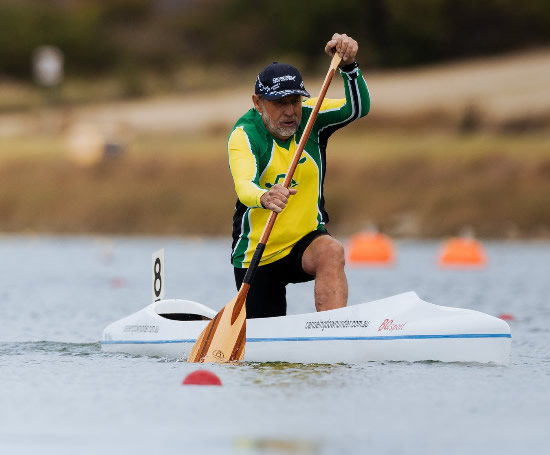
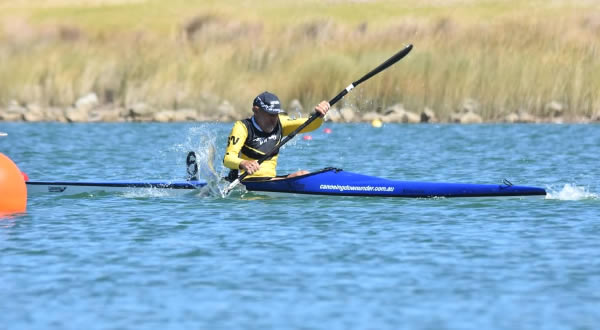
Saturday was sprint race day. I had three C1 races and one K1 race. The wind was still howling, nevertheless I manage to get down the course in my C1 without getting wet. I ended up getting 3 gold medals in the C1 75+ (as I was the only old person paddling) and a silver medal in the 1000 metres K1 in the
65+.
Sunday it was the K1 200 and 500 metre races. With the 200 and 500 metre races paddlers put their nose (bow) inside a gate on the start line rather than be held from a pontoon. The gates work easier if you have good boat control as you paddle into them forward rather than having to reverse up to the pontoon. However the
crosswind can still make things difficult.
I was 3rd in the 65+ 500 metres K1 and 1st in the 75+ 200 metres K1.
Our first Avon Descent training session was on Friday evening. Fourteen paddlers took part with three others eager but couldn’t make it on the night. We had a great session with paddlers keen to improve their flat water skills. If you know a new member who is thinking of doing the Avon and needs experience, tell them about the course.
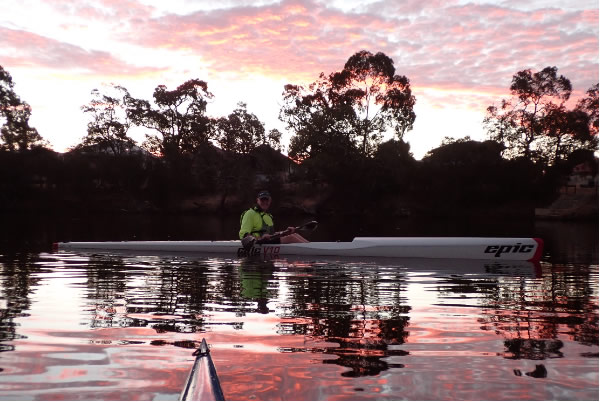
On Thursday evening I met Steve Angle out on the water opposite home. It was a beautiful evening and we were wondering where all the paddlers were. My Garmin had just decided to
die which is a real disaster. Now I have to source a new one pretty quick or I won't be able to record my SUP kilometres. Any suggestions to which one to buy? Doesn't have to be too fancy.
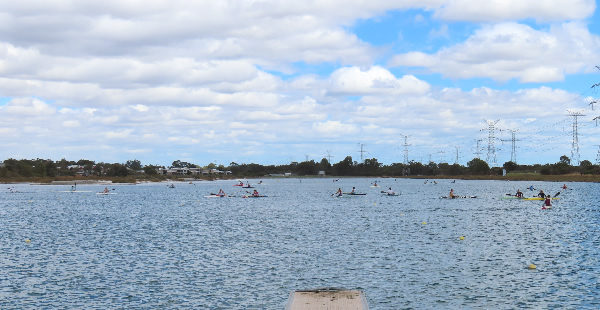
Paddlers milling around an warming up before they come to the 1000 metre pontoon to be held.
The pontoon at the start of the 1000 metre race. 8 volunteer holders lie down on the pontoon and hold the stern of the kayaks to keep them in a perfect line. The side wind, pushing the bow of the
kayaks off centre made it hard on the paddlers and the holders.
It was quite windy on Saturday for my 3 C1 races and my 1000 metre K1 race. It's much easier in a K1.
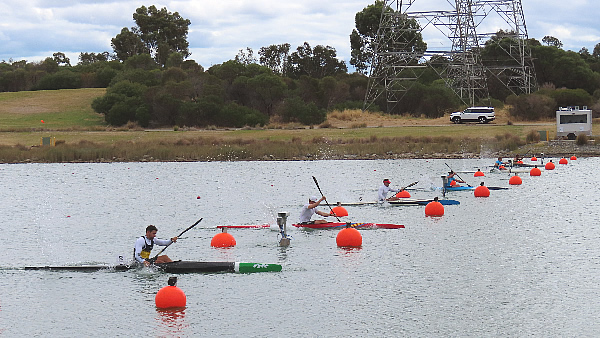
The start of the 500 metre race. The plop of water at the bow of the kayak is the gate going down as the race is started. Photo Lawrence Greed.
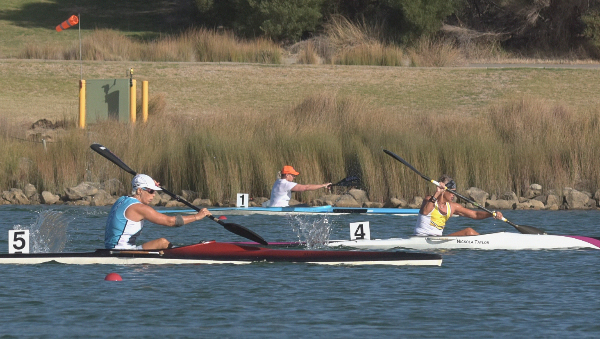
Agnes Pajor, Amanda Simper & Nicky Taylor. Photo Lawrence Greed.
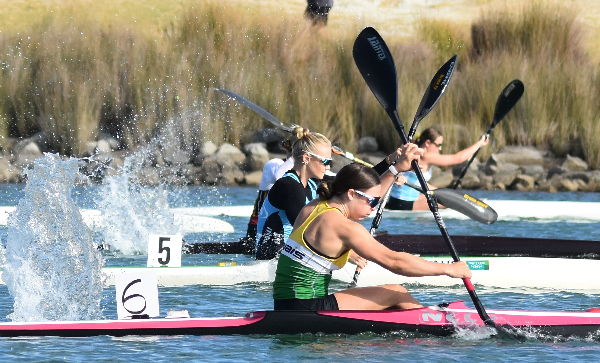
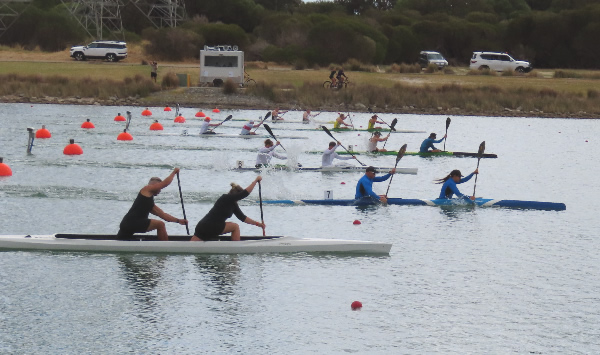
Women's race. Photo Lawrence Greed.
Josh Kippin (left) at the start of the 200 metre race. Josh was 4th in the 1000 metre final.
Orlando Fonseca continues to win many medals in the u16 years. His sister Talisa is also winning medals.
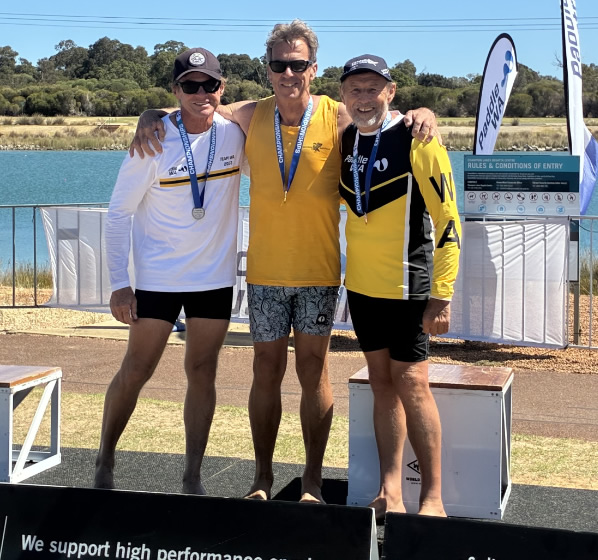
Phil, Dave & I. 65+ K1. I won 3 gold in the 75+ C1. (I was the only master). 1 gold in the 200 m 75+ K1, a silver in the 1000 m 65+ K1 and a bronze in the 65+ 500 m K1. Photo Ron Clarke.
The first five clubs with the most medals
Gold Silver Bronze Total
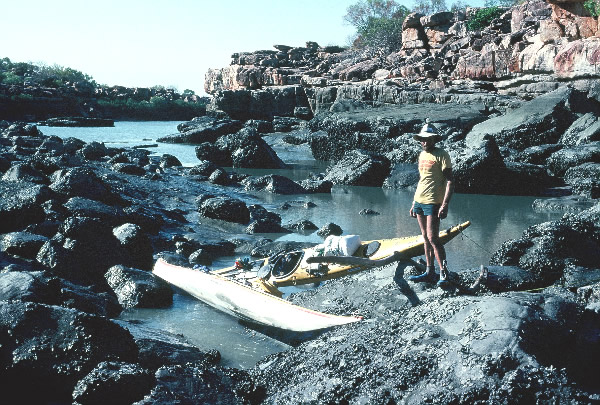
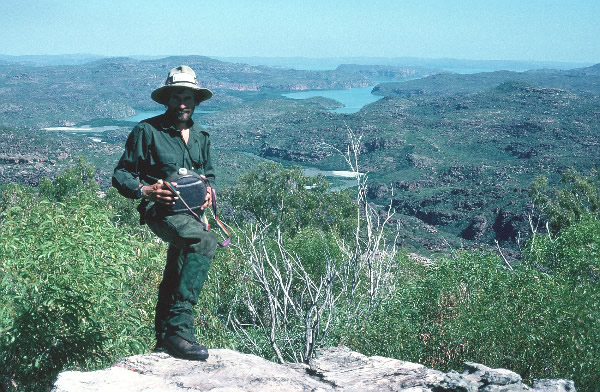
Celebrating 50 Years of Paddling Year 1988 Kimberley Kayak Expedition #5 On June 27th 1988 we cruised into Crystal Creek in Admiralty Gulf to find the falling tide had left our only access, a narrow channel which cut through a mangrove swamp, and the home we had been told of two saltwater crocs, a muddy, slippery mass of oyster
laden rocks and steep muddy banks. It looked an evil place and as our memories lingered back to croc attack nearly 3 weeks previously, we shunted nervously towards a barrage of muddy boulders ladened with razor sharp oysters. Stranded by the low tide, we faced a three hour struggle to hoist our gear to the top of the cliff, to where eventually Dennis and Duncan greeted us with champagne to celebrate our safe arrival. Our celebrations were short however, for the following day all the canoeing equipment had to be cleaned and packed away and our walking gear and rations prepared. The Wilderness couple Mike and Susan Cusak kept in regular contact on the Flying Doctor radio and that evening we talked to Dick Smith who had helped us with $500.00 sponsorship. Dick had been to Mitchell Falls by helicopter the previous day.
The end of our kayaking journey at Crystal Creek on the Mitchell Plateau. The tide left us high and dry. The slippery oyster laden rocks made it very difficult for us to
unload.
Duncan and Dennis had been living it up in Broome while we were paddling and they had won $100.00 worth of booze which they had used to entertain the ladies. They had driven north through rough terrain of the Gibb River and Kalumburu Roads, to meet us at Crystal Creek on the Mitchell Plateau. They would then share the stresses and strains of our
first walk once we got to Mitchell Falls which was 65km from Crystal Creek. As I was doing the Kimberley Circuit under my own steam I cycled to Mitchell Falls through at times 8 foot high grass, gulley crossings, steep jump ups and boulder strewn tracks. When we arrived at the falls water was cascading over its four drops into deep pools. I had been to the falls 3 times before. The
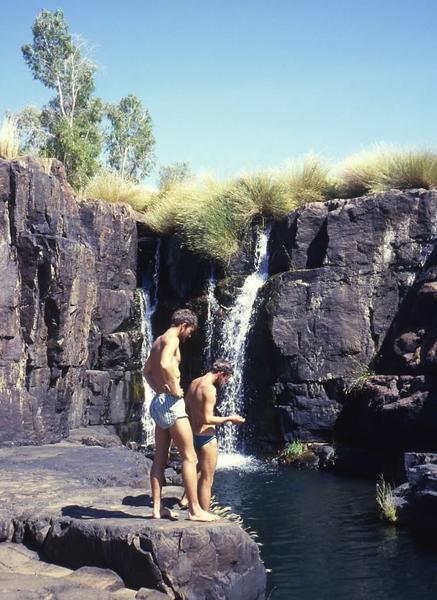
beauty never fails to impress me. Along the gorge the orange sandstone cliffs tower towards the sky, their rugged walls reflecting in the large pools below. Shaded by paperbark trees, the pools had banks laden with wild passionfruit and were home to many Johnson crocodiles and water monitors. From the top of Merton Falls, 200 metres north, we gazed at two freshwater crocs basking under
a rainbow thrown by the cascade.
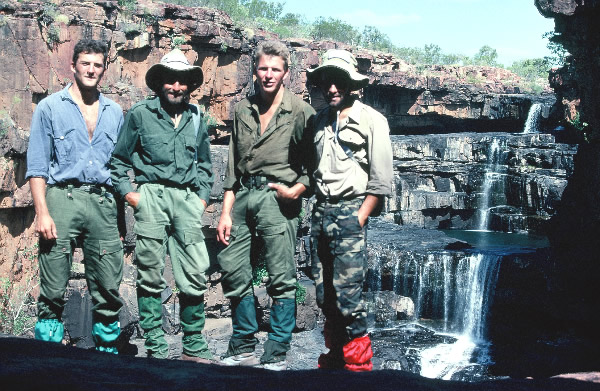
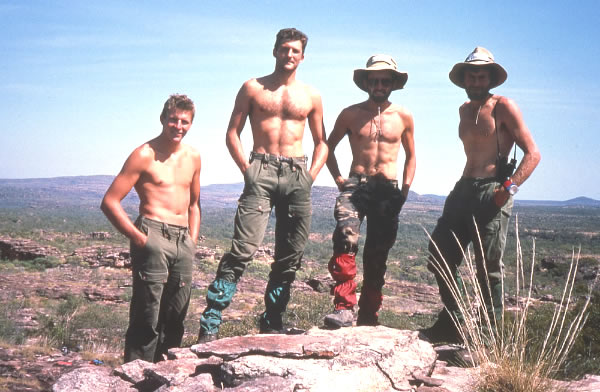
Mitchell Falls. Dennis, Me, Duncan & Ewen.
At the falls car park Ewen, Duncan, Dennis and I prepared for a 20 day walk across to Hunter and Roe Rivers. Although we were going for 20 days we carried only 12 food packs as we would go on half rations to keep our pack weight down. As
we headed towards an unnamed waterfall on the Hunter River we were forced to criss-cross many ravines, climb sandstone outcrops and fight our way through stabbing chest deep spinifex that oozed sticky resin on our clothes. It was a back packers nightmare and as the shadows grew longer, Dennis and Duncan descended a rock face into a carpet of spinifex below. Ewen, exhausted and still recovering from an oyster slash on his toe, tripped on a vine and fell head first down a two metre drop. Pinned
under his pack we feared the worst. Luckily for Ewen his fairy Godmother watched over him, he stumbled off into the sunset with a cut thick lip and a bruised hand!
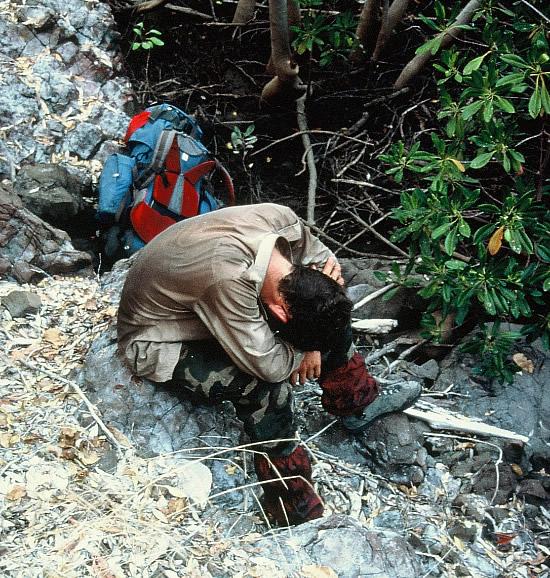
It was extremely hot, extremely hard pushing through high spinifex, and scrambling over large boulders. Ewen was often shattered at the end of the day.
As we only took 12 days of food for a 20 day walk it was good to catch fish in some of the pools.
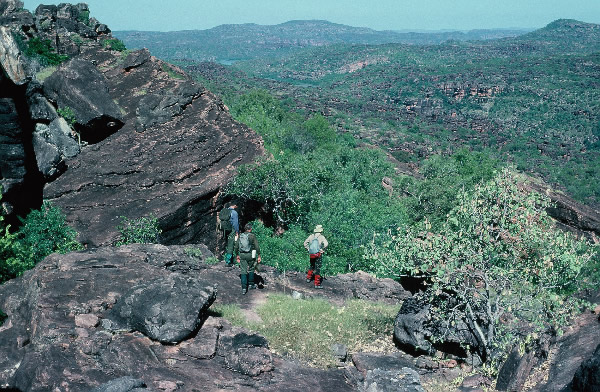
The walking was difficult much of the time. Ewen & Dennis.
Reaching the base of the 415 metre Donkers Hill the sweat poured off our bodies like tiny waterfalls. As an array of coloured butterflies and swallows criss-crossed the sky above the conical summit, we enjoyed a well-earned rest and looked out towards the 484 metre Mount Anderdon and the distant waters of Prince Frederick
Harbour. To the south and our route to the Roe River, a raging bushfire loomed on the horizon. Descending Donkers Hill to the cliffs flanking Hunter River we discovered a small pool. Within minutes Dennis had thrown a line into the water and hooked a fish with a raison and then hooked another one with no bait at all. We had a good feed that night. The area was rich in birdlife
including the black grass wren, the shining flycatcher and the rare white-breasted robin. That night like several other nights a quoll (native cat) shared our campsite and fish leftovers.
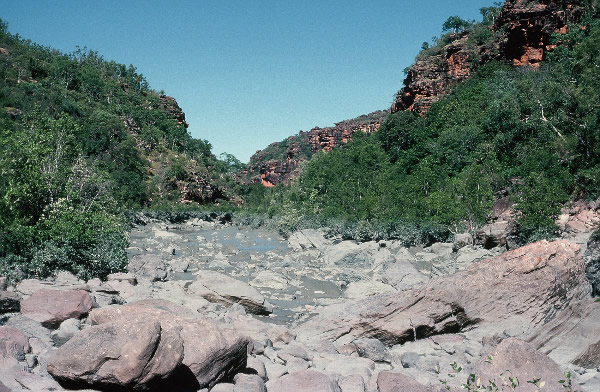
The upstream end of Hunter River.
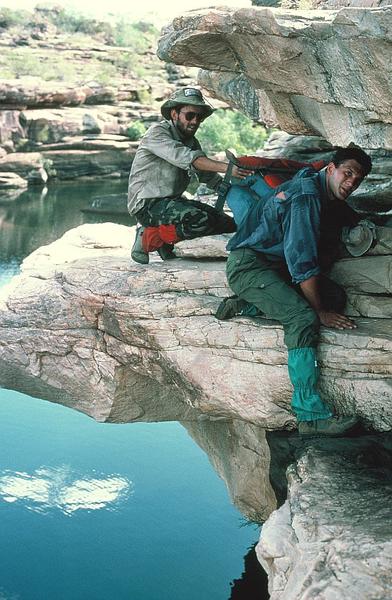
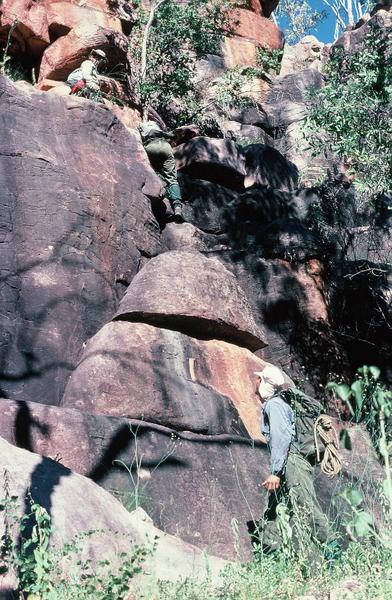
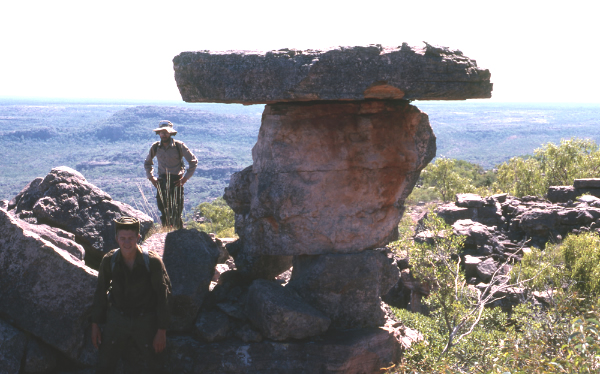
We needed to be rock climbers at times. Not easy with heavy packs.
Nearly at the top of Donkins Hill with a glimpse the Hunter River in the distance.
Hunter River snakes around.
At the top of Donkins Hill.
Duncan and Ewen on Donkins Hill. It makes you wonder when and how that was formed.
As we trekked towards Roe River the orange glow of the bush fire lit up the night sky. The fire was split into several pockets and as walked through the charred areas it felt like a war had taken place, as no blade of grass or tree escaped the scorching inferno. As many tree stumps continued to blaze, several trees crashed to the ground and in
areas not yet burnt, flames leapt 20 metres into the air. At times we could only achieve 1km an hour while walking. It was really tough going where the land hadn't been scorched, but we eventually reached the Roe River gorge and our furthest goal. Leaving the
impressive Hunter and Roe River gorges behind, we returned to the Mitchell Falls to a feast after enduring half rations for 20 days. Our new friends Mike and Susan Cusack, the Wilderness Couple were there waiting for us and ready to lend Ewen a mountain bike to use for the rest of the trip as he didn’t have a mountain bike.
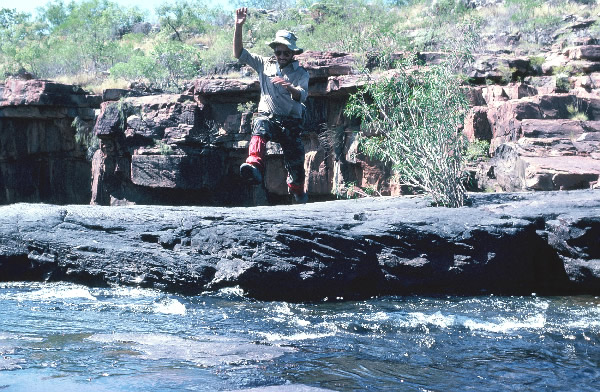
Ewen jumping over a stream.
Perth to Kalbarri On the morning of Sunday the 18th I left Clare and our dog Teddy waving goodbye to me from the beach at Jurien Bay and was filled with a great sense of
determination that I would keep myself safe for the remainder of the trip and successfully meet her in Kalbarri the following Saturday. After having an early lunch at Point Louise surrounded by idyllic turquoise waters and clear skies I jumped back in my kayak and was delighted to find that the wind was finally offering some help to push me along as I was heading more northerly and the wind had straightened, coming more out of the south now. I made excellent progress and arrived at my campsite
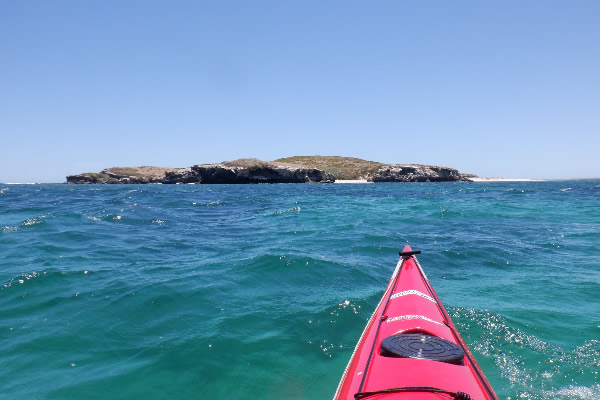
early in the afternoon having paddled a few kilometres further than my scheduled 60 kilometres per day. I was heading along what the tourist board calls the Turquoise Coast which is a 250km stretch of shallow coastline running from Leeman to Dongara protected from large offshore swells by a scenic chain of shallow reef and islands about five miles offshore. These protected waters and especially the conveniently placed islands made for some great lunch stops and allowed me to avoid punching in
and out of dangerous shore breaks every time I made land. Progress was finally coming easier as I enjoyed favourable conditions and stunning scenery and even got a glimpse of what I thought was a manta ray under my hull before it realised I was directly above it and shot off into the blue yonder.
Island near Lancelin lunch stop.
Over the next few days however, all that would change as I left the protected waters of the Turquoise Coast and ventured into more open ocean with a less than favourable weather forecast. That night as I went to cook my pasta and tinned soup I was given a very rude shock. I gathered my food, my gas, my pot and water before going in search of my
little fold up hiking stove. My face went white and I was filled with a great sense of dread as I came to the realisation that I had left my stove behind in Jurien Bay and would have nothing to cook my food with! Throughout the journey I had contemplated what it must have been like for Terry back in the eighties as he paddled and hiked through the Kimberley’s stretching his rations as far as his hunger would allow. Little did I know, I was about to experience the same thing myself over the next
few days before I would be able to replace my stove in Geraldton. Thankfully I had some tinned food which would keep me going but I wasn’t able to combine it with cooked rice or pasta as planned so the next few days would be a challenge for me.
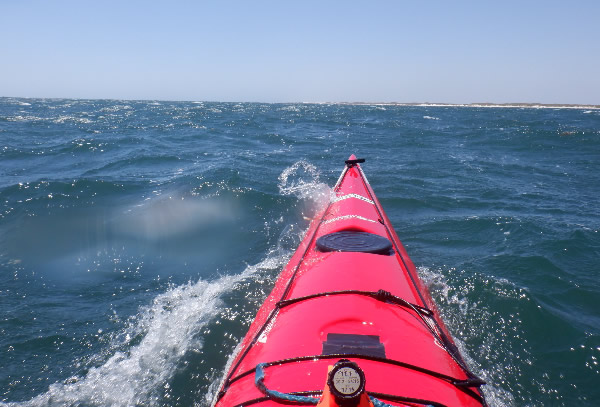
Running down a wave south of Leeman.
I spent Monday’s paddle from Leeman to Dongara dwelling on the next few days which would be the most pivotal of my trip. So far I hadn’t had weather that was any worse than a nuisance and certainly nothing I considered dangerous. The forecast for Tuesday however was for 3.5 metre swells which would cause me big problems as I had to plan where I was
going to make land through the shore break very carefully and avoid capsizing and crashing my borrowed kayak onto the rocks. Adding to the swell was the temperature and wind forecast which said the next three days would be around 46 degrees with morning easterlies gusting to over 25 knots. I knew that if I kept to my planned schedule and paddled around 60km per day, I would have an extra day up my sleeve as I wanted to wait until Saturday to arrive in Kalbarri so Clare could make the journey
from Perth to be there as I finished. Once I got to Horrocks I knew I would be ok but between myself and there lay 120 kilometres of unfavourable conditions. I figured I could sit Tuesday out but then have to paddle 60 kilometres on Wednesday and Thursday in a horrible side wind and scorching heat. Alternatively I could paddle three 40 kilometre days but risk extremely dangerous shore breaks on Tuesday and possibly get stuck at Greenough for a few days not being able to get back out to sea
waiting for the swell to die down. I decided to wait until morning and assess the conditions then.
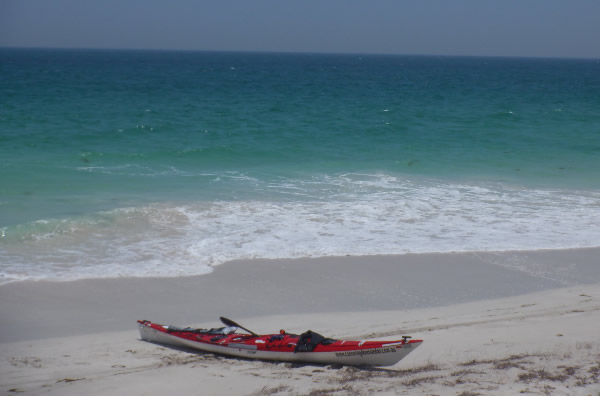
Lunch stop south of Dongara.
That hot night as I lay in my tent on a sandy 4wd track which didn’t look to have been used for years I was abruptly awoken into a panic around midnight. I shot bolt upright in my tent and threw my clothes on as quickly as possible before scrambling for my torch. I could hear a screaming engine on the rev limiter and saw headlights bouncing around
the dunes seemingly heading straight for me at tremendous speed. About 500 metres away there was a gravel carpark which came straight off the highway and a hoon who had his car right on the rev limiter would have had no idea that I was camped in a little green two man hiking tent just off into the darkness. I rushed for the door in the hope I could jump out of the way in time because I knew at the speed he sounded like he was going that he wouldn’t be able to stop before ploughing straight
through me. Just as I made it out I looked into the distance and was relieved to find that the car was not likely a 4wd and was just doing burnouts in the gravel carpark rather than tearing along the track I was camped on. After I caught my breath I kept a watchful eye on the hoon and hoped that he hadn’t seem me camped along the beach which I figured was unlikely. Then I had a tense ten minutes or so as the night fell silent and the hoon sat in his car with the engine off before finally
starting it up again. This time he gave it a few more revs in the carpark before I heard him tear off back along the road towards the highway and thankfully disappeared into the night. I was very relieved when he left and thought that it would be such an unlucky way to go to be cleaned up in my tent asleep after all the hundreds of kilometres of ocean I had paddled!
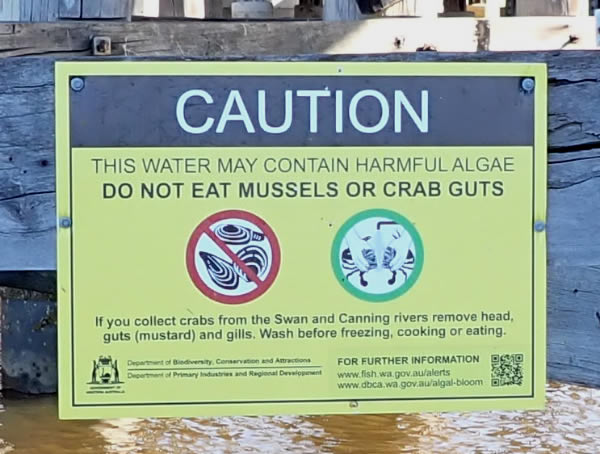
I want to know who eats the GUTS of mussels and crab?
Are You Interested
in
Up Skilling - Refining -
Improving
Your Basic Paddle Strokes & Skills?
If so why not join this
course.
Suitable for paddlers who have some knowledge of the basic strokes.
(Using 3 – 4 metre white water kayaks.)
This course will run for 5 – 6 sessions depending on paddler’s skill
level.
The idea is improve people’s paddle strokes & skills to an advanced level or to a Basic Skills Instructor level & beyond. Paddlers must be in a Club or belong to Paddle WA
Contact Terry 0417977330 or terry@canoeingdownunder.com.au
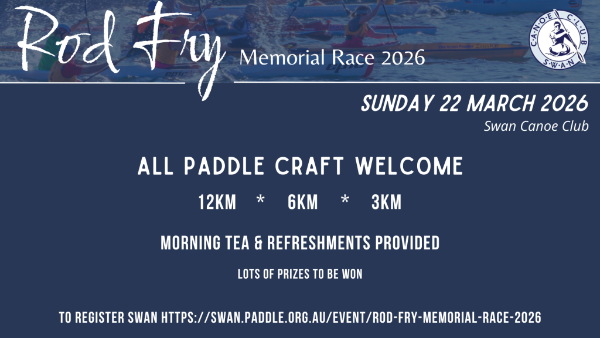
Rod Fry Memorial Race 2026 Sunday, March 22, 2026 Registrations close 11.59pm Friday March 20 2026. All paddlers in team craft must enter individually. THE RACE Where:
Swan Canoe Club, Johnson Parade, Mosman Park Check-in: 7:00 – 7:45am Race / Safety Briefing: 8:00am Start (1st Wave): 8:30am
PRIZES Cash prizes for fastest male and female single paddlers (12km course): 1st: $150. 2nd: $100. 3rd: $50. Plus random draw for other prizes. Presentations after the race. FEES Adults: $35 Juniors (U18): $20 Morning tea and refreshments are included in the race entry fee – available at the club after the race. $20 for insurance will be added for non-affiliated paddlers ENQUIRIES: admin@swancanoeclub.org.au TO REGISTER: https://www.webscorer.com/register?raceid=421720
|
|
|
|
|
|
|
|
|
|