|
|
|
|
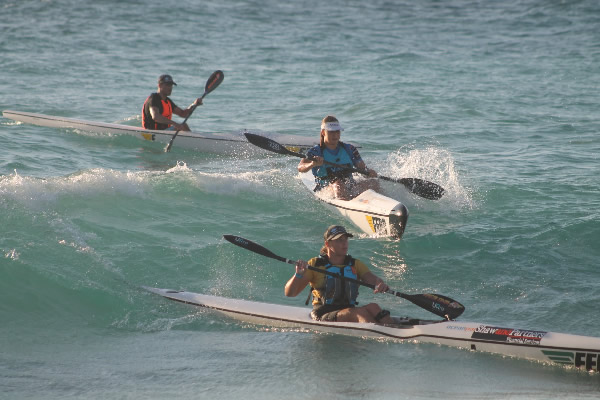
It's going to be a busy week for ocean paddlers with the start of race week.
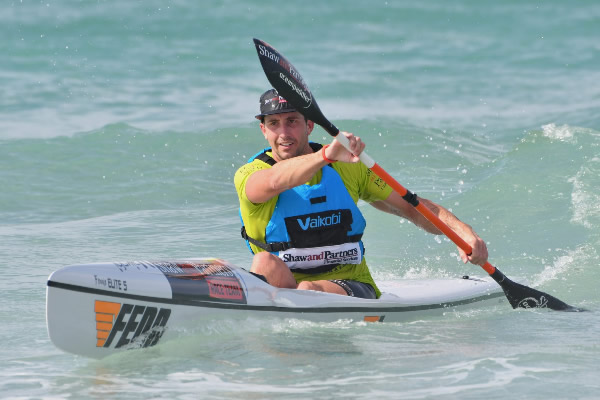
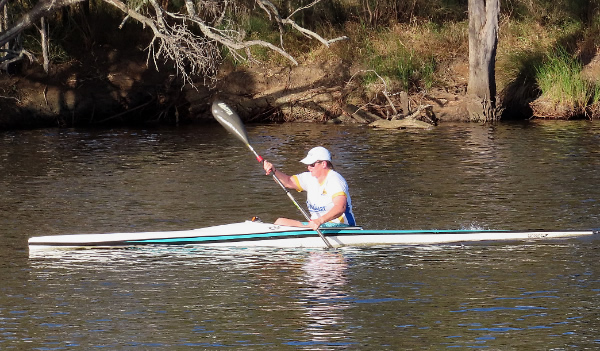
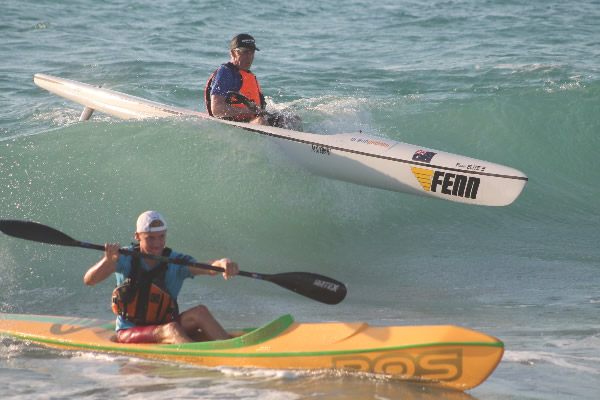
Ocean Racing Paddler of the Year, Cory Hill. Cory Hill wins most races, but in Thursday evenings race he was 2.9 seconds behind Joshua Fenn. It's going to be an exciting week of ocean races. See results below.
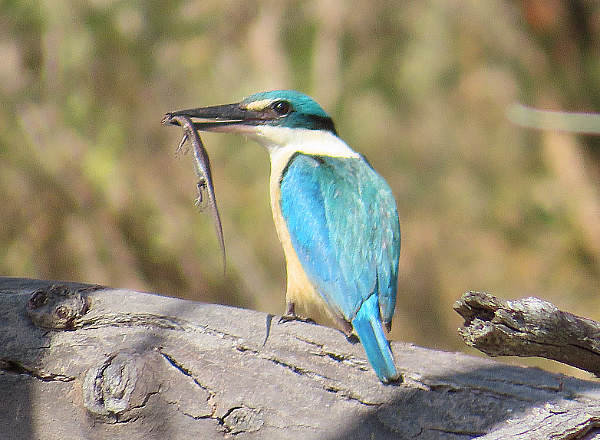
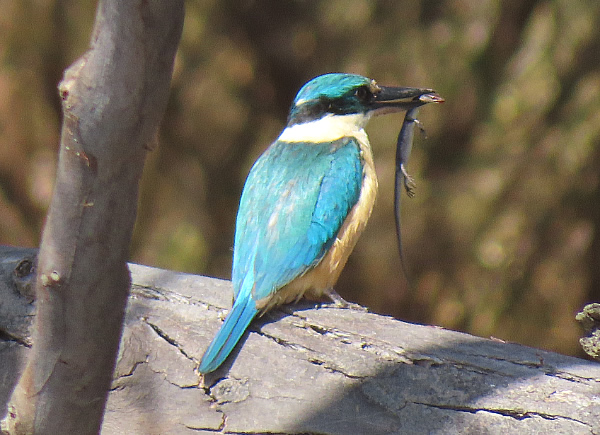
Sacred Kingfisher. Ascot member Babett Fekete said she would love to see a kingfisher on the river like the photos I have in the newsletter. This week she was excited because she saw her first one
flitting in front of her and skimming the water. She was surprised how small they are. I'm pleased to say she didn't see this one as it had caught a poor lizard.
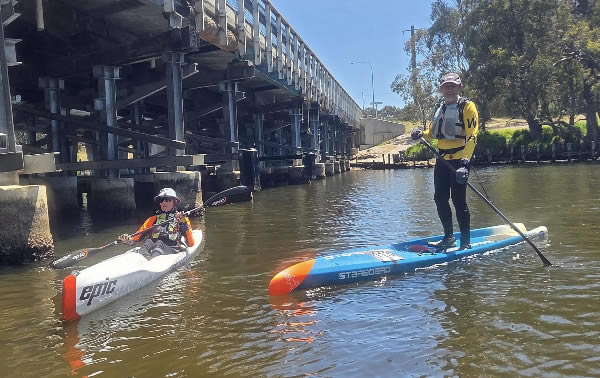
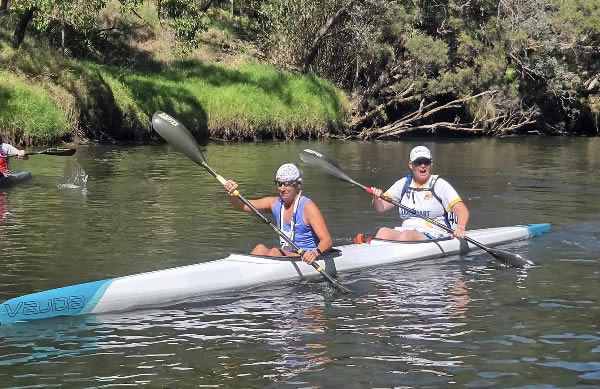
85 year old Ray Smith and me at the end of the Pinjarra to Ravenswood Race. Photo Isabel Maddison.
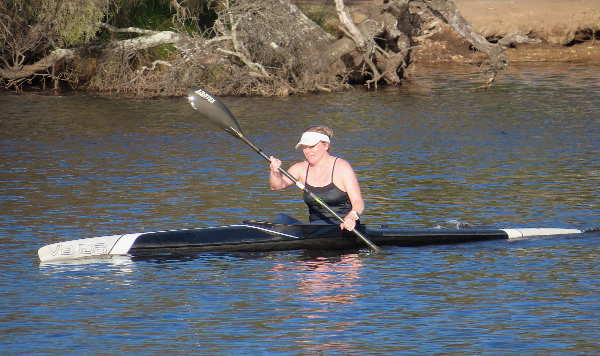
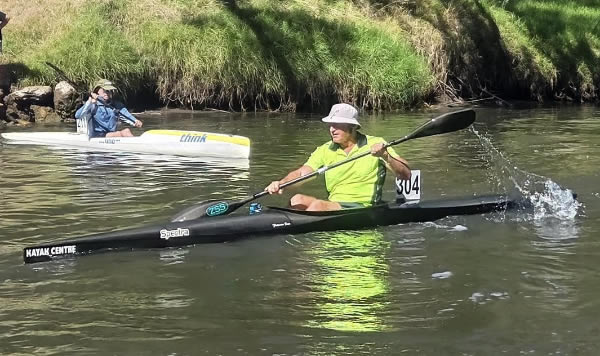
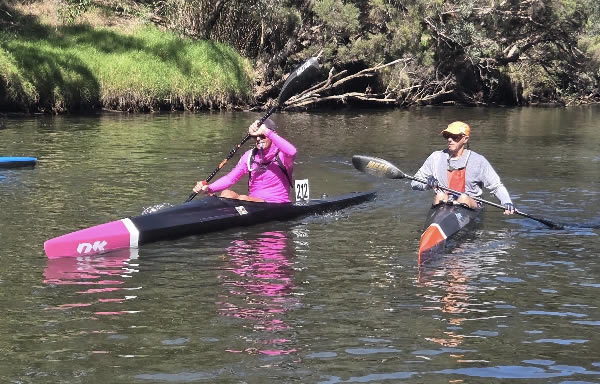
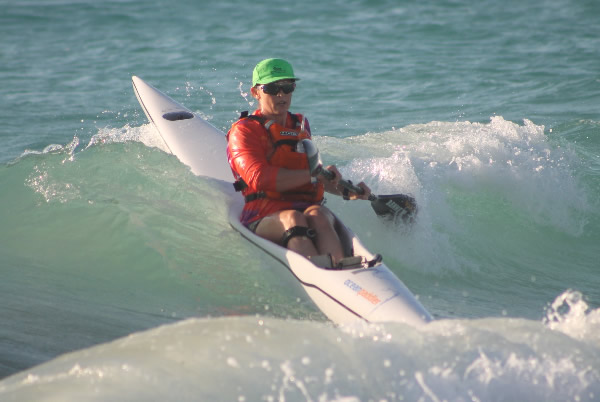
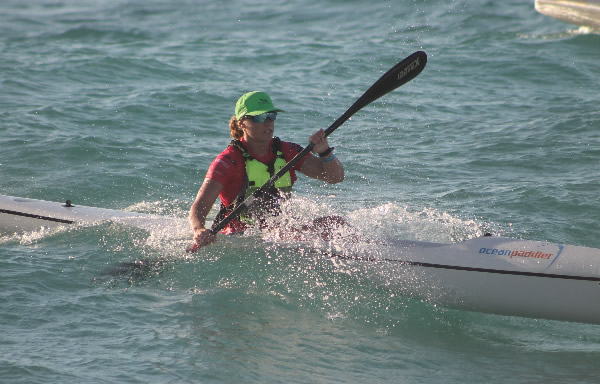
Sharon Cobley has been PRGs fastest female masters paddler for several years, but with less training more recently she is now being challenged by Anne Harris.
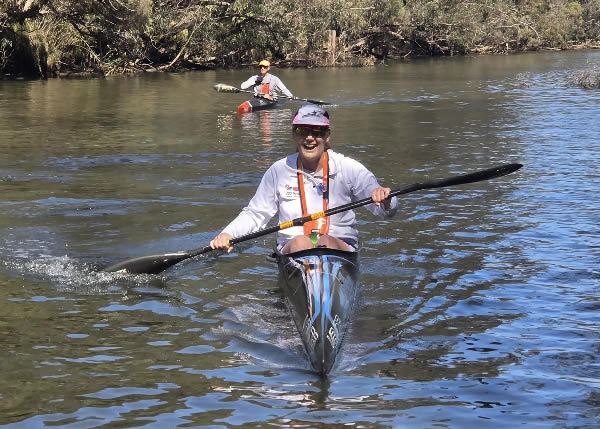
Anne Harris is happy after beating Sharon on Tuesday evening. So will Sharon let Anne beat her again?
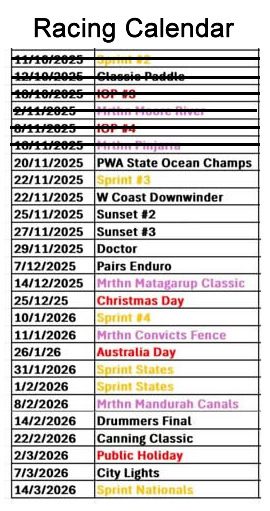
Up Coming Races - West Coast Downwinder - 22nd November 2025
- The Doctor - 29th November 2025
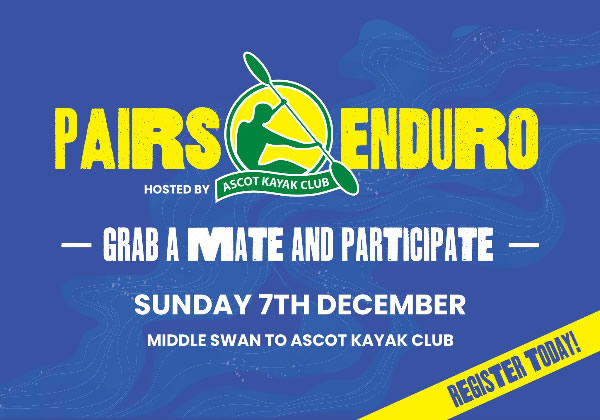
- Pairs Enduro - 7th December 2025
Get a singles partner and race as a pair - Matagarup Classic - 14th December 2025
Pinjarra to Ravenswood Race. There were only 50 boats in the race this year. It may have been because of the date change or because of the ocean downwind race week coming up and many
paddlers were practising on the ocean.
Bernard Hoffman. Photo Isabel Maddison.
Doug Hodson & Eddie Stoelwinder. Photo Isabel Maddison.
It's the start of the race and Jade Lane seems happy enough. Photo Isabel Maddison.
Nicky Taylor & Anne Harris. What a team. Photo Isabel Maddison.
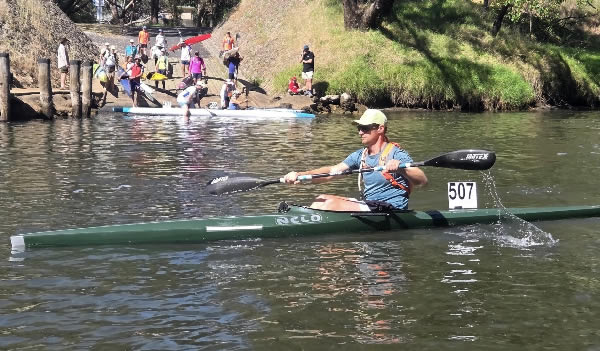
Michael Glorie. 3rd place. Photo Isabel Maddison.
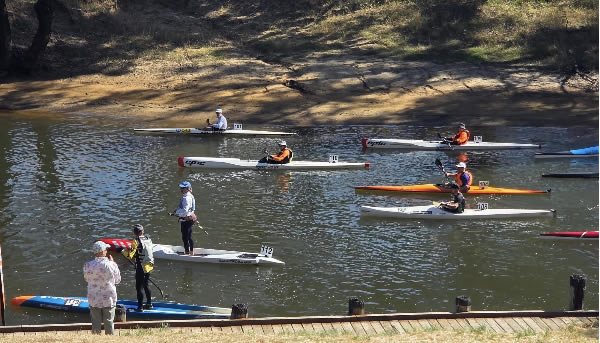
The start of the first grid.
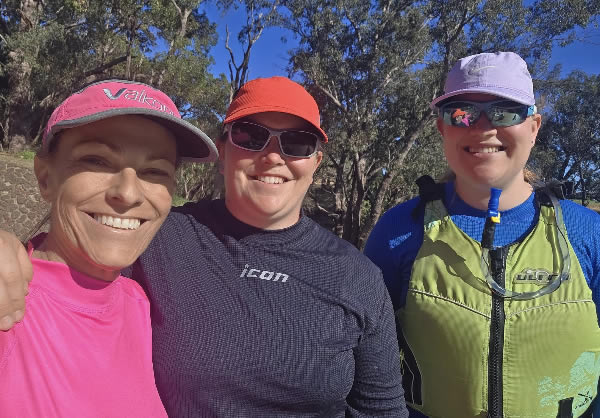
Izzy Maddison with Veronica & Anita Haarmann
Race winner Josh Kippin with three much more mature paddlers Dave Berglund, Bernard Hoffman and Grant Pepper. Race Records Updated Pinjarra to
Ravenswood: See them here on the PWA Marathon Web Page:
Jaime Roberts surfing to the finish. First female.
Selma Alibegovic. Second female.
Celebrating 50 Years of Paddling
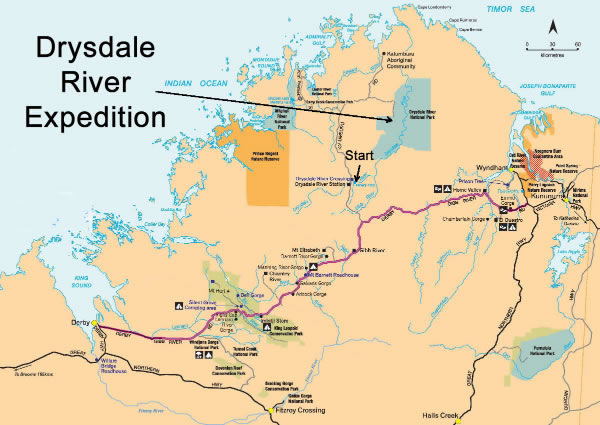
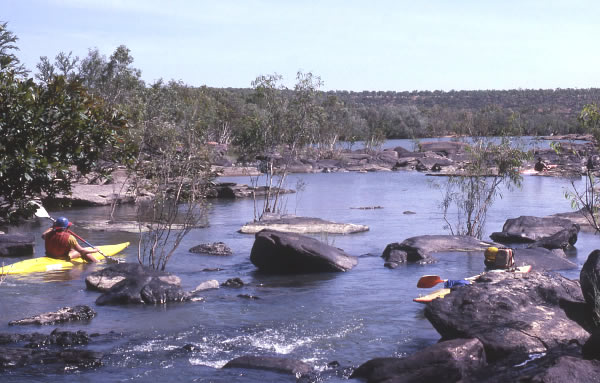
The Year 1985 Drysdale River Expedition 1985 In 1985 John Mustard and Tarquin Bowers, who were studying recreation at University had to organise an outdoor expedition as part of their university studies. Many other students planned their expeditions closer to home and some overseas but John and Tarquin decided to do the first descent of the Drysdale River which was situated in the Kimberley wilderness area. Having already completed two, 3 month expeditions around the Kimberley coast they asked me to
go along. Their friends Andrew Kikeros and Vic Challis became our support team.
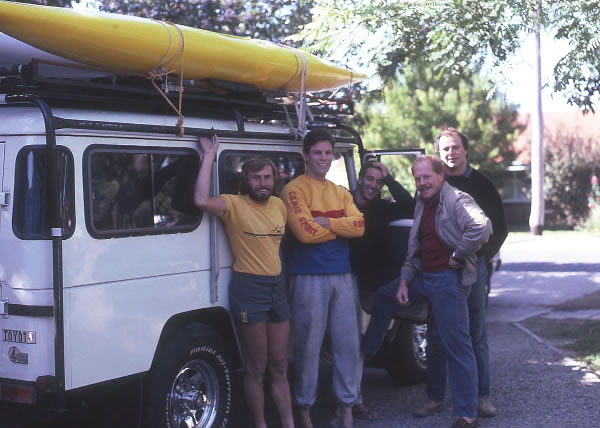
The Team. Me, Tarquin Bowers (paddler), Andrew Kikeros (support), John Mustard (paddler) & Vic Challis (support).
The Drysdale is a remote river that flows through the Drysdale River National Park in the Kimberley region. Not a lot is known about this National Park as it is rarely visited, rarely promoted and difficult to access. The river itself has a variety of conditions, from a sandy river bed, narrow channels, deep pools and in the wet season big and
small rapids and high waterfalls.
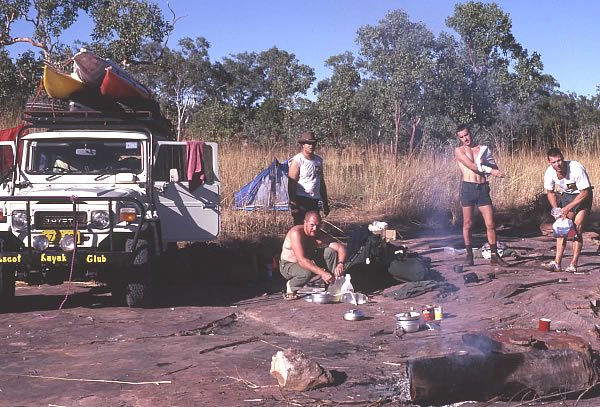
To get to the heart of the rugged Kimberley we took my four wheel drive which was loaded with 3 kayaks, 4 spare wheels, 6 jerry cans, food, clothes, equipment for 4 weeks and 5 people. We had to travel 2500kms on a bitumen road with the final stage of our journey being 500kms on a rough gravel track, the Gibb River Road, which was very wet because
it was the end of the wet season. While John and Tarquin chose to paddle plastic river kayaks, some of the first ever made, I chose to build a very strong kevlar river kayak with hatches and bulkheads.
The Team near the Drysdale River Crossing on the Kalumburu Road:
John Mustard, Vic Challis, Andrew Kikeros & Tarquin Bowers
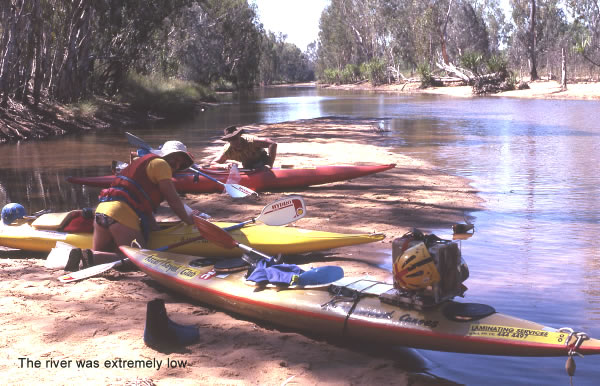
Upon reaching the river at the Drysdale River Crossing, near the Drysdale River Station it was a pitiful sight. The water trickling over the crossing was only fed by springs upstream so it looked as if our journey was going to be extremely tough. This year the wet season had been very dismal and although we had to wait for the track north to dry
up, before driving along it, we had lost any chance of paddling on good water. By mid-afternoon on May 12th 1985 the epic journey started. Our support crew, Vic and Andrew, who were going to meet us downstream near Carson River Station on May 25th, the first place they were able to get to the river, wished us luck as we
paddled into territory that no other known canoeist had been through. Our kayaks loaded with 18 days of supplies sat low in the water and were hard to control. The deep pool, downstream of the Drysdale River Crossing allowed us to make good speed but 400 metres later we struggled to get over our first rocky rapids leaving coloured marks of our kayak hulls on the rocks. In the matter of
minutes our joy went to despair and we soon realised our 320km journey to the end of the river with dozens of rapids and waterfalls was going to be tougher than we imagined. We had expected to be paddling down every rapid making good time. Pandanas palms, paperbark and gum trees lined the sandy banks. Sand bars soon intersected the river creating pool after pool and causing us to get
out of our kayaks and drag them. Further along islands of foliage dotted the wide river creating a maze and many dead end channels. We moved on, looking for openings to glide our boats through the islands and channels which were too shallow forcing us to exit our kayaks. It was tedious work with only short distances covered before we had to drag our kayaks over greenery, rocks or sand. Our very slow pace was only helped when the river narrowed and shallow races developed giving us just enough
water to float down. Small crocs mingled among the weed, some less than a metre away. In the first two hours we had only paddled 4kms.
All food and camping gear were shoe-horned into our white water kayaks. I also carried a 16 mm movie camera on deck. My kayak was kevlar and the other two were plastic, some of the first plastic
kayaks made.
The river started off being very shallow and sandy. We did a lot of dragging.
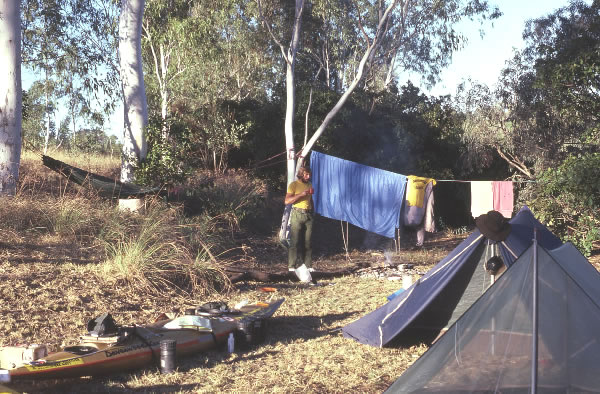
As the light faded and the birds chattered stronger we camped on a sandy island surrounded by stagnant pools of water and debris from the last flood. We caught a few fish and settled to eating a basic meal around a campfire and listened to the mysterious sounds of the night life under a clear sky full of dazzling stars. This was the
life.
Some nights I would sleep in my hammock.
By 9.00am we were ready to leave. A narrow flow of water meandered through a forest of paperbarks and pandanas palms. Further downstream the flow widened forcing us to walk our kayaks over the shallows. Cattle and large bulls shared our
path, most galloping away but a few just stood their ground which was at times a concern. Despite the poor wet season the cattle looked healthy and well fed, their coats looking as if they had been oiled and well groomed. As the jungle of trees diminished once again the river became sandy and shallow. Time out of the kayak well exceeded time in it. Our arms were stretched as we pulled
the kayaks over the sand bars but were rested in the deeper pools. We soon discovered that sitting in the seat and dangling our legs over the kayak in the short pools was much better than getting into the kayak properly. Our cockpits were quite small and quite difficult to enter easily. When we reached the confluence of the Gibb River it was disappointing to see no water flowing out of
it. From here the river became extra rocky, so there were more portaging, more dragging and very slow progress. Eventually the dry rapids that sometimes took hours to clear turned into long dry rock sections with water just trickling through the rocks. As the day slid by, dingoes and goannas raced from the river bank and owls roosted in the trees, not even flinching at our presence. To
add insult to our already tired and battered bodies we found long wiry red worms in the flesh of the fish we had caught at the end of the day. The sight of the worms turned our stomachs knowing that we had already eaten several, but that didn’t deter us from devouring the non-polluted meat.
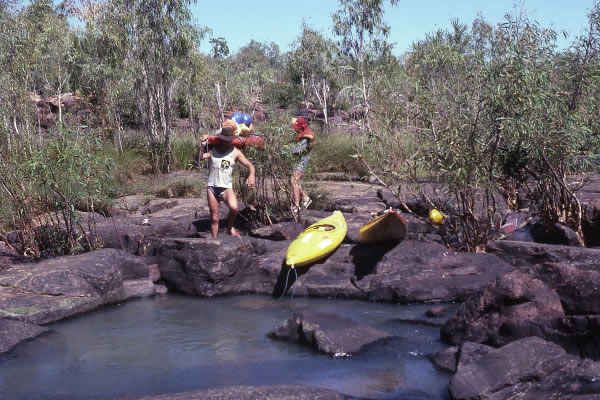
Carrying kayaks across the rocks.
The day started with a long portage over rock, in fact it was more like a waterfall. A large goanna lizard with flicking tongue was sunning itself on a rock as we splashed by. We rejoiced when we entered a long pool but another dry waterfall stood in our way so we lifted the kayaks full of gear taking one at a time. The river and river banks were still dotted with dingoes, goannas, crocodiles, fruit bats and a mass of birdlife. We had seen several Johnson crocodiles but an increase in rocky islands attracted more of them to sun bake. The sun seemed to make them docile which allowed us to creep close and surprise them. We got more than we bargained for when a crocodile guarding a narrow channel of pandanas palms was startled by
Tarquin as he entered it. It swiftly jumped over rocks and then gave John a fright as it brushed his kayak and then smashed into his paddle before submerging and swimming out into a pool. At least I managed to get it all on film.
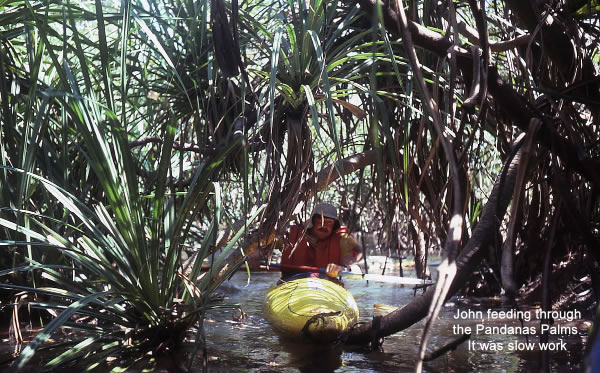
The river diverted into a pandanas palm alley. John coming through.
The pandanas palms were black with chattering fruit bats hanging in the trees. The foul smell encouraged us not to linger long and find fresh air again. Once out in the open there was a short paddle to another pandanas palm alley. Leaving it John spotted a crocodile stalking a cormorant. Within seconds the croc snapped and took the cormorant firmly
in its jaws and then lay in the shallows allowing us to paddle around it. We left the croc to his lunch, paddled a few more short pools before being stopped by another long dry boulder rapid resulting in another tiring portage. Our lunch here consisted of nuts, dried fruit and a little jerky, not a lot to keep our energy levels up, but it did. It’s surprising how little food we really needed to consume to keep us going. It was slow work pushing over and through the dark canopy of palms with spiders and frogs falling into my lap, on my legs and into the kayak. Once I got used to all the spiders tickling my legs the dread of paddling through the palms soon became quite exciting. We started jumping logs, weaving in and around the palms like a slalom paddler
and feeling the fun of the jungle. We were soon covered with creepy crawlies, branches, dry debris, spider webs and frogs that hitch hiked on our PFDs and kayaks. After several hundred metres and when we were back out in the open we had lunch and cleared our cockpits of all the debris. Once back in the water we scored a pool several kilometres long which brought the day’s kilometres to
the best yet – 18kms. Our enthusiasm to keep going that evening was dampened when we came to another long rocky rapid. After making camp and walking downstream to check the route Tarquin had caught 4 fish by the time I returned.
This was one of the only sections that we were able to paddle down the tiny rapids
Friday 17th We were in high spirits when we came across another long pool but our joy didn’t last long as difficult rock rapids stood in our way. This was followed by another long pool dotted with rocky outcrops and several crocs sunning themselves. I was able to creep up and film them with my 16mm movie camera. Another pool, another rock rapid and another surprise! As I dragged my kayak down some tiny rapids, a five foot croc lay virtually
under my feet in a rock cavity. With it seemingly frozen I took the opportunity to shoot some movie film, before it shot off in a desperate bid to find deeper water. With the excitement behind us we paddled another long pool, passing Damper Creek. The afternoon brought more rocky sections, shallow sections and pools and by night fall we made camp 300 metres past Banjo Creek. It was
another good day – 18kms. To be continued..............
Sacred Kingfisher is happy as it has just caught lunch. But poor lizard.
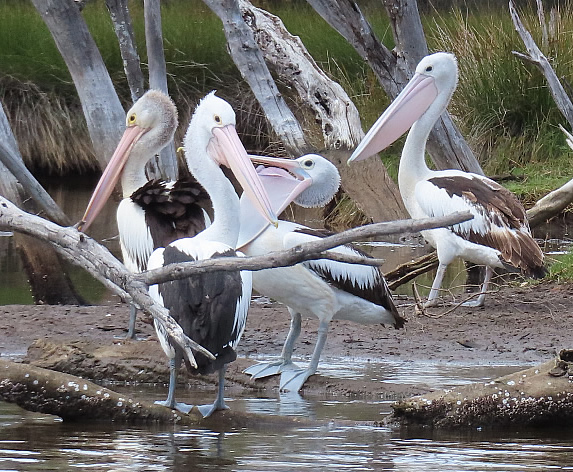
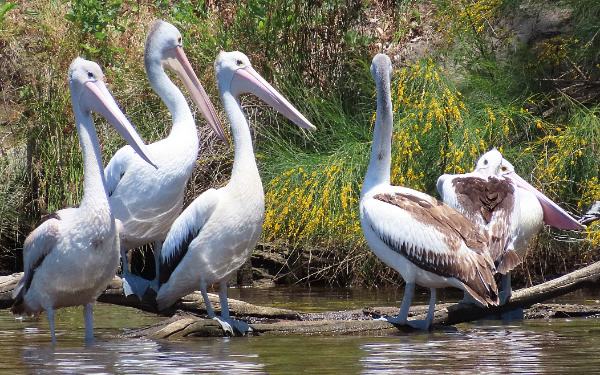
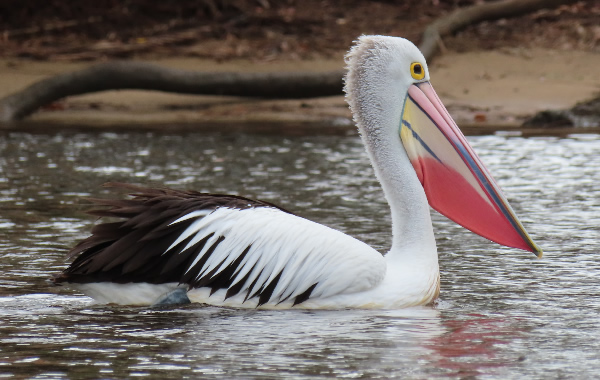
During courtship the pouch becomes bright red, blue and orange.
AKC Pairs Enduro Sunday, December 7th, 2025 Teams of Two Find partner with similar speed & endurance, test your wash-riding skills. A Pair: Two singles or two double craft. Main race starts at Middle Swan Bridge and finishes at Ascot Kayak Club. Check-in Middle Swan Bridge: (Car Shuffle Needed). Opens: 07:00 Briefing: 08.00 Start: First paddlers away 08.30 [or sooner if ready] Start Intervals: 1 minute. Main Course: Distance 13km. Start Middle Swan Bridge, downstream right of Ron Courtney Island, left turn round spit post near boat ramp before Tonkin bridge, back up stream, Island on left, finish at Ascot jetty. Pairs go off together at 1 min intervals, from slowest to fastest. Work as teams, take turns to wash ride each other for
best time. SUPS Course: Distance 12 kms. From Start to Ascot Kayak Club only. Guppy, Novice & Short Course: Start at Ascot
jetty, downstream right of Island, left turn round spit post off boat ramp before Tonkin bridge. Back up to right of Island. U10 finish at Ascot jetty. U12 & Novice/Short go round island down to boat ramp spit post again, back [right of island], finish at Ascot jetty. Rules: All pairs remain within 20m of each other at all times. Race time is when second
paddler crosses finish. No pair may wash ride another pair or any power craft. Volunteers welcomed. Registration closes: Friday 5 Dec 12:45pm
No regos on the day
Non-PA members welcome (small extra fee applies).
Find your partner, match your pace, and bring your best teamwork energy
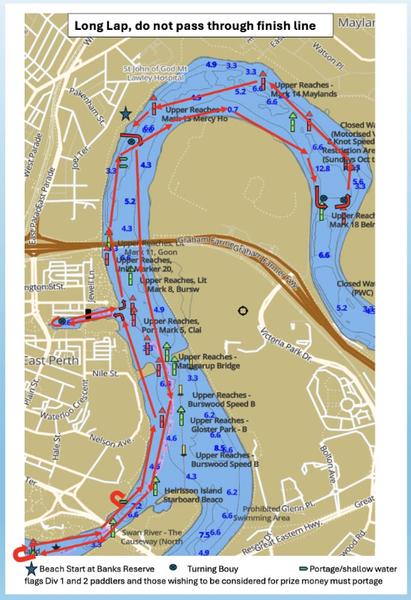
Matagarup Classic! 14th December 2025 Courses [See Map]: Main Race [12Km]: Le Mans start at Banks Reserve, up, in and out of Claisebrook Inlet [round Red buoy], up to Heirisson Bridge, back under Matagarup and Graham Farmer Freeway, round Belmont Race
Course, turn at Green spit at end of water-ski area, come to right of all Red spits on way back to Banks Reserve, DO NOT GO THROUGH FINISH LINE, carry on to in and out of Claisebrook Inlet again, back under Graham Farmer, turn at Red spit just beyond finish line, finish between Red buoy and beach at Banks Reserve. Short Course [6.7km]: Le Mans start at Banks Reserve, up, in and out of Claisebrook Inlet [round Red buoy], up to Heirisson Bridge, back under Matagarup and Graham Farmer Freeway, turn at Red spit just beyond finish line, finish between Red buoy and beach at Banks Reserve. Novice & Guppy Course
[3.7km]: Start at Banks Reserve, up, in and out of Claisebrook Inlet [round Red buoy], back under Graham Farmer, turn at Red spit just beyond finish line, finish between Red buoy and beach at Banks Reserve. Register Matagrup Classic 14th
Dec
|
|
|
|
|
|
|
|
|
|