Yukon River Descent
Sunday 18th July.
My diarrhoea was short lived as my morning ‘constitutional’ was back to normal, thank god! Ed was still shy about going to the toilet, so he walked at least 350 metres away before he squatted.
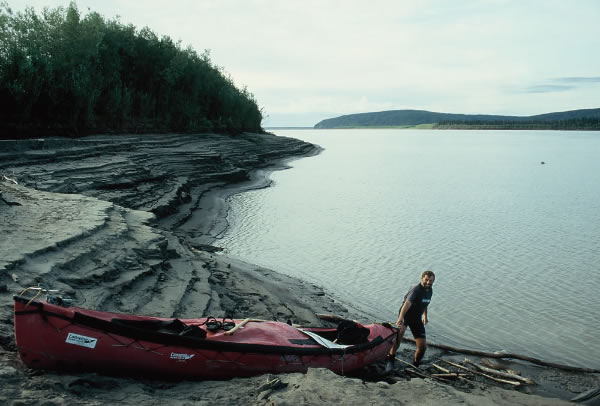
We left Alice Island on a cool and cloudy morning with little wind to give us trouble down the first long straight. Nearing Fox Island we had two choices, I assumed
the left and straightest channel would be deeper and faster so we followed it. It soon shallowed however, with sandbars popping up to slow the water and our progress.
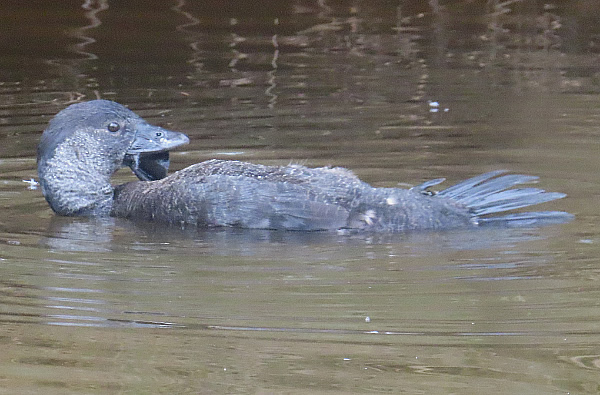
A flock of fifteen ducks floated in front of us. They soon scattered flying forward and then landing again. Some fled by walking on water. We followed them for some time before they were finally tired of having to keep
fleeing, we never saw them again.
The experience reminded us of lunch time a few days earlier. As we were paddling towards a sand bar we watched a duck scoot across the water at supersonic speed as if it couldn’t fly, reminding me of the Road Runner cartoon. As we paddled away from the sandbar it kept scooting after us as if we were its mum.
The current slowed considerably and it was hard to push around the long eroded bend. It had been my decision to take the channel but I wished now that we had taken the other one as I was feeling guilty. The canoe dragged along the shallows for kilometres, until at last the two channels joined and formed deeper water just before the Graylin straight. It was great to feel the pull of the current again even if it was
only slow. On the right side of the river the hills were steep with a few cabins located next to streams. We usually stopped for lunch at the 40km mark, but we could see the village of Graylin in the far distance so we kept going.
When we arrived in Graylin we met some summer school students, who were walking to the river. We asked the whereabouts of the store and Washeteria, but as it
was Sunday nothing was open! One of the student leaders had lived in Tasmania for six weeks. She was from New Jersey in the US and her co-worker was from Anchorage. They were there to run a summer camp activities for the local students.
Two guys came over, one looked a real redneck, scruffy with no front teeth. He wasn’t the sort of guy that you would want to meet on a dark night or in
the middle of the wilderness by yourself. After talking for a few minutes they left us and soon after a native Alaskan drove over on his four wheeled motor bike. He told us that we were the first boaters through this season. He also told us how the locals once used rowing boats and dogs to pull boats upstream, now they had big motors on their boats. He also said there wasn’t much work in the village, although some of the men went fire fighting in the summer. He then said, “You should be careful
when you pass Anvik, they have the worst mosquito population in the world, it’s called Mosquitoville, and don’t drink the water there, it is foul”.
He finished off by saying, “As you move downstream you will see more people and the villages are bigger due to the population being Catholic”. He then started his bike and shot off whilst we were having a meal of noodles and breakfast
cereal and later returned with a clip seal bag full of dried fish. We thanked him – they tasted a little oily, but still delicious. We now had dried fish for another two lunches.
Heading towards Anvik the right shores were hilly and we managed to find both water and lots of mosquitoes in a stream near Point Hill. Anvik was somehow eluding us. We should have been able to see it several
kilometres away, but somehow it was hidden; only a lone house on a hill could be seen. We were puzzled as to its whereabouts, we knew it had to be close, but somehow it wasn’t there. Just as we were about to think that we were going crazy or our map reading skills had gone to the dogs, we suddenly saw some houses down a channel behind a swampy island 200 metres away. Yes, we had now found the well camouflaged village.
We started paddling up the creek against a flow of the current, meeting an army of mosquitoes that swarmed around us like bees around a honey pot. I sprayed myself with insect repellent and Ed hid under his white mosquito net. Ed was ready to retreat back to the main river but I persuaded him to paddle up to the muddy boat ramp. I jumped out and sank right up to my knees in mud. As I explored part of the community Ed sat there in the canoe like a gnome
wearing a mosquito net.
The village was surrounded by a channel, a big flood plain, a swamp and lots of greenery, one of the best breeding grounds for mosquitos ever to be seen. The old guy at Graylin was right, you just don’t stop here unless you love mosquitoes and have a passion for scratching.
It didn’t take me long to realise that the town didn’t have anything I needed, apart from a large can of insect repellent. Ed was sitting in the canoe protected by his mosquito net, patiently waiting for my return. Once back in the canoe we paddled hard to clear the swamp and get away from Mosquitoville. We wondered how anyone could live there but I suppose people get used to the mosquitoes. Once back in the main river we passed a high hill and drifted along trying to
kill the mosquitoes that hung on our clothes or were biting our flesh. When we were happy that they had all been eradicated we lay back, put our feet over the gunwales and took in the sun. We drifted with the current, dozed and relaxed completely. Ed was soon well out of it listening to his music through his head phones and nothing could stir him.