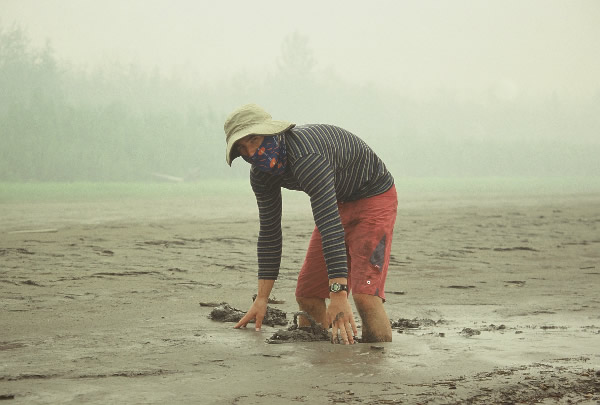
Suddenly we heard a loud sound that for a brief moment seemed as if it was coming straight for us. Our hearts skipped a few beats until we realised it was a car on a road running close to the water’s edge. When the noise faded we narrowly missed several fallen trees that were poking well out into the river. My eyes strained through the thick smoke
looking for the shore, fallen trees and powerboats.
We finally reached Galena and immediately saw two kayaks on shore. I climbed some steps ascending the riverbank to find a National Parks office with two tents erected on some lush grass in front of it. I walked into the office and asked the receptionist where the store was. One of the ladies asked me how long I was staying. She then
went on to tell me that it would be better to keep moving. It was as if we were not welcome in town. I responded with, “Are you trying to get rid of me?” She then replied with a laugh, “No, it’s the smoke, the fire is directly across from the town and visibility will not get any better for days, but it should be clear further downstream”
There were two stores in town but they didn’t
have nearly as much choice as we’d found in Tanana. One store sold beer, probably the reason why it was busier than the other. We needed minimal food other than bread and cheese but we felt cheated somehow when we walked out with so little.
Our need for water was far greater than groceries, so we walked over to the laundry to check it out. Inside we found the two kayakers, a German and
a Japanese man, watching their clothes spin around and around. It was as if they were watching a TV. We introduced ourselves and the Japanese chap asked us if we wanted a beer. We declined but he was insistent and put two beers in my carrier bag for later. They had started paddling from Whitehorse on June 6th and were also going to the end of the river.
We returned to the boat for
lunch. Ed didn’t want his beer so I had two, and by the time I had eaten spam paste and cheese spread sandwiches and an apple I was feeling pretty happy with life!! After lunch we moved 200 metres downstream and docked again, this time closer to the laundry so we could top up all of our water containers.
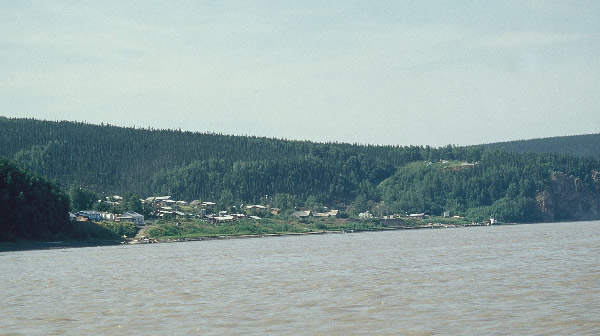
By the time we reached the laundry for the second time the smoke had cleared a
little and we were able to see an airfield across from it, complete with a control tower and numerous other buildings. There was once a US military airbase nearby but it had closed down some years ago and I think there is only a small military presence there now.
Like most communities in Western Alaska, Galena is a fly-in village: there are no highways, roads, or power lines linking it
to the state’s larger centres. Large diesel generators are used to produce electricity, using fuel that is delivered during the summer months by a river barge when the Yukon is ice-free. The resulting electricity costs for local residents here are nearly three times the national average, even with assistance from a state-funded subsidy program.
There was nothing to keep us in
town (although we were later told that there were important fossils on display at the council offices), the smoke had put paid to that, so we pushed off again to find clearer air further down the river. With the smoke dissipating, a large cargo plane screamed along the runway and took off right over us giving us quite a scare.
As the smoke thinned our breathing became easier and we no
longer needed our mouths covered to filter the smoke. Things seemed to be looking up. We paddled on hoping to find the perfect campsite, without success. Eventually we had no choice but to camp on the end of Bishop Rock Island on a tiny clearing right at the point. It really didn’t look a pleasant site but we could see no better camp spot downstream. When we landed there were hardly any mozzies or gnats around, despite being only metres from the forest edge. However the huge bear tracks
imprinted in the mud were more disturbing as we didn’t have a lot of room to run! A narrow channel on the north side of the island separated us from the mainland, an easy swim for a bear. If we were going to have visitors it could be tonight. We made camp and ate dinner with a large number of beautiful dragonflies flying around us, which had us thinking that maybe our camp wasn’t so bad after all.
Thursday 15TH July.
I woke somewhat disappointed that bears hadn’t visited us during the night. I really wanted to take a photo of one scoffing our food or poking its head into my tent. After all, this was Alaska and weren’t bear encounters meant to happen here?
There was little room to go to the toilet unless we wanted to squat down in a thick forest full of mozzies. Instead I walked along the vegetated shores to bare my bum. Immediately a swarm of mozzies flitted around my backside probing my delicate skin. The mozzie repellent that I’d squirted on my bum had no effect. I have to say, it was one of the quickest toilet breaks that I have had. Ed was a little smarter than me, he used his
big mozzie net to cover himself completely. I was beginning to think that his mozzie net idea wasn’t such a bad thing after all.
Two big trees floated by our island camp at a good speed, one from each channel, and the thought of giving chase after them gave us something different to do in our day. But by the time our paddles were beating the water they were well gone and completely out
of sight, and had disappeared into thin air.
We often spoke about staying on the water throughout the night and sleeping in the canoe and just letting the current carry us downstream to see how far we could get. That way we would cover a few kilometres without exerting any energy. If we were going to do it though, it had to be very soon, there weren’t too many days left of our journey.
Paddling hour after hour gave us lots of time to think and dream and by now we both had plans that we wanted to put in place when we returned home.
About 10kms from our camp, cranes and earth moving equipment could be seen along the north shores close to the village of Koyukuk. We had no idea what they were doing there and we didn’t stop to find out. At this point we were at a major
turning point in our journey, it was here that the river changed direction and headed directly south. With less than 850kms to go it really felt as if we were heading home. Nothing, not even the strongest wind could stop us now from reaching our goal. Even if we cut our days paddling distance to 60kms we would still make it on schedule.
We were so excited at the thought of the end of
the river, we felt as if we could walk on water. The ecstatic feeling lifted our spirits and gave us a warm glow inside. It was one of those days when we didn’t mind paddling at all – in fact it was enjoyable and the sight of a few deserted cabins scattered along the sloping cliffs and hills on the right side of the river gave us points of interest. The day was still and with no wind to slow us down we made good time to Nulato. By 12.15pm we floated by the hillside cemetery and were captivated
by the sight of several small shrines lining the slopes that led towards the hillside cemetery.
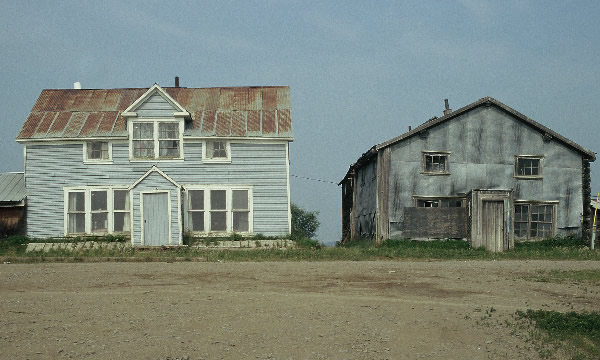
As we headed for shore there were two old double-storey houses leaning in opposite directions, looking like something out of a children’s story book. They instantly gave the village charm and character. It was like arriving in an old western goldmine town instead of a small Alaskan
village.