|
|
|
|
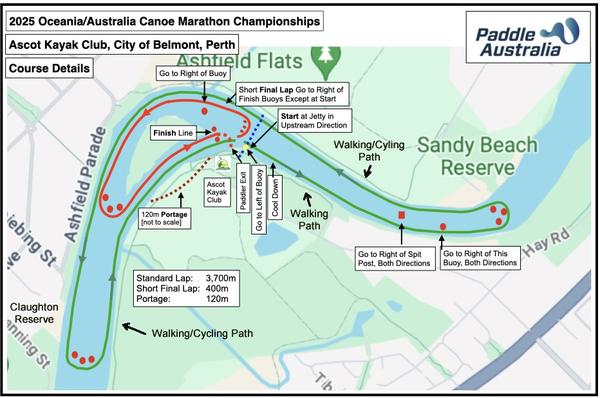
Due to the low water levels the Northam to Toodyay Race has been moved. It now starts at the lower end of Bells Rapid near Bolland's Elbow and finishes at Ascot Kayak Club, a near 30km paddle. *********************************** Paddle Australia is excited to share our Paddle to Paris documentary.
After thousands of training hours, it will come down to just seconds for our One Team in
Paris.
Tune in this Sunday 14 July to watch the Paddle to Paris documentary, following the journey of our 18 Aussie paddlers to the Paris 2024 Olympic and Paralympic Games. Sunday 14 July 2024
1pm QLD/NSW and 2pm VIC/WA/SA/TAS
LIVE and FREE on Channel 9 and 9 Now
- Wild Water Race
- The Marathon Dinner
- The Yukon River Descent - Twenty Years Ago
- Ullswater Lake
- Lake Titicaca
- Junior Wild Water Racing - Europe
- Clint Robinson Coaching
- Little Black Cormorants
- Coming Events
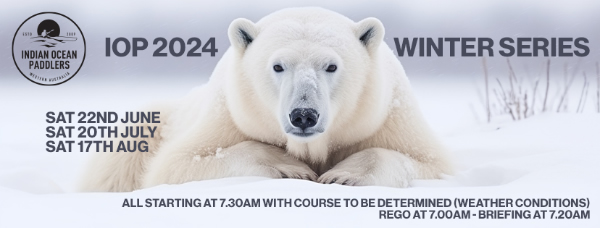
- 20th July 2024 - IOP Downwind Winter race #2
- 26th July Friday - Avon Scrutineering afternoon.
- 28th July 2024 -
Walyunga N/P to Middle Swan
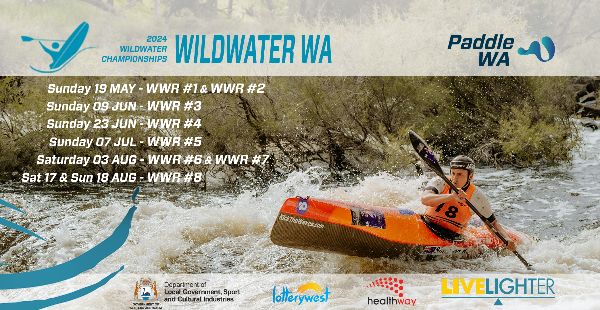
- 3rd August 2024 Saturday afternoon -Wild Water Races #6&7
- 10th - 11th August 2024 - Avon Decent
Wild Water Race Yagan
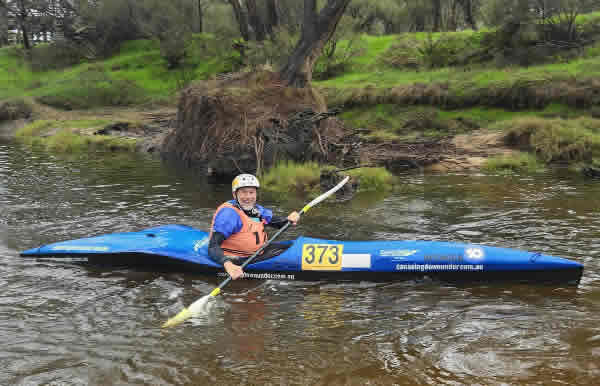
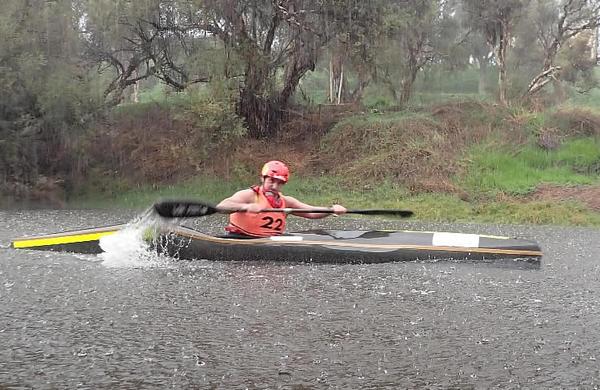
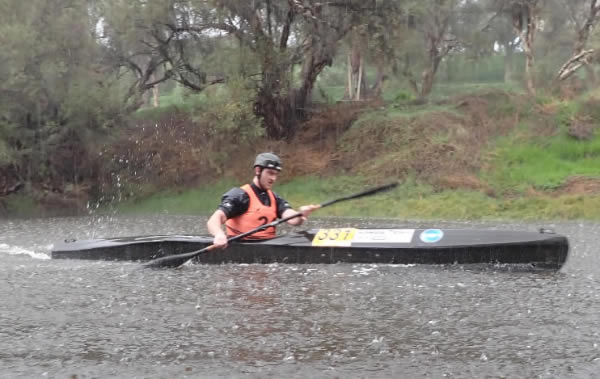
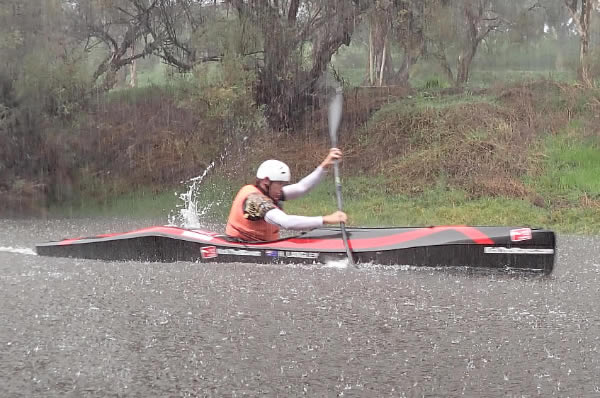
Bridge (Upper Swan) to Amiens It wasn’t the best day for photography, the river levels were low but nevertheless the course was tricky which made for great racing. The low water and tight channels with tight turns did mean that mistakes can easily be made even by the best paddlers and for a few paddlers that did happen. For Harry and Nina who are back from the European
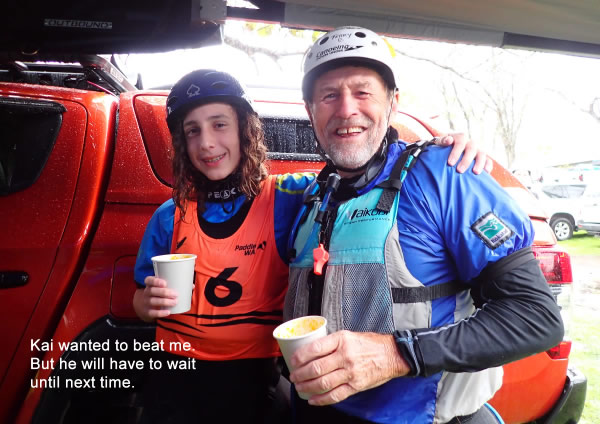
World Cup races they made no mistakes and were first in their classes. I managed to get back into the top 10 again (due to some faster paddlers missing) as well as beating young under 18 Kai Stafford who has been dying to beat me. (I think he will at the next race.) Young Rhys Macrae not too long ago had the same thoughts, but he has been beating me for some time now and he is on
his way to the top. When Jill Roberts, (who paddled in this race for the first time on a ski,) gets in a Wild Water Kayak and gets to understand the water currents, she is going to be one to watch.
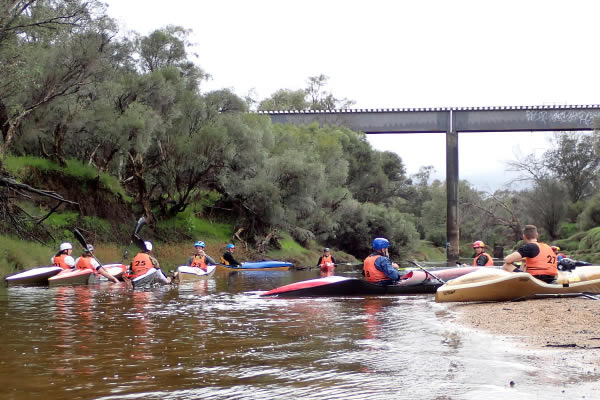
Some of the paddlers gather at the start.
We paddled up to the start.
Darryl Long about to cross the line.
David Burdett will be heading to Europe for the world champs in a couple of weeks.
Harry Langley will be heading to Europe again for more racing this time for the world championships.
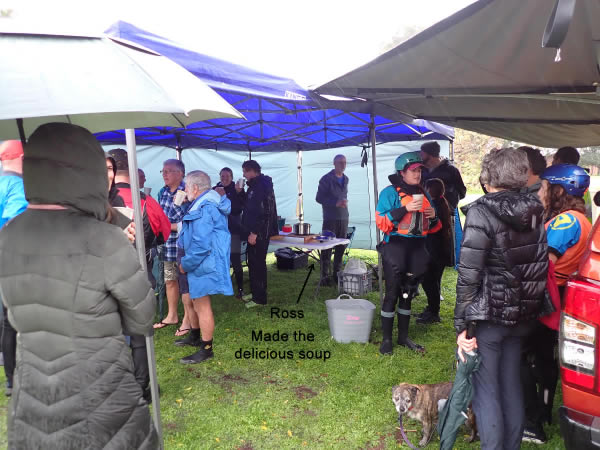
Soup time at the finish thanks to Ross Burdett.
Kai Stafford. The young and the old. I try to beat all the
newcomers to wild water racing as long as I can.
But the young guns don't take that long to pass me. If you want to get on some easy moving water check out the section of river between Bolland’s Elbow at the bottom of Bells Rapid to Amiens Crescent. It is a great section to paddle when it’s low
water. It’s not death defying, but even in low water it can be a challenge. Thanks to Christopher Greed, Kate Mcrae, Izzy Combe, Ross for the soup and Kris and Steph Bedden for organising the race.
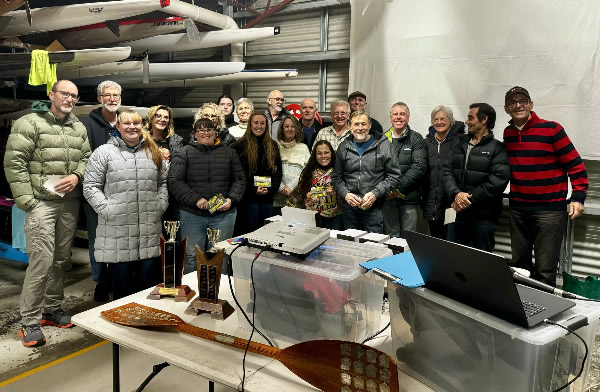
The Marathon Dinner Ascot Boat shed
Some of the volunteers who help out at the races. The Marathon Committee Members are Doug Hodson - the leader Lily Farrell, Warren Southwell, Martin
Watson, Joe Dowse, Peter Martin, John Hilton and Terry Bolland.
Behind the scenes and webscorer expert Ray Smith jnr. Members doing a Marathon Officials Course at the moment are-
Doug Hodson, Warren Southwell, Peter Douglas, Peter & Bronwyn Martin, Martin Watson & Terry Bolland. We are getting ready for
next years Australian Marathon Championships. Put it on your training calendar. 11/12/13 April 2025
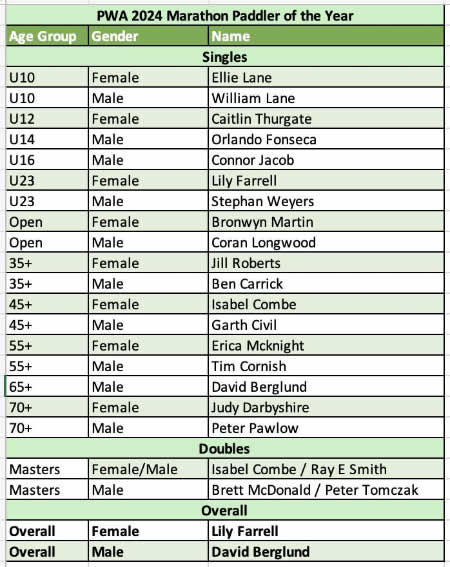
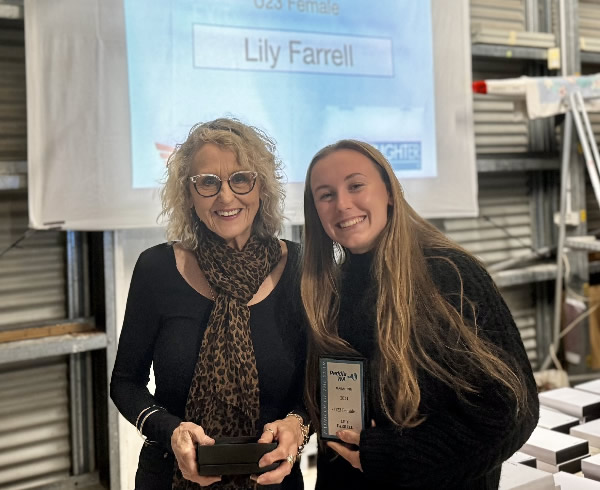
Overall Ladies Champion - Lily Farrell
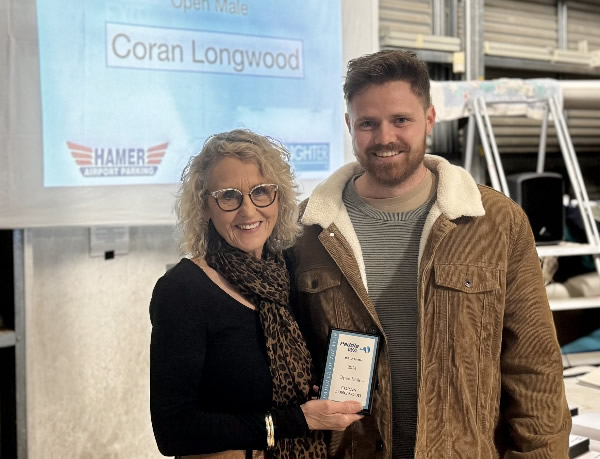
Overall Men's Champion - Coran Longwood.
The long course at the Australian Marathon Championships next year.
The Yukon River Descent 20 Years Ago Saturday 19th June. It was 9.00am when I awoke. The sun was already scorching the tent and flies were buzzing and flapping between the inner and the tent fly and making one hell of a racket. I got up and started packing slowly, allowing Ed the chance of a sleep in. We were now ahead of schedule and with only a few kilometres to
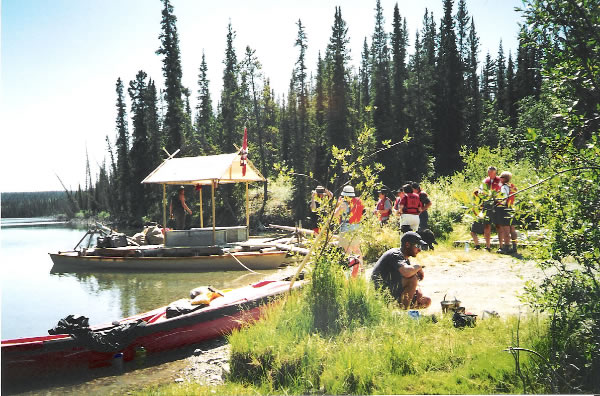
paddle that day, we were in no hurry. Dominating the river were high sand cliffs which appeared and disappeared all along the way. A few houses stood prominently on top of the big cliffs and so close to the cliff edge that I could envisage erosion would have them falling into the river in a few years’ time. Just before lunch we came across some people mingling on a jetty belonging to a huge mansion. It had an immaculate green lawn right down to the water’s edge creating a great camp site. We passed them slowly in the hope of an invitation but nothing was forthcoming. Further along in a small cove, a guy was leaving a jetty in an old looking boat/raft with the words ‘Gold Rush Tours’ on the side. Two dogs followed it by running along the bank and through the
woods. Within 2kms the raft stopped next to a road and the dogs caught up. It looked a great spot for lunch so we stopped too. We had a chat with the guy about his tours; he was trying to replicate the gold rush days, when prospectors would drift down the river on rafts. And as in Australia, he too was faced with spiralling insurance costs, which were making his tours
uneconomical. As we cooked our noodles, his dogs started sniffing around our pots and nearly had our noodles for their lunch. The black one had white eyes like the devil and a pretty scary face.
Saturday 19th June. It was 9.00am when I awoke. The sun was already scorching the tent and flies were buzzing and flapping between the inner and the tent fly and making one hell of a racket. I got up and started
packing slowly, allowing Ed the chance of a sleep in. We were now ahead of schedule and with only a few kilometres to paddle that day, we were in no hurry. Dominating the river were high sand cliffs which appeared and disappeared all along the way. A few houses stood prominently on top of the big cliffs and so close to the cliff edge that I could envisage erosion would have them
falling into the river in a few years’ time. Just before lunch we came across some people mingling on a jetty belonging to a huge mansion. It had an immaculate green lawn right down to the water’s edge creating a great camp site. We passed them slowly in the hope of an invitation but nothing was forthcoming. Further along in a small cove, a guy was leaving a jetty in an old looking
boat/raft with the words ‘Gold Rush Tours’ on the side. Two dogs followed it by running along the bank and through the woods. Within 2kms the raft stopped next to a road and the dogs caught up. It looked a great spot for lunch so we stopped too. We had a chat with the guy about his tours; he was trying to replicate the gold rush days, when prospectors would drift down the river
on rafts. And as in Australia, he too was faced with spiralling insurance costs, which were making his tours uneconomical. As we cooked our noodles, his dogs started sniffing around our pots and nearly had our noodles for their lunch. The black one had white eyes like the devil and a pretty scary face.
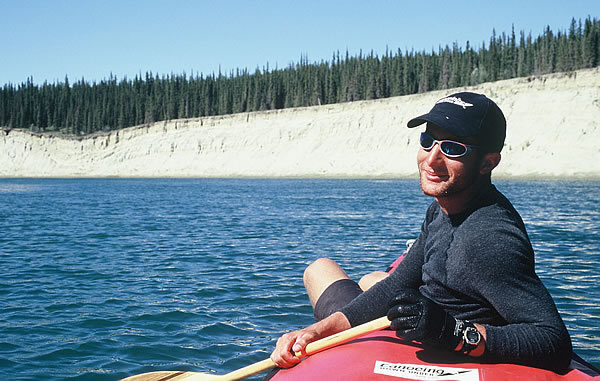
Ed relaxing as we allow the current to push us along.
Ed boils the noodles next to a tourist raft.
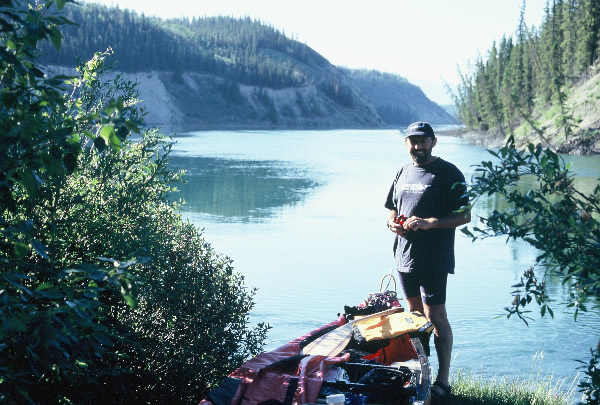
Whitehorse was now only a few kilometres away and we wanted to make camp before reaching the town limits to save money. We stopped at a camp spot at a place called Canyon City. It had once been a thriving town but it has been abandoned for so many years that now there are no buildings standing. Canyon City was built because of the Canyon Rapids
just downstream of it. When the miners floated down the river on their rafts they had to stop at Canyon City or run the risk of being capsized by the rapids downstream. The rapids were too dangerous to run with loaded rafts or boats and inexperienced skippers. Instead, most miners would unload the gear from their boats onto trams at Canyon City and experienced river guides would float the boats down to a safe area below the rapids. The trams would then take the gear to a loading dock below the
rapids; from there it would be reloaded into the boats again. It was early, too early to camp and because it was a public place we lifted the canoe from the water and sat in the shade watching the river traffic, a tour boat and a few walkers go by. Throughout the remainder of the day several canoeists passed by, the last at about 9.30pm. How great it is to have daylight for so many
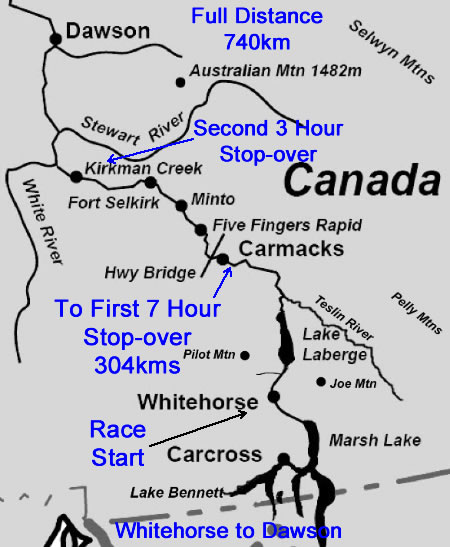
hours. Two families water skied and picnicked with their children. One guy attempted to get up on his skis many times, but failed every time and spent at least half an hour in the freezing water. I could only imagine how cold he must have been. When his wife tried, she got up straight away and flew down the river like a true professional. We sat around and started working on our race plan again and what gear we would actually take with us in the boat. It was difficult to estimate how we were going to cope with such a long race and Ed seemed overwhelmed with the 740km distance that we had to do. For our first stretch of 304kms we estimated taking about twenty four hours which would get us to the 7 hour compulsory stop. Then we would be left with 436kms and a three
hour compulsory break in between, but we couldn’t even guess how long it would take us to do that stretch. At 11.00pm as I was sitting on the canoe overlooking the river and writing my diary there were still boaters and walkers passing by. Don’t these people sleep? I finished my diary in the tent away from the mozzies. At midnight I could still hear a few people out and
about.
Rest time. Sunday 20th June. We were up at 7.30am. My wonderful night’s sleep
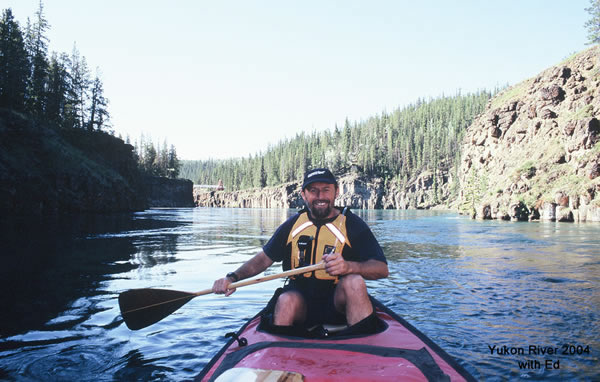
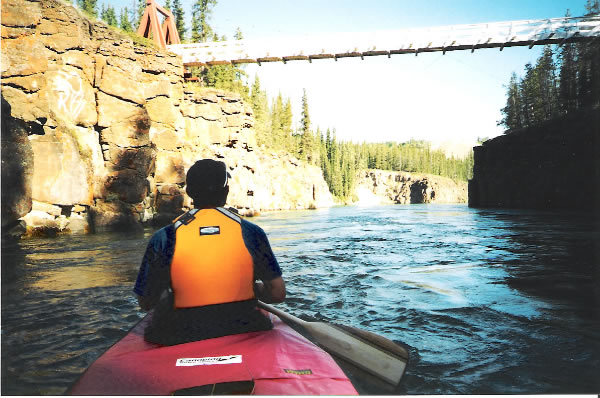
had been full of dreams, but it was hard to remember a complete one; over breakfast I was trying to piece them together. Once on the water we reached the Canyon within minutes. Due to a dam having been built downstream the rapids had disappeared, though the river still had a good flow. The vertical canyon walls made it an impressive sight. We drifted and took photos and tried to imagine what it would have been like in the good old days before the dam was built. Within minutes the current had
pushed us under a walk-bridge that gave pedestrians fantastic views of the narrow canyon, and then out into a small lake, which was home to several float planes. We moved across to the right side of the lake to land close to the dam wall where we would have to portage about six hundred metres. I walked down the road for about three hundred and fifty metres, past the Fish Ladder
Information Centre and Viewing Building and after another two hundred and fifty metres I found a spot where we could launch again. On my return I asked the guy at the information centre if we could leave our gear in the building for safe keeping for a few minutes so we could do the portage in two parts. Thankfully he was happy to oblige. The Fish Ladder and Information Centre was a popular tourist attraction. It gave tourists an insight into how the fish, which swim up river to spawn, swim up
the fish ladder to get upstream beyond the dam. Some salmon swim over 3000kms, from as far away as the Bering Sea to spawn.
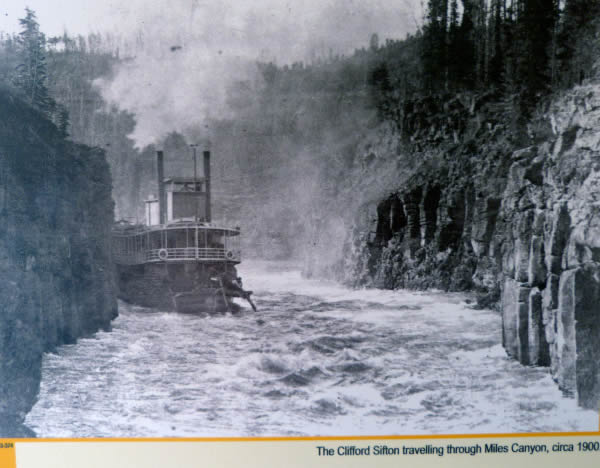
The Canyon has now been dammed so there are now no rapids, just flowing water.
In the goldrush days. The Canyon before being dammed.
Back at the canoe we saw a pick-up truck coming towards us. We thought it might be an employee from the dam about to offer us a lift, but unfortunately it turned around and motored away. Disappointed, I put on my day pack, tied some rope onto my big drum and large dry bag and hoisted the rope across my shoulder. Ed did a similar thing. It was quite
a load and it wasn’t a pleasant walk. We returned for another load and on our third trip we carried the canoe. We had left some gear in the boat, which made it even heavier, and by the time we reached the kiosk our backs were hurting. Once everything was at the kiosk we then had to do it all over again, to get the gear down to the river. The portage was long, hot and hard work, but there was no point in complaining. It had to be done. Before launching we visited the Fish Ladder Information Centre, thanked the man for allowing us to leave our gear there, had a quick look around and took photos of a full length map of the Yukon River that was on the wall. Seeing the map made us realise how far it was and here we were only near the very start! There were
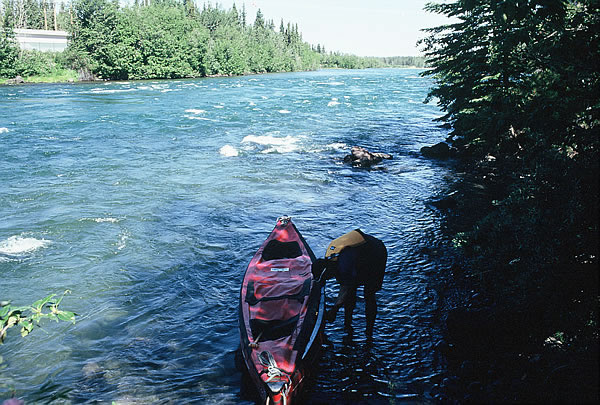
some good rapids below the dam and wires spanning the river to carry poles for a canoe/kayak white water slalom course. We put our canoe into the water just before the last rapid. The river was flowing at a good speed and further down we could see rapids approaching. Here the river widened. I steered us on a safe route, a little anxious of the rapids waiting downstream. We approached the rapid where the fast water was sweeping through a few rock bars and raced down a twisted tongue of water
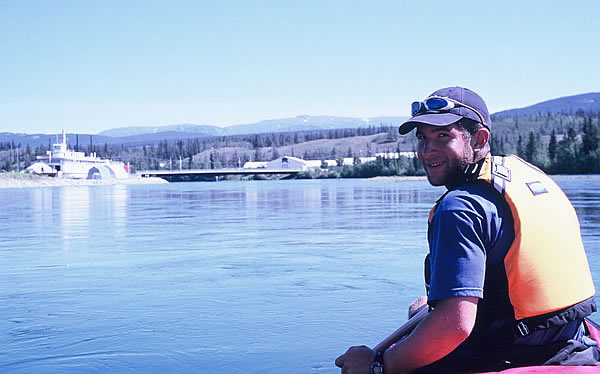
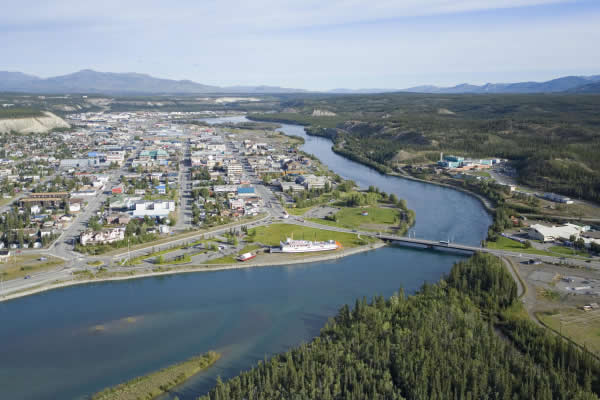
trying to avoid the rocks and big eddies that could easily throw us into a spin. It was great fun, the water was splashing into our laps and pooling onto our spray-deck but we didn’t care, we were having a great ride and it was cooling us down. For a few minutes we were in a frenzy, but suddenly all the excitement stopped as we rounded a corner and into calmer waters. Ahead we could see an old paddle steamer located on the left shore and a little further, a bridge. We were nearing the heart of
Whitehorse and a new phase in our journey.
Putting in below the dam. We enter some easy rapids.
With steadying heart beats we cruised towards the town centre taking photos along the way and landed on the riverbank next to the ‘Kanoe People’ store. Three locals drinking the afternoon away sat close by. We left our canoe nearby and walked a few hundred metres to the ‘Up North Adventures store’, hoping the gear was going to be there when we
returned. We grabbed a cart and wheeled it back to the river. We put all our gear on the cart and pushed it back to the ‘Up North Store’ where we had organised temporary storage. It was really warm with temperatures well over 30˚. Once the gear was stored, we walked around town looking for Bed & Breakfast places listed in our brochure. Most were full, others weren’t there and some
looked more like the ‘Adams Family’ House. In the end we found a motel room, with air conditioning, a fridge, a good shower and a bath for $50.00 per person per night. It was also close to the ‘Up North’ store and the town centre. Although it cost a little more than we wanted to pay we couldn’t resist the comfort. Ed and I splashed out and had tea at Subway before returning to the
motel to check over our maps and place dots on them at 10km intervals. Ed turned in for the night at 8.50pm. I wrote in my diary until 11.15pm. It was still light outside. The following day we shopped for groceries for our long journey after the race and stored it all with our Old Town expedition canoe, which was being transported to Dawson City where the race finished. We were hiring
a lighter canoe for the race. Later that evening we attended a Yukon River Quest briefing session for competitors. To cap the evening off we were all treated to a free meal.
RACE DAY: Wed 23rd June. WHITEHORSE – The Yukon River Quest. It was while researching on the internet for my Yukon River Expedition, that I happened to read about the ‘Yukon River Quest Race’ and
immediately I was captivated. I just knew that Ed and I had to take part in this fantastic event and with Ed needing no convincing we sent in our $300.00 entry fee. It did mean however, that our whole journey had to be structured around race day. The article read, ‘The Yukon River Quest, at a distance of 740kms is the longest endurance marathon canoe & kayak race in the world’!!
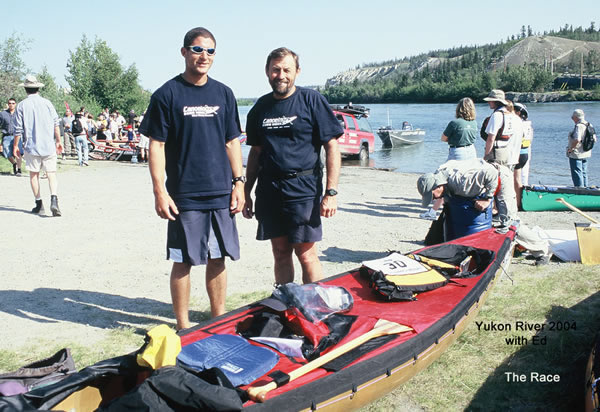
Now that’s impressive! This race was five and half times longer than Western Australia’s Avon Descent and with only two compulsory stops, one of 7 hours and another of 3 hours. It was truly an endurance race. Here was a place that didn’t get dark, here was a river that could be paddled for 24 hours, and here was a river, apart from a 50km long lake, that was running at 5 to 10kms an hour through some stunning wilderness areas. We arrived at ‘Up North’ Outfitters at 8.30am. They were one of the sponsors of the event and rented several other canoes to competitors. We then walked to the start line and the canoes arrived at 9.30am so we were able to check them out and start loading. Our canoe was a Wenonah 18′ Kevlar canoe which was much lighter that our trip canoe and it felt great, but by the time we loaded it with our tent, sleeping bags, clothes, food
and water, it became heavy to lift. Amongst all this gear, I also carried two cameras and a satellite phone. Unlike most of the other competitors, we didn’t have a support team so we had to be prepared to get through the 740km race self-supported. As this was our first time in the event we really didn’t know what to expect, but we had to make sure that we had all the relevant gear to
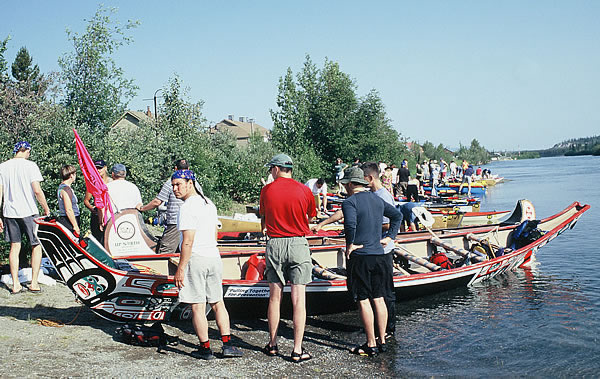
survive the journey whilst keeping it to a minimum too. All canoes had to be fitted with spray decks due to the potential rough crossing of Lake Laberge. Every other team was actively sorting their gear. The big Voyageur canoes that held 6 – 8 paddlers were the most impressive and the most difficult to organise. Many of the canoe teams looked like serious racers, so we really felt like
the underdogs. You could see from the limited gear they had, they were not planning to stop! The biggest majority of craft were canoes and this is how the race organisers liked it, so as to keep the canoeing tradition going. However, single and double kayaks were slowly becoming popular but there was a length and width rule put in place to ensure that the kayaks didn’t become too narrow, long and fast. If they did, the kayakers would blitz the field or become a danger when crossing the lake in
rough conditions. So single and double kayaks had to be sea kayaks; no sleek racing kayaks were allowed. By 10.30am we had everything in the canoe and the spray deck strapped down. We were now ready and had time to return to the motel to collect our water bottles and cooked rice for our journey. Unfortunately we had packed away the milk and sugar to add to the rice and without those
essential ingredients my rice wouldn’t taste as good, so I threw it away. Sweet rice has always played a big part in my long races. It has always kept me going, now we would have to do this race without it! We finally closed the door of the motel room leaving all the creature comforts of home. No more TV, no more showers, no more comfortable bed and no more toilets for some time. Our home for the next forty two days at least, would be camping on the river.
All boats are in place for the start of the race.
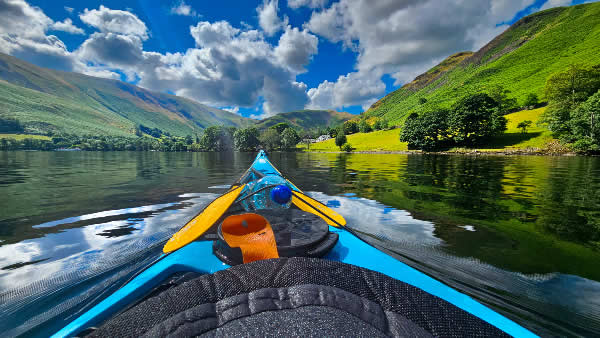
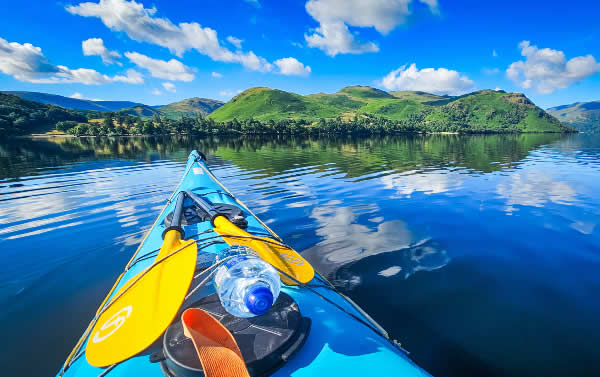
Michael Lawless Ullswater, Lake District, UK
Ullswater lake is the second largest lake in England at seven and a half miles long, but is less than a mile across. It is also the third deepest English lake at 250 feet deep. There are dramatic views from both sides of the lake. It is surrounded by stunning mountain scenery to its south,
softening to the gentle hills of the north.
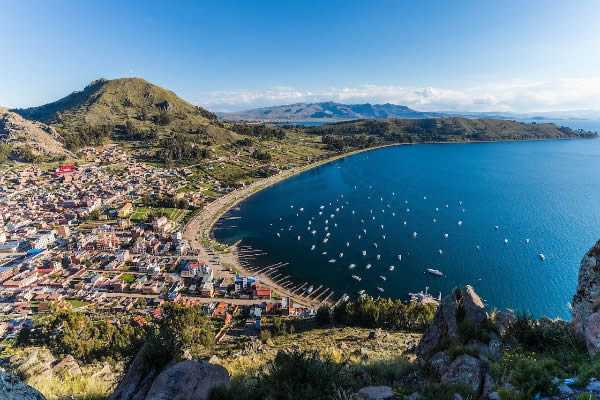
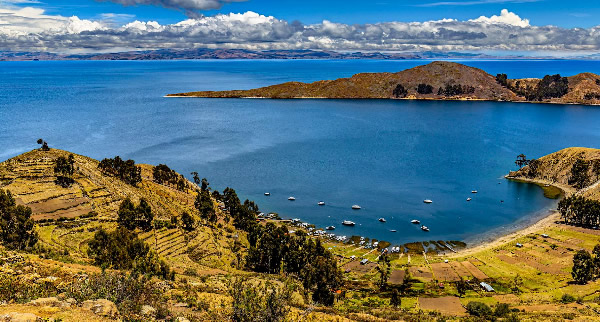
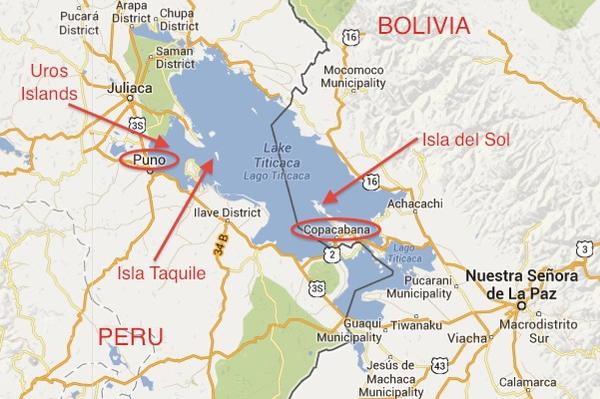
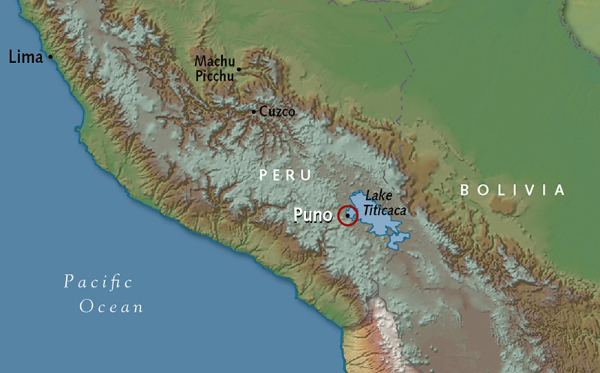
Lake Titicaca Peru and Bolivia Highest navigable lake in the world Lake Titicaca is located on the border between Peru and Bolivia. It is the highest navigable lake in the world, at an altitude of 3,812 meters above sea level (numerous smaller lakes around the world are at higher elevations). With a
surface area of approximately 8,372 km², it is the largest lake in South America by water volume and surface area. The lake is known for its rich history and cultural significance to Andean civilizations. The lake has had a number of steamships, each of which was built in the United Kingdom in "knock down" form with bolts and nuts, disassembled into many hundreds of pieces,
transported to the lake, and then riveted together and launched.
A view of Lake Titicaca taken from the town of Copacabana, Bolivia.
According to Inca mythology, the god Viracocha emerged from its waters to create the sun, the moon and the stars. Pre-Inca cultures, such as the Tiahuanaco, also considered the lake sacred and established large ceremonial centers on its shores. Titicaca is home to numerous islands, both natural and artificial. Among the most notable are Isla del
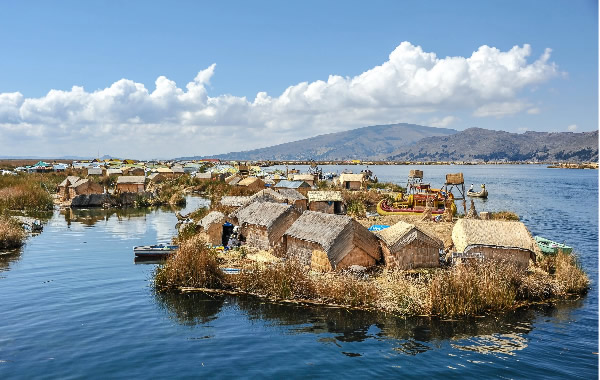
Sol and Isla de la Luna, which are important archaeological sites with Inca ruins. The floating islands of the Uros, made of reeds, an aquatic plant, are another notable attraction; The Uros, an indigenous group, have inhabited these islands for centuries.
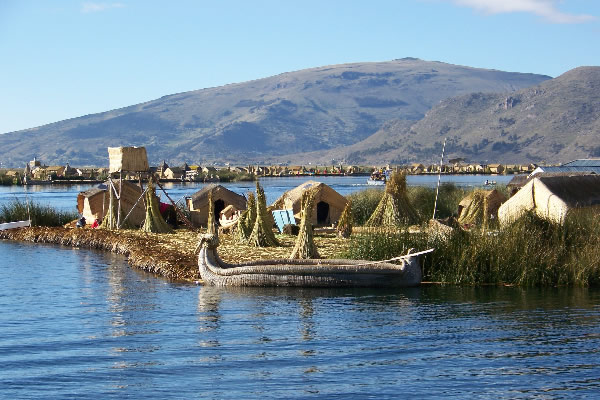
The "Floating Islands" are small, human-made islands constructed by the Uros (or Uru) people from layers of cut totora, a thick, buoyant sedge that grows abundantly in the shallows of Lake Titicaca. The Uros harvest the sedges that naturally grow on the lake's banks to make the islands by continuously adding sedges to the
surface.
According to legend, the Uru people originated in the Amazon and migrated to the area of Lake Titicaca in the pre-Columbian era, where they were oppressed by the local population and were unable to secure land of their own. They built the sedge islands, which could be moved into deep water or to different parts of the lake, as necessary, for greater safety from their hostile neighbors on land. Golden in color, many of the
islands measure about 15 by 15 m (50 by 50 ft), and the largest are roughly half the size of a football field. Each island contains several thatched houses, typically belonging to members of a single extended family. Some of the islands have watchtowers and other buildings, also constructed of sedges.
Five major river systems feed into Lake Titicaca. In order of their relative flow volumes, these are Ramis, Coata, Ilave, Huancané, and Suchez. More than 20 other smaller rivers empty into Titicaca. The lake has 41 islands, some of which are densely populated.
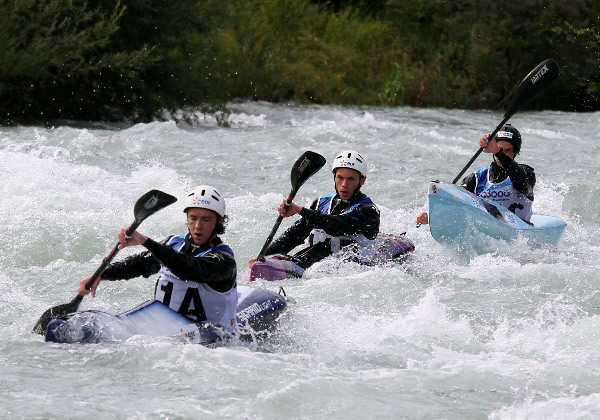
Wild Water Racing in Europe Junior Team Events Widwater racing is a competitive canoe/kayak discipline whereby the athlete must manoeuvre a 4.5m long and quite unstable craft down a section of river as fast as possible. The boats are constructed from composite materials such as carbon, kevlar and fibreglass and must weigh a minimum of 10kg including
mandatory airbags fitted in the bow and stern. Wildwater racing boats are not permitted to have rudders. Instead, the athlete must tilt the boat to one side, utilising the boat’s curved profile to effect the turn. The boats must adhere to a minimum width, with the widest part of the boat being on the deck behind the cockpit. This ‘winged’ profile creates good secondary stability when the boat is on edge for turning. Wildwater athletes use ‘wing-blade’ paddles to
produce more power and efficiency. There are two forms of wildwater race; classic and sprint. Both are time trial whereby the athletes are set off at intervals (usually of one minute). The classic race ranges from 10-30 minutes and is thus aerobic in nature. The athlete must learn all the intricacies of a 4-10km section of river and must be familiar with the course at
a variety of water levels because variations in flow may create different options for faster lines. The sprint race is usually held on a very difficult section of white water and there are a number of heats, with the top 10 athletes making it through to the final. The race is between 200-600m (45-120 seconds) and the sprint races are either contested on artificial white
water courses or on a natural river. Due to the difficulty of the white water and the short duration there is very little room for error in order to get a good result. Sometimes 10 athletes can finish within the same second.
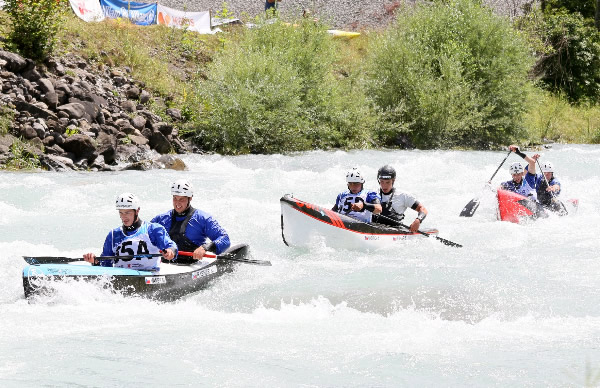
It's great to see that C2s are still paddled. Teams are made up of three competitors in the same class. For a team start all boats are released at the audible start signal, all athletes must pass through the start line within 10 seconds of the release. In the team event all 3 boats must cross the finish line within 10 seconds of each other. If the team will not pass the finish line within 10 seconds they will be disqualified for
that run
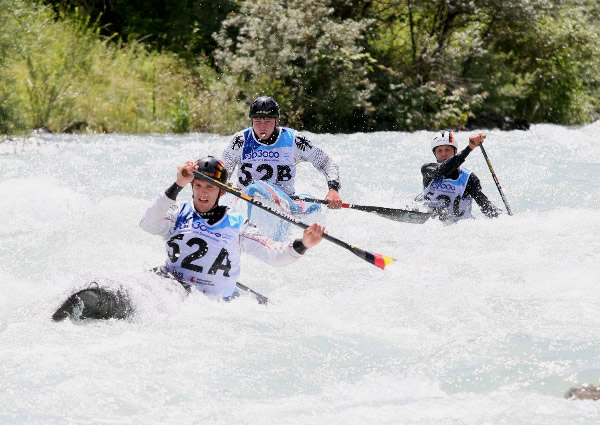
Paddlers in C1 are tested in the rapids. Any athlete or team overtaken by another athlete or team must allow the overtaking boat/s free passage if the overtaking athlete shouts
"free".
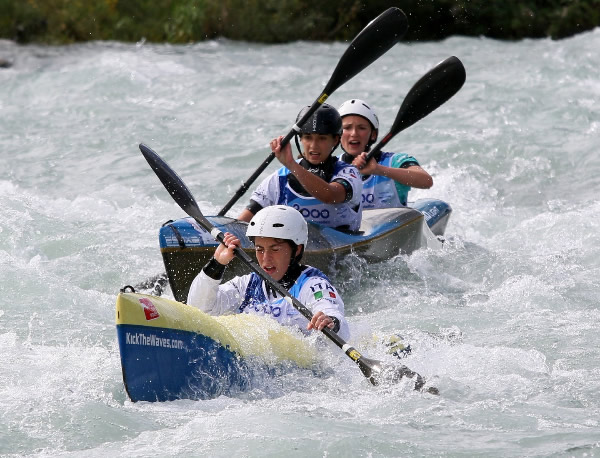
Girl's team event. In team events, the time is measured from the departure of the first boat until the arrival of the last boat.
Boy's team event. Crossing the finish line upside down disqualifies the run. The boat is considered upside down when the body of the athlete is entirely under water.
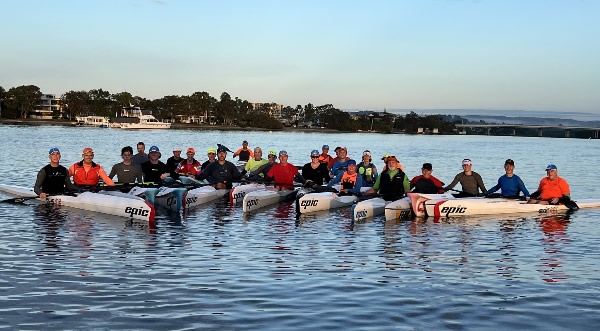
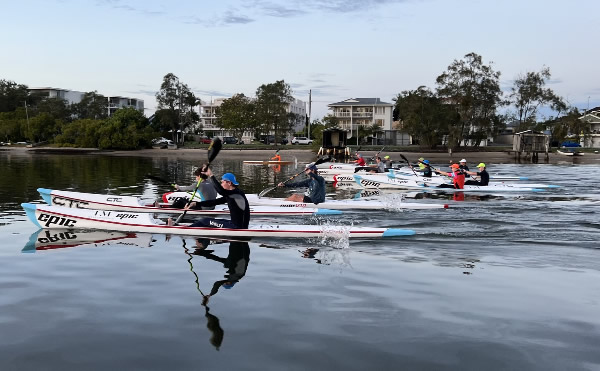
SUNSHINE COAST CAMP 2024 with Clint
Robinson What a cracka of a day - and a little tiring  5.30am - our Camp Group joined the Base Endurance Technique Session with the Clint Robinson Paddling Group for 90 minutes 8am - we all enjoyed a big gathering at Murray's Cafe for breakfast 10am - the rest of the morning was taken up with Video Feedback for each paddler's technique development 2pm - another water session from Maroochydore River out around Old Woman Island and back in through the tricky Maroochy River
Mouth 6pm - dinner at the popular Rice Boi in Mooloolaba Wharf Bring on tomorrow's session!!
Ready for technique training.
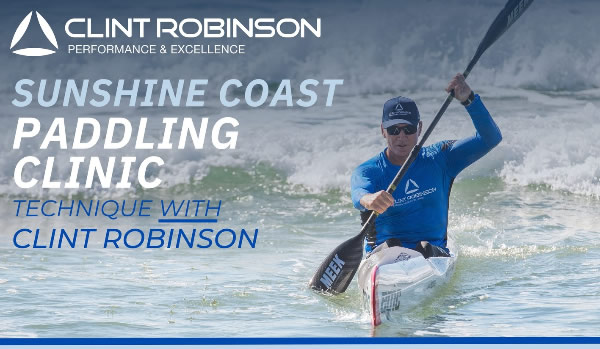
Coach Clint Robinson Olympic Gold Medallist. Member Australian Olympic Team – Beijing 2008 Member
Australian Olympic Team – Athens 2004 – Silver Medallist Member Australian Olympic Team – Sydney 2000 Member Australian Olympic Team – Atlanta 1996 – Bronze Medallist Member Australian Olympic Team – Barcelona 1992 – Gold Medallist World Kayaking Champion – 1992 & 1994 Australian K1 1000m Champion – 11 times (2 x Junior, 9 x Open) Australian K1 500m Champion – 5 times (1 x Junior, 4 x Open) just a few of his achievements.
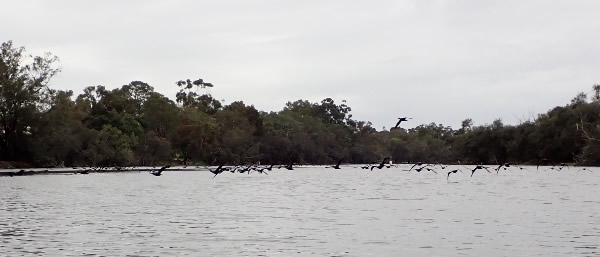
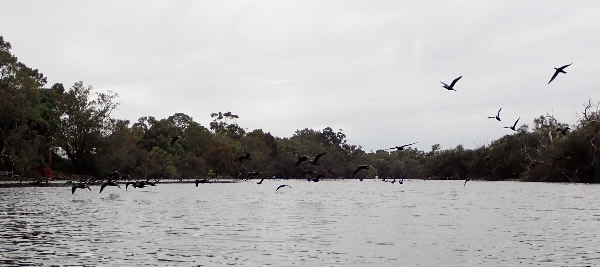
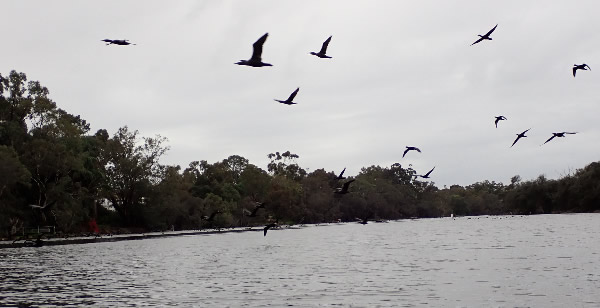
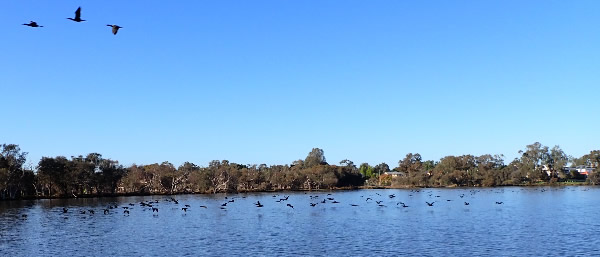
In May/June the Little Black Cormorants are great to watch on the Swan River and they are still around. They come in their thousands sweeping down the river like squadrons of aircraft. It’s especially exciting
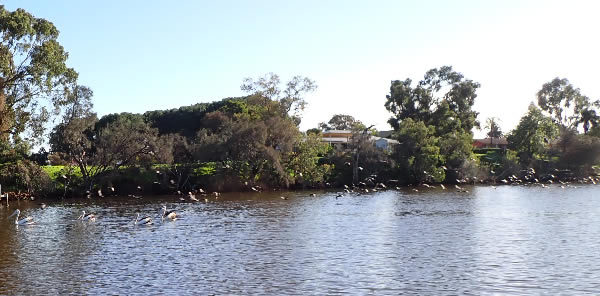
when they are flying low and suddenly they realise I’m there sitting in my kayak. Their flightpath instantly changes to go around or over me like fighter pilots. When they find a good feeding ground they will land on the water. They catch fish by diving underwater using their webbed feet to propel them along. Dozens of them will dive at a similar time. If there are pelicans amongst the
group the pelicans will often try to steal their catch when they come to the surface.
Here they come in their hundreds.
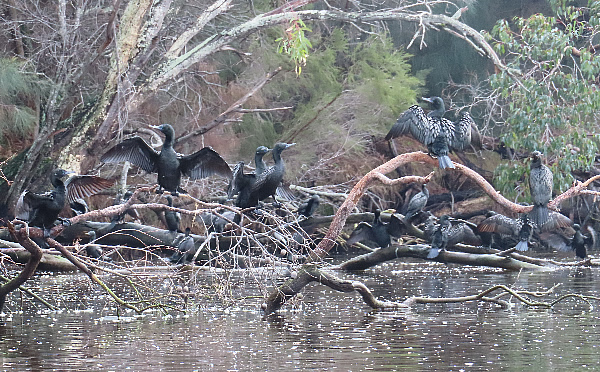
When not feeding they gather in large numbers in trees along the river. Although they are black they are also quite a pretty bird, with wide, green eyes and with feathers on their back with a greenish shine. These overlapping feathers create a beautiful pattern. They have a grey hooked bill and fairly big grey/black webbed feet. When the winter feeding frenzy season is finished on the Swan River they will disappear leaving only small groups to make the Swan River their home for the rest of the year. Like the Darter after leaving the water they will perch on a tree branch, post or any other type of perch and
outspread their wings to dry them out.
So many Little Black Cormorants.
Drying out after their fish hunt.
- 20th July 2024 - IOP Downwind Winter race #2
- 26th July Friday - Avon Scrutineering afternoon.
- 28th July 2024 -
Walyunga N/P to Middle Swan
- 3rd August 2024 Saturday afternoon -Wild Water Races #6&7
- 10th - 11th August 2024 - Avon Decent
Down Wind Race 2 Registrations now open for the Indian Ocean Paddlers, Inc (IOP) 2024 Winter Series, Sorrento Surf Life Saving Club WA Saturday 21 July 2024. Get on board and register now!
|
|
|
|
|
|
|
|
|
|