|
|
|
|
Next weekend is going to be busy. There are 3 events on at the same time that I would love to take part in, but I have to choose one.
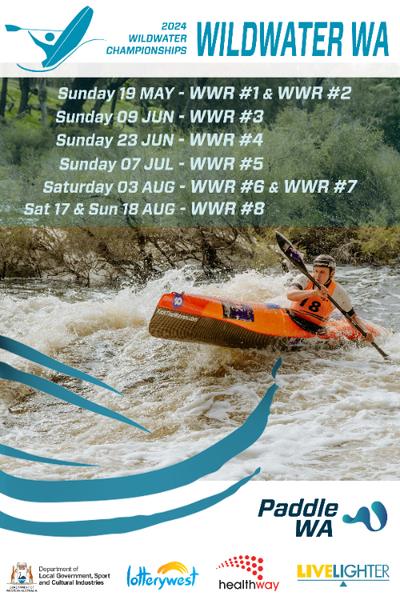
We have the wild water race, a new race which includes
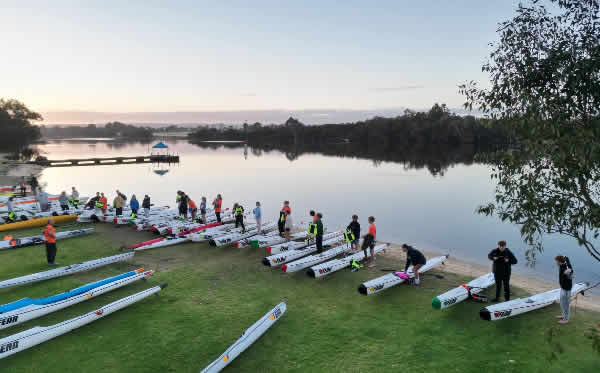
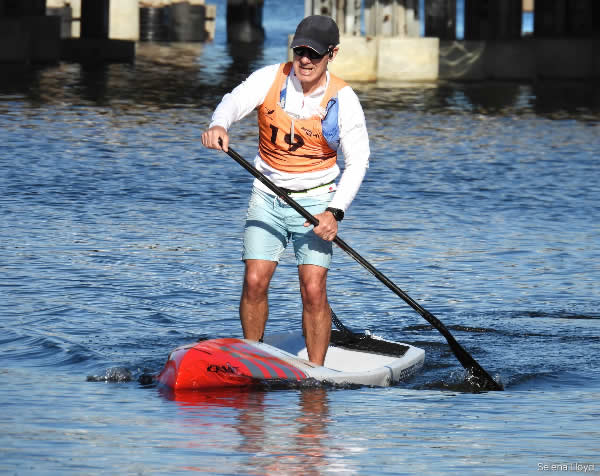
rowers and a SUP race. See the info below. You have to be impressed with young 16 year old Sasha Small who has only been paddling a couple of years, but he is doing so well.
We certainly have some good juniors coming
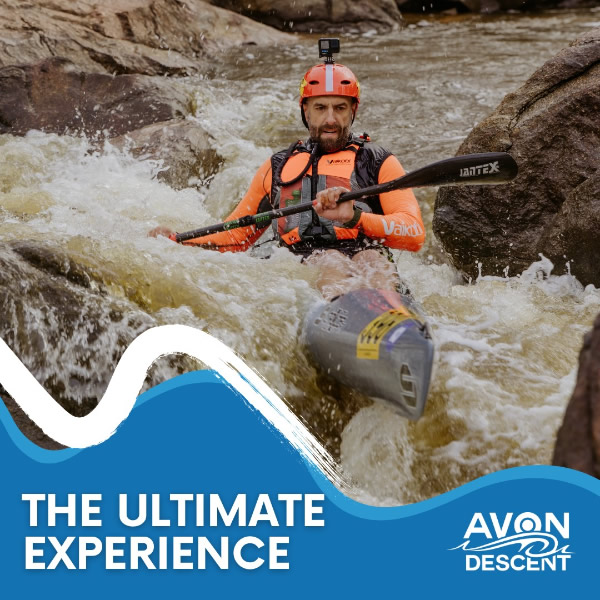
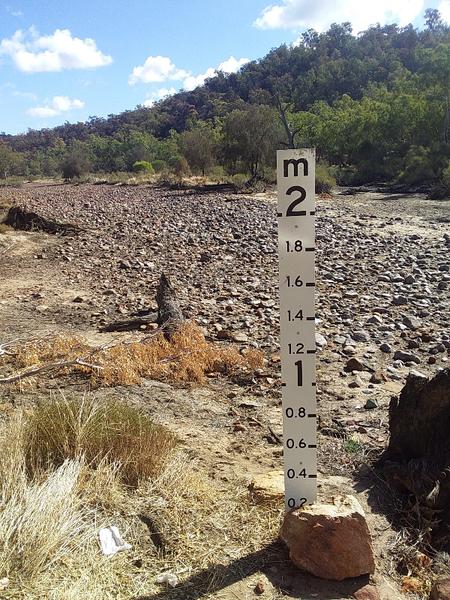
through, we just need to make sure they don't get girlfriends at 17 and lose them to the sport!! - The rain this week reminded me of when the Avon River was so low a day before the race we thought we would be walking the whole course and then overnight a storm lifted the river to a pretty good level and we were excited again.
- It also reminded me of the year I paddled 40 or more kilometres every day through one of the wettish winters in history and I had to be on the water, rain, hail or shine.
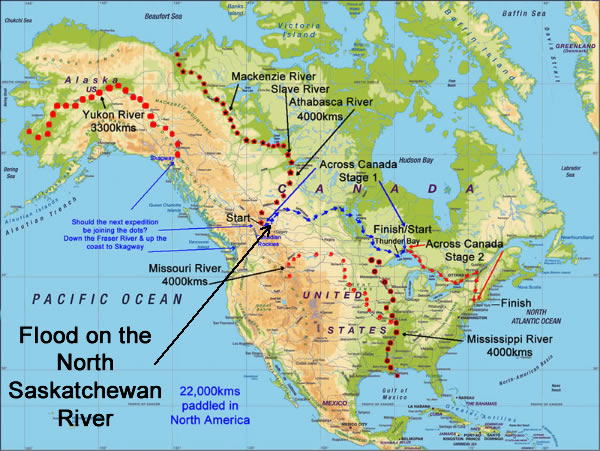
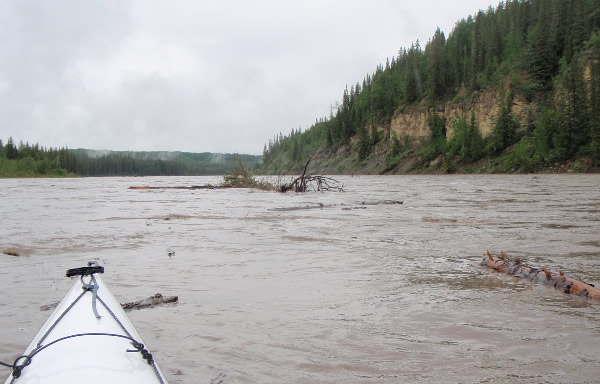
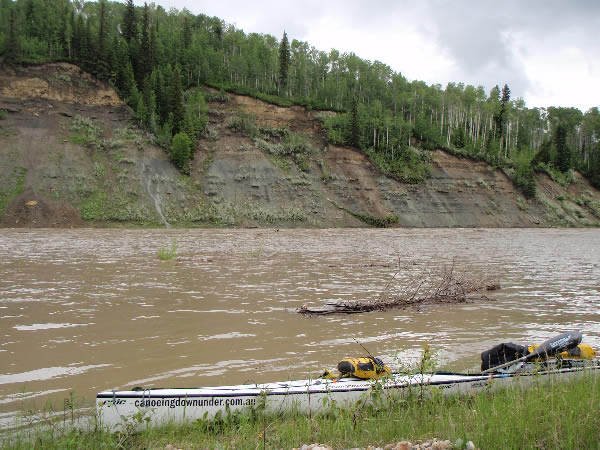
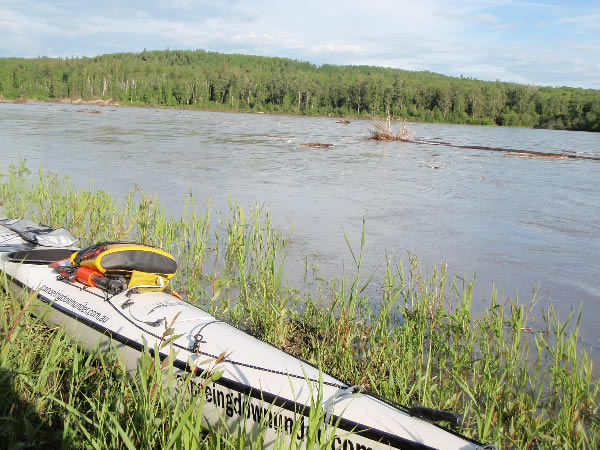
- It also reminded me of when I paddled down the North Saskatchewan River in Canada and a storm over night lifted the river to
a flood level causing me some concern. (See story below)
I have paddled over 22,000 kms in the US and Canada as well as backpacking 1,200 kms and cycling 10,500 kms.
- Paddler of the Week - Sasha Small
- Portugal's Fernando Pimenta
- The Avon
- Expedition Africa (Namibia)
- The Ramon Race
- The Flooded North Saskatchewan River Canada
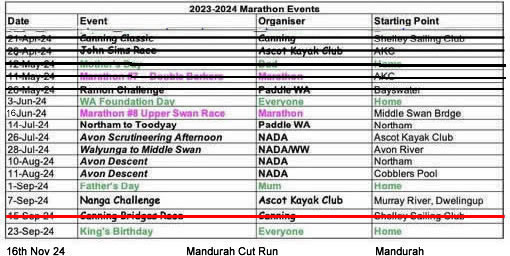
- Coming Events
- Wildwater Race
- K4 vs Rowing Challenge
- Upper Swan Marathon
Coming Events - 9th June 2024 - Wild Water Race #3
- 9th June 2024 - K4 vs Rowing Challenge
- 9th June 2024 - WA SUP Paddle Loops
- 16th June 2024 - Upper Swan Marathon
- 22nd June 2024 - IOP Downwind Winter race #1
- 23rd June 2024 - Wild Water Race #4
- 14th July 2024 - Northam to Toodyay
- 20th July 2024 - IOP Downwind Winter race #2
- 28th July 2024 - Walyunga N/P to Middle Swan
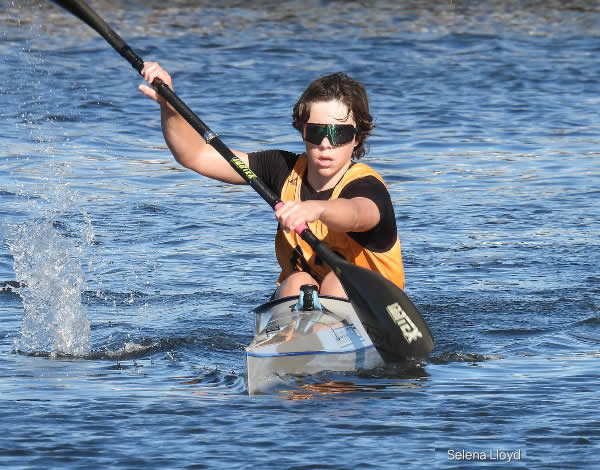
Paddler of the Week Alexander (Sasha) Small Sasha is a member of Swan Canoe Club. He is amazingly fast and he is destined to be a top paddler.
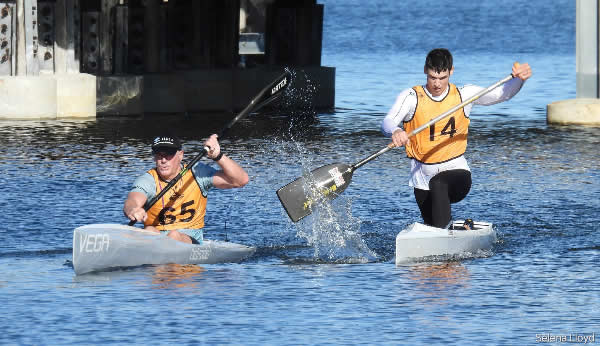
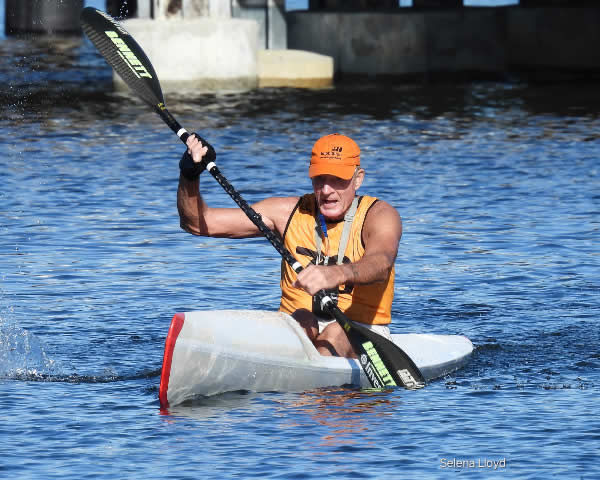
Sasha Small - 1st U16 K1 in the 18km Ramon Race and he was also the fastest in the under 18s. He is a machine. Photo Selena Lloyd. When you are under 16 and you beat paddlers like Derek Cross, Dave Berglund and a mass of other fast paddlers and you are the 11th single craft over the line, your chances of
being a great paddler in the future are virtually set in stone.
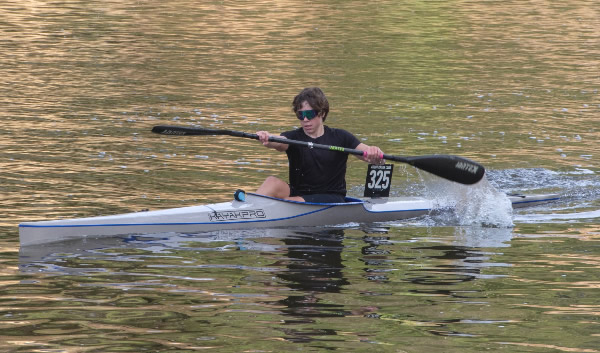
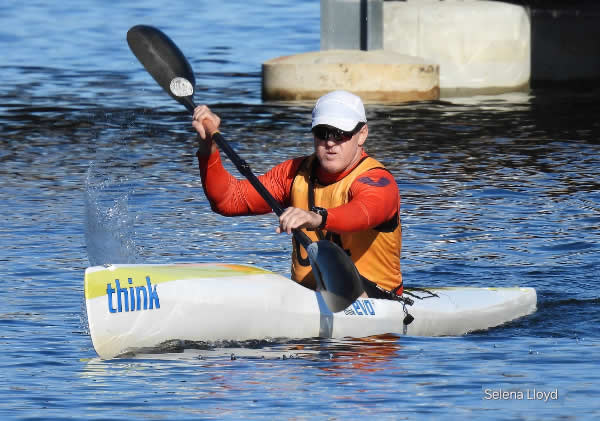
Sasha Small in the John Sims Race. Photo Selena Lloyd. Sasha has been paddling with Swan Canoe Club for a couple years now and just recently he has really found his feet in long distance racing. He competed at the 2024 sprint kayaking nationals and showed that he has great potential to put down fast and competitive times, especially as next season he will be in the top age of the under 16
age category. More recently he has really found that he has enjoyed the paddling community and getting to know paddlers of all ages. Currently he is training at Swan Canoe Club regularly,
but has also been invited to participate in training sessions with Travis England. Sessions are typically quite merciless and not for beginner paddlers, but Sasha has shown that he is more than capable and the group is eager to have a young one pushing them hard. This season Sasha is looking to see if he has what it takes to compete on the world stage and potentially sprint kayaking or marathons Depending on where the wind takes him.
He has been part of Demi O'Brien's, Swan CC coaching squad. There are some good paddlers coming out of that junior squad. Will he be another Fernando
Pimenta?
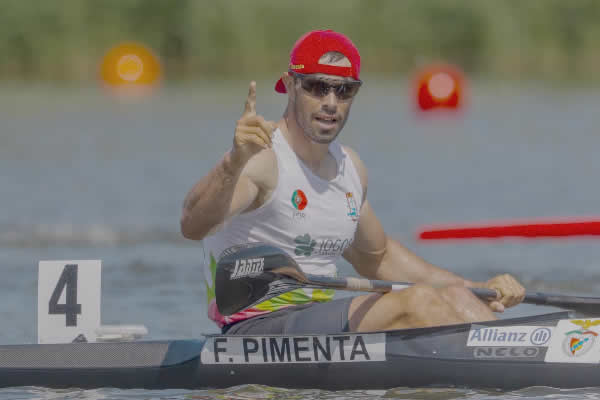
Portugal’s Fernando Pimenta completed a
hat-trick of gold medals on the final day of the International Canoe Federation Canoe Sprint World Cup in Poznan, Poland. After sharing top spot with Poland’s Slawomir Witczak following a thrilling men’s K1 500 final, Pimenta swept aside his opponents with two dominant displays today. Pimenta boosted his hopes for the Paris 2024 Olympics with an impressive victory in the men’s K1 1000 before powering to glory in the non-Olympic event of the men’s K1 5000. “It has been a great week for me,” said Pimenta. “There have been some
good performances. “Now it’s time to focus on Paris and continue to work. Things are going well and I hope I will produce a better performance in Paris. “I am focusing on the K1 1000 so just one discipline.” *********************************************** The stars came out to play at the 2018 ICF Canoe Sprint World Championships, but there was one star who shone brightest of all, turning on a master display that whipped the big Portuguese crowd into a frenzy. For months in the build up to the Montemor World Championships Fernando Pimenta was the face of the event. He was Portugal’s most successful canoe paddler of all time, was a better-than-even prospect of winning gold at home, and was easily marketable. There was always the danger that the local federation was placing too
much pressure on the young man who shared Olympic K2 1000 silver in London in 2012. They need not have worried. Pimenta, as it turns out, thrives on pressure. Can’t get enough of it. Draws his opponents into his web with a laid-back, almost slap-stick pre-race routine, and then blows them out of the water over 1000 metres of brutal bravado. He did it twice in front of his adoring fans – first in the K1 1000, and then in the K1 5000. ************************************************** Pimenta has competed since the late 2000s. His first major result came at the 2010 World Championships in Poznań, Poland, when he won the K-2 500 metres silver medal together with Joao Ribeiro. One year later, he contributed to the Portuguese K-4 1000 metres gold medal at the European Championships in Belgrade, Serbia, and claimed a bronze in the K-1 1000 metres. Together with Emanuel Silva, he won the silver medal in the K-2 1000 metres event at the
2012 Summer Olympics in London, which was Portugal's only medal at these Games. ************************************************** Portuguese Canoe Federation awarded the best athletes and teams of the season 2019 at the Gala awards that
were held in Coimbra. The award for the best paddler of the season 2018 went to canoe sprinter Fernando Pimenta who excelled at European and World Championships last year. He first won European Champion title in the 1000 metres event in K1, and added silver and bronze medal from the European Championships in Belgrade in the 500 and 5000 metres events. He won two World Champion titles
in front of his fans at the World Championships in Montemor-o-Velho. While being presented the award the crowd welcomed him with a standing ovation.
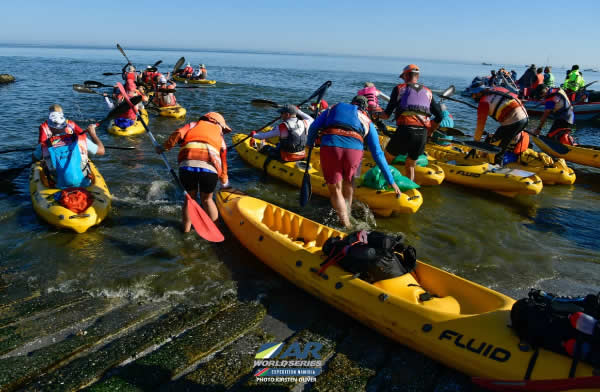
Cobbler Pool last weekend. Hopefully this weekend it will look a little different. Photo Glen Stewart
Expedition Africa (Namibia)
WA Paddlers
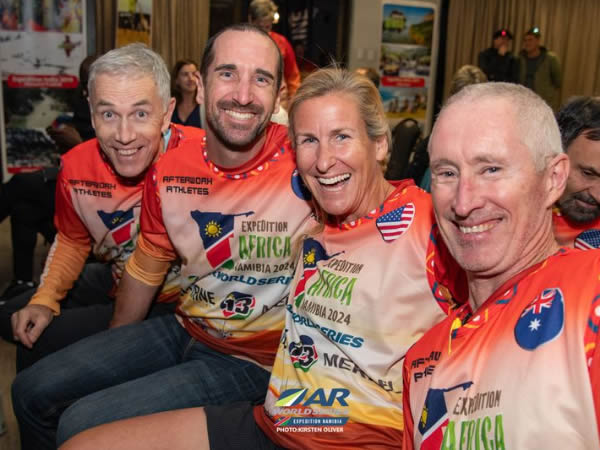
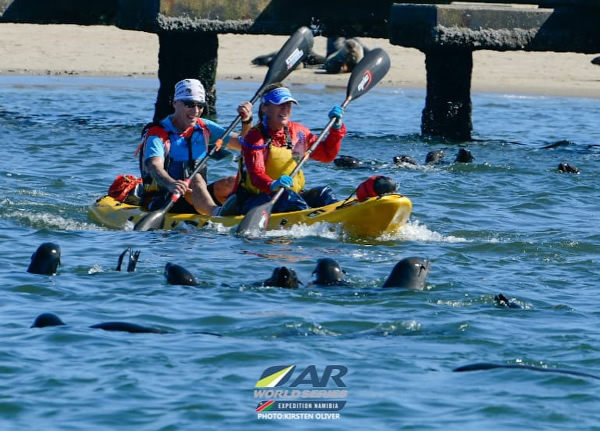
Danny, Dave & Grant take on the world. Adventure racing is a multi-discipline endurance sport where competitors compete in teams, navigating from control point to control point in a number of disciplines. - Disciplines include: mountain biking,
trekking, kayaking, rope work and orienteering.
- Teams are expected to navigate using a map and landmarks.
- Teams must be able to operate in harsh remote environments in all weather conditions.
- Teams travel throughout the day and night. They can decide if, when and where to rest.
- The first team to complete the whole course, with all the control points visited will be declared the winner.
- Teams are
required to complete the entire distance together (always within hearing and visual distance of each other), helping and assisting each other.
- Teamwork and team dynamics are essential. A detailed understanding of your teammates and of your own capabilities is essential.
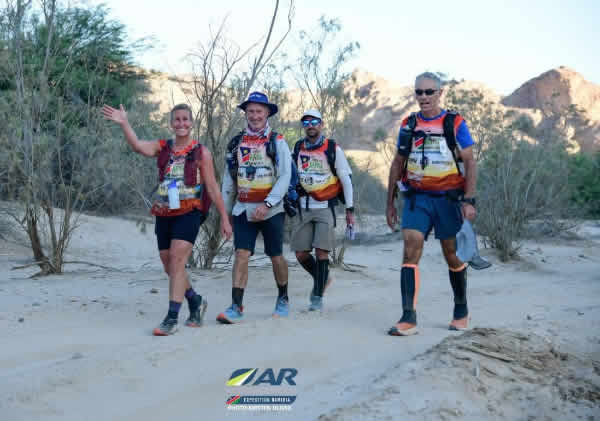
WA paddlers Danny Murphy, Dave Symons, Shelley a lady from the US, and Grant Pepper are competing in a tough race.
They’re doing expedition Africa (Namibia) and you can follow on expedition africa adventure on facebook or Instagram. - Route is linear, and teams need to pass through all
control points (CP) and transitions (T).
- Teams who miss any CP’s or transition areas will be ranked behind teams who visit all control points and transitions.
- Winning team three to four days, last team six days.
- The route will adhere to
ARWS guidelines for a Qualifier event of 72 hours of racing time for the fastest team.
- Total distance: approximately 490 km. Exact distance to be determined once route
scouting is completed
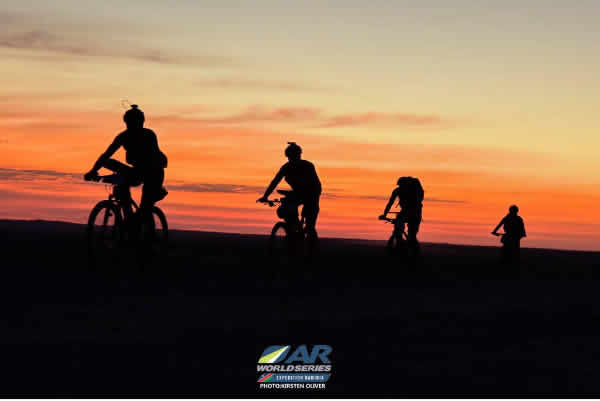
- Mountain biking 68 % = 335 km
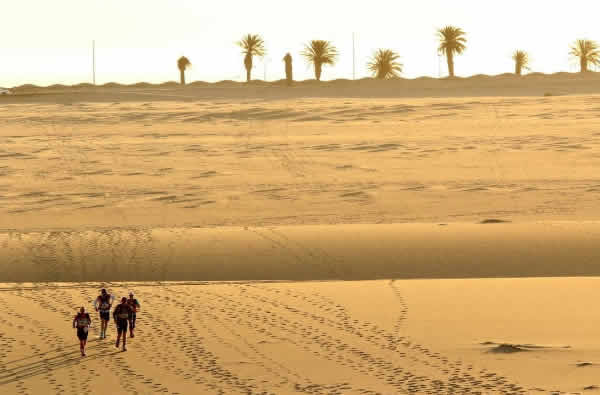
- Trekking 25 % = 120 km
- Kayaking 7 % = 35 km
- 10 legs with
9 transitions.
The spectators are friendly. Photo Rob Howard
Our team just going for a walk.
Just because it's getting dark it doesn't mean we stop!
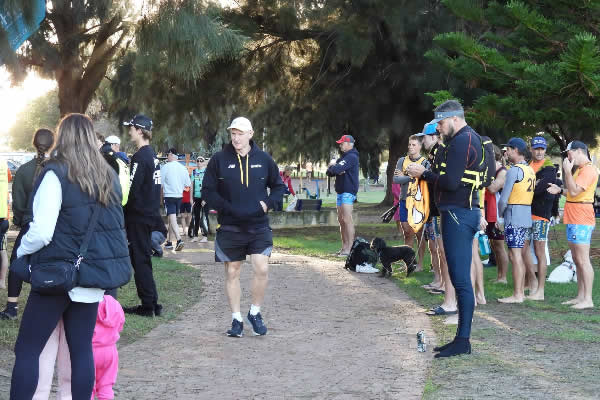
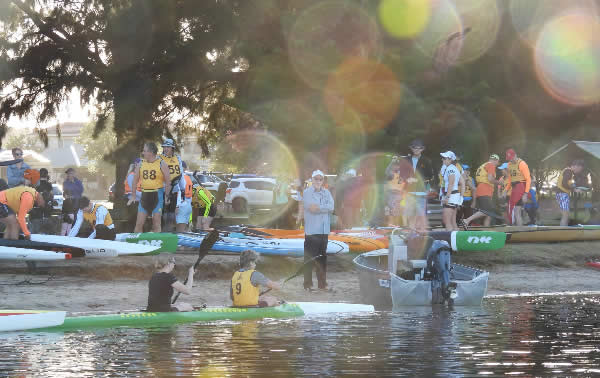
The Ramon Race It was another successful race
Boat driver Rob Riggir surveying the scene. Photo Selena Lloyd.
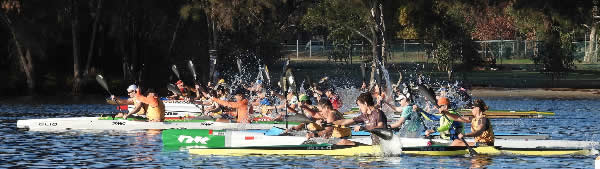
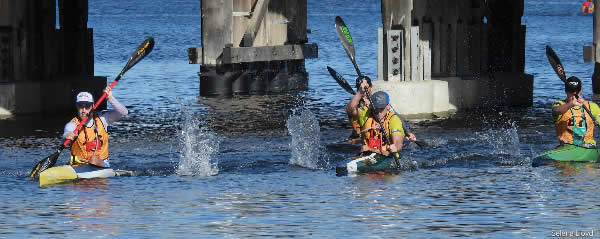
The K2s are off. Photo Selena Lloyd.
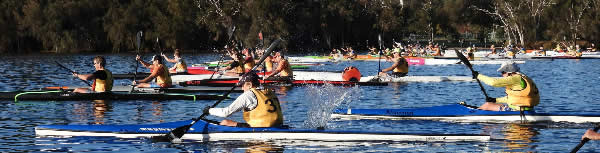
65 K1 and skis are off. Photo Selena Lloyd. With 65 boats on the
line I thought it was going to be chaos. I think it might have been if I chose to start at the centre of the group, but John Hilton, Robin Jacob and I kept to the left side of the river to avoid all the boat wash and get clean water for the take off. For a hundred metres or so there was little wash, but as the better paddlers got ahead the wash came at us. So the
advantage of being away from others was to get clean water for the take-off but the disadvantage however was that there was no chance for me to wash ride someone off the line and get an extra boost forward. With this in mind I would have to be in the right place on the line and next to someone that is slightly faster than me to get a lift. If they were too fast they would be gone, if they are too slow I would not get an advantage.
And if I did get next to a faster paddler I would need to get on their wash straight away because if I didn’t they would leave me behind and I would end up floundering in the huge amount of wash that the large pack would be leaving. So with the large numbers today it was a dilemma to which position to be in for the best take off. (It’s much easier to take off when paddlers are of similar speed.) With most skis being more stable than kayaks they tend to get off better
than I do in the rough water.
Anyway I chose to keep away from the rough water and it did work for a while but eventually I had to paddle across all the wash waves coming from the faster paddlers and get into smoother water behind a line of boats in front of me. Just after the
old Ascot Inn I fell behind Kim Mahony and Brenton Rose two ski paddlers in the 45+. Although I could see Warren Southwell ahead in the next group, who I loved to be up with, it was too soon to try any heroics to try to catch him so as Kim was going a good speed I sat behind him and Brenton. Their wash was a little messy but I was able to keep up. At the railway bridge where we had to turn and head back to the start Brenton made a move and tried to get in front of Kim. It didn’t seem to work and
he fell back and I managed to get on the back of Kim leaving him behind. Kim’s wash was much smoother than having two boats and as there were a lot of bits of weed and stalks in the water his ski parted the water and I managed to avoid getting weed on my nose, which is always an issue. About a kilometre from Garratt Road Bridge I decided to leave my safe heaven and see if I could take
a lead the powered in front of Kim. He then got onto my wash and I paddled as hard as I could to get closer to Warren’s group and catch up with Peter Gigengack who wasn’t as far ahead. In catching Peter Kim fell off my wash. I tried passing Peter but he picked up his pace and we were neck and neck. By the time we rounded Kuljack Island and heading back through Ascot Waters Kim was catching and by the time we were paddling under the low footbridge he was only metres behind. With Peter misjudging the low bridge and capsizing I only had Kim to worry about. He caught me as I left the Ascot channel and entered the river. With only 640 metres to go I knew it was going to be a good race to the finish line. He seemed stronger, but as we moved out from under the bridge for a 150 metre sprint I managed to be slightly ahead. In my heart I wanted Kim to beat me by a second,
because he did more of the pulling than I did, but my drive wouldn’t accept what my heart was telling me and although I eased off just before the finish line I beat him by a small margin. As I was picking Jenny up from the airport at 11.40am, I didn’t have time to stop for presentation. I changed, had a burger and then drove home to shower.
Ben Carrick, Travis England, Harry Hewitt and Charlie Hewitt. They finished Ben, Harry, Charlie and Travis.
In
front of them by 2 mins 20 secs was Kent Jenkinson. Photo Selena Lloyd.
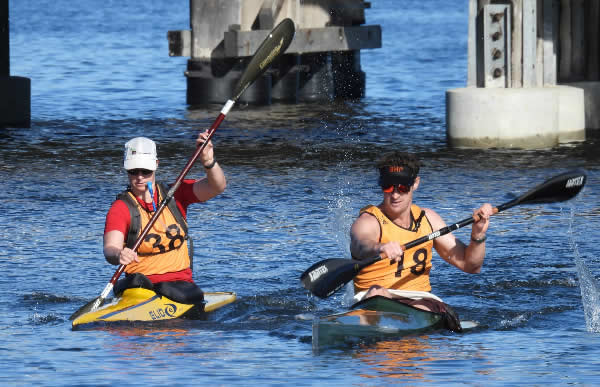
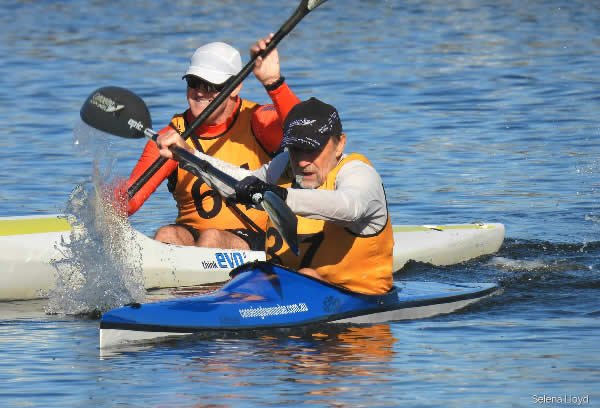
Lindsay Allen trying to sprint away from Gary Nagy. Gary got to the line first. Photo Selena Lloyd.
Tim Cornish and Rob Jenkinson fight for the line. Rob kept the slight difference ahead. Photo Selena Lloyd.
Bronwyn Martin taking on Michael Glory Photo Selena Lloyd.
I always love beating Ron who is my age 73, but I never can when he is on his ski. He is a machine. Photo Selena Lloyd.
Kim Mahony helped me along. Photo Selena Lloyd.
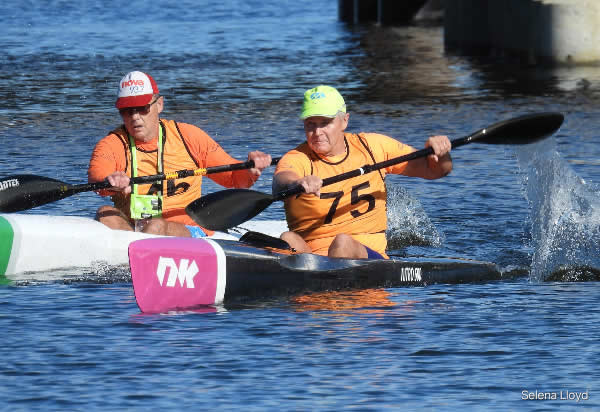
Kim and I fight for the line. Photo Selena Lloyd.
So good to see a large contingent of our intro to ski paddlers take part in the 6km Paddle WA
INC Ramon Challenge today. For many it was only the fourth time they had been in a ski. They were
joined by a number of our Youth athletes who also competed in the 6km and 11km races. Thanks to the coaches and mentors for providing encouragement to our paddlers.
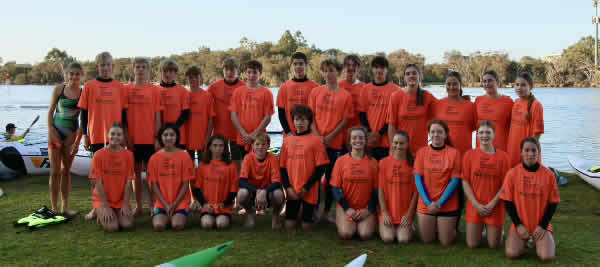
Sorrento Development Squad.
Declan Hoare 3rd in the SUP 11kms.
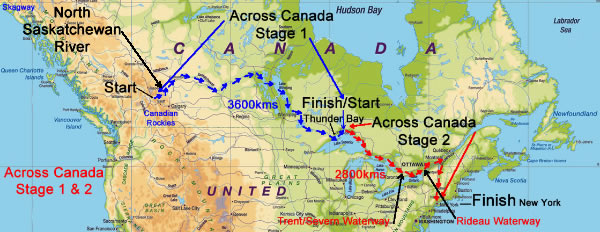
Across Canada Expedition –
Stage 1 North Saskatchewan RiverMy solo part of the journey
across Canada started in the Rocky Mountains. I headed east paddling down rivers, across lakes, up rivers, portaging from lake to lake and then across some of the biggest lakes in Canada. This story is of day 4 of
that journey when
the North Saskatchewan River suddenly flooded.
Day 4 of my 3600km trip across Canada.
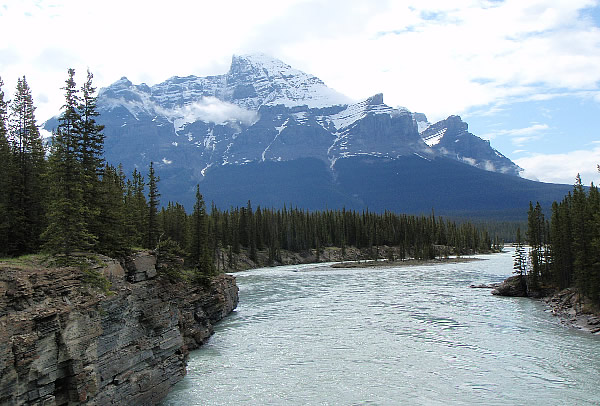
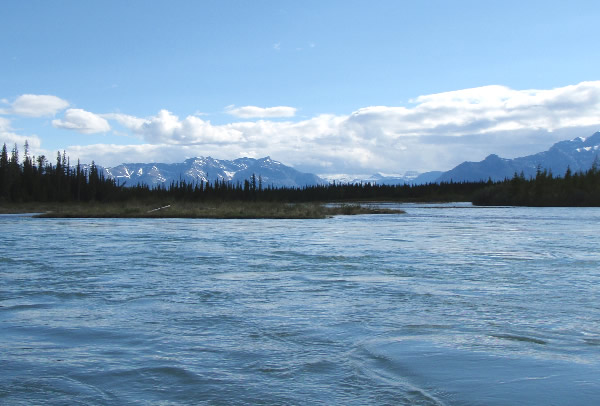
North Saskatchewan River above the Saskatchewan River Crossing.
Easy scenic paddling going with the current.
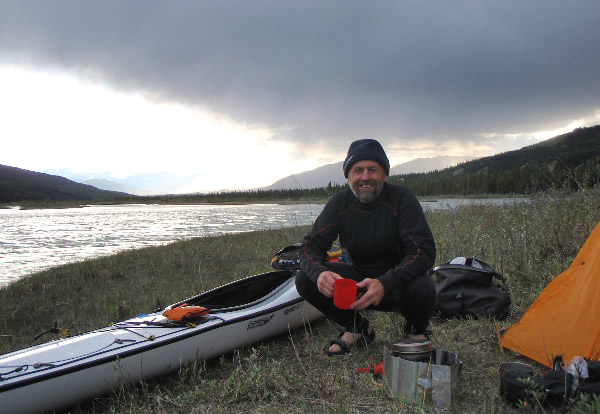
My first camp. Morning breakfast and a cup of coffee. The sun had gone leaving threatening clouds.
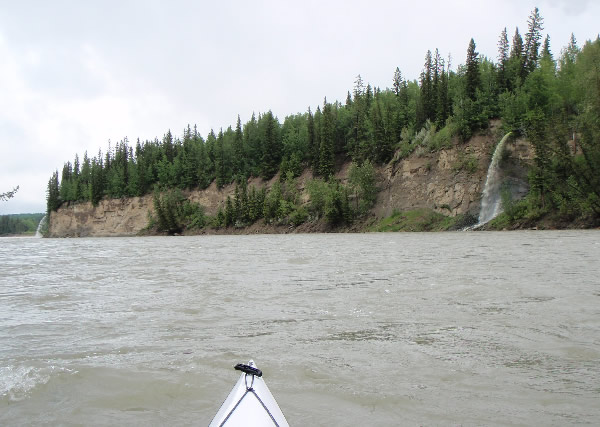
The heavy rain started leaving waterfalls to enter the river. I carried on against the cold Arctic wind and rain. I was now heading north right into the wild weather. It wasn’t pleasant, but with two
thermals and my goretex Kokatat paddling jacket I felt warm enough. I spotted a real wolf I think, it stood there and watched me pass by but by the time I had my camera out it skipped off. I also saw a dear and a fawn and several other mule deer, but I was yet to see a moose. It was too cold to rest so I kept paddling and eventually came to the Abraham Gates where the river narrowed and the cliffs lined each side. It was quite spectacular although a thunderstorm and heavy rain prevented me from getting any pictures. Waterfalls were cascading from the top of the cliffs all over the place. It was really raining and this stunning piece of country was even more majestic and impressive with all the
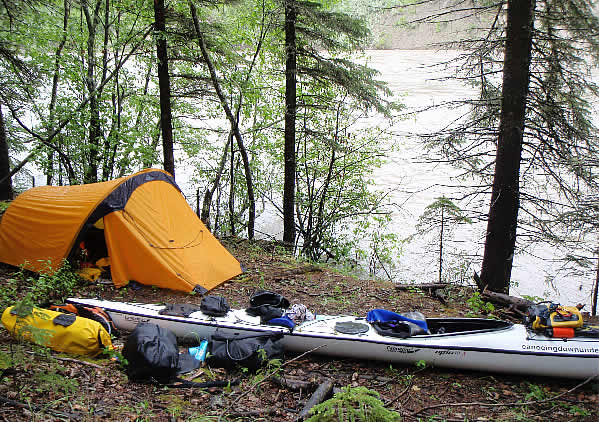
waterfalls. The storm hit another level and the thunder and lightning made it a more dangerous place to be. About 7.30pm I spotted a place in the woods. I didn’t know if it was going to be level but I just had to check it out as every other place I looked at had been too muddy or too low and waterlogged. I pulled up next to a gravel bar and dragged the kayak along a pool of water until level with a gap in the tree line. I took my paddle and checked it out and yes there was enough dry level ground to put my tent and it was 2 metres higher than the river. It did mean however I had to climb the 2 metre slope with all my gear which required a little care as the bank was steep and slippery.
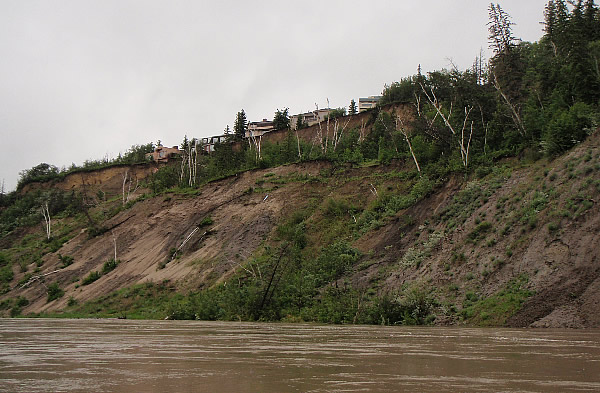
With the storm the river rose to the level of the bank and was still rising. Friday 17th June:
Day 4 It was raining yet again, so I just stayed in my sleeping bag until it eased. I was camped in a pine forest and as well as the rain, water was dripping from the trees and onto the tent. When I crawled out and checked my surrounds I was surprised to see the river had risen at least 2 metres, even more. The previous night I was able to
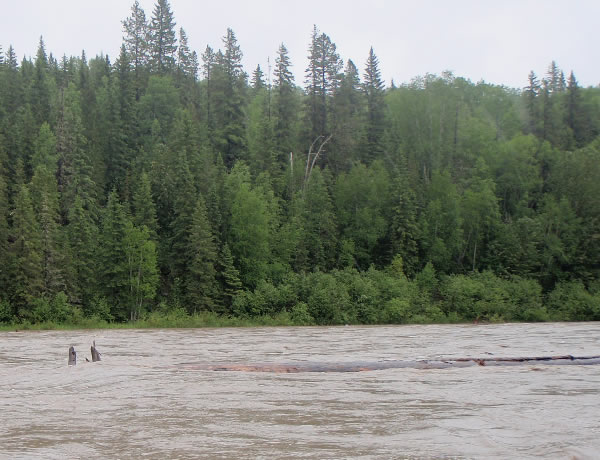
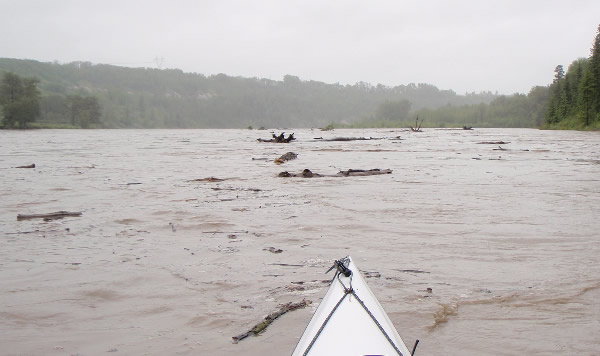
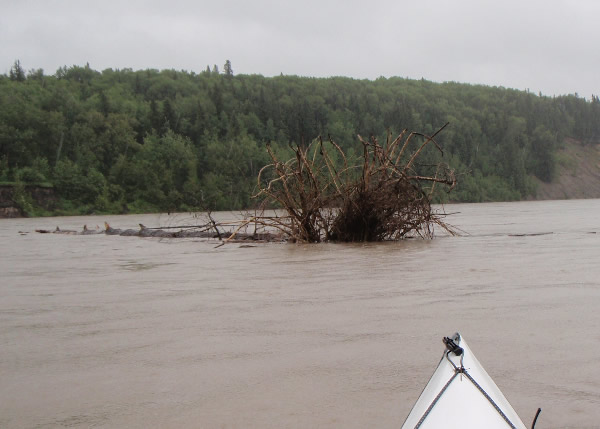
walk along the stony river bed carrying the kayak to the forest, but now there was only water from one high bank to the other. The water had nearly crept above the banks and was only inches from spilling onto the forest floor. Not only was the river swollen but there were a large number of huge trees, large logs and debris floating by. It was like a highway for floating trees. It was
easy to believe that the river level could rise in such a short time, but it was much harder to believe that so many huge trees would be floating by. Seeing them I couldn’t imagine what my paddling day was going to be like. I packed as fast as I could but I was pretty slow. When I was ready to leave I said goodbye to the old dead pine tree that I thought may have fallen on me in the
night. As you can imagine I was pretty pleased it hadn’t. My problems though were just starting as I realised that it was going to be difficult task to get the kayak in the water and get safely away. There was only a metre gap between the trees, and with the water flowing swiftly through them, I was wondering how I would get my 5 metre kayak positioned parallel to the shore with only a one metre gap and a swift current, and then get in it and paddle away. It looked impossible. I put the kayak
down against the bank and the small gap between the trees and the bank but the current grabbed the bow, whipped it downstream onto a tree and nearly from my grasp. Well that wasn’t going to work so I immediately pulled it out. I saw a very narrow gap a few metres downstream between some scrubby trees. It looked near impossible, but more feasible so I dragged the kayak along the ground
and wedged it between some small trees and the bank. There wasn’t much room to squeeze into the cockpit but I managed to fight through the branches and get in. That was the easy bit, now I had to paddle away from the bank through the immediate bushes in the hope I wouldn’t get jammed in the other branches, which the current was flowing through at great speed. I knew if I capsized at that point I could get tangled in the branches. If I capsized further out, I would have to deal with the cold icy
melt water, and as there were no eddies along the bank the likelihood of getting out of the river would be very slim, so I didn’t want to capsize to prove a point. I always carried my Epirb distress beacon and my Spot Locator in my PFD but today I decided to carry my satellite phone on me as well, just in case I did get separated from my kayak! The thing about risks is that you have to
prepare for them in advance so if anything did happened you had the means to save yourself. Although the satellite phone was bulky having it on me would be much more useful to get help straight away. As soon as I paddled through the trees and away from the bank and into the main flow I was joined by a large number of floating big trees, lots of branches and a multitude of smaller
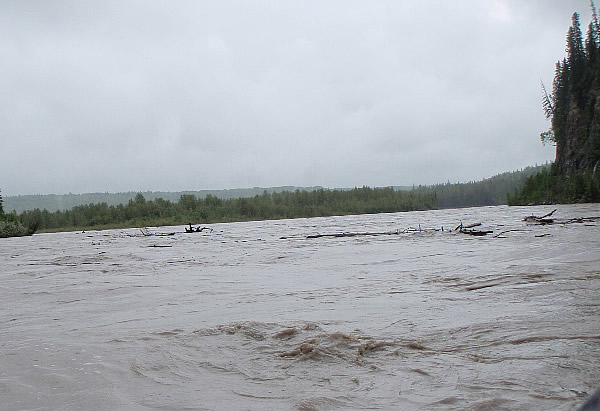
pieces of timber. I was happy though and what an amazing sight it was. Some of the trees were going faster than I was. They must have been in a faster current or just fitter than me. The water was running quick, real quick and at the bends where there were waves, standing waves, boils and swirls, the logs were travelling even quicker. I tried skirting the bigger waves, but it was near impossible. I had thought this section was going to be easy!
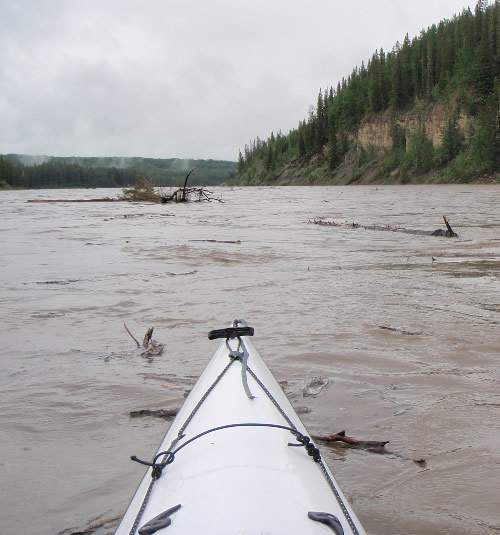
The debris increased. It was hard to find a path through the branches and logs.
The current was also travelling at a good speed and creating waves and whirls especially on the bends.
I soon found myself dodging a big tree, I missed it, but I hit a few minor branches as there were too many of them to avoid. The floating branches and logs seemed to be in the same part of the river where I wanted to be. Brett who
shuttled me to the start said it had been a big snow year and the snow was still melting and with all the rain, the river is higher than normal. So with the storm we had the previous day it was now in flood. I could hear the rumblings of the rapids from a long way off. It was always a sign to get ready for some big waves, although some times the sound was created by the water rushing
through branches or the water hitting rock ledges along the shoreline. It was still a scary sound. Moments later I saw a mass of waves ahead with several trees bobbing up and down. It was certainly time for me to give it my full concentration. I managed to skirt the worst of the waves and move around the bend into less turbulent water where it felt much safer. Some of the faster water
appeared to be closer to the shoreline, especially on the bends and it was where I wanted to be to gain the fastest speed, but it wasn’t the safest place to be as I had to contend with the floating debris as well as landslides and trees falling into the river. To make matters worse, it was raining hard and was extremely cold and the only way to keep warm was to keep paddling. So my day
was somewhat different from my normal day of paddling but I soon became accustomed to the continual swerving to miss the trees. I couldn’t miss all the smaller bits of timber and branches as there were too many of them. Sometimes it was as if I was running over a mine field. As I moved over them I listened and felt the timbers and branches scrape underneath along my hull and eventually hit my rudder. The branches, trees and driftwood were just like me floating down the river having a good ride. They had probably been jammed up somewhere for years and now they had a chance to go places. For just being pieces of timber they were actually quite bright as sometimes they would take a different route around an island to myself and beat me to the bottom. I
tried to keep my distance from the bigger logs, especially near the bank and in the shallows as the trees could hit the bank rebound and get pushed out or get turned quickly and hit me. Other trees and branches often hit the shallows then they would spring up into the air, which was quite spectacular, but dangerous. Some went underwater and played hide and seek for a while, and then popped up in places downstream where I wasn’t expecting them to appear.
I found a spot to have a break. At some spots where the river was divided by an island the logs would jam up against the island and create one big mess of tangled logs and a mass of whitewater. If I was to get tangled
up in a log jam with the swift current pushing against them I would certainly die, it was as simple as that. Thank god I could read whitewater and had the knowledge and skills to recognize the best route and keep away from such dangerous places. So it was a day of high drama and so different from any other day. At times it had been quite frightening, but really it was quite fun. I had
a late start so I started looking for a camp at 7.00pm but I needed a spot that was high enough to keep me well away from the rising water. It was too dangerous to camp on a lower elevation. Eventually after scouring the bank on both sides I managed to find a suitable place which was over 2 metres higher than the water level, although I still didn’t know if that was high enough. A
beaver greeted me to my new campsite. It happily allowed me to get very close to it before it moved away. It later nibbled at the young tree shoots which were lined along the bank. I watched on. With the rising water level I was concerned that I just might have selected a spot that might get swamped in the night, so having mobile phone reception I texted Alaine at the shop and asked her to ring me at 3.00am in the morning my time. I didn’t tell her why I wanted her to call me at that time, as I
didn’t want to concern her, but it was so I would wake up and be able to check the water level in the night. If need be I could pack up quickly and get back on the river. At 3.00am the phone rang. I fumbled in the dark and hit the wrong button and switched it off instead of answering it. I sent Alaine a text to tell her that I had received it. With torch in hand I climbed out of the
tent and checked the water level. The river had risen quite a lot and although it was getting close I was confident it wouldn’t reach me before 6.00am when I would check it again. With little cloud I could see the moon for the first time since arriving in Canada. With nothing to fear, except maybe being washed off my island, I went back to sleep pretty quickly. When I woke at 6.00am it
was raining yet again so I stayed in bed a little longer as I didn’t see the sense in getting wet. By the time I was up and ready to leave, the water was within half a metre of my tent. I had judged my departure perfectly.
Camp. The water in the night rose, but I just managed to break camp before the water reached my tent, but it was close.
There didn’t seem as many logs for the first hour but then I started catching up with them. The river was raging and not too far downstream, encircled by a small forest of trees I noticed a caravan besieged by rushing flood waters. An elderly couple was standing anxiously in knee deep water waiting for a rubber duck rescue boat to rescue them.
There was fear on their face, but the rescue boat was on hand trying to manoeuvrer between the rocks and trees towards them. It looked a tricky task as the swift flood waters played havoc. The crew was all decked out in rescue gear and helmets, but they had a tough job working the current and trying to get around the trees and avoid the flooded rocky shallows as well as trying to find a safe place to land to pick up the couple. Their car and caravan would most likely get washed
away.
I couldn’t help as the current was too strong, even my fitness level. I was soon swept away downstream.............................
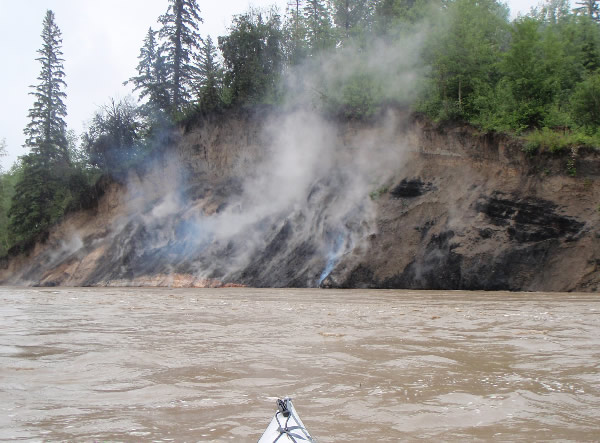
A coal seam burning at the side of the river
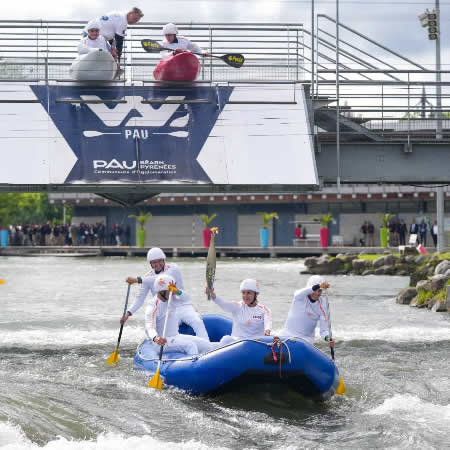
Olympic Torch Relay Rafting the trail to Paris 2024. The Olympic torch makes a splash on its journey, uniting the world through the spirit of water sports at the Stade
d’Eaux Vives in Pau!
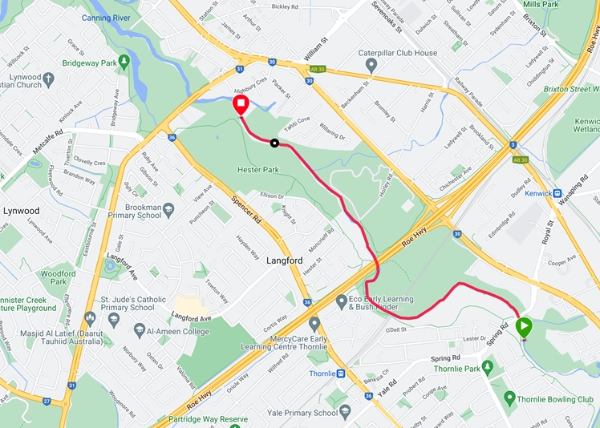
Wild Water Race #3 Enter
Here:- The 3rd of 8 races for the 2024 Wild Water Season Location: Hester Park, Spencer Road Langford
Registration: 08:30am-09:00am
Briefing: 09:15am
Race start: 10:00am Course: Starting and finishing at Hester Park, paddlers make their way upstream to the starting point (drain) with the return leg being the race. Transport: A car shuffle is not required Safety: Due to the course being held in wild water conditions, it is necessary for all paddlers to wear helmets and PFD’s. Each competitor should also have a whistle attached to their PFD for emergency situations.
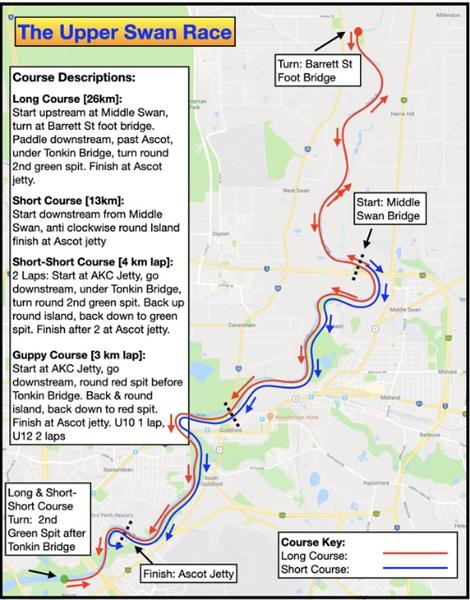
2024 Uper Swan Race Sunday 16th June Enter here: https://www.webscorer.com/register?raceid=352942 A longer race [26km] great preparation for Avon Descent. Also a great Short Course option [13km] down a magnificent stretch of river Book a shuttle with West Coast Downwinder [save the car shuffle]: Upper Swan Shuttle Pre-order burger from Swan Café $8.00 Location: Middle Swan Reserve, Middle Swan Road, West Swan
[This race involves a Car
Shuffle]
Check-in: 7:15
Briefing: 8:10
Start:
8:30 Ascot for Short-Short & Guppy:
Check-in: 09.00
Briefing: 09.30
Start: 09.45 Registration:
Write PA and your PA number e.g. PA123456. If your number is less than 6 digits, put zeros in front to make 6 e.g. PA001234. Write your Date of Birth like this: 1999-06-01. If you are not a club member and have no obvious affinity, you can join direct to Paddle Australia https://paddle.org.au/membership-information/#directprocess All participants register individually Courses:
Long Course:
Start at Middle Swan bridge, head upstream to Barrett St Bridge. Turn anticlockwise round buoy in middle of river. Head back down-stream past Ascot Kayak Club going to right of Ron Courtney
Island. Continue downstream, under Tonkin Highway bridge to left round Green Spit post, near International Hotel (was “Ascot Inn”, old Jetty has been removed). Paddle back to Ascot to right of Ron Courtenay Island & through finish line at Jetty. Short, Outrigger & SUP Course:
Start at Middle Swan bridge heading downstream to Ascot, turn anti-clockwise round the island paddle back up to finish at Ascot Jetty. Short-Short Course:
Two [4km] laps: start at Ascot
Jetty, paddle to right of Island & under Tonkin Highway bridge. Turn to left round Green Spit post, near International Hotel (was “Ascot Inn”, old Jetty has been removed). Paddle back to Ascot to right of Ron Courtenay Island. Turn left around Island. Paddle down to Green Spit again. Paddle back to Ascot to right of Ron Courtenay Island & through finish line at Jetty Guppy Course:
Start at Ascot Jetty, paddle to right of Island & under Tonkin Highway bridge. Turn to left round Red Spit post, near before Tonkin Highway, near boat ramp. Paddle back to Ascot to right of Ron Courtenay Island. U10 [1 x 3km lap] paddle back to Ascot to right of Ron Courtenay Island & through finish line at Jetty. U12 [2 x 3km laps] paddle back
to Ascot to right of Ron Courtenay Island, round Island & back to Red Spit post, then paddle back to Ascot to right of Ron Courtenay Island & through finish lineat Jetty.
Wild Water Racing 9th June
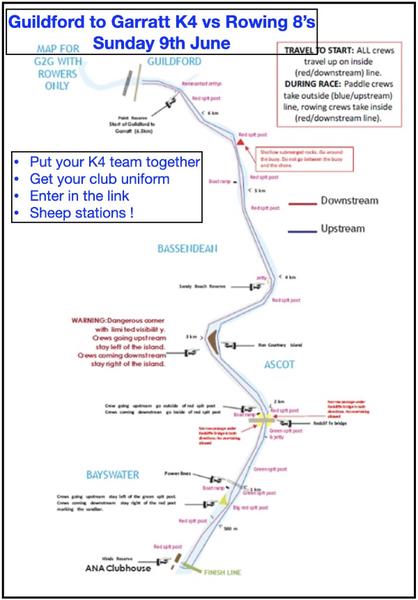
K4s vs Rowers Time Trial 9th June Make a team It's racing in a Time Trial format, with boats starting one by
one
and the winner of each category determined by the fastest
time from start to finish. It is a Rowing WA
event.
They will have 8s, 4s and pairs. Usually about 40 boats and then hopefully we will have 15 - 20 K4’s.
Rowing boats will start individually or in pairs. K4’s will be split into 2 or 3 groups and squeezed in between rowing grids according to
speed. Go here for more details:- https://www.webscorer.com/register?raceid=352831
A few rowing terms:- Sweep
A style of rowing in which each rower uses one oar. Sculler
A rower who rows with two oars, one in each hand. Coxswain or "cox" The oar-less crew-member, usually included, who is responsible for steering and race strategy. The coxswain either sits in the stern or lies in the bow of the boat, and faces in the direction of travel. Coxswain - +: Coxed (with coxswain)
- -: Coxless (without coxswain)
- If not present then the boat is coxless, except for
an eight.
Sweep
In a sweep boat, each rower has one oar.
Eight (8+)
A shell with 8 rowers. Along with the single scull, it is traditionally considered to be the blue ribbon event. Always with coxswain because of the size, weight and speed of the boat – bow loader eights exist but are banned from most competitions for safety reasons.
Four (4-) or (4+)
A shell with 4
rowers. Coxless fours (4-) are often referred to as straight fours, and are commonly used by lightweight and elite crews and are raced at the Olympics. In club and school rowing, one more frequently sees
a coxed four (4+) which is easier to row, and has a coxswain to steer.
Pair (2-) or
(2+)
A shell with 2 rowers. The Coxless pair (2-), often called a straight pair, is a demanding but
satisfying boat to master. Coxed pairs (2+) are rarely rowed by most club and school programs. It is no longer an Olympic class event, but it continues to be rowed at the World Rowing Championships.
Sculling
In a sculling boat, each rower has two oars or 'sculls', one on each side of the boat.
Octuple (8x)
A shell having 8 rowers with two oars each. Generally a training boat, but raced by juniors in the UK.
Quad (4x)
A shell having 4 rowers with two oars each. Can be coxed (4x+) but is usually coxless (4x-).
Triple
(3x)
A shell for three scullers with two oars each, usually without a coxswain. These boats are considerably rare.
Double (2x)
A shell for two scullers generally without a coxswain.
Single (1x)
A shell
designed for an individual sculler. Very good for skill development, particularly beginners, and a very competitive class at world events, WRC. Extremely rare is the coxed single which is only used as a training boat or for adaptive rowing.
Coming Events 9th June 2024 - Wild Water Race #3 9th June 2024 - K4 / Rowing Challenge 16th June 2024 - Upper Swan Marathon 22nd June 2024 - IOP Downwind Winter race #1 23rd June 2024 - Wild Water Race #4 14th July 2024 - Northam to Toodyay 20th July 2024 - IOP Downwind Winter race
#2 28th July 2024 - Walyunga N/P to Middle Swan
144 pages, 360 photographs, 280 of them being of 52 different species of birds and 80 being scenes of the river.
|
|
|
|
|
|
|
|
|
|