|
|
|
|
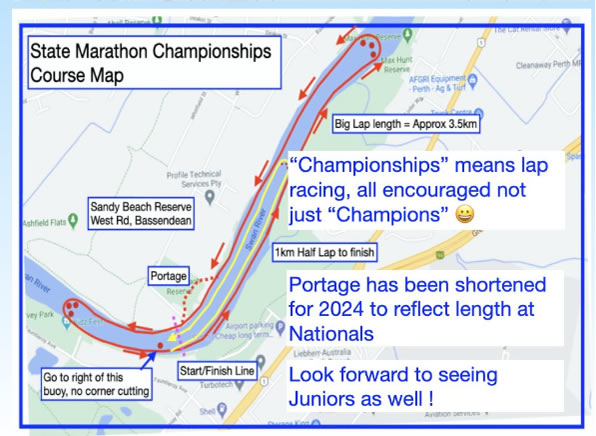
Can you believe it's nearly Easter. With no races last weekend it was a little quieter on the water but this weekend with the West Australian
Canoe Marathon Championships taking place it's going to be all go. So it all the action starts at 8.00am at Sandy Beach.
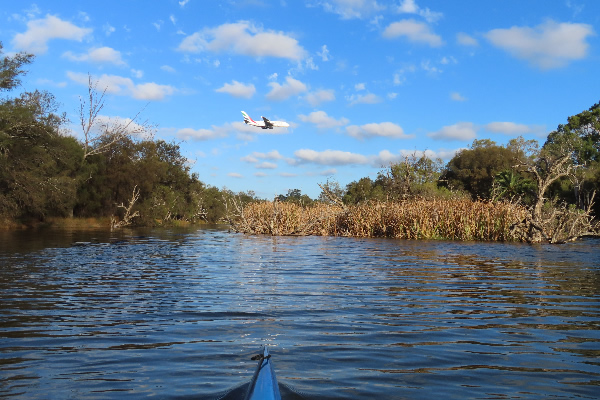
In March 2023 there were a huge amount of birds on the river, but these last few months with all the
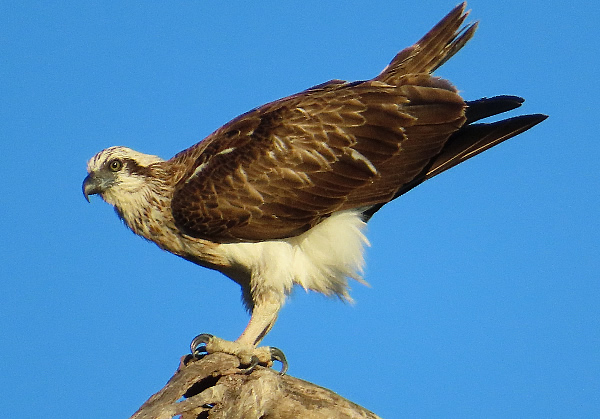
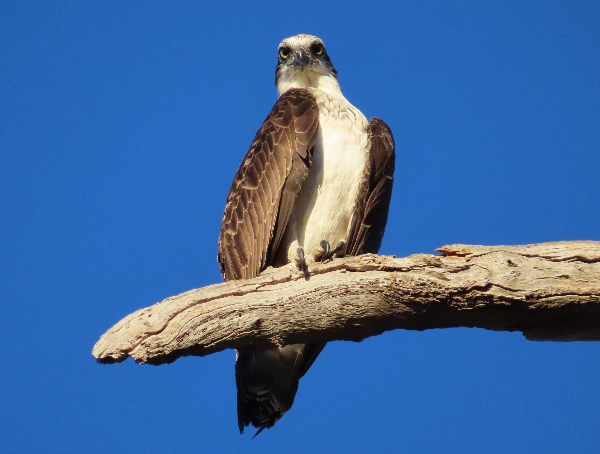
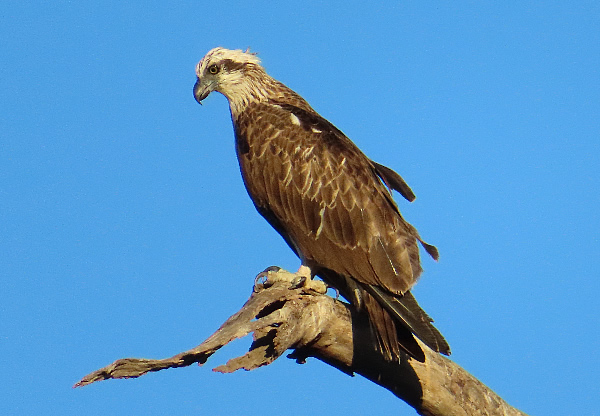
extreme heat there seems to be less bird life around. I’m wondering if the hot days have drove them away to a more suitable place? Nevertheless I had the pleasure to take a lot of photos of Ospreys this last weekend.
Read this week's 2 stories about the Ospreys.
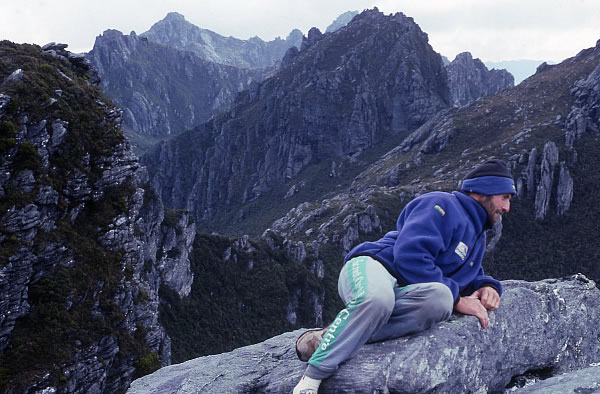
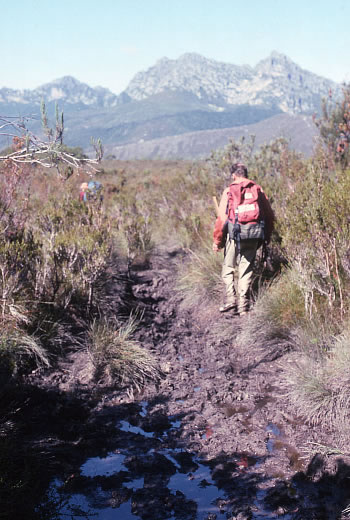
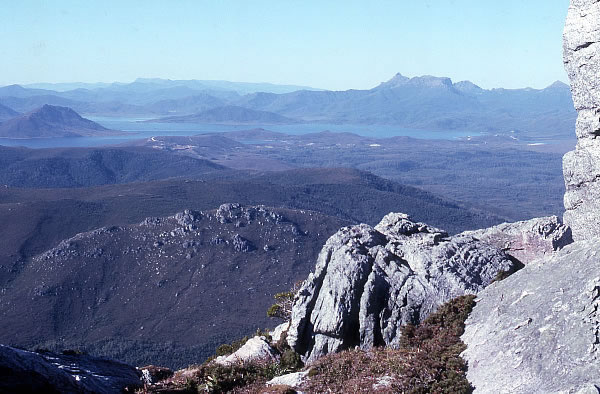
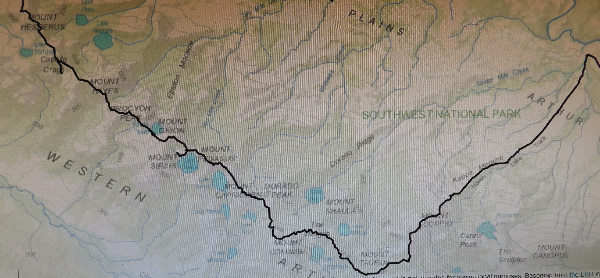
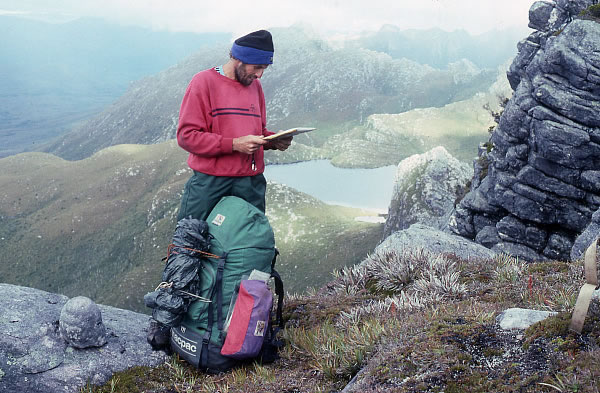
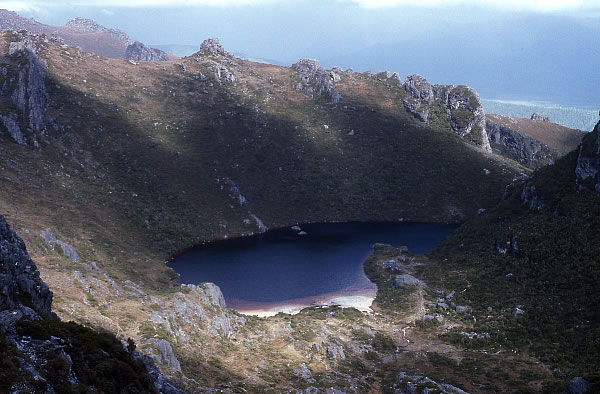
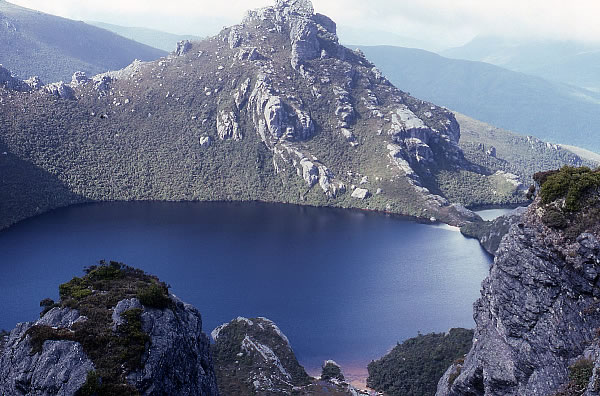
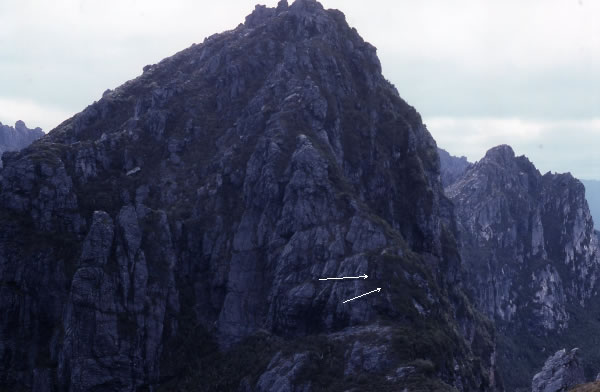
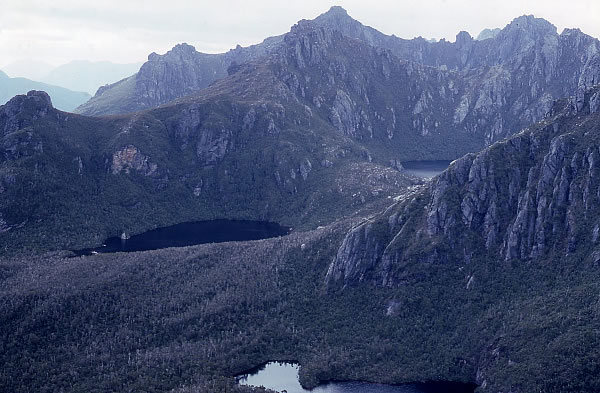
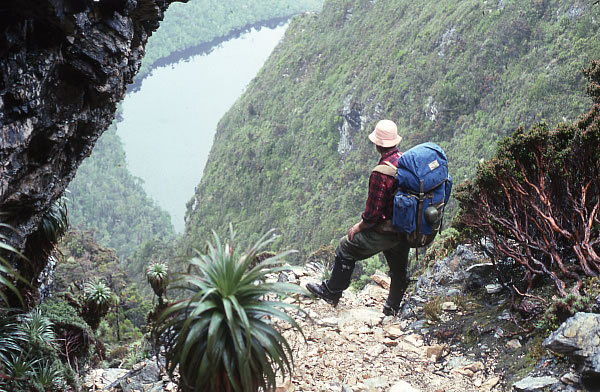
Read the short story of a walk that I did on the Western Arthur walk trail in Tasmania. The route was up and down the slopes of the range in this photo. It was a testing walk but so stunning.
- Paddler of the Week
- Osprey - To Catch a Fish
- ParaCanoe Selections
- Who's Out There
- Singapore Paddling
- To Backpack the Western Arthur Track - Tasmania
- Birds Along the Way
- For Sale - Epic 16X Ultra
- For Sale - Wavehopper
- Epic Paddles
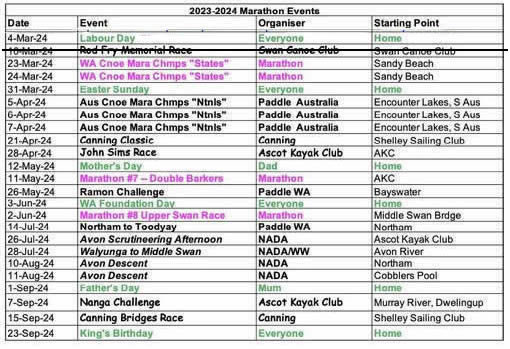
- Coming Events.
- State Marathon & Australian Marathon Championships
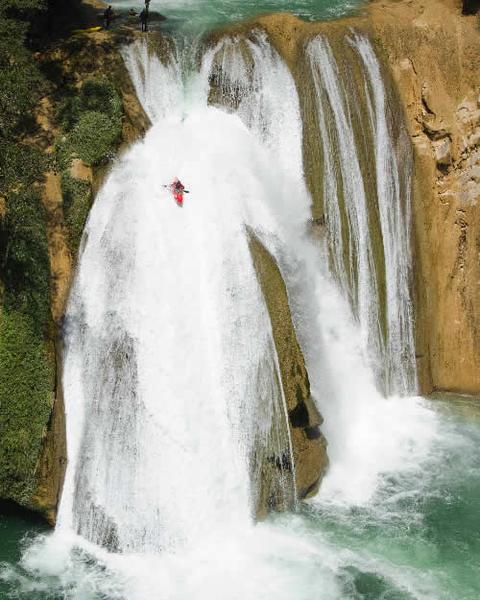
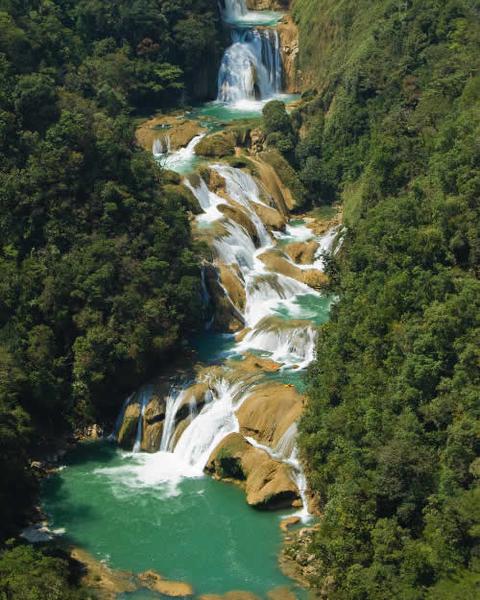
- A Wild Ride With Andy Griffith - Colorado River
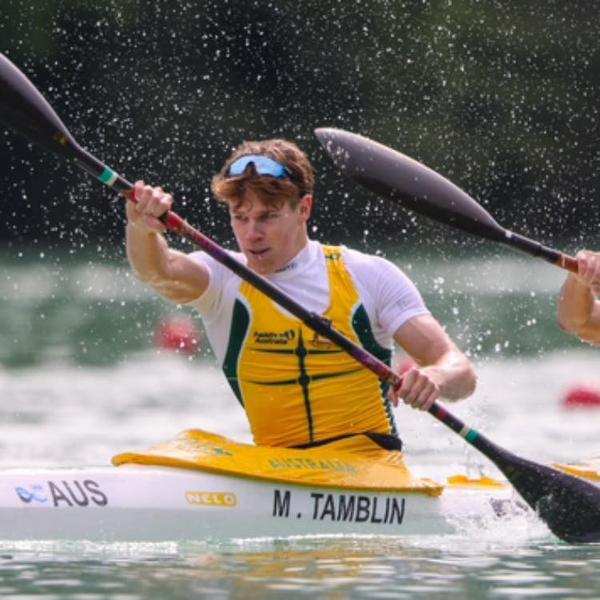
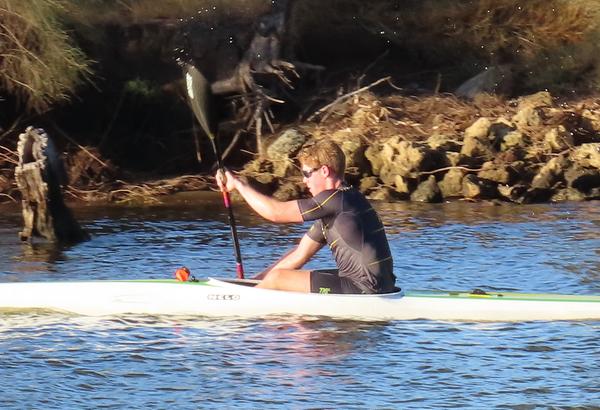
Paddler of the Week Mitchell Tamblin Mitchell Tamblin, an Australian canoe sprint athlete, has made a name for himself in the world of paddling. He is also into marathon paddling and he will be competing at the State and National Canoe Marathon Championships coming up. - Name: Mitchell Tamblin
- Age: 19 years -Feb 8th 2005
- Federation: Paddle Australia
- Discipline: Canoe Sprint / Marathon
Mitchell’s dedication and hard work have earned him recognition both nationally and internationally. He competes with passion and determination, representing Australia on the water.
Mitchell training this week. Last week Mitchell was competing in the Australian Canoe/Kayak Sprint Championships. This Saturday and Sunday he will be competing in the West Australian Canoe/Kayak Marathon Championships
and two weeks later will be competing at the Australian Canoe/Kayak Marathon Championships in South Australia. Last year Mitchell raced at the 2023 ICF Junior and U23 Canoe Sprint World Championships in Auronzo, Italy. Mitchell also participated in the K1 Mixed Relay 5000 and secured a commendable fourth place finish alongside his teammate Chelsea
Jentz Mitchell was also selected to race in the 2023 U18 Asia Pacific Cup Team at Lake Karapiro in New Zealand. He was also part of the Paddle Australia National Development Squad (NDS) 2022/2023 In 2021/23 as a under 17 year old he made it in the Sprint WASPS Squad.
Mitchell learnt his canoe racing at Norwich Canoe Club before emigrating to Australia in 2021.
He is a member of Bayswater Paddlesports Club in WA.
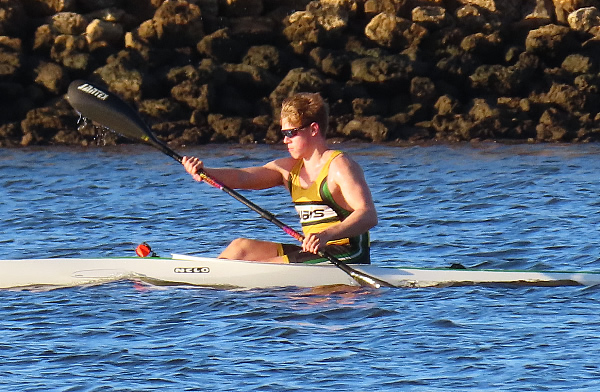
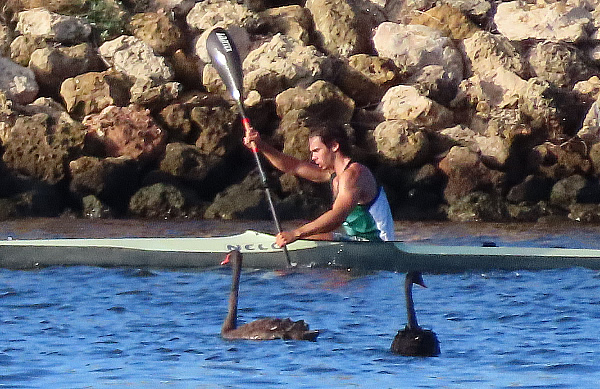
At the WA Marathon Championships and the Australian Championships Mitchell will be paddling doubles with Stephan Weyers above, who is also an exceptional paddler. Stephan gained a lot of experience at the World Marathon Championships last year and hopes to go to the World Marathon Champs this year in
Croatia.
Osprey- To Catch a Fish On my Sunday morning paddle I came across an Osprey. (Friday night I photographed two.) I noticed it on my way back from Barkers Bridge about 600 metres from
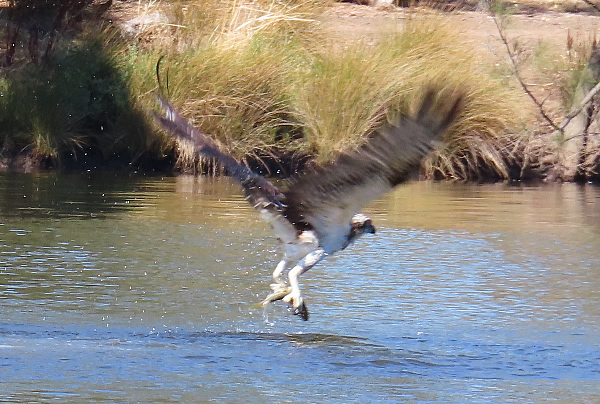
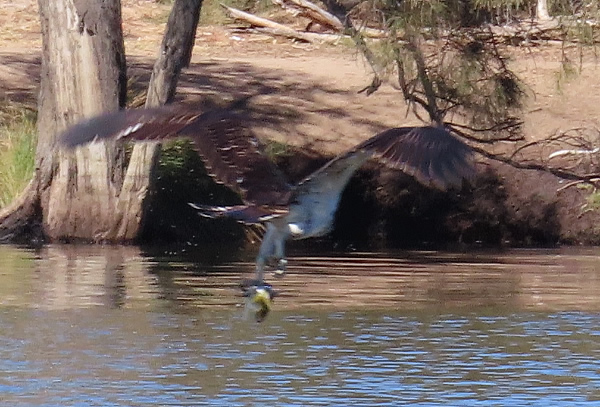
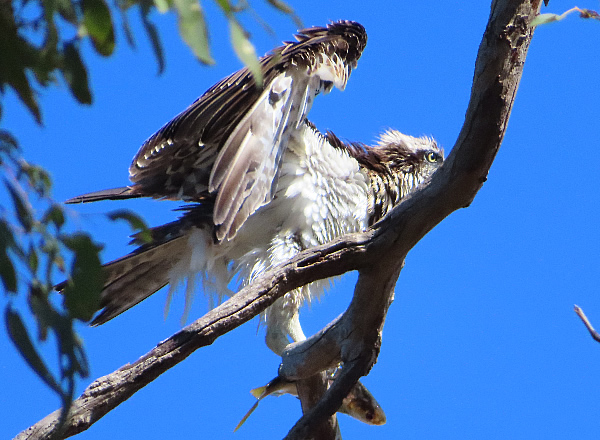
the bridge on the north bank in a high tree. I started taking a few photos, then it took off and dived in the river with a big splash. I was a little slow aiming my camera towards it, as at the time I thought it was going to fly off and I was wobbling a bit in my kayak. However, when it raised itself from the water I managed to get a shot of it carrying a fish back towards a high
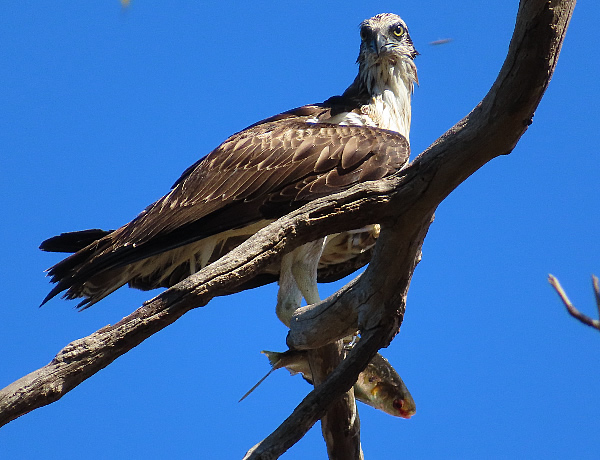
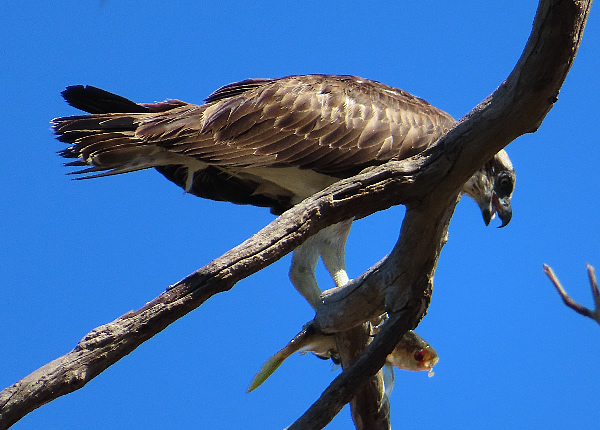
tree. It then started to have a feast. It’s times like these I love being on the river, well in fact I love being on the river all the time, but witnessing the terrific bird life and their movements whilst being in a kayak is the icing on the cake. Two ladies on
stand-up-boards were just passing and they couldn't believe their eyes. Being new paddlers to the river they hadn't seen anything like it before so they were overjoyed. A few more social paddlers came by and they were happy to see it on a branch eating the fish. I carried on heading home seeing a Whistling Kite high in the sky circling Success Hill. Unfortunately it didn't land. A
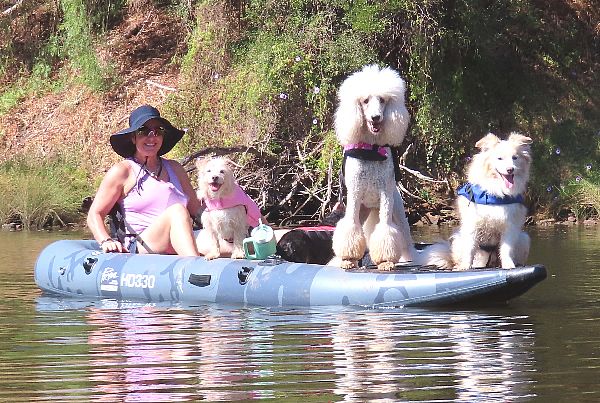
little further near Fishmarket Reserve boat ramp I met Sue in a inflatable canoe with four dogs on board. Sue had trained for the Avon Descent with me in 2005 so it was good to meet up.
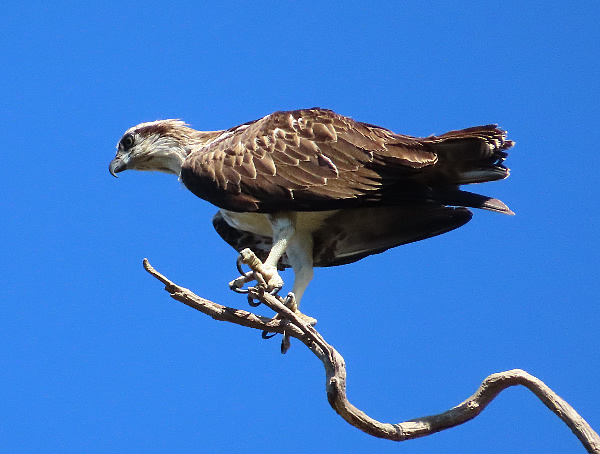
An Osprey getting ready to dive for a fish. The female Osprey is larger, longer and heavier than a male. Females can also be differentiated by a broad band of streaks across the upper breast. Most adult males tend
to have a cleaner white upper breast, however some males have a paler, thin lot of streaks similar to the females. Fish make up some 99% of the Osprey’s diet. I love it when I see an Osprey catch a pretty large fish and the fishermen on the banks are catching nothing but tiny fish that they have to throw back. An Osprey’s sight has been adapted to spotting fish from the air. They usually hover for a few moments before diving feet first and plunging in the water to grab the fish with their talons. It’s large, scaly feet have sharp little spines (spicules) beneath their talons which, together with their long, sharp, curved claws and reversible outer toe, helps grip the slippery fish. They then immediately take off, from the water, with their powerful wings. They generally take fish that are between 25 to 35 cm in length, however they do catch fish that are much bigger and are over 2 kg in weight. When they catch the bigger fish though, it is quite a weight for them to lift out of the water. With the Osprey’s feathers being dense and oily they repel water. An oil gland situated at their rump, near their tail feathers, produces oil which the Osprey spreads around its feathers by rubbing and preening. It acts as both waterproofing agent and as an anti-parasitic. Their nostrils rather than being round are long and slit-like and can be closed
when underwater, which will then stop any water from entering their nasal passages.
The Osprey dives and plunges in the water feet first and grabs a fish and takes it up to a high branch to have lunch.
The Osprey left the tree and dived straight down without hovering.
The Osprey lands on a high branch to have a meal.
Migratory ospreys travel south during the Northern hemisphere winter. North American birds travel south to Central and South America, while British ospreys migrate to West Africa. However in countries like Australia where the climate isn’t so harsh and food is plentiful Ospreys will stay in the same area.
Lunch time. It’s always a bit of a risk taking my non-waterproof camera with me on a training run in my K1; I could get swamped by a boat, I could capsize my K1 or I could meet up with other
paddlers who want to race me and it get drenched from water off their paddle, but with all the photos I have taken over the last few years it has been worth the risk of losing it or getting it wet.
In 2005 Sue took part in my Avon Descent training. Today she was doing something a little more sedate taking her four dogs for a ride. They look happy, well three do!
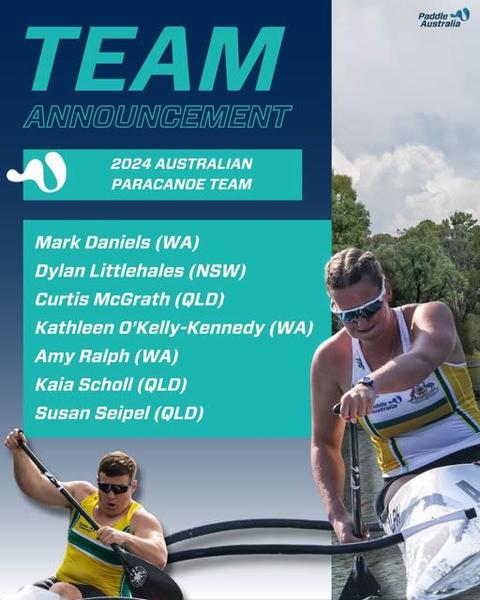
2024 Australian ParaCanoe Team Selection Three paddlers from WA Congratulations - Mark Daniels, Kathleen O'Kelly-Kennedy and Amy Ralph
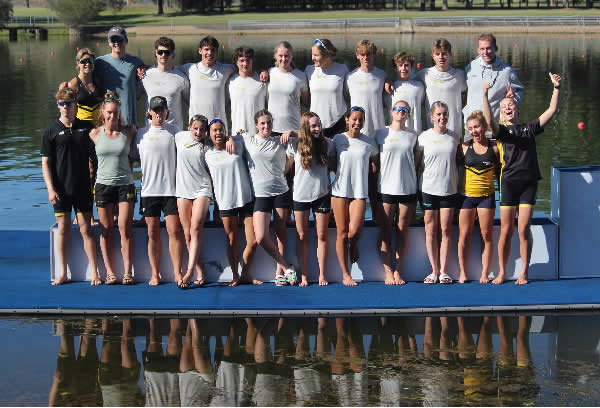
Last week it was the Australian Canoe/Kayak Sprint Championships in Penrith and the team have returned home with some good results.
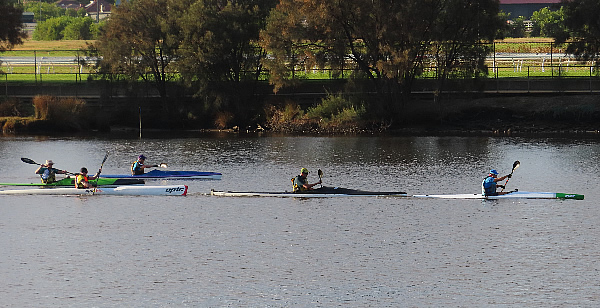
The young guns are still out there paddling after a big week at the Sprint Champs. I suppose the next big competitions will be in Europe.
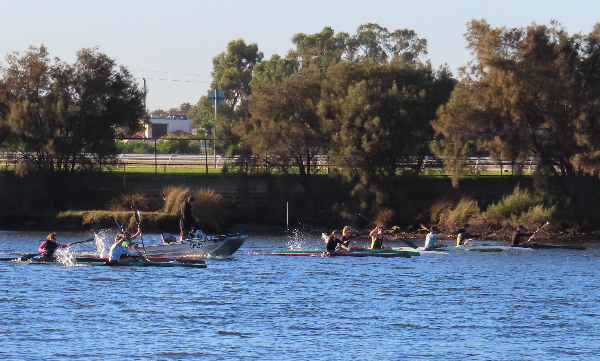
From the young to the more mature. They call themselves The Washriders. Most if not all are above 60 years old and they train 4 times a week or more. Most training sessions there are usually 6 - 10
paddlers. Leading is Chris Meadwell, Alan Moreby, Don Stephens, David Brown and bringing up the rear in the green kayak is Steve Coffee.
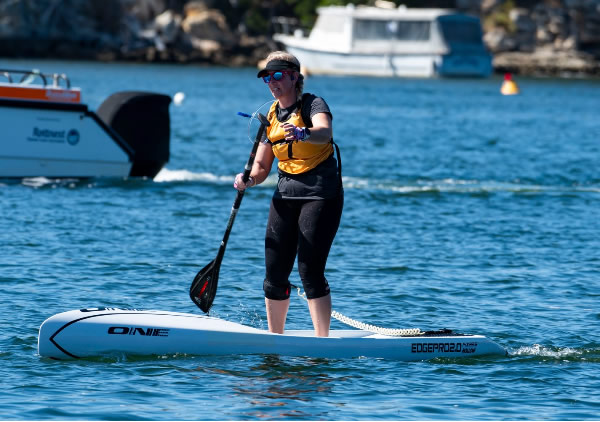
A big shout out to Emma Hammy Raphael who paddled the long course on a SUP at the Rod Fry Race. The paddlers who took part will know that it was windy, it was rough and there were lots of big boats creating huge waves. It was a tough race on a ski and really tough on a SUP. Darren Pratt and Declan Hoare also paddled.
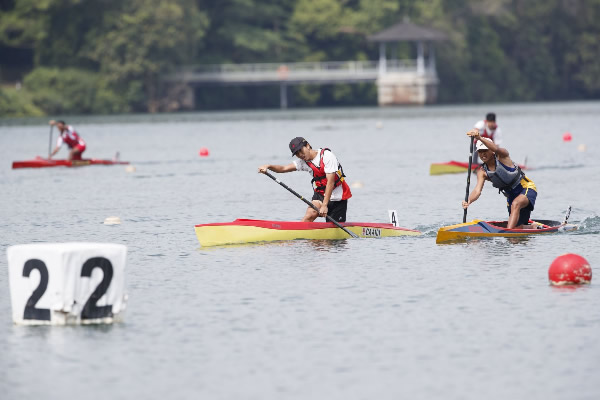
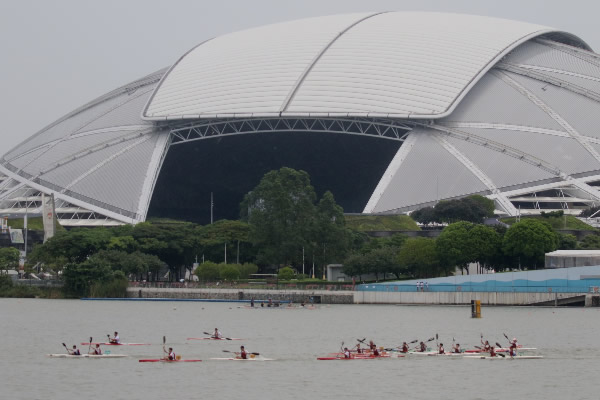
Singapore Canoeing The Singapore Canoe Federation (SCF) was founded in 1971 and is the National Sports Association responsible for the management, coordination,
development and promotion of canoeing in Singapore. It represents the interest of its athletes and members to Sport Singapore (Previously known as the Singapore Sports Council), the Singapore National Olympic Council (SNOC), the public and other International Canoeing bodies. To spur local interest and participation, the SCF has embarked on numerous initiatives.
In 2002, to support the rising demand for learn-to-canoe courses, funding attained went towards both the hardware – facilities include a permanent office, classroom and storage area – and the software – developing and hiring coaches and administrative personnel. In March 2004, the SCF pioneered Singapore’s first dedicated public paddling centre at MacRitchie Reservoir. Subsequently in August 2010, a second public paddling centre commenced operation at Pandan Reservoir. These public paddling
centres and the programmes they run are a joint effort between the SCF and Singapore’s national water agency, the Public Utilities Board (PUB), which are aimed at both creating a sustainable environment for canoeing and increasing accessibility to water sports all over Singapore.
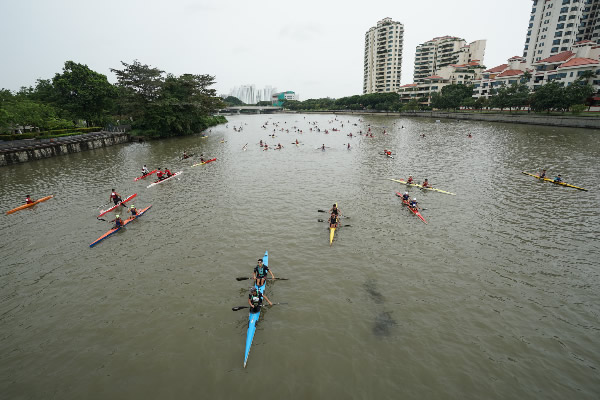
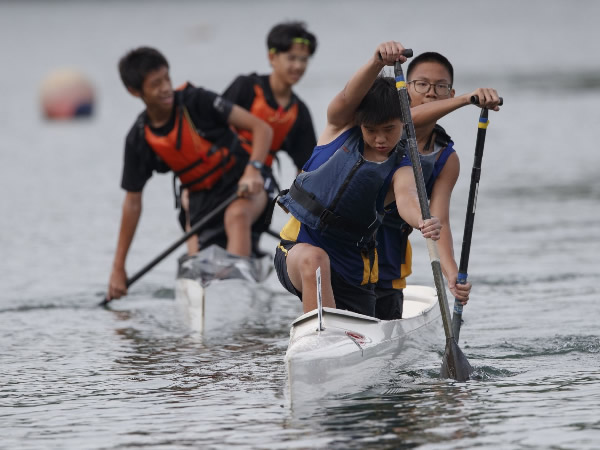
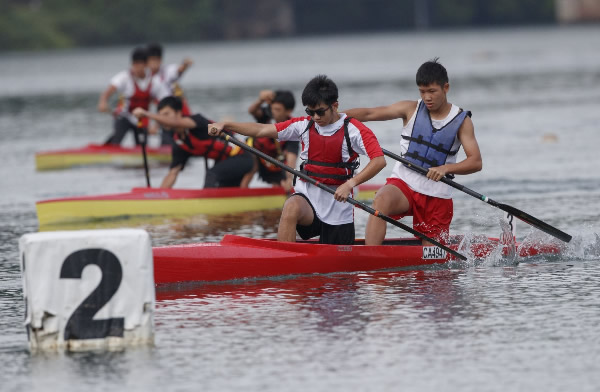
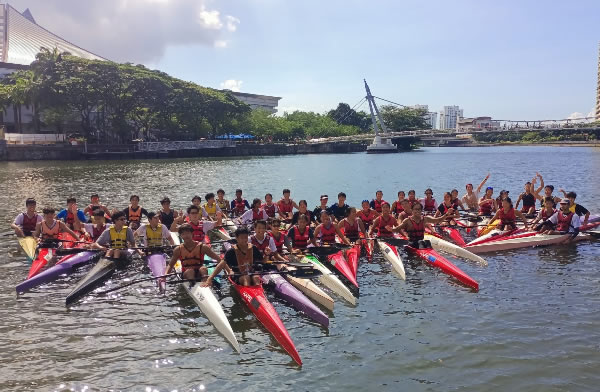
In the 2022 Singapore Schools Games Canoeing Championships there were 600 paddlers. In the 2023 Singapore Canoe Marathon there were 700
paddlers.
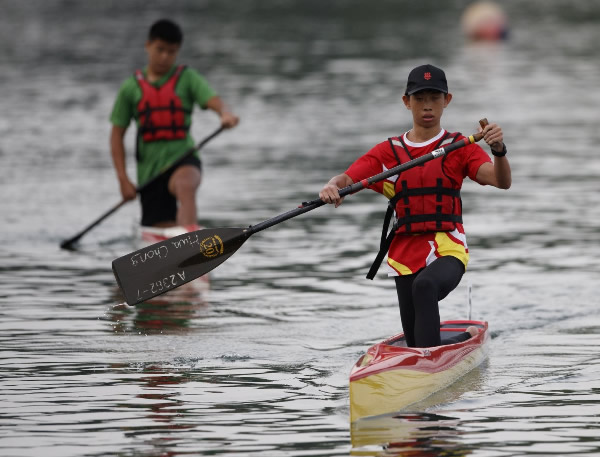
It's amazing how many young paddlers they have in Singapore. And look many are paddling high kneeling C boats. Photo: Michael Loh
Event Date Approx No of participants - 2022 Singapore Schools Games Canoeing Championships 4,5,6,7 Apr 2022 600 participants.
- 2022 Inter-Tertiary Canoe Sprint Championships 9 Apr 2022 180 participants.
- 2022 Singapore Kids Kayaking
Championships 10 Apr 2022 70 participants.
- 2022 Singapore Sprint Cup 1 23 Apr 2022 20 participants.
- 2022 Pesta Sukan Canoeing Race 31 Jul 2022 560 participants
- 2022 Singapore Canoe Sprint and Paracanoe Championships 20 – 21 Aug 2022 280 participants.
- 2022 Singapore Canoe Polo Championships 3, 4, 10, 11 Sep 2022 300 participants.
- 2022 POL-ITE Canoe Sprint Championships 19 Nov 2022 185 participants.
- 2022 Singapore Mid-Distance Canoeing Championships 20 Nov 2022 320 participants.
- 2023 Singapore Canoe Marathon 15
Jan 2023 700 participants.
- 2023 Singapore Junior Canoe Sprint Championships 11 – 13 Mar 2023 60 participants.
Watch the video here: Singapore Canoe Marathon 2019 you tube - Search Videos (bing.com)
To Backpack the Western Arthur Track March 1991
On my 24,000 km, Kayak, Walk, Backpack, and Cycle Around Australia I arrived in Tasmania at Devonport after 10 months of continuous exercise. Here I cycled from Devonport to Cradle Mountain, via Sheffield, and then walked the Overland Track to Lake Sinclair and from Lake Sinclair I cycled to the Western Arthur Track which I was about to
walk. March 9th. Huon River Campsite. We broke camp and moved on to the beginning of the Western Arthur walking track. My walking buddy was Peter who I had never met before today. He was so in awe of the trip I was doing around Australia
and my Kimberley Expeditions that he wanted to walk with me along the Western Arthur Range. Peter had been an abalone diver for nearly 20 years, had skippered fishing boats, and owned a miniature donkey stud. His favourite passion was fly fishing. When he contacted me I was a little apprehensive but he said he was an experienced walker and I thought I could do with a walking partner as
the track is renowned to be one of the most difficult walks in Australia. It was extremely foggy as we filled in the registration book with visibility down to three metres. Right from the start, the track was muddy and the dew and moisture that gathered on the foliage saturated my trousers. Cobwebs, sparkling with dew, spanned the track but we pushed through them, and dodged the
deepest mud holes. At 10.30am the mist started clearing and we could finally see where we were headed. I kept quite clean but Tim and Peter had mud up to their backsides. By 11.40am we experienced our first complete view of the range; the mountains didn’t look too high but the peaks were extremely steep and rugged. Just before Junction Creek, Tim who was my driver and support decided to return to the vehicle so we stopped to have lunch with him before he left.
Tim my support walking towards the Western Arthur track. A bit muddy. Peter and I moved to the base of ‘Moraine A’ where we rested. I filled my water bottle at the creek and took on the climb. Soon after the
start of the climb Peter showed signs of fatigue. Every 50 metres he would stop for a rest, although at that point the climb wasn’t too steep. He urged me to go ahead and he said he would meet me at the top, as he simply wanted to take it easy on his first day. There was no way I was going to leave him, so we continued on, Peter resting frequently. I became more and more uneasy about Peter’s health as the rests continued. At one stage, after an extended rest, I found him propped up against a
rock, looking like death warmed up. He was trying to eat some bread but he couldn’t swallow it. I wondered whether he’d become dehydrated. I thought to myself what have I let myself in for? This was the first piece of up-hill, difficult may it be he shouldn’t be lagging so much. Then I found out that he wasn’t carrying water as he’d intended to drink from the pools and streams
along the way, but there was none to be collected on the climb. I gave him one of my water bottles, as he didn’t even bring a water bottle along and the water revived him for a short time but then we continued along the same pattern, stopping and starting, although Peter was now drinking frequently. My immediate concern was whether we should keep going or turn back, but Peter
insisted we keep going to the top. We probably had little choice anyway as Tim would have left the point of our departure by now and we were in the wilderness with no vehicle. So we kept going.
Half way up the mountain. Looking down on Lake Pedder. South West National Park. Tasmania
Now Peter was drinking our biggest problem was the lack of water; my supply was dwindling fast with Peter requiring so much of mine. The springs that Peter expected to find along the way were non-existent, so I had no option but to try for the top and find water there. I lifted my pack, left Peter with some water, insisting he rested until I got back, and climbed. The track was steep, but the magnificent view of Mt Hesperus and surrounding area spurred me on. Several small soaks dripped between the rocks, and I cupped my hand to collect a little. Disappointingly, at the top there were no fresh, clear lakes, only shallow bog holes from which I had to siphon water. I left my pack and descended, topping up my water bottles from the water dripping from the rocks. Peter was still at the same place when I returned and we were still a long, long way from the top. We discussed the situation – should we go up or down. It was 6.00pm and getting late, but we decided to keep climbing. Peter was a determined, independent character, but I managed to convince him to let me carry his pack. Without the
load, his pace quickened but it was still hard work as his energy had gone. I helped him as much as I could, but that was difficult on the narrow, steep track, so I decided to take his pack to the top and then return to help him. The summit was pretty exposed with very few camping spots but I found a tight spot behind a large boulder. I set up camp quickly, just in case it got dark before I returned, and then started to descend towards him. Before I’d got too far, Peter was nearing the top. He
was struggling and really looked sick. I could see that he had been vomiting. I gave him the last of my water and led him to our tent hidden behind the rock. He lay down while I tried to siphon water from three holes that I dug in a sandy, wet patch on the east side of the boulder. The soak took time to fill but eventually I filled the bottles. The water was dirty so I filtered it through my hanky. (I found out that Peter mostly walked on flatter terrain from fishing lake to fishing lake and
just drank the water from the stream and lakes along the way and never carried a water bottle. It was hard to believe he didn't carry one on this trip.) Peter rested while I fed him soup and I tried to get as much liquid into him as possible. He said little. After dinner I sat on a rock overlooking Lake Pedder and to the west Port Davey Harbour. The stars were bright, the air cold, and
although the wind howled there was a strange silence around me. Reflecting on the day, I thought how lucky we were to be here and then, at 9.45pm, I bedded down for the night.
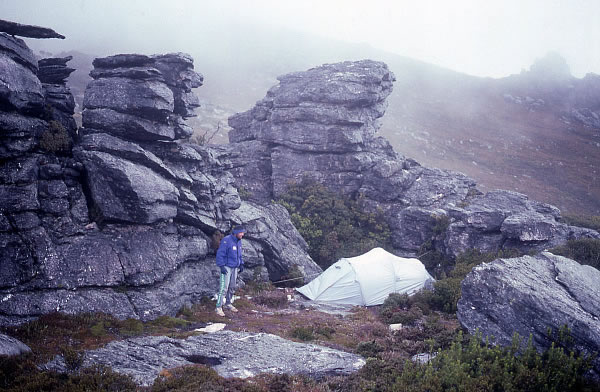
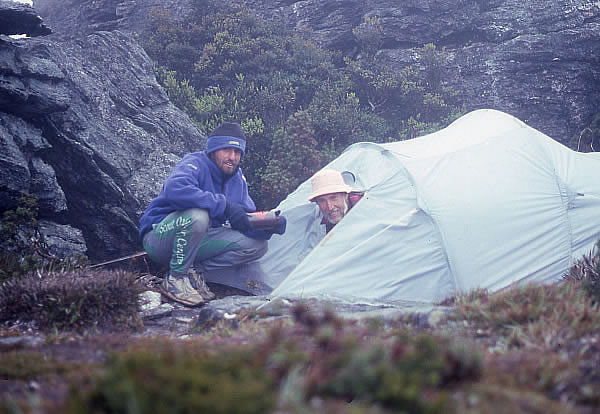
Our first camp on the range. Mt Hesperus.
March 10th. Mt Hesperus. Rain fell on the tent at 5.45am and then at 6.00am it poured. The rain increased throughout the morning. It wasn’t a good time to be out walking, so we stayed where we were. Peter
said he was feeling much better and after the previous day’s scare he was happy to drink plenty of fluid, keeping a bottle next to his side and drinking often. At 4.30pm I decided to brave the elements. It was still raining and the wind was icy cold. I returned to the tent, half frozen. I had a meal of muesli, cheese, biscuits, chocolate, nuts and dried fruits. Peter had bread, jam and
salami. We didn’t move that day, (Peter needed rest) or the next as the weather was atrocious. March 12th. Mt Hesperus. The day
hadn’t improved; in fact, it had deteriorated further. The wind had shifted to the S.W. again and the temperature plummeted. I felt too cold to leave my sleeping bag but Peter braved it for a short time at least (he’s got skin of steel) but he soon came running back in. Peter fell asleep and it started to hail and the ice continued to slide off the tent. When the storm stopped, I
darted out to the toilet but soon returned to my cocoon.
We hid from the bad weather for a couple of days. The weather suddenly improved, there was blue in the sky and we could see Lake Pedder again. At 1.30pm we decided to make the break and quickly took down the tent and
packed our bags. Our route took us up the hill near the peak of Mt Hesperus after which we descended before climbing again. Lake Cygnus was clear but hail swept across the mountain and soon reached us. Several minutes later it snowed, then the lake and the mountain tops disappeared in the white-out. The terrain to Lake Ceres became steeper with several hard ascents and descents. The track was steep and muddy, and water cascades flowing down the path soaked my already wet feet. Way ahead along
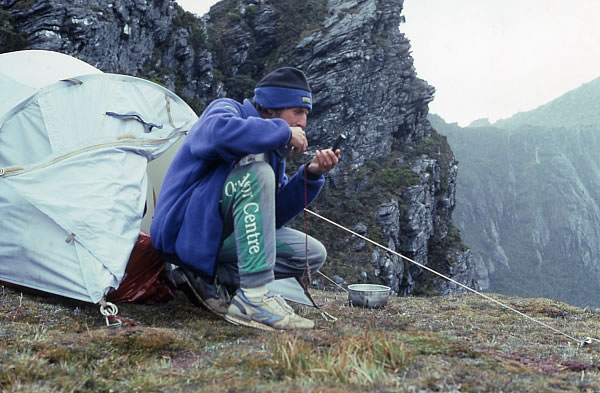
our route, some amazing rocky mountain tops that looked impossible to walk over were visible. By 6.00pm we had made it to Square Lake in another hail storm, so we decided to camp for the night. Square Lake had a sheer cliff on its north and west side and the camp site that we chose was on uneven grass tufts but at least it was dry. We soon erected the tent and threw things inside. It was icy cold but fairly calm. We cooked inside the vestibule using Peter’s stove – a feast of spaghetti, peas,
soup, muesli bar, milo and chocolate. I spotted a marsupial rat running across the grass just before I retired.
The track led up over the tallest of mountains.
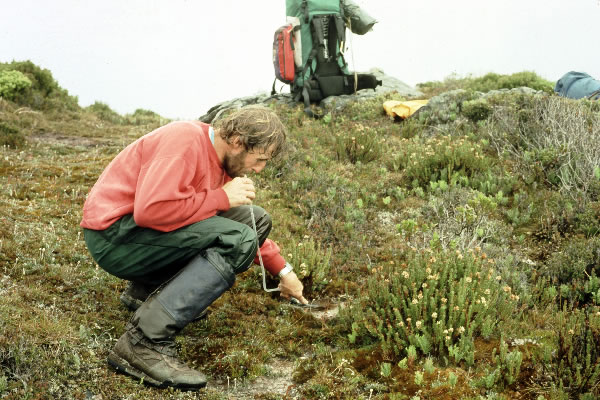
On top of the ridges we collected water from the pools.
Lake Cygnus. The scenery was amazingly beautiful.
March 13th. Square Lake. The rat had been running around our gear stored in the vestibule all night and Peter had spent some time shooing it away. Although my bed was uneven, I slept rather well, only waking
a few times when Peter was after the rat. It was foggy but calm when I crawled out of the tent. As we were packing up at 9.00am, an American couple came walking down the hill. They were annoyed about the weather being so awful, so although they had only just started their walk, they’d decided to walk out. It was a steep climb, but from the top of the hill we had a beautiful view of Lake Oberon. Further on, the track was blocked by huge boulders with a hole only big enough to accommodate a person’s body. Our packs had to be hauled up the rocks. We climbed higher to Mt Pegasus and then descended a steep track, picking our way through menacing tree roots and branches until we reached the base of Mt Capricorn. From the top of Capricorn it was an extremely steep climb down over loose rocks followed by a dirt stairway, its giant steps created by hundreds of
walkers. It was a slippery and hazardous descent. When we walked forward down the steps, our packs would hit the steps behind, knocking us off balance so most of the time we climbed down backwards with our faces to the incline. It was so slippery and there were so few hand holds that the chances of falling several hundred metres were very real. With extreme caution we climbed
over exposed tree roots as the track curved around sheer cliff faces. I can’t remember ever doing such a steep descent with a heavy pack. With some relief we made it to a saddle, safe from the vertical drops. Looking back up, we were amazed at how steep it was, and it was difficult to believe that we had done it without falling. But we had, and many had done it before us, so we weren’t really that clever! As we moved along the next slope towards Mt Columba, three other people, like dots, could be seen descending Mt Capricorn. We watched for quite some time as they moved slowly and carefully, at times using ropes to prevent themselves from falling. Happy to be on flatter but wetter and muddier terrain, we started the next climb to Mt Columba along tracks
intersected by tree roots and boulders. As we looked back, the views of the mountains and lakes down in the valleys were awesome. We found a superb campsite right on the edge of High Moor, only metres away from a huge sheer drop, which ended near Lake Dione. No sleep walking tonight, I thought. The walk continued......
The steep track we took down Mt Capricorn.
We could see three walkers ascending.
Lake Titania and Lake Uranus.
Peter looking down to Lake Ariel.
Time to trim my beard just in case we see someone important. No sleep walking tonight as there was a big drop beside the tent.
The way we came. Over the mountains.
Birds Along The Way It was a windy Friday evening nevertheless I decided to take my camera on my paddle just in case there were any birds to photograph. Having high winds is not the best
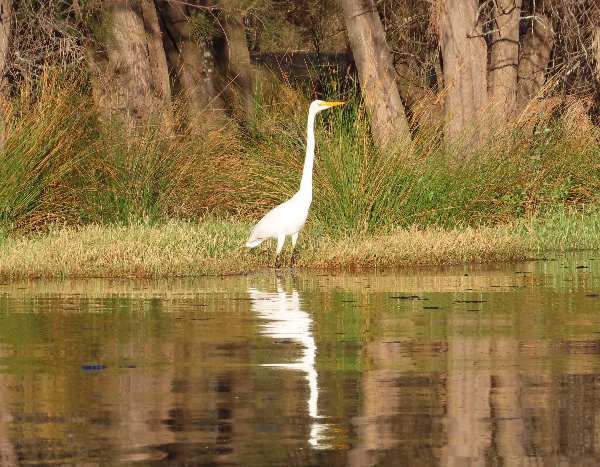
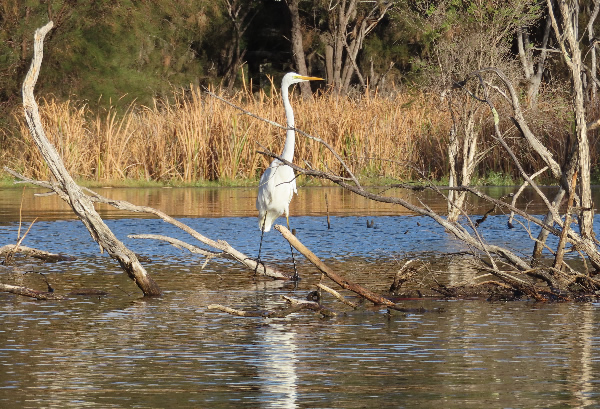
when I am trying to take photos from a 40cm wide kayak. The wind not only pushes me away from the bird it also creates waves, which when I am side on to them there is a bigger chance I will capsize with camera in hand. As I moved upstream towards Bassendean there were a few Darters and Egrets but not a lot of bird life. It was still hot so that might account for the less activity. The
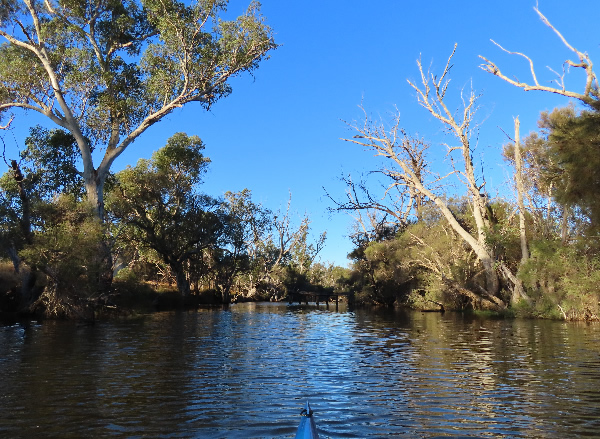
tide was high, the sun was getting lower in the sky creating the vegetation and trees to be a rich colour and the moon, although only a bit bigger than a slither gave me a reason to paddle down the less paddled Helena River. It’s narrow, it’s tree lined, it’s only a kilometre in length but occasionally I get some good shots, if not of birds but the river itself. However it can be too shallow if not close to high tide. As I turned into the river an Osprey sat on the top of a tree. Sometimes I will hear their distinct call before I see them. I took photos and moved on and then there was another one 50 metres further on top of another tree. I took more photos and moved on passing several ducks and an egret and slipped under the Great Eastern Highway road bridge. Although the trees that were lit up with the dying rays of the sun and looking magnificent, although many were
dying, I found no more birds.
I came across an Osprey at the mouth of the Helena River.
A little further there was another one.
I moved upstream on Helena River on high tide. After a kilometre it is blocked by trees.
Great Egrets potter just before the Great Eastern Highway roadbridge.
Further down Helena River you will find an old wood bridge. On my return I moved under the road bridge and heard these two young lads who were fishing, swearing their heads off and jumping up and down. Apparently they
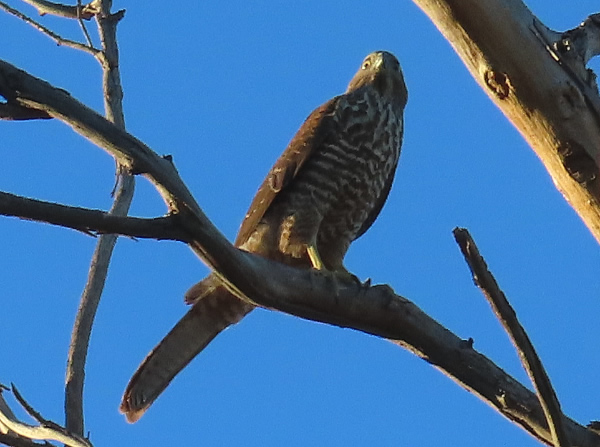
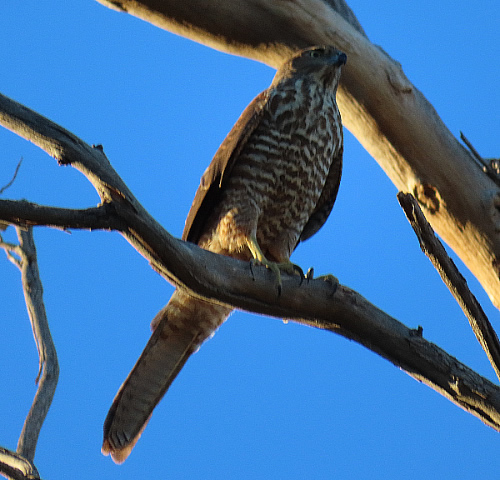
were standing on an ants nest and trying to get them all off. It was actually quite funny. A little further on the northern bank I notice a large bird aloft a high tree which I believed it to be a Brown Goshawk which was a coup as I don’t see them very often and when I do they are either hidden in the tree foliage or fly off before I get my camera out. Goshawks don’t hang around so I had to get my camera out quickly and take a photo before it flew, however it was quite high in the tree and as soon as I took my hands off the paddle and pointed my camera in the air I felt a little unsteady in my kayak. Within a few seconds it took off but I managed to get a couple of shots although I was wondering how the photo would come out considering I was a
little jittery. Even if it wasn’t perfect it was good to see it though. Meeting the Swan River the two Ospreys were in the same tree so I took a few more photos and headed home. It was still windy and the sun was now only reaching the top of the tall trees. I attempted a few one minute sprints just to feel that I had done some real exercise tonight.
On my return I spot a Brown Goshawk (or was it a Collard Sparrowhawk) in a tall tree.
It didn't hang around long only enough time to get a couple of quick shots.
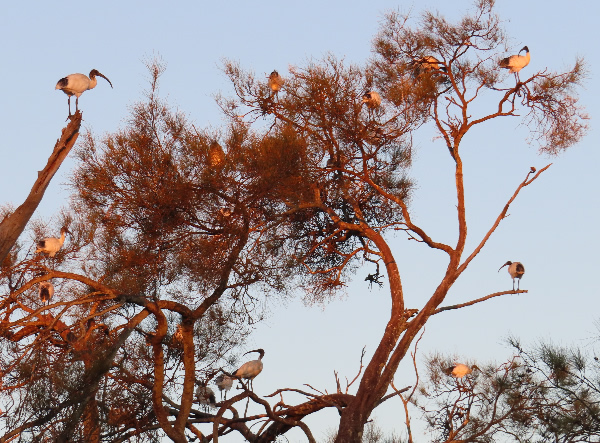
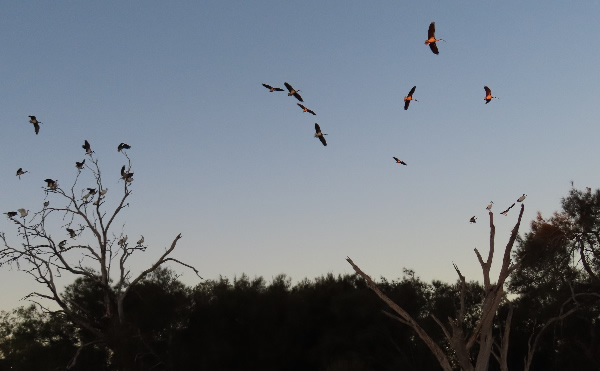
About 300 metres upstream of Sandy Beach Reserve, on the South Guildford side flocks of ibis were landing in the trees which had the sun catching the top of the tallest ones. The wind was painfully annoying as it created river waves and as I tried to take photos it made it quite difficult. As I moved away more flocks of ibis were landing in the
tree or heading that way. It was like they were returning from work and going home to congregate in the trees and their family for the night.
White Ibis were coming home from work and gathering in some tall trees for the night.
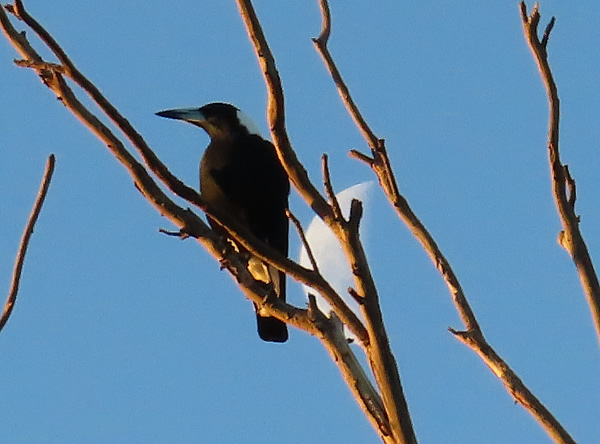
I moved around the corner of Sandy Beach to notice a magpie high in a tree. With the moon out I thought I could get a photo with it in front of the moon, but it was harder than I expected. The wind was blowing one way and there was a strong tide pushing the other so it was virtually impossible to line myself up as within a split second I would
drift. I kept trying, going backwards and forwards and using my paddle to draw myself into position. I had to be careful when drawing that the water from the top paddle blade didn’t drip onto my non-waterproof camera, although to capsize would have been worse. As I was trying to take a photo I was on a knife edge, but eventually I managed to get one, although I didn’t think it
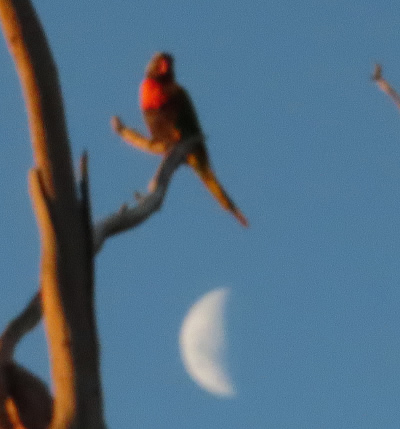
was a good one. Then a rainbow lorikeet came into the tree and I attempted to get it into a shot. Every time I felt myself overbalance I would think to myself, is this picture worth it, as a capsize would cost me $560.00 for a new camera. I do take too many risks to get a shot. I managed to click a photo although it was way out of focus. I was happy to head home against the wind and get there upright.
I tried to get a good photo of a magpie and a rainbow lorikeet with the moon in the background but the strong winds and tide kept pushing my kayak out of line.
I got a bit jittery taking this photo so it came out blur.
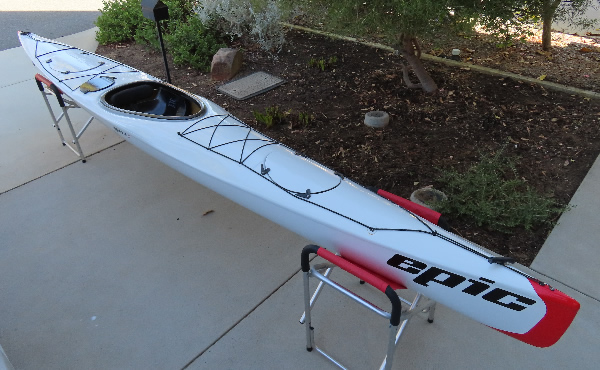
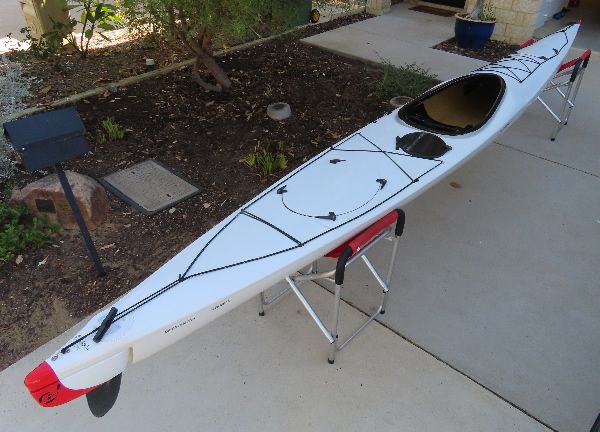
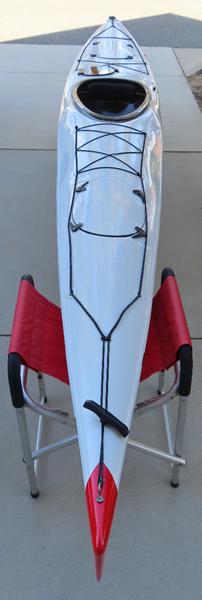
Epic 16X Ultra Sea Kayak Excellent condition. Its been checked over and polished by a professional. $3850.00 Contact Roy Catts 0432
412 521 Email: cattfurn@iinet.net.au
The Epic 16X offers a unique combination of stability, maneuverability, and speed that touring paddlers of all abilities appreciate. In addition to all of the great features that come standard on an Epic, the 16X includes the advanced
Epic Track Master™ steering system, an adjustable seat, and front deck cutaways for a closer, more efficient stroke. Ample storage space, including a convenient day hatch, makes the 16X an excellent choice for day trips and extended overnight excursions.
Length: 16" (4.88m)
Width: 23" (58.4 cm)
Depth: 11.5" (29.2 cm)
Capacity: 335 lbs (152
kg) Storage Capacity: Bow - 18.9 gals (71.5 L) Dayhatch - 9.5 gals (36 L) Stern (17.7 gal (67 L)
Ultra 17 Kg Nomex honeycomb core Woven carbon and Kevlar fabric Vacuum bagged, heat-cured epoxy Red bow & stern
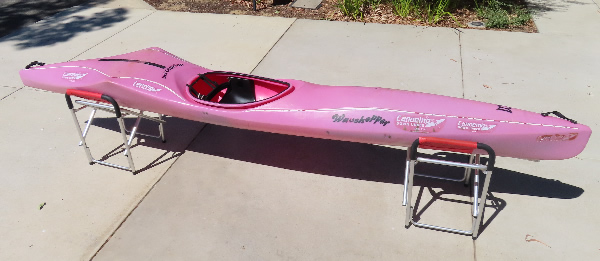
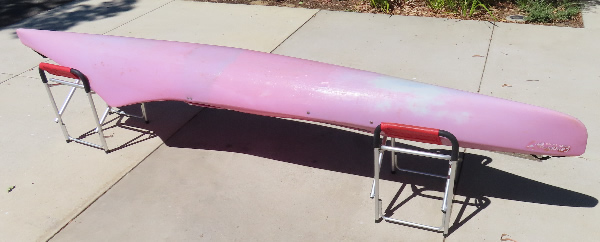
$250.00 Contact Terry 0417977330
Having to say goodbye to a few of my 50 some kayaks.
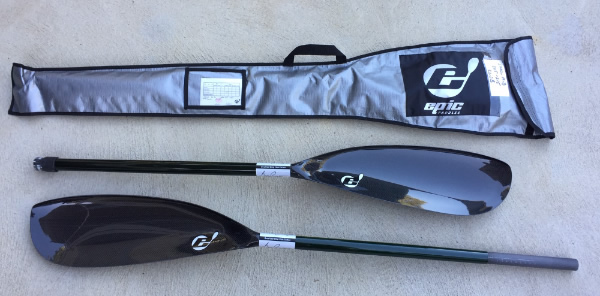
Epic Paddles Small Mid Wing
Epic Small Mid Wing Paddle
Special Small Mid Club Carbon - $460 (usually $499.00) - 737g
- Carbon fiber blade, Green oval shaft
- Fully adjustable length & feather
Small Mid Full Carbon - $570.00 (usually
$649.00) - 680g
- Carbon fiber blade, Black 3K carbon oval shaft
- Fully adjustable length & feather
All Epic paddles include a silver bag with purchase.
This Saturday and Sunday Mornings Saturday K1 & SUPs Sunday K2s Racing starts at 8.00am Saturday morning.
Don't Miss A Wild Ride with Andy Griffith on wilderness adventures in the Grand Canyon. 27th of March at 6.30pm at Swan Canoe Club Andrew Griffiths first joined the Swan Canoe Club in 1968, he is a past president with years of
experience running big rivers and guiding on the Colorado. In the 1970s Andy Griffith was one of Australia's best white water paddlers. In the 80s the fearless Andy moved to Colorado USA where all the white water and action sports were. White water legend Andy will be giving a talk on Wednesday the 27th of March at 6.30pm at Swan Canoe Club on wilderness adventures in the Grand Canyon. All welcome. Andrew reckons that anyone can paddle the Colorado (anyone with a bomb proof roll that is!) Andrew will talk about his experience leading trips along the complete 450km of the river for 18 + days (either in a kayak or in a raft with day hikes on shore.) He describes the trip as “floating through one of natures’ greatest miracles which has a profound effect on the soul.” His wife
Christine describes it as ‘life changing.’ Andrew will describe not only his experiences but also how you can arrange to go on one of these amazing wilderness trips.” RSVP to elena@developmental.net.au
|
|
|
|
|
|
|
|
|
|