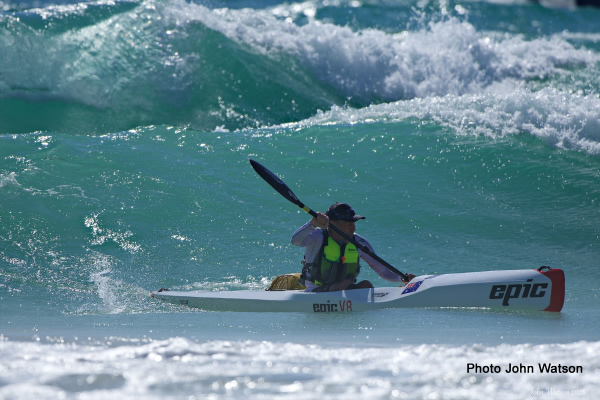
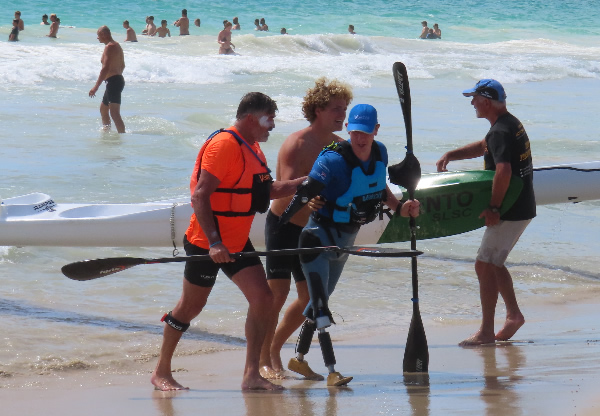
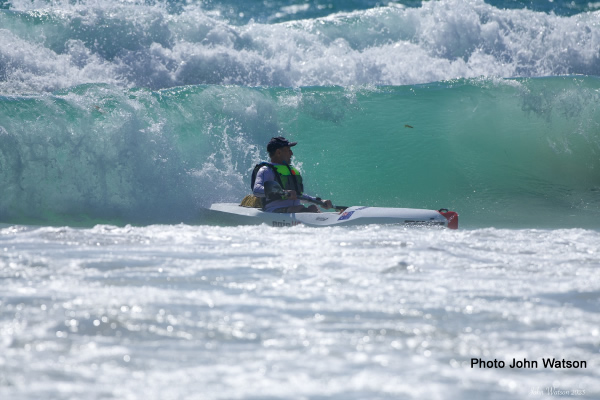
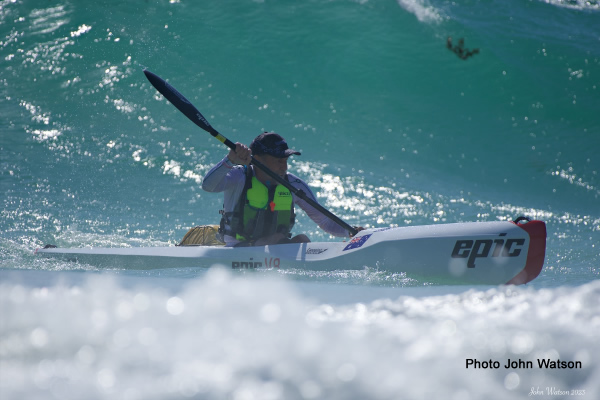
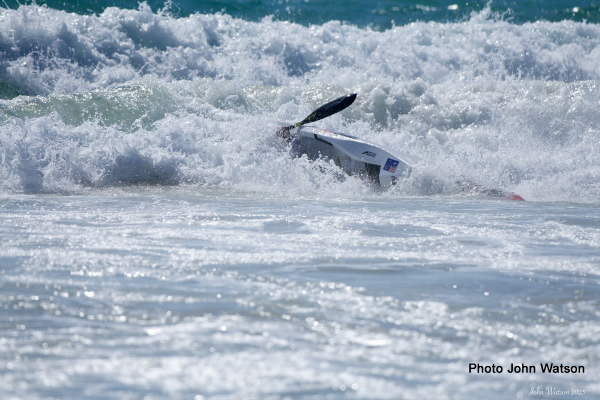
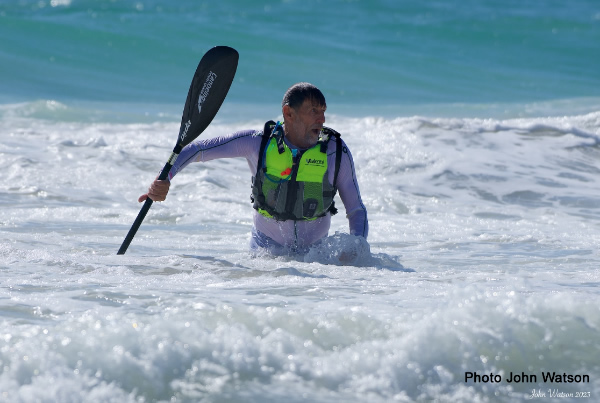
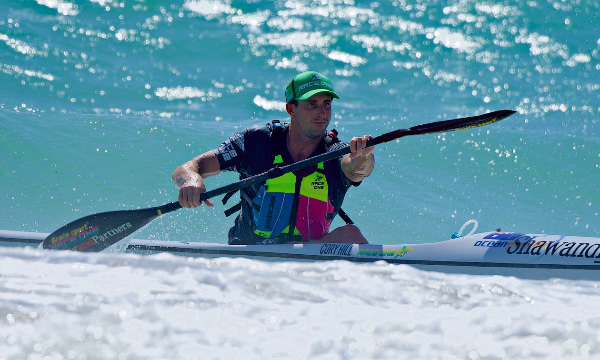
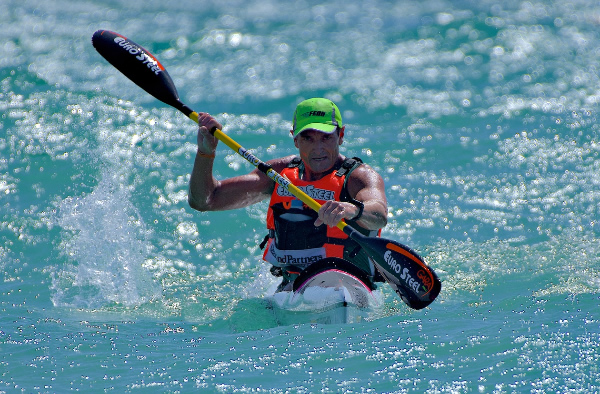
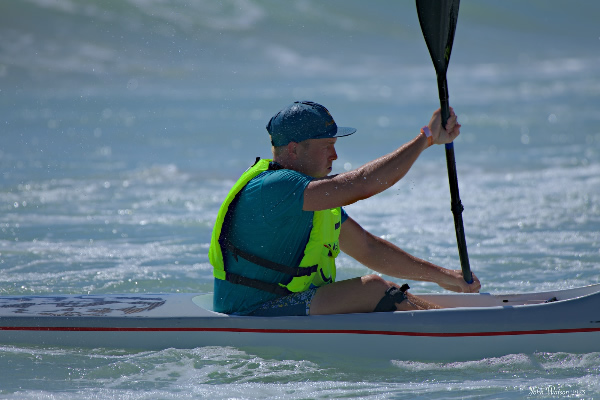
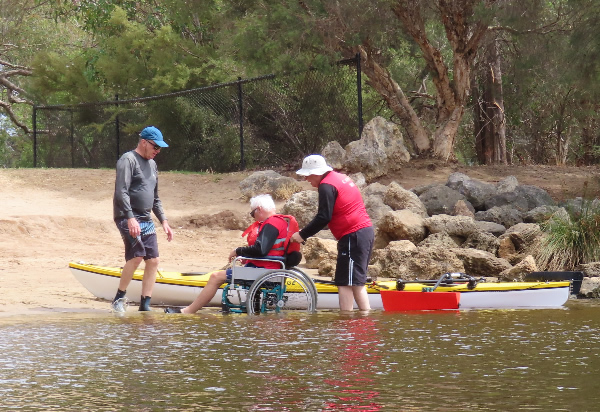
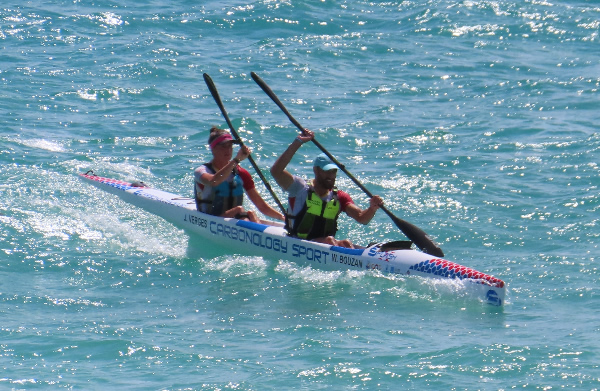
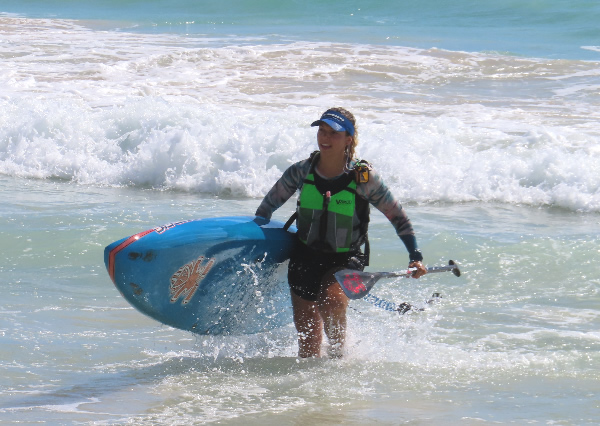
Jonathan White coming ashore at the finish line in the double ski. Jonathan also paddled in the West Coast Down Wind Race, the two Sunset Races and the Doctor Race, so he had a big week.
Jonathan talks to Helen
Trehoret. (Total SUP)
I live in Mid Devon 2 minute drive from the Grand Western Canal, where I do the majority of my training. I also train at Exeter Canoe Club and do my surf training at Exmouth, all in the South West of England. As a teenager I did a lot of whitewater kayaking as well as climbing, mountain biking, running, rugby and cricket. I just loved
being active. I joined the Marines and there I specialised in Mountain and Cold Weather Warfare, so climbing and skiing became work too. Kayaking faded away for me, especially after a nasty incident on the North Esk, Scotland where I had a couple of difficult swims.
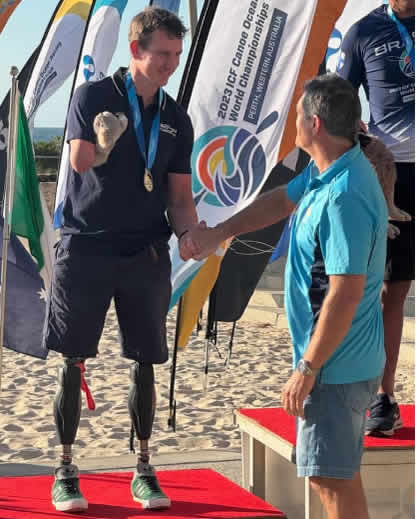
I was injured 8 years into my career during my second tour in Afghanistan. Whilst I was commanding a foot patrol, I stood
on a mine, the explosion instantly tore off both legs and destroyed my right arm below the elbow. The result was double above knee amputations and my right arm amputated above the elbow.
I got into paddling again for exercise and a challenge. In 2012 I did the Devizes to Westminster (DW), a long distance race based in the UK, but after that I did nothing more. I had a busy life
period, building a house, starting a business and having kids. Then I had a difficult period of 17 reconstructive surgeries over 2.5 years and my marriage falling apart. So after this I decided I needed a focus again and got back in a boat in Autumn 2018. I completed DW race again in 2019 with the same partner, Lee. The 2012 race had been a catalyst for him to get into sea kayaking and had enabled him to become a full time guide.
So after the 2019 DW I started marathon racing. Jim Taylor-Ross, the UK Epic Kayaks rep and the GB Ocean Racing manager was at my first race he told me “What you are doing here in marathon is great, but I think you would really enjoy surfski and we are trying to open it up to para athletes” so a couple of weeks later, on a Thursday evening, we met at Exmouth Beach with another paddling friend, Dave. He got me in a ski, worked out I
could roughly steer it. Worked out that with a helping hand I could re-mount it and that was that, the Saturday was spent doing the Epic Bay Surfski race.
How easy was it to cross over from K1 to ocean racing?
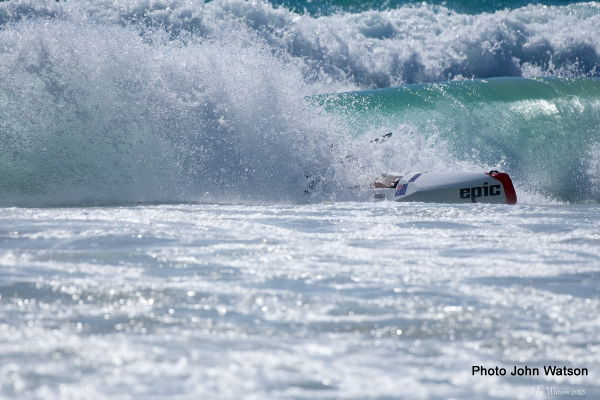
There are a few extra skills to learn, but a lot of it is psychological.
It’s about getting used to the constant water movement, getting used to seeing big walls of water moving towards you but knowing its actually ok and not panicking. In my K1 I wear really short prosthetics, so I have the height of a 10-year-old but with a grown man’s body. So we remounted the footrest rails much closer to the foot rest and then instead of a pulsar, I have a ceiling on my footrest that stops my feet from slipping up and off.
I have the tiller geared so it is very sensitive so I only need to make small movements. In the Surfski, I’ve designed a similar footrest that holds my feet to some extent so I don’t get washed out of the boat. We have also adapted the steering to a tiller bar to do the same as in my K1. I wear longer legs in the surfski, this makes entry and exit at the beach easier and is also good for remounting as they act as a counterweight to
my head. My paddle has a collar that is fixed lengthways on the shaft but it can rotate freely, this is what I hook onto during paddling. I’m working with Farley Sports to improve this design a bit.
Having done the Epic Bay race, Jim and Mark Ressel (Mr Icon) were happy with my performance so I could go onto the Icon Race (The race that is a step up from the Epic Bay
race). The Icon is an A-B race and definitely more challenging than Epic Bay.
From there I went on to the Nelo Summer Challenge in Portugal. This was the first time a Para-athlete had competed in a world-level ocean race. The World Champs in France (2019) was a tough race, I had been ill during the 2 days before, and my batteries were
drained by just over halfway, so it was just a case of keep paddling. Then it was great to see other para athletes in France. Again I didn’t have my best race and was soundly beaten, so I was given a benchmark of where I need to get to moving forward.
Once I finish my master’s course in September, paddling is going to become a real focus. I’m going to continue to
compete across three disciplines, sprint, marathon, and ocean. I would like to make Paris 2024 on sprint. There is talk of having a world-level para marathon, so I’d like to make that too. And then I would like to continue to tick off all the big global surfski races, until I’m ready to do the Cape Point Challenge and Molokai. I hope completing these races will really get people to re-think what’s possible.
I just love training. I love the feeling, I love the progression, the experimenting, the micro companions with myself one my training partners. I just love pushing myself. I think I’m actually a much nicer person to be around when I have that in my life. I think it gives me confidence and allows me to relax. I also think training is a form of meditation for me. I can’t think about all the other day to day rubbish when I’m in my boat as I just concentrate so
hard on the present moment, what I am doing there and then, reach stroke, each effort.
About the Author - Total SUP article-
Helen Trehoret
SUP, OC1, V6, Surfski ... and field hockey coaching, Helen is a busy
British mother of two who lives in Bretagne, France with a passion for all things Ocean. Helen runs Barrachou SUP, a SUP tour company specialized in excursions around Bretagne and Scotland.