|
|
|
|
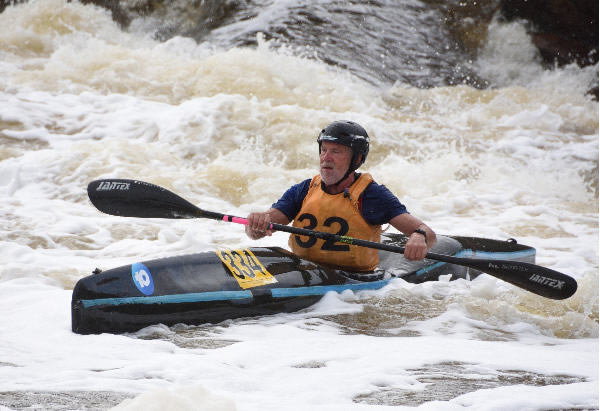
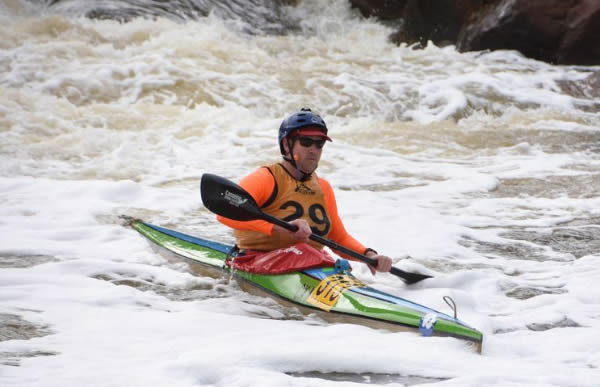
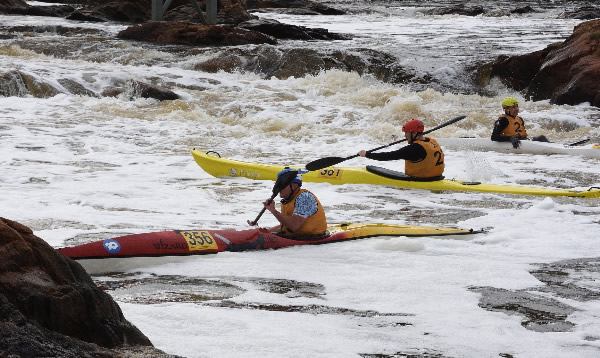
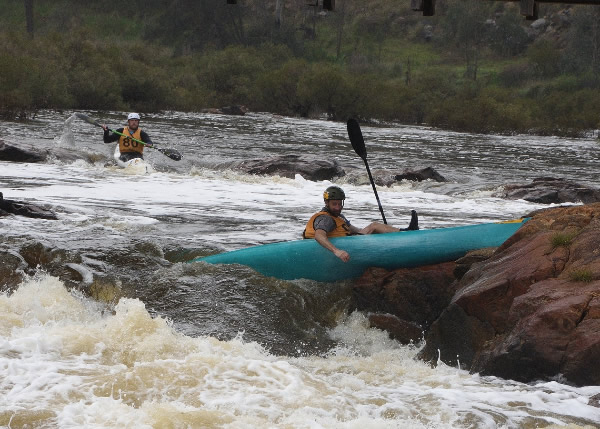
Can you believe it. In one week we will be driving across to Northam to take part in the 50th Avon Descent. For me it will be my 29th full Avon, although if I hadn't been on overseas trips I would have done many
more. Paddling the complete distance is very gruelling but it's extremely rewarding and the only way to do it. However if you want to have fun with friends, doing it in a relay team is a way to go.
I still feel I have the energy and drive to do the full Avon Descent for at least another 5 years, (fingers crossed) then just maybe I may have to do it in a relay team. No birds photos for a few weeks until I buy a new camera.
- Powerboat Practise
- Toodyay T Trees
- Who's Out There - Juniors - Sella Descent Paddlers
- Ukrainian Olympic Paddler Leonid
Kamlochuk
- Walyunga to Middle Swan Race
- 4 Years to the Day - A Day in the Life of TB
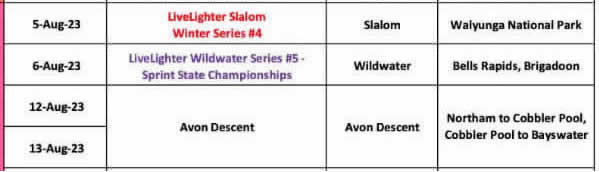
- Coming Events
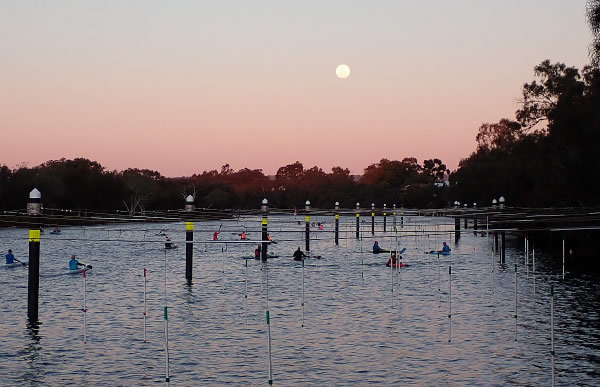
The full moon rises Tuesday night at Ascot Kayak Club.
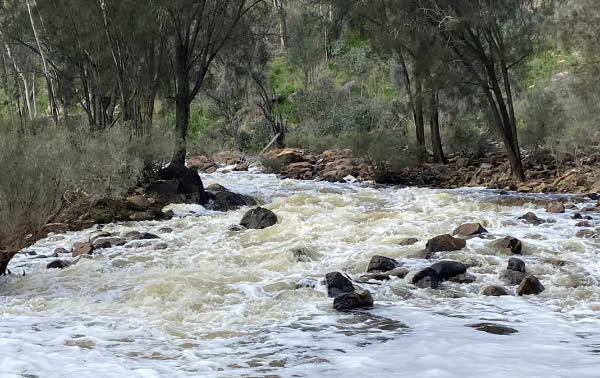
Syds Rapid Thursday 3rd August. It looks as there are a couple
of rocks that need moving. Photo Jane Liddle
Paddlers Remember You are not allowed on these parts of the river if the powerboats are practising.
Powerboat Practise
Saturday 5th August Bells Rapid to Middle Swan Powerboat Practise Sunday 6th August Northam Weir to Posselts Ford
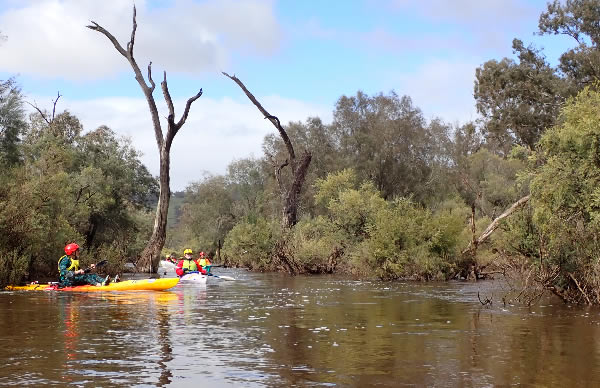
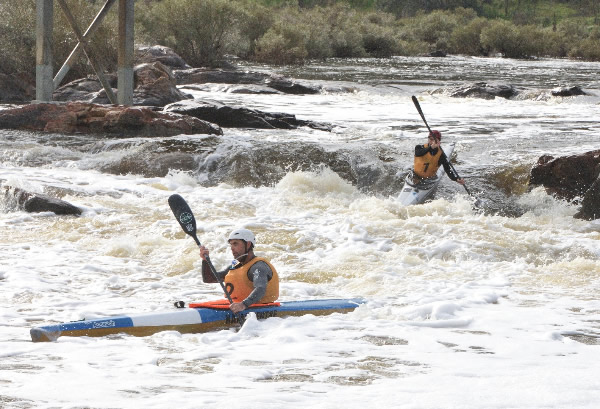
Toodyay T-Tree Run There has been several changes to the t-trees over the last two years and since the floods. Some changes have made them easier, some have made them more difficult.
But they are certainly easier than 20 years ago. It was good to see five piglets swimming across the river.
I was too slow to take my camera out after seeing five piglets swimming across the river.
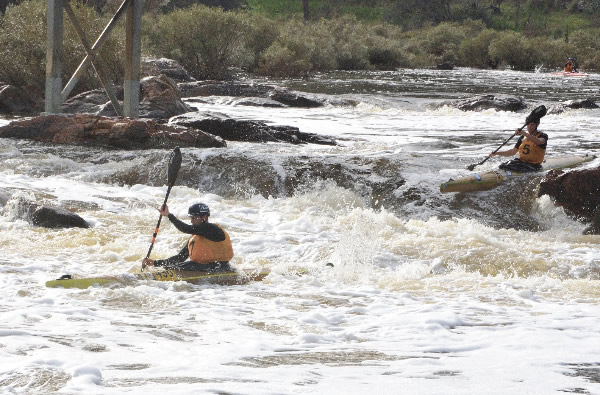
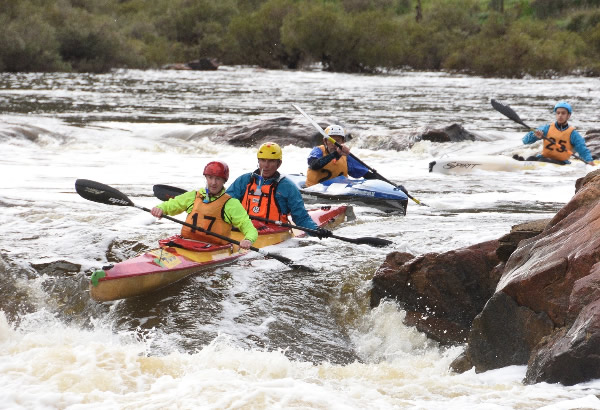
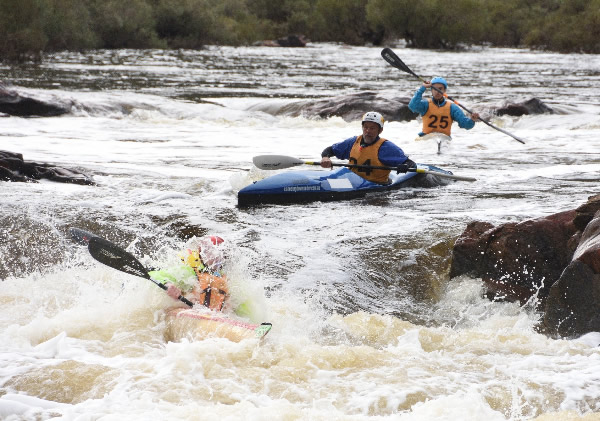
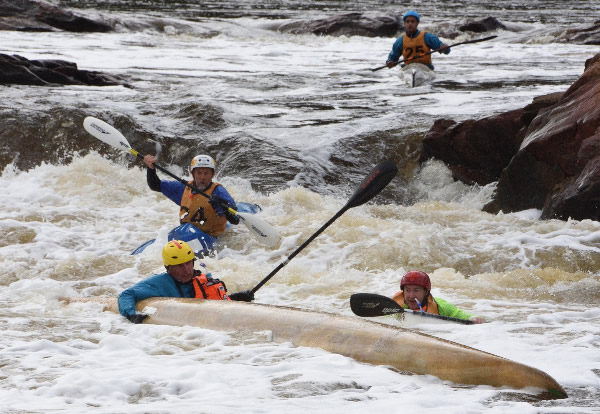
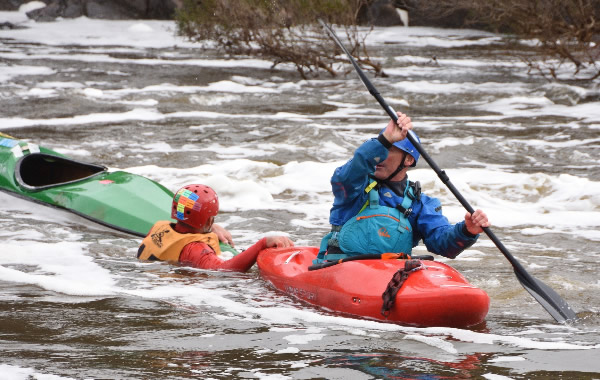
Jeannette Busch and Kate Crossing paddle the last part of Leatherhead Rapid with confidence.
Geraint Madison at Leatherhead Rapid.
Photo Isabel Combe. That's her on the left who you can't
see!!
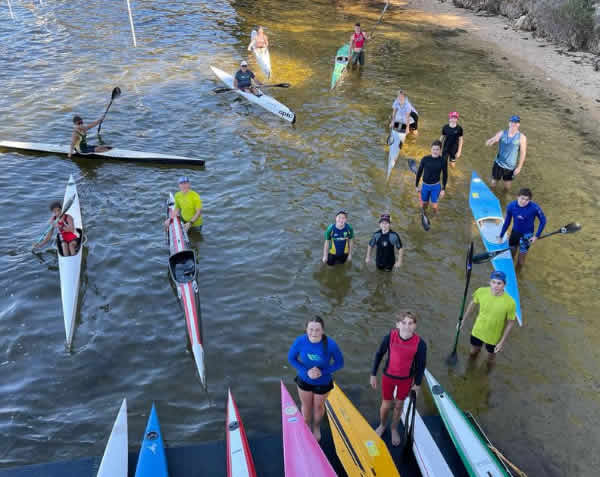
Who's Out There Swan Canoe Club Juniors If you had told me that I would have 20 kids in the program at Swan Canoe Club, I probably wouldn’t have
believed you… but here we are and it’s been amazing! Incredible kids across a massive span of ages all working together on the water. They have raced sprint, marathon, surf and wildwater events and have enjoyed every second of it. My biggest thanks to coaches (both past and present), parents, club and committee members at the club and everyone else who has helped find boats and other resources. Demi O'Brien
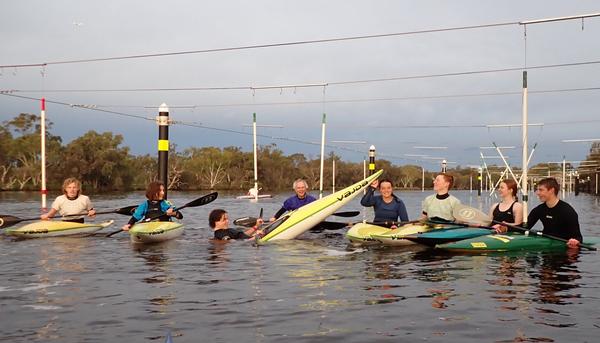
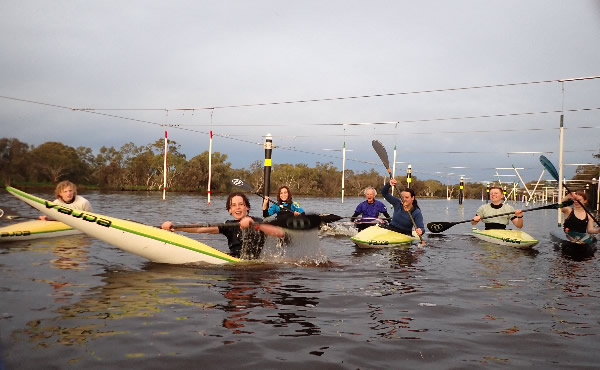
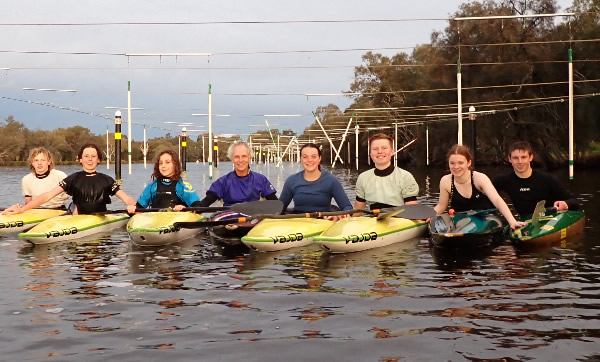
Junior paddlers at Swan Canoe Club with coach Demi.
Fun times with coach Robin Ascot slalom juniors on Wednesday
evening.
Rhys MacRea having a ball.
With coach Robin Sanders.
Ascot's Hunter Florisson is paddling in Prague at the moment.
Sella
Descent Tomorrow 4 West Australians Steve Bird, Brendan Rice, Jeremy Doney and Will Lee will competing in the Sella Descent. This is one of the most famous
long distance races in the World. It has a spectacular Le Mans start with over 850 boats (mostly K2s). Steve & Brendan, and Jeremy & Will will be paddling K2.
It has attracted some of the best marathon paddlers in the World and
should be live streamed. Start will be 6pm Perth time. Already drawn the departure order of the 85th International Saddle Descent. You can check in full
at http://sella.321go.es/ The International Descent of the Sella | asturias.com
Jeremy Doney and Will Lee ready for
racing.
Steve Bird above & Brendan Rice below are teaming up.
Ramon Andersson & John Jacoby 1988 Winners. In 1988 Australia's
John Jacoby and Ramon Andersson left an indelible mark on the race setting a record that was on track to be
unbeaten: one hour, six minutes and thirty-six seconds in completing the 17 kilometers
that separate Arriondas de Ribadesella (the most powerful section of an extraordinarily beautiful river, with a natural course of sixty kilometers of splendid nature).
But in the year 2009 Julio Martínez ratified his reign with his eleventh win in K-2, along with the Asturian paddler Miguel Fernández Castañón, establishing a new record of the test with a time of 1 hour, 1 minute
and 14 seconds.
Ukrainian Olympic Paddler
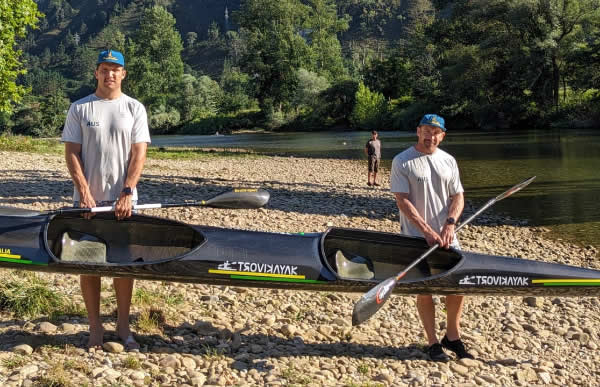
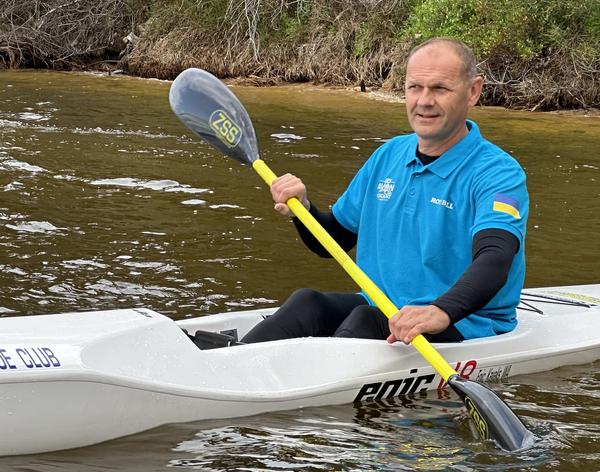
Leonid Kamlochuk Ukrainian champion paddler Leonid Kamlochuk, 49, has arrived to join Aussie legends in the Roy Hill Olympians Challenge Relay Team for
the 50th Avon Descent. He was last on Australian waters when he competed for Ukraine at the Sydney Olympics. Leonid is racing in a C1 for the final stretch of the Avon Descent and will cross the finish line at Bayswater on August
13th.
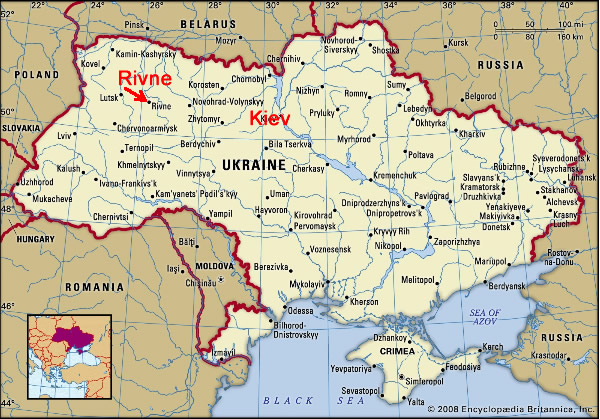
Leonid holds 42 individual champion cups of Ukraine and is the President of the Canoe Federation in the Rivne Region, Ukraine. Among the athletes he coaches are several canoe champions, including in paracanoe.
Current positions and titles, 2023 - International Master of Sports.
President of Canoe Federation in Rivne region, Ukraine.
Head of the Association of Olympians in Rivne region.
Director of the Regional School of Higher Sports Excellence, Rivne. International/Olympic canoe and paracanoe coach for Ukraine athletes. Coaches Mykola Syniuk Toyko 2020 Olympics paracanoe Silver Medallist.
Ukrainian Olympian Leonid Kamlochuk is going to be competing in an Avon Descent relay team consisting of 4 Olympians. He will paddle my C1 on the last leg to Bayswater. Sponsored by ROY HILL
Leonid lives in the western Ukraine city of Rivne, with wife
Victoria and their daughter Polina, 9. Their son Valentyn is studying at university in Lviv. His wife Victoria Kamlochuk
sponsor ROY HILL
Pen Pal Program Director and English Language Specialist - Ukraine-Australia Schools Ambassador
- Promotes the mutual benefit of cross-cultural relationships between Ukraine English Language
students across the region of Rivne and their Perth pen pals.
- Coordinates English Language teaching colleagues with exchanging pen pal letters and souvenirs between Rivne, Ukraine and Western
Australia.
- Nurtures professional relationships between educators in Ukraine and WA.
- Coordinates the purchase of educational items to further the learning of English Language for her students.
- West Aussie Kids for Rivne Kids, Ukraine coordinator for all Ukraine schools’ correspondence
- English Language specialist teacher at Rivne Lyceum 26, Ukraine since 2018 – a school
that teaches English from six-year-old through to high school graduation.
Leonid Kamlochuk and his family have
lived through the atrocities and terror of war coming to their homeland since February 24, last year. Military-aged men are not allowed to leave Ukraine. So it is a great privilege that special permission was granted by Ukraine authorities for Leonid to join the Avon Descent’s 50th Anniversary Roy Hill Olympians Challenge Team. Leonid promotes hospital fundraising, via the GoFundMe page: “Rivne Regional War Veterans’ Hospital” Ukraine.
(Payment via Australian coordinator.)
Walyunga to Middle Swan Seeding Race
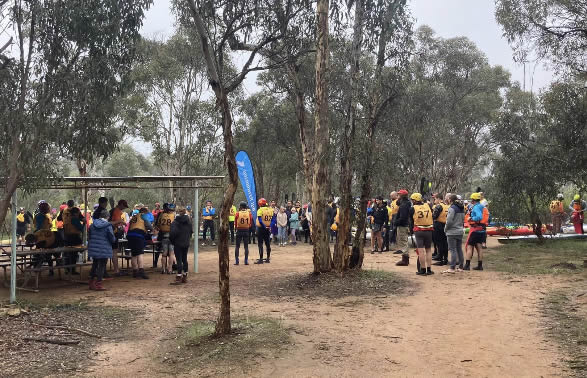
The briefing. Photo Jane
Liddle.
It was dubbed the race of the century, well maybe I’m going a bit overboard, but nevertheless it was going to be a good race. It would start at Walyunga National Park and head downstream to Middle Swan Reserve. There were the infamous rapids, Walyunga Chute, Terminator 2, the dreaded Bells Drop, the even more dreaded Devil’s Slide, Side Swipe, Dogs Breakfast and Bolland’s Elbow before the Upper Swan
tea tree section and finishing with 11kms of open water. It all
started in the Upper Walyunga Pool, and although the first grid had seven of the fastest paddlers taking off at one time, most of the other grids only had 4 paddlers going off together. I was number 24 on the list and I took off with K1 paddler Andrew Mowlem, Dave Martin and Matt Jones. Andrew was fast in his K1, he is a good New Zealand marathon paddler so when he took off he was impossible to keep up with, but to my delight I kept ahead of Dave and Matt.
Everything went okay to Terminator 2 where I saw a K2 portaging which seemed strange. I paddled through without problem and in the flat water before Bells
young Connor Jacob pulled beside me. I thought he would put the pressure on and pass but he didn’t and when we got to Bells Rapid I told him to go ahead, but he was just happy to follow me.
Having written a book on the Avon River does put some pressure on me as other paddlers think I know where to go. I usually do, but I’m not perfect and sometimes I might not paddle the rapid the way I should. When paddlers are following me though, it does put the pressure on me even more. I remember one year when the river was low I had decided to do a long portage on the second day of the t-trees.
Unbeknown to me at the time a heavy double kayak followed me through the trees not realising I was about to lift my 12kg kayak and run 400 metres. They weren’t so happy as there was no going back. Considering I’m an old bloke of 72 with a grey beard and 2 grey hairs on my head, I’m still pretty okay in the rapids.
Jesse Phillips and Luke Dooley lead the way. Photo Lawrence
Greed.
Travis England and Ben Carrick chasing. Photo Lawrence
Greed.
As I came up to Bells Rapid I could see the double pair of Joe Dowse and Gordon Lentz having problems and were loitering near the top of Bells Drop. Just as I was headed for the drop they also started to move towards it. I thought to myself, oh dear this is not going to be good. I suddenly had to back off my speed as they beat me to the top of the drop and then adjust my line to make sure I was able
to cut across to the right as I went down and be in the right position for the next part of the rapid. (Many paddlers follow the water current down the drop and then realise that they can’t make the right hand turn and get swept into the big eddy on the left and have to turn around and ferry glide back over to the right. If this happens you can lose many minutes.)
Luckily for me I managed to avoid Joe and Gordon who had capsize down the drop and make my way to the right and into the next rapid before Devil’s Slide. The approach to Devil’s Slide can be tricky as eddy currents tend to hide behind rocks just upstream and tend
to mess up the perfect line especially if you paddle a boat without a rudder. However today was my lucky day I had a good approach and went down the drop without a hitch. (Last year Dave Martin tried to go down Devil’s Slide with me.) Now all I had to paddle was Side Swipe, Dogs Breakfast and Bolland’ Elbow, the last of the rapids, but I was confident that they were not going to be a problem.
I approach Bells Drop a second after Joe and Gordon. Photo
Lawrence Greed.
Get the right angle and follow. Young Connor Jacob following
me. Photo Lawrence Greed.
Joe and Gordon capsize but I manage to get around them. Photo
Lawrence Greed.
With cheers from Geraint Madison, who was doing split times at Bolland’s Elbow I was away heading downstream with only a few T trees and flat water ahead. I had a quick glance behind to see no-one close, but about 4 kilometres later young Connor Jacob and two others were on my tail. I didn’t mind Connor passing because he is a young gun and destined to be WAs best but I didn’t like Phil Edwards, who
was in a Wild Water Kayak or Peter Gigengack, who was in a K1 passing me. They had started one or two minutes behind me so I had no chance of beating them. When they did pass me about 1km after the S Bend, where the trees get more interesting I just couldn’t let them storm ahead so I joined the conga-line which consisted of Connor, Phil, Peter and me. At a good speed we meandered like a snake down the river ducking and swerving around the trees, and paddling through shallows that dragged us down. It wasn’t easy to keep up with them and many times I
fell back at a tight or shallow spot, but I somehow managed to keep behind them through the trees and to the last bend before the open water after Amiens Crescent. As soon as Connor got out of the trees and into the clear river he took off with Phil still tagging on. Peter fell off their wash and I soon caught him up and we became two pairs. Eventually Phil fell off Connor, and later we caught Phil. To my surprise
Andrew Mowlem started passing us. He must have capsized somewhere. Another long ski also passed.
Phil and I wash-rode Peter for a while and then started taking in turns leading. I was happy when we passed under the Maali footbridge as it meant we only had 5 kilometres to go. With about 3 kilometres to go Peter suddenly fell back, told us to keep going as he was so uncomfortable in his kayak he needed to slow up. Slowly we pulled away from him leaving me and Phil to paddle the last few kms.
On the last kilometre Ben Hewitt, who started before me, starting passing. Although he was paddling a lot faster I just had to try and get on his wash. I managed to keep on it for about 400 metres, but then I didn’t have the strength to keep it up and had to let
him go. I managed to leave Phil behind but after dropping off and just about killing myself Phil managed to catch me at the finish line. Although I crossed the line before him, Phil and Peter went off 2 minutes behind me at the start so their time was faster. Well what a great race. I started number 24 but finished up being 21st which included 3 double teams in front of me. To think I was only 19 minutes and 25 seconds behind an Olympian Jesse Phillips, Ben Carrick and Luke Dooley who were all in K1s and I was in a
Wild Water kayak. It was quite uplifting. It was Ben first, Luke 2nd and Jesse third. With the World Marathon Champs coming up in 24 days maybe I should stop messing about on the white water, and concentrate on flat water, but it is too hard to resist. Organiser Kris Smith and his volunteers did another great job and there was so much soup at the end of the race you could go for seconds. Race Results here:-
https://bit.ly/2023Avon3Results
Phil Edwards catches up in the Upper Swan t-trees. Phil Edwards
and Phil Langley are two fast paddlers that I am competing against in the Avon in WW kayaks. Photo Lawrence Greed.
Peter Gigengack also catches me up in the Upper Swan t-trees. Photo Lawrence Greed.
John Hilton, Simon O'Sullivan and Matt Jones at Bells. Photo
Lawrence Greed.
A little mistake and a broken rudder and it's all over. Photo
Lawrence Greed.
Dave Worthy was one of the paddlers on rescue at Bells Drop. Photo Lawrence Greed.
With Luke Dooley and John Breed.
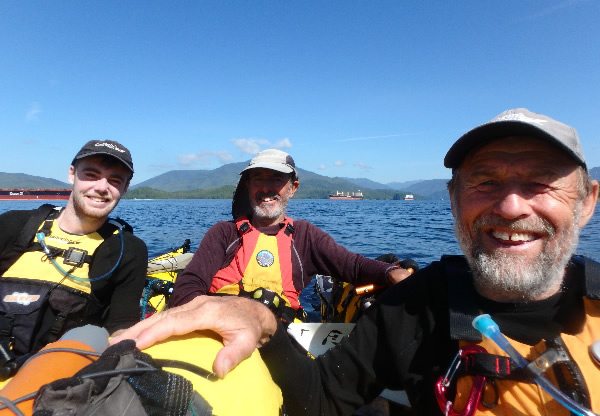
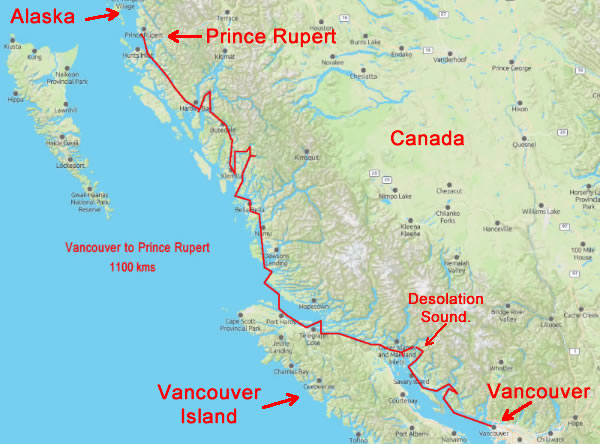
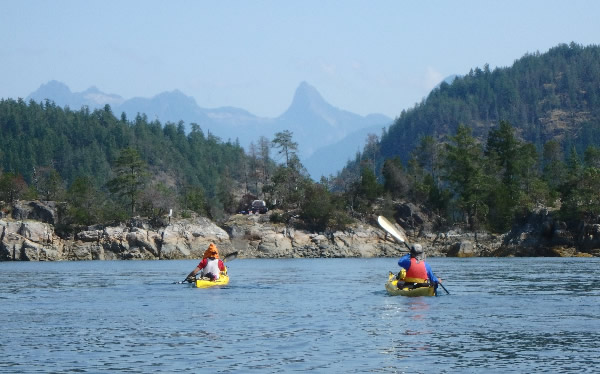
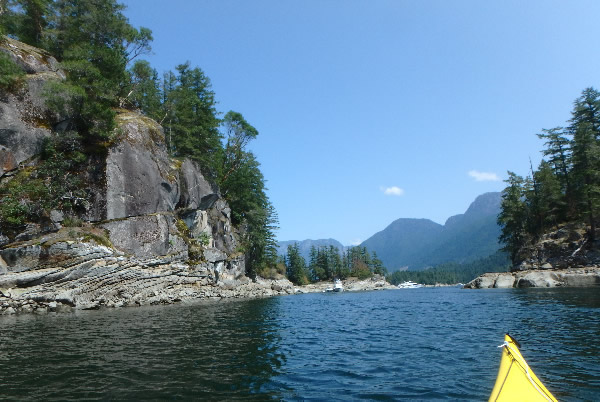
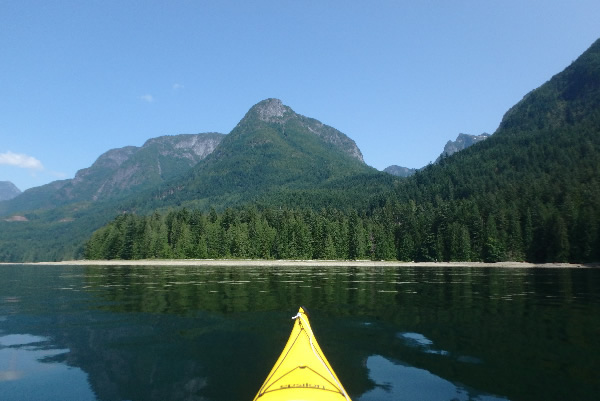
It was the 4th August 2019 - Canadian Coastline - Inside Passage 4 Years to the Day The further north we travelled the more isolated we became, but in certain areas such as Desolation Sound, a marine park, we unexpectedly came across people and boats. We felt a little annoyed to see so many people but it was very understandable as the scenery in the area was pretty spectacular. When we turned into the sound two killer whales appeared; one sliding extremely close to Luke’s kayak and leisurely swimming a few metres from us before disappearing behind. It was the first killer whale I had seen from a kayak so it was a special moment. Not only were we excited seeing such stunning scenery we now were overjoyed seeing our first killer whale. Over the next few kilometres Mount Denman (1920 m), the highest peak in the area, looking a bit like the Matterhorn was the centre piece of the stunning mountain range we were headed towards. It was a privilege to be able to paddle here, especially after seeing so many beautiful photographs of the mountain on the internet.
Short stay paddlers, who had rented kayaks from a nearby rental company, crowded two small islands, which had designated areas of raised wooden platforms for tents to prevent erosion or destruction of the undergrowth. Further along,
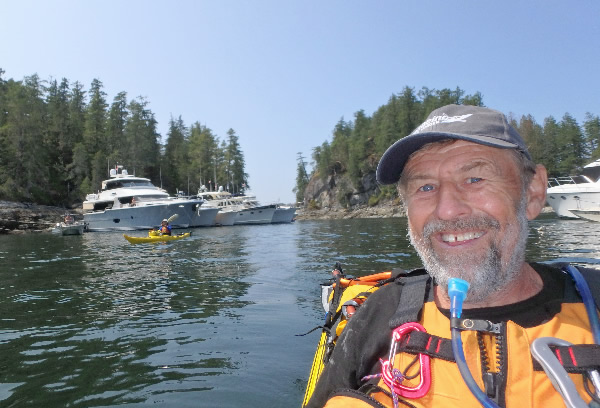
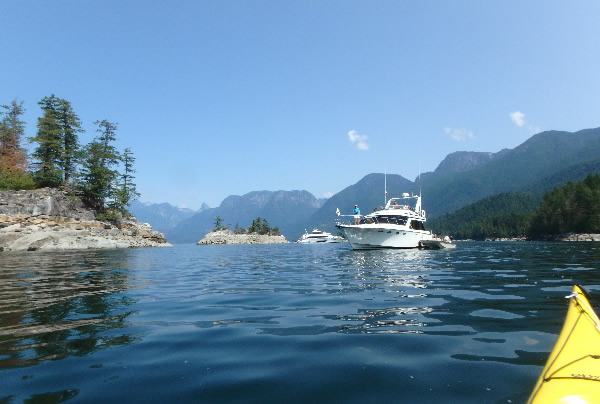
nestled between islands, we came across several million dollar boats and yachts that were anchored. The area looked as if it was a playground for the rich or at least people richer than we were. There were also float planes arriving and taking off bringing people who must have been renting a berth on a boat. With the water in this area said to be the warmest water along the coast people were taking advantage by swimming, paddling on small sit-on-kayaks, or paddling
stand-up-boards.
We head towards Mount Denman (1920 m).
The scenery was quite stunning. Desolation Sound, Marine
Park,
This was the busiest tourist area we came across in 1100kms.
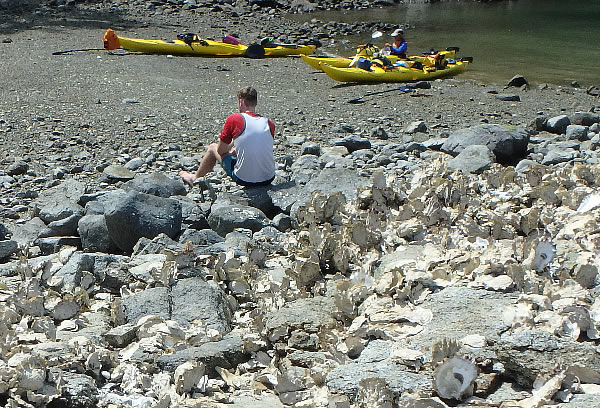
Within five minutes of threading our way through the islands we left the flotilla of boats and with Mt Denman staring down at us we were alone once more. It was an amazing contrast. Lunch was taken on a beach that had huge oysters
surrounding it. Compared to the vast expanse and height of the mountains we were like pinheads. There was always something to grab our attention; waterfalls, whales, small dolphins, sea-lions, eagles, a multitude of islands, and the highest monthly rise and fall of the tide which created tide races, boils, whirlpools and strong
currents. The camp spot we were headed to looked brilliant from a distance, but it was a real disappointment when we arrived as the entire beach was like a mine field at low tide with thousands of huge oysters sticking up like cut-throat razors making it impossible to land without our feet being cut to ribbons. I hadn’t seen
oysters so big and so many in one place. We moved on and found a lovely small beach around the headland with a fresh water creek running nearby. It was heaven so we erected our tents. With it being the highest tide of the month, our beach was soon underwater and paradise was no more, and we had the hassle of packing up quickly to try to find a spot above the high tide level. The water rose right up the shore, which was lined with cliffs and impenetrable forest and covered any low lying area, so
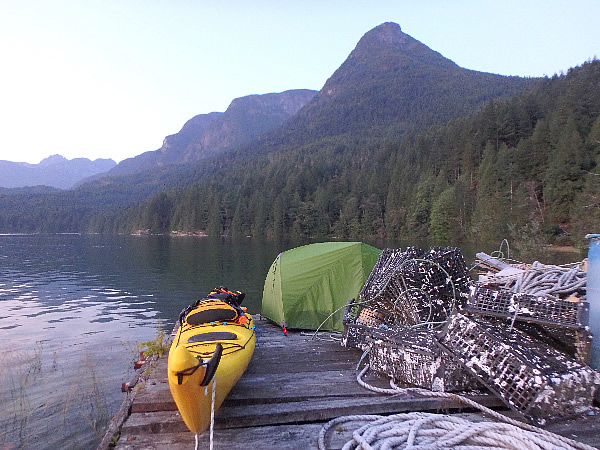
we had nowhere to go. Luckily Luke found an abandoned pontoon with some old drums on it. It was an eyesore in such beautiful surrounds but we appreciated it being there as it was the only place we could find to camp. In the night the tide receded several metres and the pontoon, which was partly on land was angled sharply and
John's kayak had slipped off the pontoon. Luckily he had attached his paddle leash to the pontoon which had saved it from being swept away.
Lunch time. Huge oysters littered the rocks.
It looked like the perfect beach from a distance but in fact the shoreline was covered with thousands of huge oysters. |
|
|
|
|
|
|
|
|
|