|
|
|
|
SATURDAY, 6 AUGUST
Classic Races
Location: Posselts Ford, Toodyay
Race Check in: TBA
Briefing: TBA
Race Start: TBA - Individual (morning), Teams (afternoon)
Course: Starting below Posselts Ford and finishing 6kms downstream above Emu Falls.
The course comprises of rapids, winding sections of moving water, exposed & submerged rocks and ti tree obstacles.
Transport:
SUNDAY, 7 AUGUST
Sprint Races
Location: Bells Rapid Park, Baskerville
Register here: https://bit.ly/2022PACWWC
Ascot's George Pankhurst is in Europe competing is several international slalom races. He has just competed in the ICF Junior Slalom Championships.
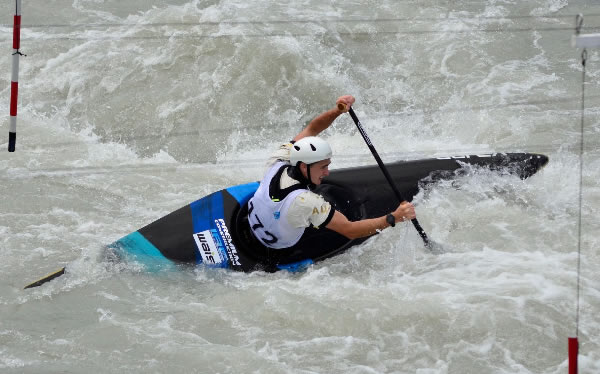
WA's Zlatan Ibrahimbegovic will be competing for Australia in the Senior Canoe Slalom World Championships in Augsburg.
This year marks the 50th anniversary of Canoe Slalom being included in the Olympics (Munich 1972). Zlatan competed for Yugoslavia in these Olympics finishing 29th in K1 slalom..
Our Australian team, which includes WA's Ben Pope and Brodie Crawford, are racing in the ICF Canoe Slalom World Championships in Augsburg July 26th - 31st
To watch all the action head to
https://federations.canoeicf.com/canoeslalom- world-championships/augsburg- 2022
WAs Zlatan Ibrahimbegovic
off to Munich to compete in the Senior Canoe Slalom World Championships.
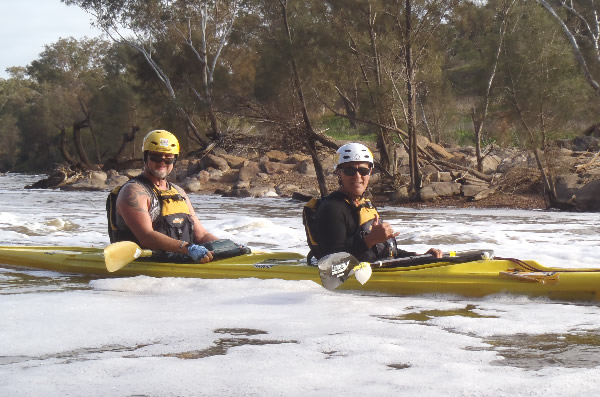
Two top guys.
Chris Watson and Rob Jarrett.
Not so much in speed but in personality!
They are getting ready to take on the Avon Descent.
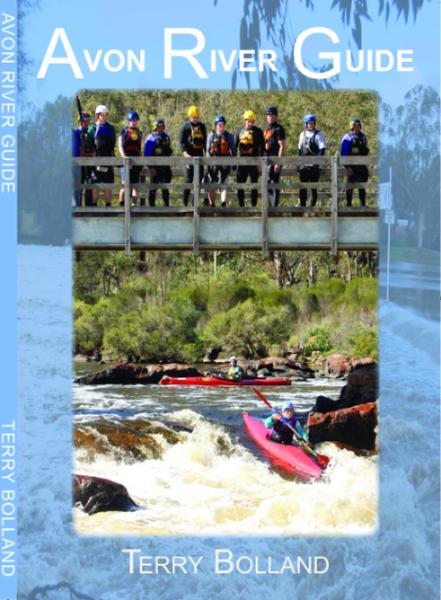
My book the Avon River Guide is now live.
All you have to do is to click below and you will open the book.
There is a lot of information in it for you to ponder.
When you open it the maps are several pages down.
I will be updating as the weeks go by.
It you see something that you feel is not quite right, or needs updating please send me an email to: terry@canoeingdownunder.com.au
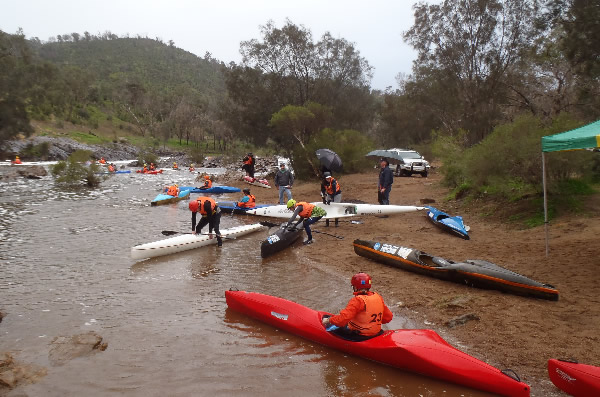
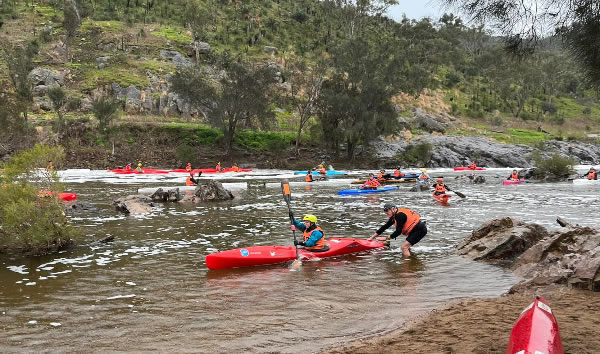
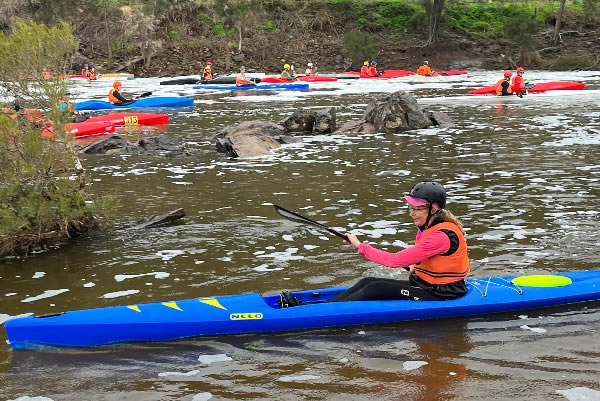
Bells to Amiens WW Race
We are so lucky to have this part of the river so close to Perth. It's a section that is still testing but pretty safe for newcomers to take part in.
I love this race because you can just go for it and you know there is little danger to worry about, however one mistake could be the difference between winning and losing.
This river course also helps you to keep your skills sharp as there is turbulence, eddies and corners to negotiate which is important to practise no matter how good you are.
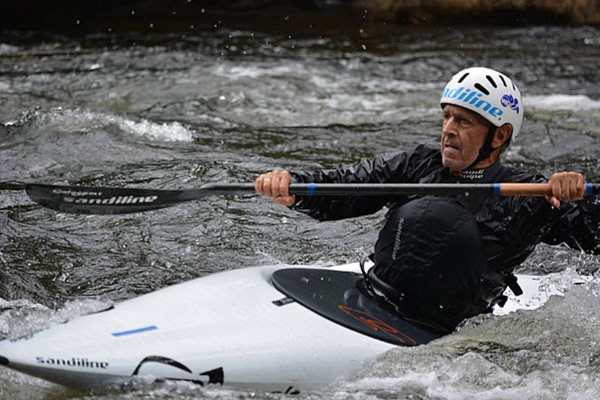
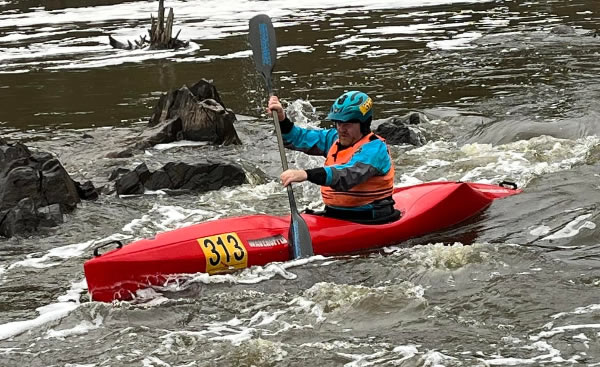
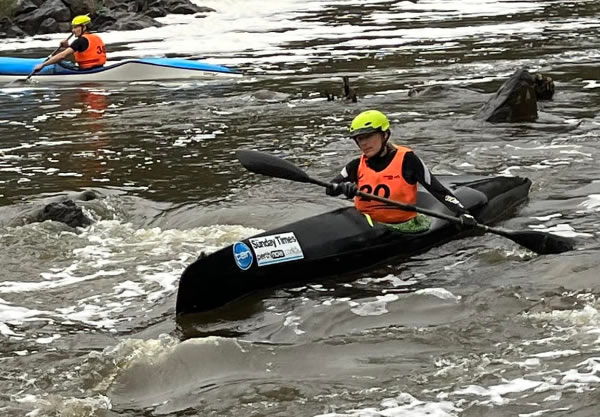
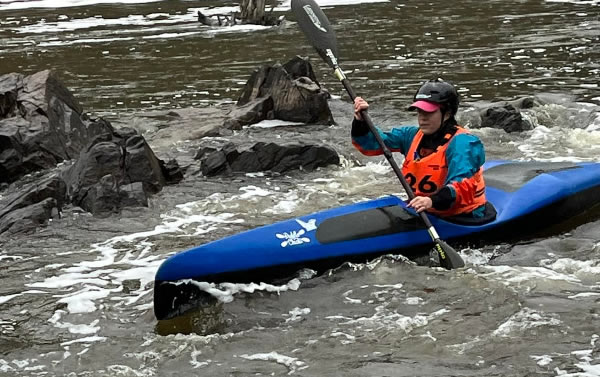
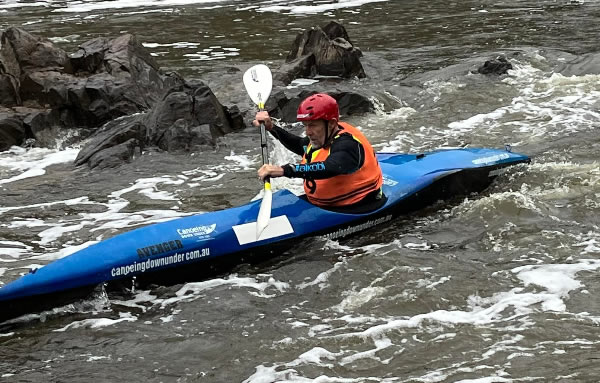
It was pleasing to have come 10th and have beaten paddlers like Darryl Long and John Hilton (don't know what happened to them) and I was only a minute behind Grant Pepper and 42 seconds behind the fastest lady Nina. At 71 I still seem to have the skill and the fitness to give others a run for their money.
We are short of Wild Water paddlers though as we only had 18 out of the 40 paddlers paddling Wild Water kayaks so we certainly need more paddlers to paddle Wild Water kayaks. Hopefully the wavehopper paddlers and paddlers in the sundry section will eventually move into WW kayaks but most importantly we need more paddlers to try wild water racing.
So why not give it ago.
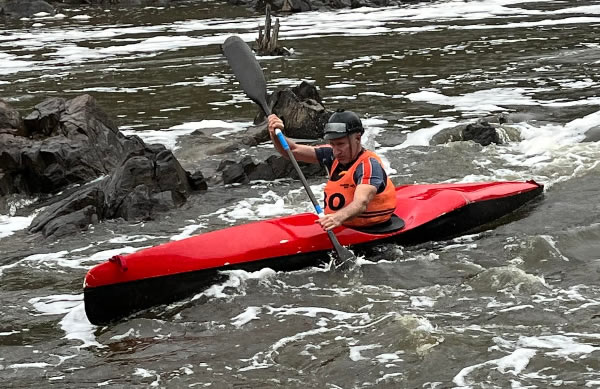
Melanie Hackett is away.
Photo Tom Canavan.
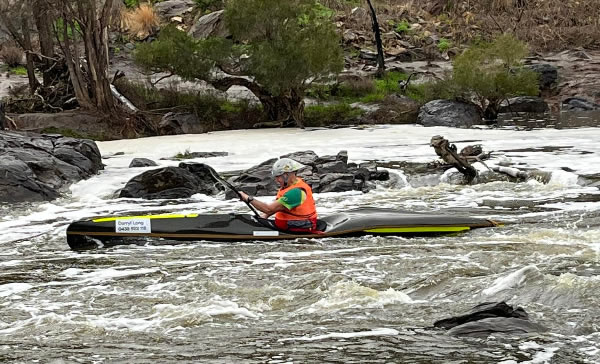
Marie Andersson.
Photo Tom Canavan.
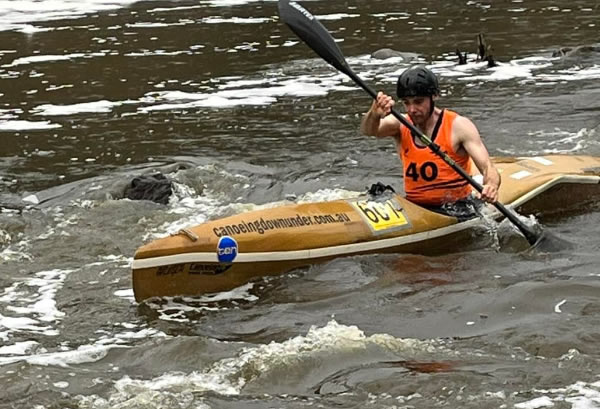
Kris Smith.
WA Wild Water Chairman and organiser.
Photo Tom Canavan.
Maya Elston.
Photo Tom Canavan
Steph Bedden.
Photo Tom Canavan.
Terry Bolland.
Photo Tom Canavan.
Grant Pepper.
Photo Tom Canavan.
Darryl Long.
Photo Tom Canavan.
Luke Dooley. Winner.
Photo Tom Canavan.
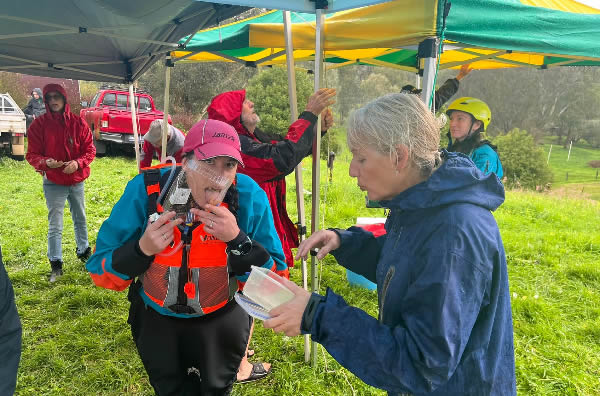
Steph and Maya finishing all the food whilst we take the tents down!!
Results including sundries.
https://www.webscorer.com/race?raceid=283496
Results: Wild Water & Wavehopper boats.
https://www.webscorer.com/racedetails?raceid=283496&did=335023
White Water Tips
The Current
The river flows at various speeds in different locations. The fastest current is in the middle of the river where it is deepest. The slowest is near the banks where resistance occurs. However, there are some exceptions. On sharp corners, the current increases in speed on the outer side of the bend and slows down on the inside of the bend, creating an eddy. Obstacles in the middle of the river cause the flow to vary when water
is deflected. Changes in the shoreline also have an unexpected effect on the current.
BENDS
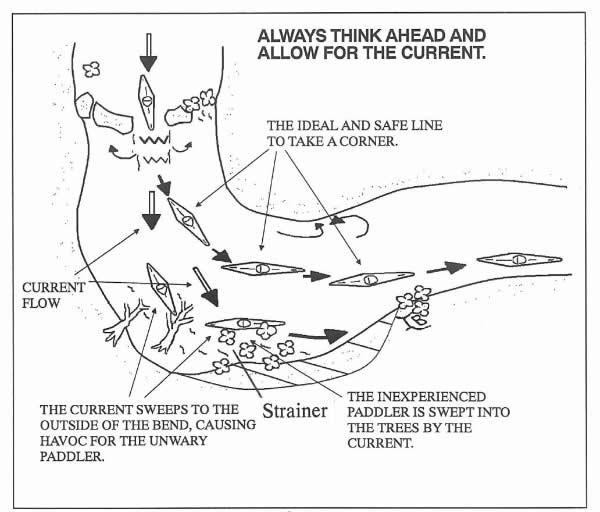
At a bend, the water is prevented from flowing in a straight line by the outer bank, which forces it to change direction and form a swift flowing current. If paddlers lose control and are forced to the outside edge of the bend, they may be presented with a number of potential hazards.
For example, some bends have rocky walls which act as barriers and the result is a continually surging, thrusting turbulence. Under these conditions, paddlers may find themselves forced against the wall and unable to remain upright.
Other bends have dangerous undercut banks and trees. Paddlers may be swept under, become trapped and have an extremely difficult time trying to escape.
Trees are extremely dangerous as branches act as strainers as the water flows between them.
Remember, never relax until the complete rapid has been run and you are into clear flowing water.
The current sweeps to the outside of a bend.
Think ahead and take a safe line to avoid being pushed into the bank by the current.
THE ‘V’ GUIDE (CHUTE)
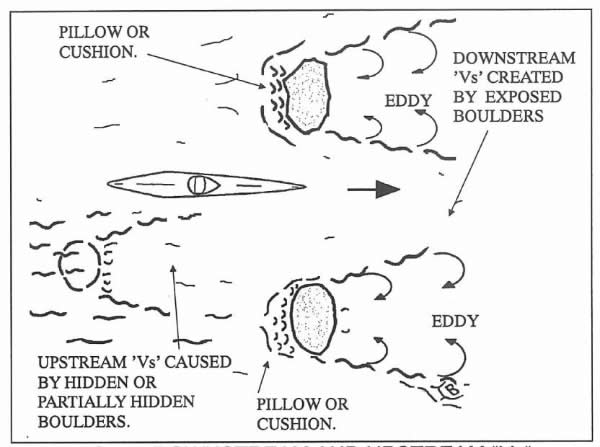
There are downstream and upstream ‘V formations in rapid rivers. Downstream ‘ V shapes form when a fast flow of water is compressed between narrowing shores, boulders or other obstructions. The ‘slack’water behind the obstruction is called an eddy, and the line
that forms the side of the ‘ V is called an eddy line. When canoeing down rapids the ‘V (or ‘tongue’) acts as a guide, as it indicates a safer and deeper passage. The beginning of the ‘V is usually smooth, but it is often followed by waves, standing waves or stoppers.
When a ‘V is pointing upstream, it is pointing to a rock that may be above the water or just submerged. Although you may not be able to see a rock, watch out for the ‘V indicators to avoid running into them.
In more complex rapids, there may be many downstream and upstream ‘Vs. Choose the best downstream ‘V sequence available to allow for the safest route. It is wise to check the route from the bank first and memorise the features.
A downstream V Guide (tongue) at the Walyunga Chute.
A downstream V Guide (tongue) at Bells Drop.
Stoppers
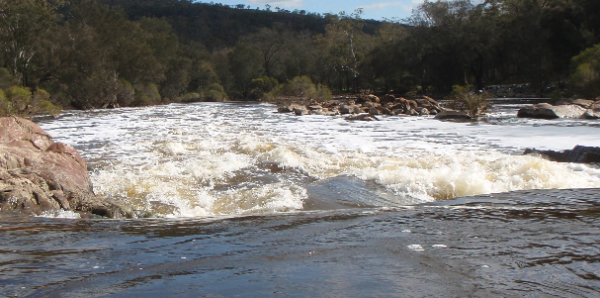
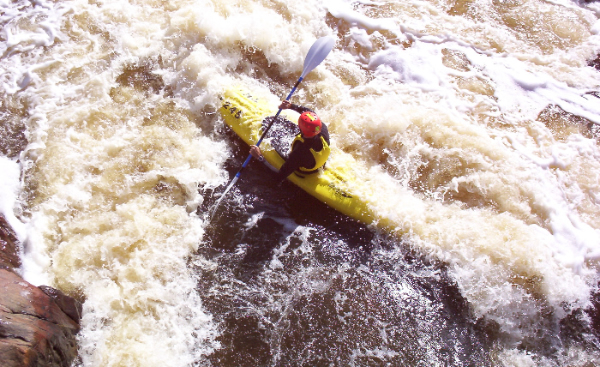
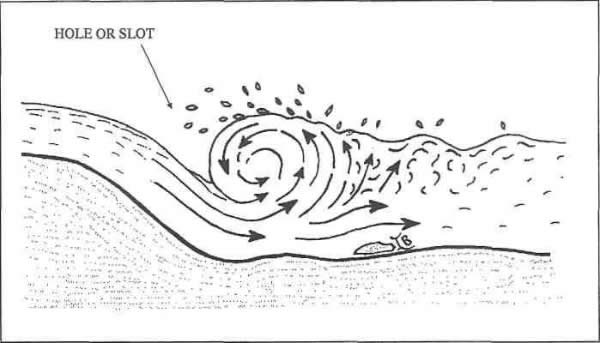
‘Stoppers’are caused by water gushing steeply over a ledge, weir or large rocks. The fast moving water which tumbles over the obstruction, starts to recirculate once it hits the bottom. As the foaming water rolls back upstream, it forms a ‘stopper’ which can trap a canoeist within a continuous washing machine action. Big ‘stoppers’ must be classed as potentially dangerous and should always be checked and in many cases,
portaged. When racing, experienced paddlers will avoid stoppers where possible, as they reduce the boat’s forward speed. However, manageable ‘stoppers’ are a source of great fun for the white water enthusiast with well developed skills.
PADDLING STOPPERS
Small 'stoppers' do not usually present problems for proficient paddlers. However, larger and more powerful 'stoppers' can cause difficulties. The force of the recirculating wave on the boat and paddler
can stop and hold the boat. It is then difficult to prevent the boat turning sideways in the wave and capsizing. If you can not skirt them, here are a few simple rules which may help you:
- Accelerate several metres before the drop.
- Maintain power during your descent into the turbulence.
- Ensure that the kayak points directly downstream.
- As the boat drops into the slot, reach over the top of the wave, drive the blade deep into the water and pull hard.
- Maintain power.
If you want to gain entry into an eddy
directly below a 'stopper', it may be necessary to angle your kayak slightly in the same direction, then apply the power stroke (which is dug in over the wave) on the side of the boat that is furthest away from the eddy. A power stroke
can also be used for support.
Maintaining speed and power throughout the manoeuvre
is crucial for avoiding the powerful towback, which may suck you back into the stopper.
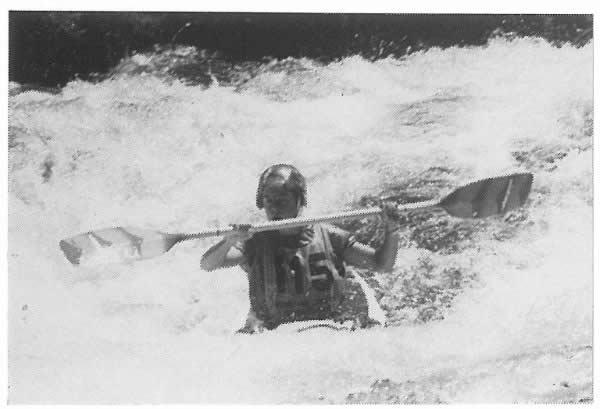
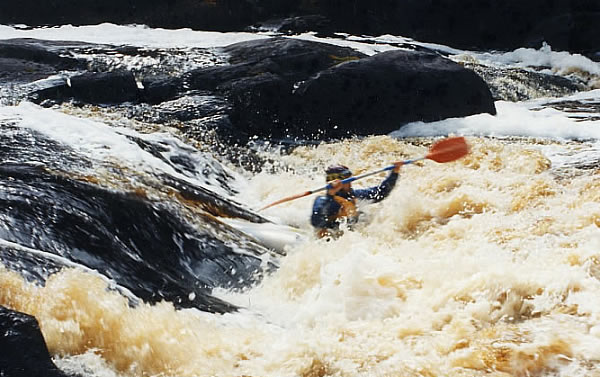
Reach over the top of the wave.
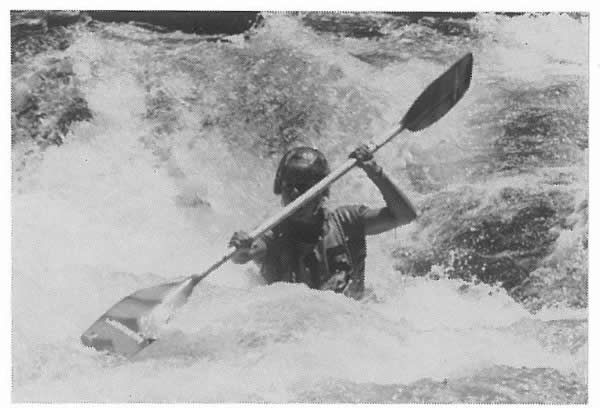
Dig your blade into the wave and pull hard.
Getting ready with paddle position to pull over a powerful stopper.
Photo Roger Smith.
If you don't pull yourself out of the stopper with your paddle, you may get sucked back into the stopper. And then you are in trouble!!
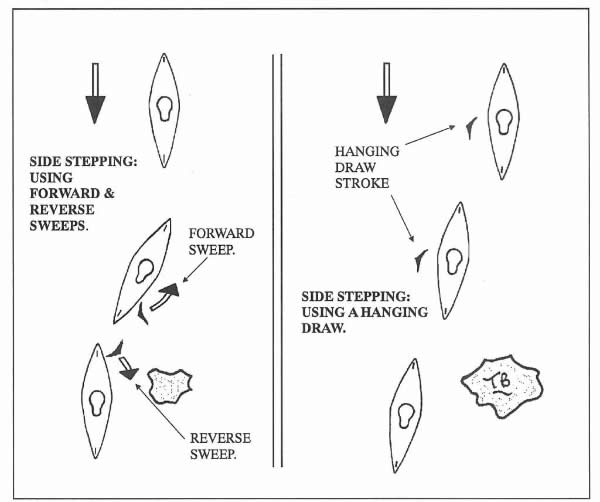
SIDE STEPPING
Frequently a paddler has to move around obstacles that are in the boat's path. Failure to do so may result in the boat becoming broadside to them. Two common paddle strokes used to avoid obstacles are; the Hanging
Draw (a Draw Stroke on the move) and the Forward Sweep/ Reverse Sweep combination.
WILDWATER RACES
WWR #4 Walyunga Races- Saturday 23rd July
Starting from the pool above the slalom course in Walyunga National Park, and racing downstream 400m to the bottom of the Walyunga Chute Rapid.
Check-in: 8:00am - 8:30am
Briefing: 8:45am
Race Start Single: 9:00am
Race Start Teams: 10:30am
Register through Just Go! Under "Events and Courses" search "Wildwater"
Walyunga to Middle Swan
This is the last Avon Descent Seeding Race!
Starting in the long pool from the top carpark, racing 23km downstream through the Walyunga Slalom Course, Bells Rapids, the lower Ti Trees and Amiens through to Middle Swan Reserve.
Competitors follow a winding river consisting of exposed rocks and Ti-trees with the added fun of rapids and a strong current.
Sunday 24th July
Check-in: 8:00am- 8:45am
Briefing: 9:00am
Race Start: 9:15am
Register through Just Go! Under "Events and Courses" search "Walyunga to Middleswan"
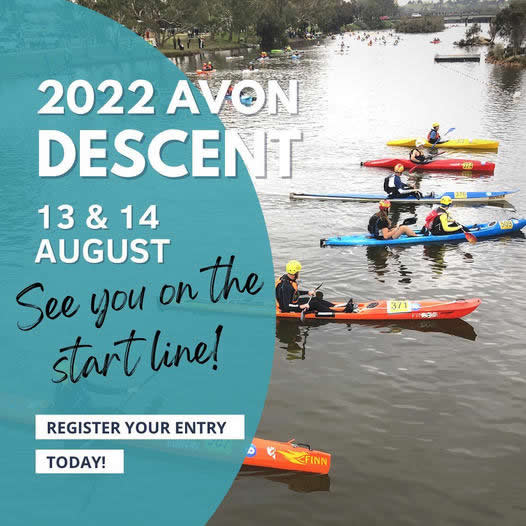
Avon Descent Scrutineering
Paddlers - lock Friday 29 July in your diaries for scrutineering!.
We will be holding scrutineering at Ascot Kayak Club from 3-7pm, & the Swan Cafe will have some yummy dinner options available
too..
We’d appreciate if all paddlers could please ensure they attend scrutineering at @ascotkayakclub . We appreciate the commitment it takes to get there, but it is a critical step towards helping make #avondescent safe for all participants (penalties could apply for non-attendance).
|
|
|
|
|
|
|
|
|
|