|
|
|
|
Now Only 927 kms to Go
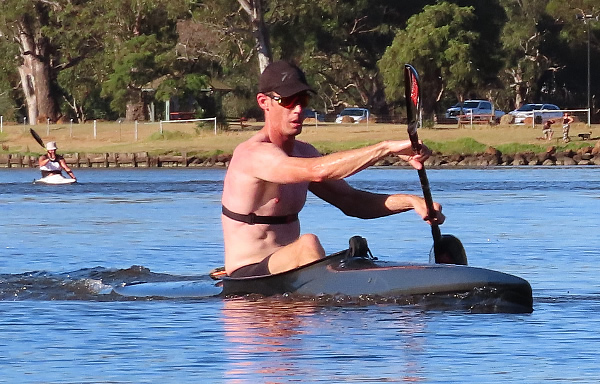
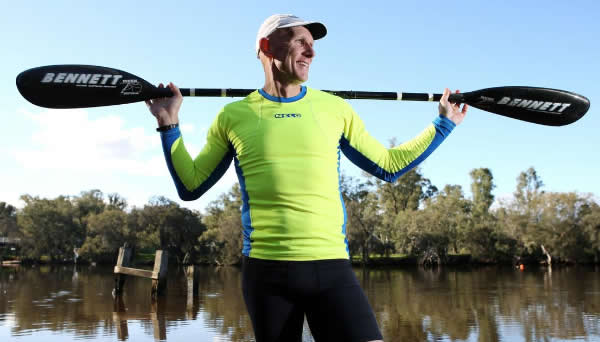
I have paddled 276.08 kilometres this week.
In the last 4 weeks I have paddled 1130.23 kms. The month before I paddled 1053.65 so in the last two months I have paddled 2183.88 kms.
Most days I am paddling over 40 kms a day.
The wind this week has been really annoying. It' been so strong. It has also been a pain as I'm about to take a photo. I just get lined up, start to focus and then the wind blows me away or into the trees.
Although I am close, I’m not there yet so I need your help to encourage me to reach my goal by donating to the
Prostate Cancer Foundation of Australia.
Please donate whatever you are happy to give
Go Here:
https://fundraise.pcfa.org.au/fundraisers/terrybolland
- Pelicans
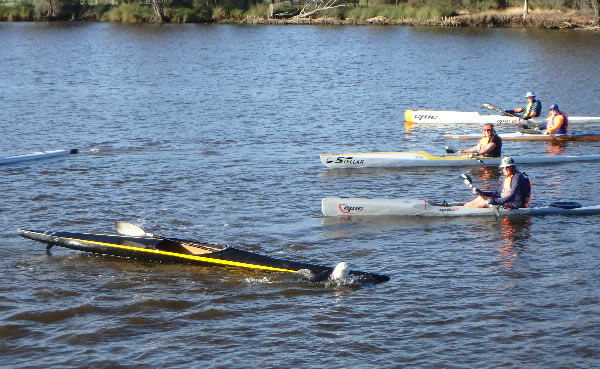
- Paddlers Training
- Ramon Andersson inducted into Paddle Australia Hall of Fame
- Paddle Canada's Western Coastline - Luke Dooley
- On My Paddles - Birds Along My Way
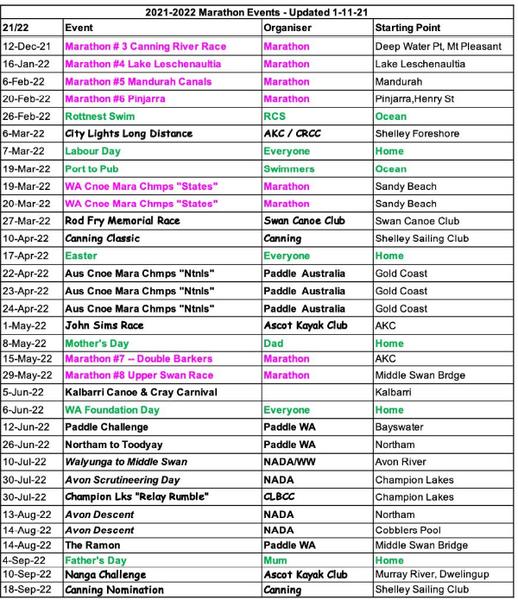
- Coming Events
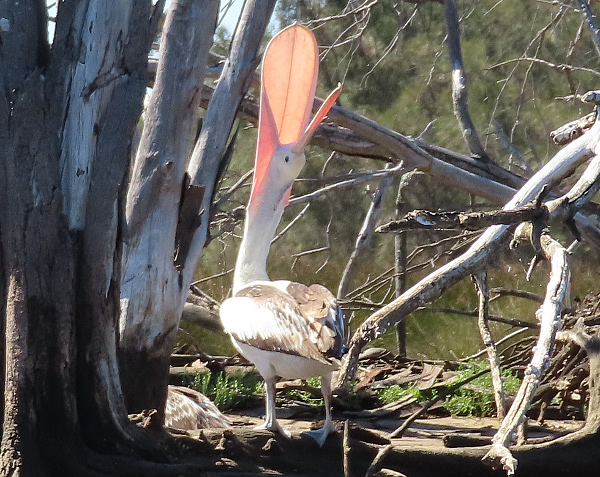
A pelican has a yawn on Monday morning.
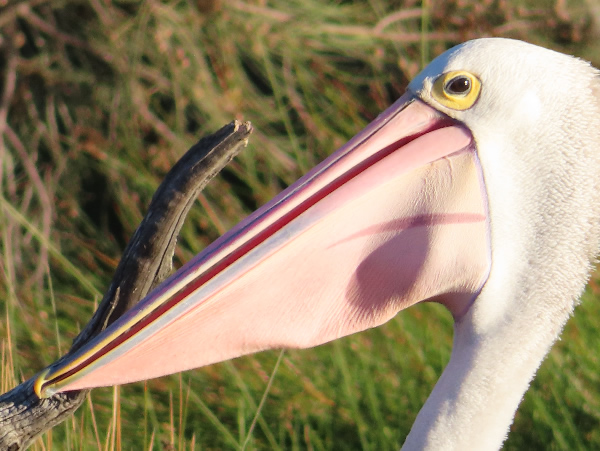
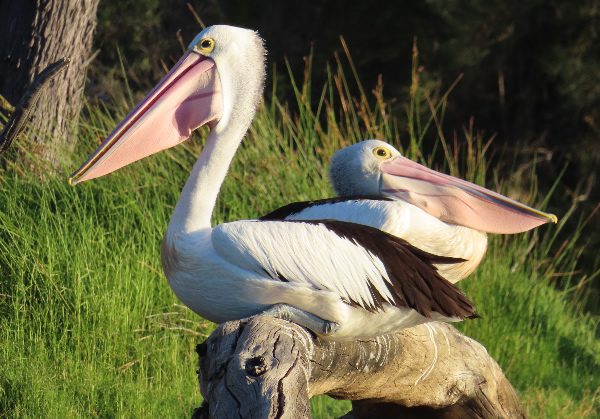
Pelicans have the largest beaks of any bird. In some species, the beak can reach up to 46 cms (18 inches) long. The large pouch, called a gular, underneath the beak is the pelican’s most unique feature.
When I took this photo on Monday evening the large pouch, called a gular, underneath the beak was vibrating, like it was blowing up and then being deflated. Even from a far distance I could see this happening.
Australian Pelicans are carnivores. They eat mainly fish but they also eat other animals that live in the water like turtles, crustaceans and other waterbirds. Their highly sensitive bill helps locate fish, snapping around the prey when they sense movement. Their throat pouch can hold up to 13 litres of water. It is used like a net, collecting any prey that is inside. The pelican then empties the water and swallows the prey whole.
Males are bigger than females.
Only one marathon race left before Christmas.
The Canning River Race on Sunday.
Deep Water Point, Mt Pleasant.
Australian Masters Games Marathon
is back
Paddling will have a two-day marathon event early in Masters Games week.
The location and specific days have just been finalised.
Marathon Entries will open soon.
Pairs Enduro
Race results
https://www.webscorer.com/race?raceid=262288
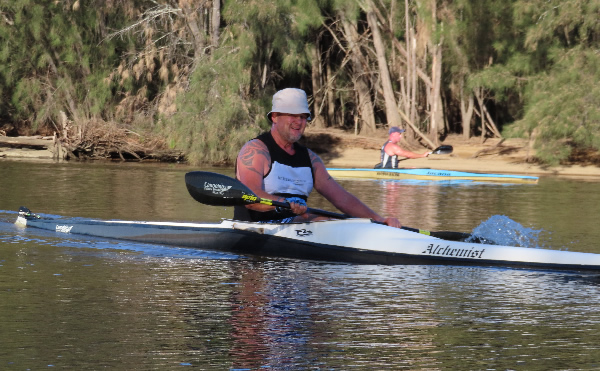
Anthony Clarke on a training run.
Chris Watson stopping for a chat.
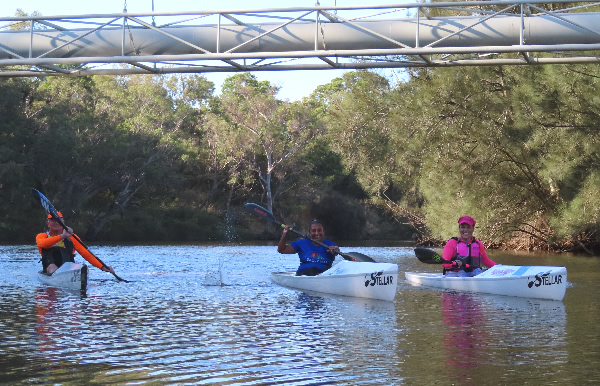
Geraint Maddison, Nishani Jacob and Isabel Combe.
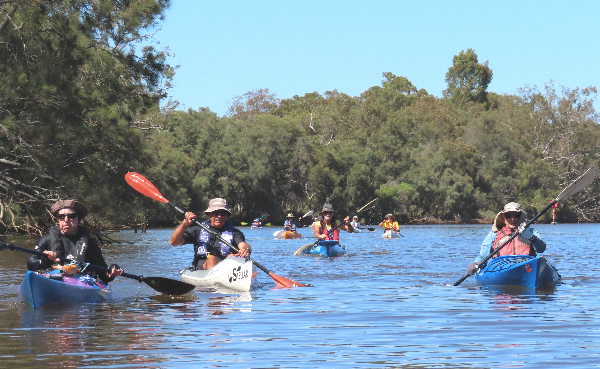
One of the social paddle clubs.
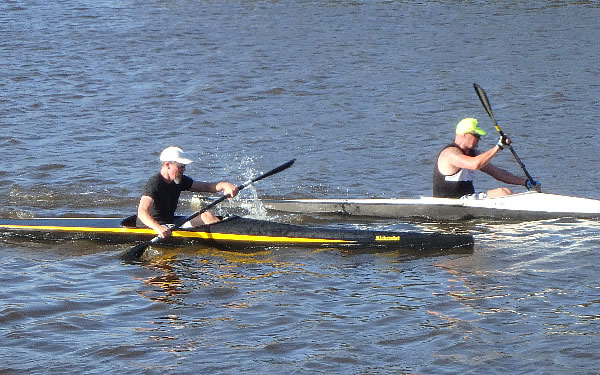
PRG Group Handicapped Race
John Liso (left) was going great until 120 metres from the finish line.
Then he capsized!
Most paddlers would head for the nearest shore to empty out. Not John.
He was so determined that he swam with his kayak to the finish line.
Olympic bronze medalist Ramon Andersson inducted into Paddle Australia Hall of Fame
Dual Olympian and Olympic bronze medalist Ramon Andersson has today been announced as the newest inductee to the Paddle Australia Hall of Fame.
Membership of the Paddle Australia Hall of Fame represents the highest level of recognition for an individual’s contribution to canoeing.
Ramon grew up along the river in Midland watching the Avon Descent, and developed an affinity for canoeing at high school. At university, it wasn’t long before his passion for paddling surpassed his other love, football. At 20, he gave away state league football to become a full time paddler.
During his long and illustrious career, Ramon has excelled as a coach and an athlete. A dual Olympian, Ramon won a bronze medal in the K4 1000 at the 1992 Barcelona Olympic Games, and two months later won a gold medal in the K2 at the World Marathon Canoeing Championships.
Between 1988 and 2000, Ramon won 29 Australian Championships, a silver and two bronze medals at the World Championships, and 14 World Cup medals.
In 1992 and 1993, Ramon was named the WA Sports Federation Sportsman of the Year, becoming the first male to win the award two years in a row. He was also the WAIS Athlete of the Year for 1992/93, and runner-up Australian Institute of Sport Athlete of the Year in 1992.
In 1995, he overcame chronic fatigue syndrome to be selected for the 1996 Atlanta Olympic Games, where he again competed in the K4 1000.
Since retiring from elite paddling, Ramon has gone on to pave a successful career in coaching. Ramon’s influence and impact at the grassroots levels has significantly helped to raise the profile of paddling in Western Australia.
Ramon works tirelessly to not only help young paddlers pursue their own Olympic dreams, but to upskill and help develop coaches within Western Australia. The quality of paddlers is a direct reflection of the coaching they receive, and Ramon has been a massive influence in ensuring coaches have access to the latest, and best information on coaching.
At a state level, Ramon has been the Head Coach of the Western Australia Institute of Sport (WAIS) Sprint Canoeing Program since 2003, taking the program from a small part-time program, to one of the most successful programs at WAIS, where it won Program of the Year three times between 2007 and 2012, and more recently in 2021.
Ramon has coached many Olympic and National team athletes including dual Olympian and 2008 bronze medalist Lisa Russ, World Cup winner and 2012 Olympian Alana Nicholls as well as London 2012 Olympians Jesse Phillips and Steve Bird. His most recent success is both Shannon Reynolds and Jaime Roberts representing Australia at the Tokyo Olympic Games.
Ramon is an incredible role model for all paddlers, young and old, and for up-and-coming coaches.
Paddle Australia would like to congratulate Ramon on being inducted to the Hall of Fame.
Paddle Canada's Western Coastline
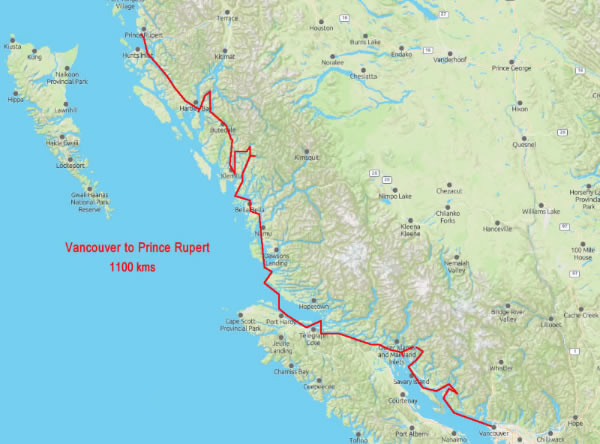
Vancouver to Port Prince
Luke Dooley
Stage 1
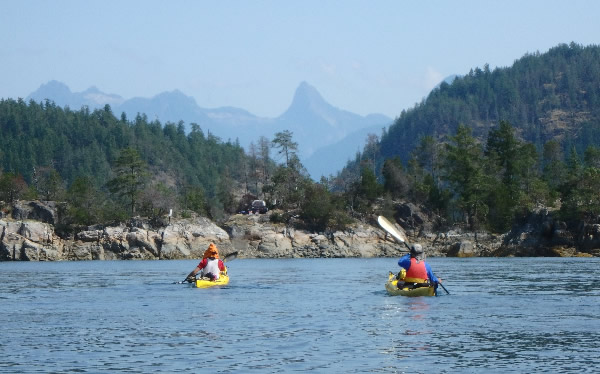
Back in August of 2019 I completed my biggest paddling adventure to date: a 1,100 kilometre sea kayak journey up the inside passage of Vancouver Island to Port Prince Rupert along the stunning western coastline of Canada. My journey was a true wild adventure with huge grizzly bears
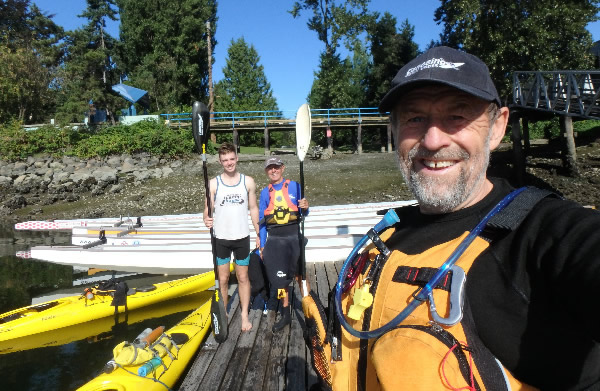
coming to dinner, stunning views of snow-capped mountains and kayaks launching themselves into the water in the middle of the night. I was invited to join the trip by my friend and paddling mentor Terry Bolland who has been doing similar trips for most of his life. I also joined John Breed who is another friend from the Ascot Kayak Club in Perth who’d joined Terry two years earlier for his 2,800km sea kayak trip from Lake Superior (Thunder Bay) to New York. The adventure began this time as we
set off from our waterfront bnb in False Creek in Vancouver in three identical plastic sea kayaks we’d purchased new from Skyview Outdoors.
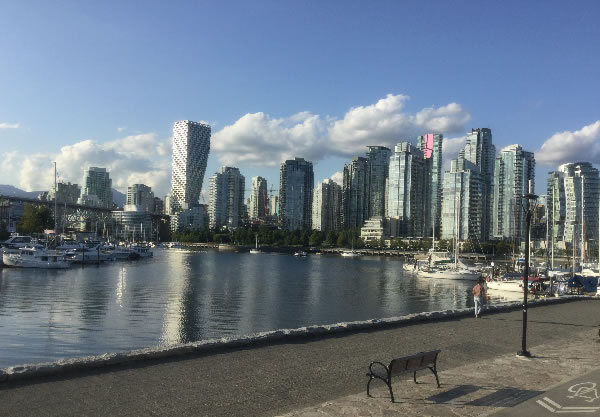
Looking out from our BNB.
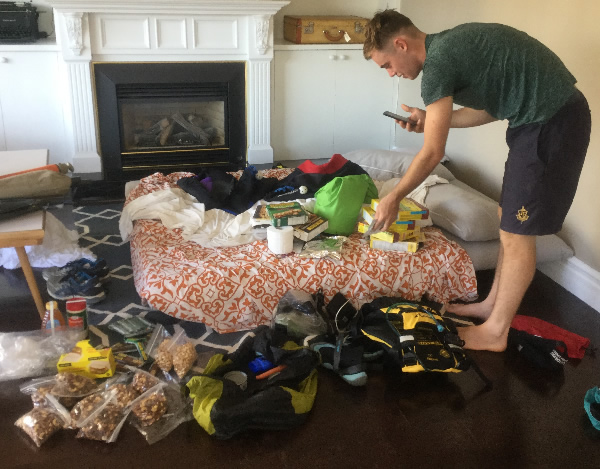
Sorting my food in day packs.
The first few days were tough going as we had to get used to the weight of our fully loaded kayaks which carried all of our food, water and camping gear. They weighed about 85-100 kilograms
each without a paddler so they didn’t exactly handle with the ease of our 8kg racing kayaks back home; nor were they as fast! It was especially demanding early on as we had to paddle very large distances right from day one to get out of Vancouver and into areas where it was more acceptable to pitch a tent. We managed around 30 kilometres a day on average; however the first four days were around 35-45 kilometres which took 9 or so hours. I found it amazing that we began to enter stunning scenery
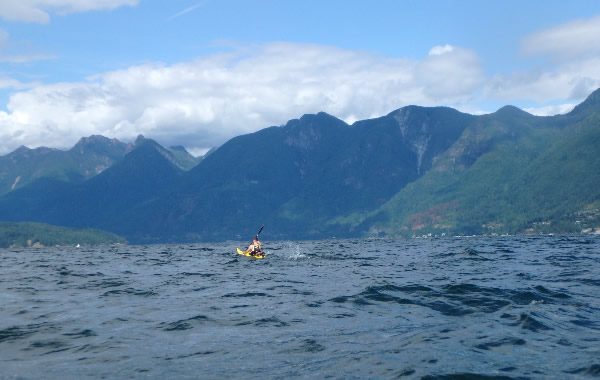
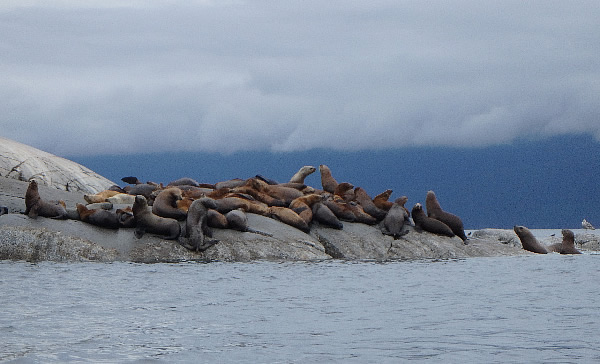
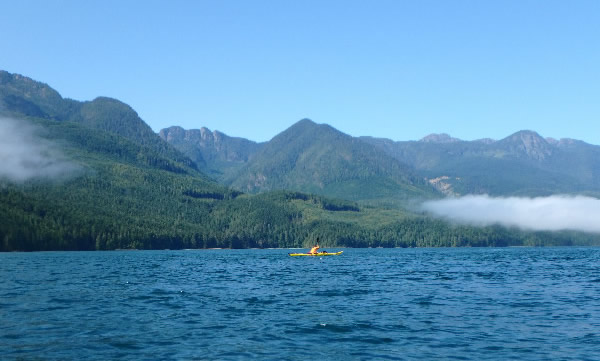
with enormous mountains lining the shores of the 4-6km wide channels within only a few hours of leaving the city. There was a lot of marine life too. It was thrilling to see our first seal pop its head out see what we were up to. Later in our journey I would begin to think something strange was happening if we managed to go more than an hour without spotting one. On one of the days a pod of 20 seals followed us for most of the morning; jumping and splashing alongside us only about 40 metres
away.
20 kilometres out of Vancouver and we are in the wilds.
Seals find an island to make home.
One of the main goals of our trip was to see as much wildlife as we could and we were very fortunate to be able to see some killer whales. The first lot we spotted were on the entrance to
Desolation Sound. We had just rounded the bend and the channel opened up to reveal some enormous snow-capped mountains at the far end. All of a sudden I got a shock as an enormous flash passed directly under my kayak. When it returned I realised it was two orcas. Terry and I scrambled to get our cameras out as they came for one final pass. They then raised their enormous fins out of the water, dove down again and disappeared. It was our first sighting and we hoped it wouldn’t be our last. About
a week later we saw an enormous pod a few days away from Port Hardy. This time there were too many to count. There were dolphins and porpoises everywhere and killer whales of all different sizes. There were a few powerboats around including a research one which was chasing the pod with a drone. It was such an enormous pod that we were making ourselves dizzy trying to take as many photos as we could in all directions. They were jumping all over the place and swimming right underneath us. I was
fast enough to chase down a few of the larger ones and get a good look at their features while still keeping an appropriate distance. Another day we were very fortunate to follow a humpback whale as it made its way up a passage. It was doing the same speed as us and was only about 100-200 metres ahead as it rolled, spouted and flipped about for over an hour in front of us. It was a great moment and really helped to make the miles fly by.
We met our first killers whales at the entrance to Desolation Sound.
One of the biggest challenges we faced during the trip was trying to find a decent campsite. Even though our tents were extremely small hiking tents, finding a flat and accessible clearing to
pitch them was a daily struggle. On some days we would have to paddle ten or more kilometres (2.5 hours) further than our daily target in search of somewhere suitable to make camp. The issue was that the mountains, although they were spectacular, had steep slopes jutting directly down into the sea which meant the shoreline throughout most of the journey was sheer cliff; making landing impossible. The shorelines which were not a cliff were usually extremely densely vegetated with enormous fir
trees and thick bushes, meaning that it was simply not possible to find a clearing or in some cases to even land on the shore. Thankfully Terry had done a lot of homework before we left Australia and was able to reliably offer one or alternate suggestions for each night’s campsite. The tide was also an issue because it would rise and fall about 3-5 metres every night. We had to be extremely careful to find a spot that would not be flooded and ensure our kayaks could not float away. One night we
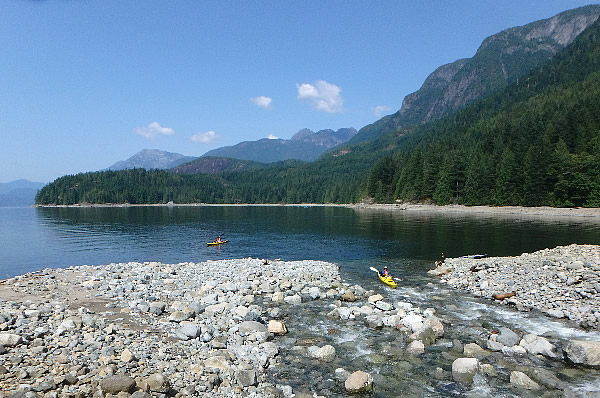
arrived at a campsite with a beautiful sandy beach where we could land and pitch our tents with ease. There was even a freshwater river flowing for us to have a wash! That evening, just after I’d begun to fall asleep, I heard Terry and John shouting at me to pack up my tent. The tide had risen and was about to flood our little beach! We scrambled to pack up our things and were then left wondering where we might go. I was feeling a bit sleepy and just wanted to go back to bed so I paddled over to
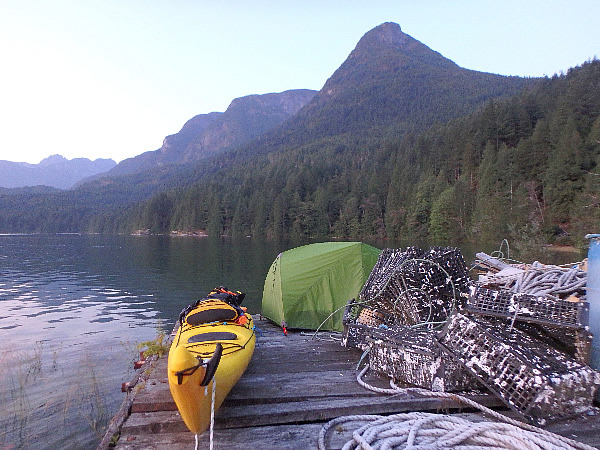
an old oyster farmer’s pontoon which was washed up near our beach and set up there. It looked like it had not been used in many years and was littered with old drums, shells and barnacled rope. Terry had called it a bit of an eyesore when we first arrived but it saved us from paddling into the dark and getting all of our gear wet so we were very thankful in the end.
Low tide when we arrived to camp.
When the tide came up the water covered our camping spot and the trees were that dense we couldn't camp on shore.
Luckily an abandoned pontoon was nearby.
So we camped on it. We got a surprise in the morning.
The next morning we were a given a very big shock. Half of the pontoon was washed up on the shore and the other half was still floating in the water. John had slept at the far end of the
pontoon and pulled his kayak up onto it. During the night the floating end with John’s kayak lowered itself and created a steep slope as the tide went out. We woke in the morning to find John’s kayak was no longer on the barge! Thankfully he had attached his paddle leash to the side and the kayak hadn’t floated away. It was a close call! I was also very lucky because I had left my kayak floating and tied to the barge. As the tide went out my kayak got caught on two big logs. I found it resting
on the logs in the morning and was amazed that it hadn’t tipped over. It was teetering right on the edge of a log about half a metre above the water. If it had ended up about 10 centimetres further along, it would have missed the second log and flipped upside down, leaving all of my gear to sink to the bottom or float away. We were very fortunate that we were in possession of all our gear as we each nearly lost it all twice over that night.
After about three weeks of paddling we arrived in Port Hardy which was really our main and final stop to resupply ourselves with food for the final three weeks of our journey; during which we would pass through no more towns or settlements. By this stage I was missing my girlfriend a
lot and was considering leaving Terry and John to carry on by themselves. I had to make the decision in Port Hardy as there would be no more opportunities to change my mind once we departed. Thankfully I was able to talk to a lot of people back home and decided at the last moment that I would carry on with the others and complete the journey. I was a little upset when I got back in the kayak but after a few hours I was very thankful I’d chosen to continue and knew I’d made the right
decision.
To be continued-----------------------------
Paddling along Vancouver Island.
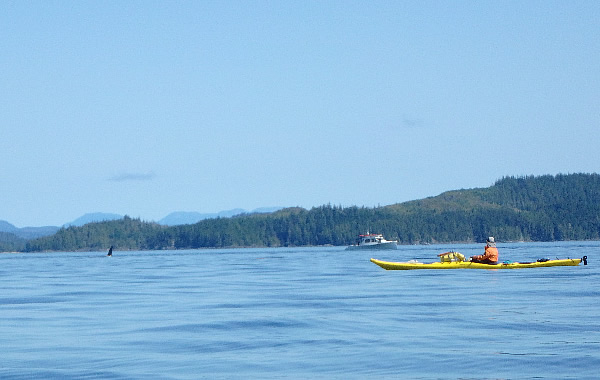
Killer whales were all around us.
On My Paddles
Birds Along My Way
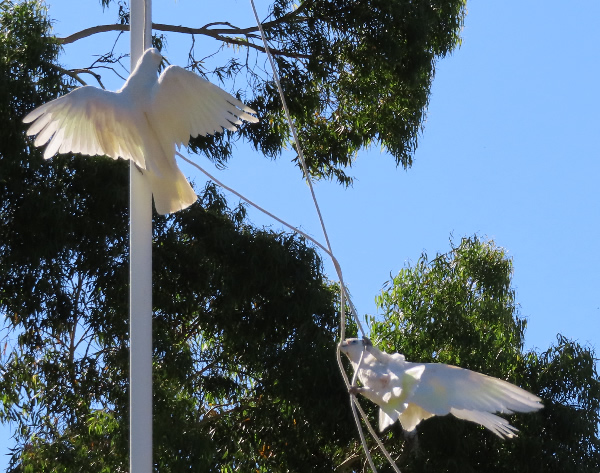
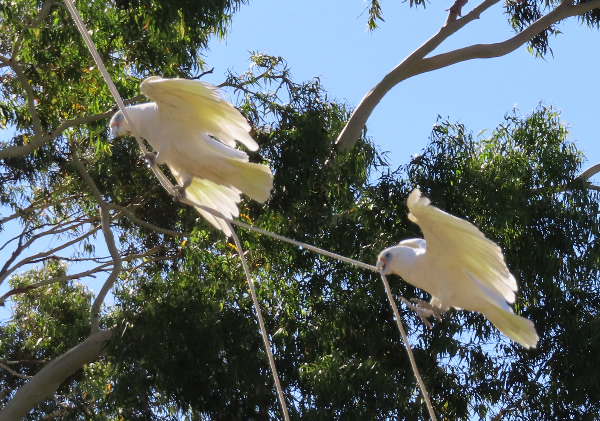
These white cockatoos are training to be a circus act.
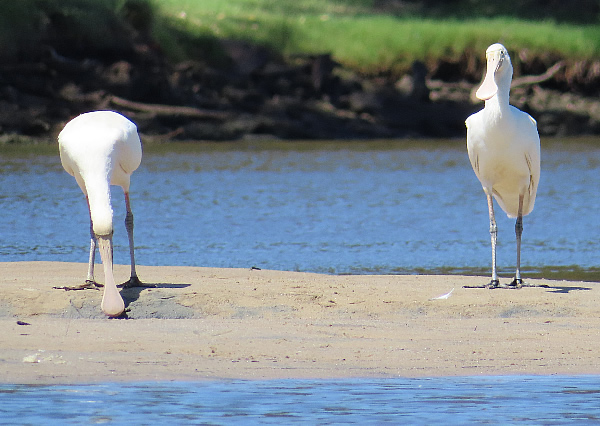
The two young spoonbills once living on Ron Courtney Island are now feeding themselves.
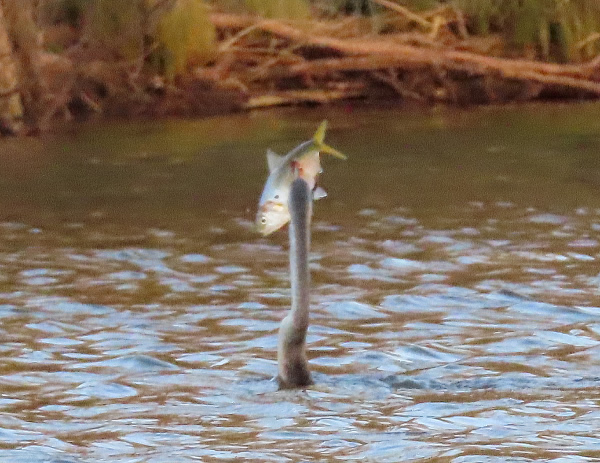
A Darter stabs a fish. It then tossed it up in the air and catches it in its beak.
It then tossed it again and it slid down its throat.
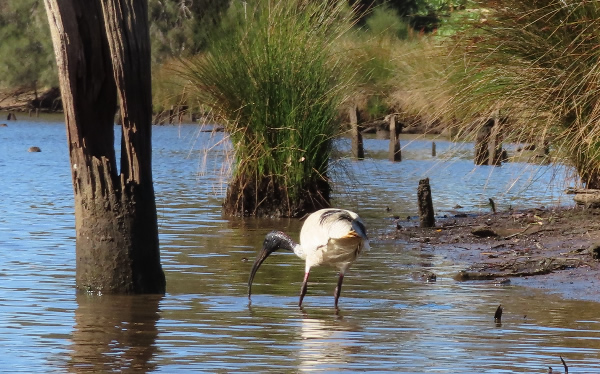
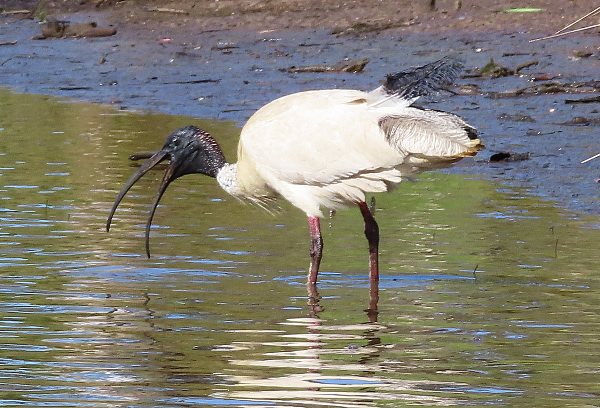
The Australian White Ibis having a feed at low tide on Monday.
The Australian White Ibis' range of food includes both terrestrial and aquatic invertebrates and human scraps. The most favoured foods are crayfish and mussels, which the bird obtains by digging with its long bill. Mussels are opened by hammering them on a hard surface to reveal the soft body inside.
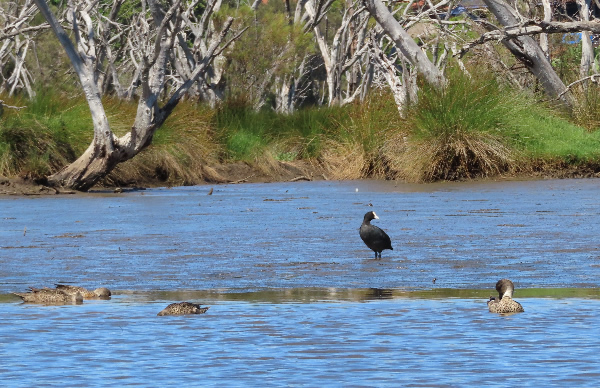
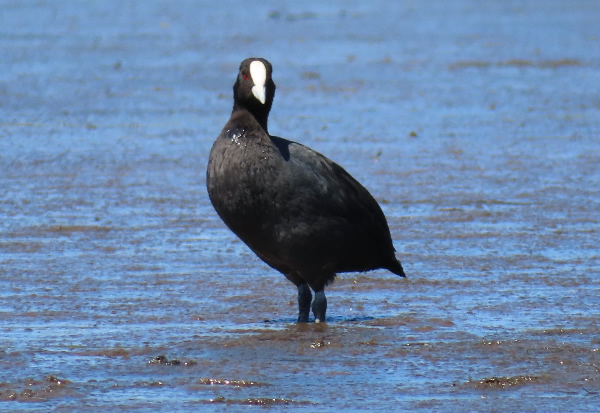
A Eurasian Coot, has a sooty-black plumage and a gleaming white bill and frontal shield covering its forehead.
Food is mainly obtained during underwater dives, lasting up to 15 seconds and ranging down to 7 m in depth. Birds also graze on the land and on the surface of the water. In Australia, Eurasian Coots feed almost entirely on vegetable matter, supplemented with only a few insects, worms and fish.
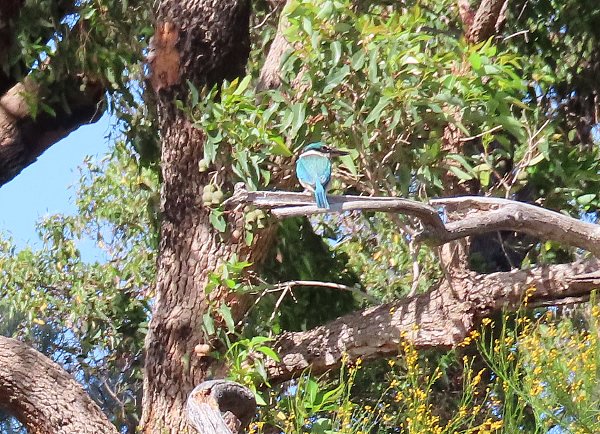
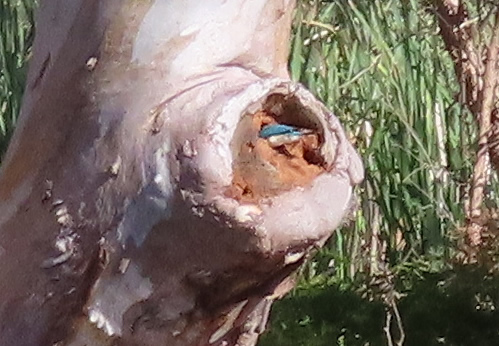
A kingfisher explores a hole in a tree. Below
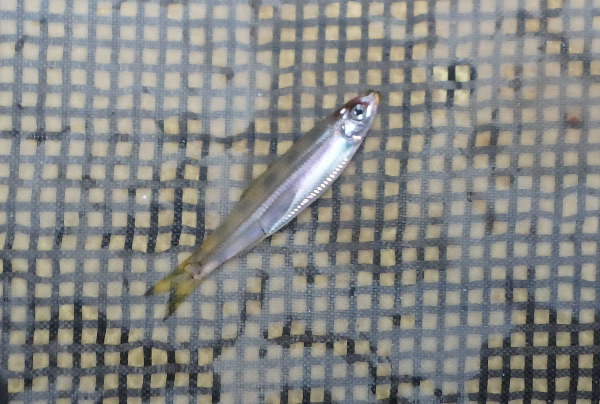
I had a huge fish jump in my cockpit this morning -
it was at least 8 cms!
|
|
|
|
|
|
|
|
|
|